
A saddle pad is the only barrier between a rigid tree and your horse’s living anatomy. The wrong pad concentrates pressure on the spine, traps heat, or slips under load, turning every ride into a source of soreness. Between memory-foam correction pads, wool-felt western blocks, and quilted all-purpose designs, the choice comes down to how much customization your horse’s back actually needs.
I’m Mo Mahin — the founder and writer behind Furric. I spend my weeks comparing fiber blends, shim configurations, and wither contours, cross-referencing ASTM test data against thousands of owner reports to find the pads that actually balance impact absorption with heat management.
Whether you are a dressage rider dialing in saddle fit or a trail rider needing non-slip security, the right saddle pads prevent bridging, wick sweat, and keep your horse working pain-free — without adding bulk that deadens communication through the rein.
How To Choose The Best Saddle Pads
Selecting a saddle pad starts with understanding your horse’s back shape, the discipline you ride, and whether the pad is compensating for an imperfect saddle fit or simply providing a clean, protective layer. The three specs that separate adequate from excellent are shim adjustability, lining breathability, and spine-channel clearance.
Shim Pockets vs. Fixed Padding
Horses with asymmetric shoulders or muscle atrophy need pads that can be adjusted side-to-side and front-to-rear. Four-pocket designs with removable, trimmable memory-foam inserts let you level the saddle in minutes. Fixed-density pads (quilted poly, single-layer felt) work only for horses whose backs are already symmetrical and saddle-ready.
Bottom Material and Slippage Control
A pad that shifts mid-ride creates rubs and uneven pressure. Fleece bottoms grip well but can felt under wet saddles. Rubberized or “Tacky Too” non-slip bottoms stay locked without pinching hair. Wool felt naturally resists migration when compressed, but thinner felt sheets can creep on slick-backed horses if the saddle’s panels aren’t tight.
Quick Comparison
On smaller screens, swipe sideways to see the full table.
| Model | Category | Best For | Key Spec | Amazon |
|---|---|---|---|---|
| LeMieux Suede Dressage Square | Dressage | Show-ring elegance & heat control | Bamboo lining + suede top | Amazon |
| Reinsman Contoured Trail Pad | Trail/Western | Non-slip security on rough terrain | Tacky Too bottom + spine channel | Amazon |
| Weaver Equine Wool Blend Felt | Western | Shock absorption & weight distribution | 1-in. wool felt + wear leathers | Amazon |
| ECP All-Purpose Correction Pad | Correction | Custom shim fit for eventers | 4 pockets, 12 memory-foam inserts | Amazon |
| ECP Memory Foam Half Pad | Half Pad | Under-saddle correction for dressage | Trim/stack shims, 8.5×22 in. | Amazon |
| Tough 1 Square Pad | All-Around | Budget work pad with soft fleece | Acrylic top, fleece bottom, 30×30 in. | Amazon |
| Dover Saddlery Quilted All-Purpose | English All-Purpose | Affordable daily training & lessons | 600g poly fill, 7.5-in. girth loops | Amazon |
In‑Depth Reviews
1. LeMieux Suede Dressage Square

The suede top and bamboo lining combination is what sets this pad apart: the bamboo wicks moisture faster than polyester weaves, and the suede binding resists fraying after repeated machine washes. Riders of warmbloods 16.2 hh and up report the XL size fits 18-in. dressage saddles with no shifting.
The elasticated D-ring tabs and PU leather girth protection area add structure where the pad sees the most wear. The high wither cut provides relief without exposing the saddle’s pommel to direct contact.
Owner feedback consistently notes that the white color stays crisp through multiple wash cycles, though the bamboo lining requires cold-water-only care to maintain its shape retention properties.
Why we love it
- Bamboo lining offers superior heat and sweat regulation
- PU leather girth zone prevents wear-through
Good to know
- Priced for the show ring; may be overbuilt for daily schooling
- XL still runs slightly short on extra-long-backed warmbloods
2. Reinsman Contoured Trail Pad
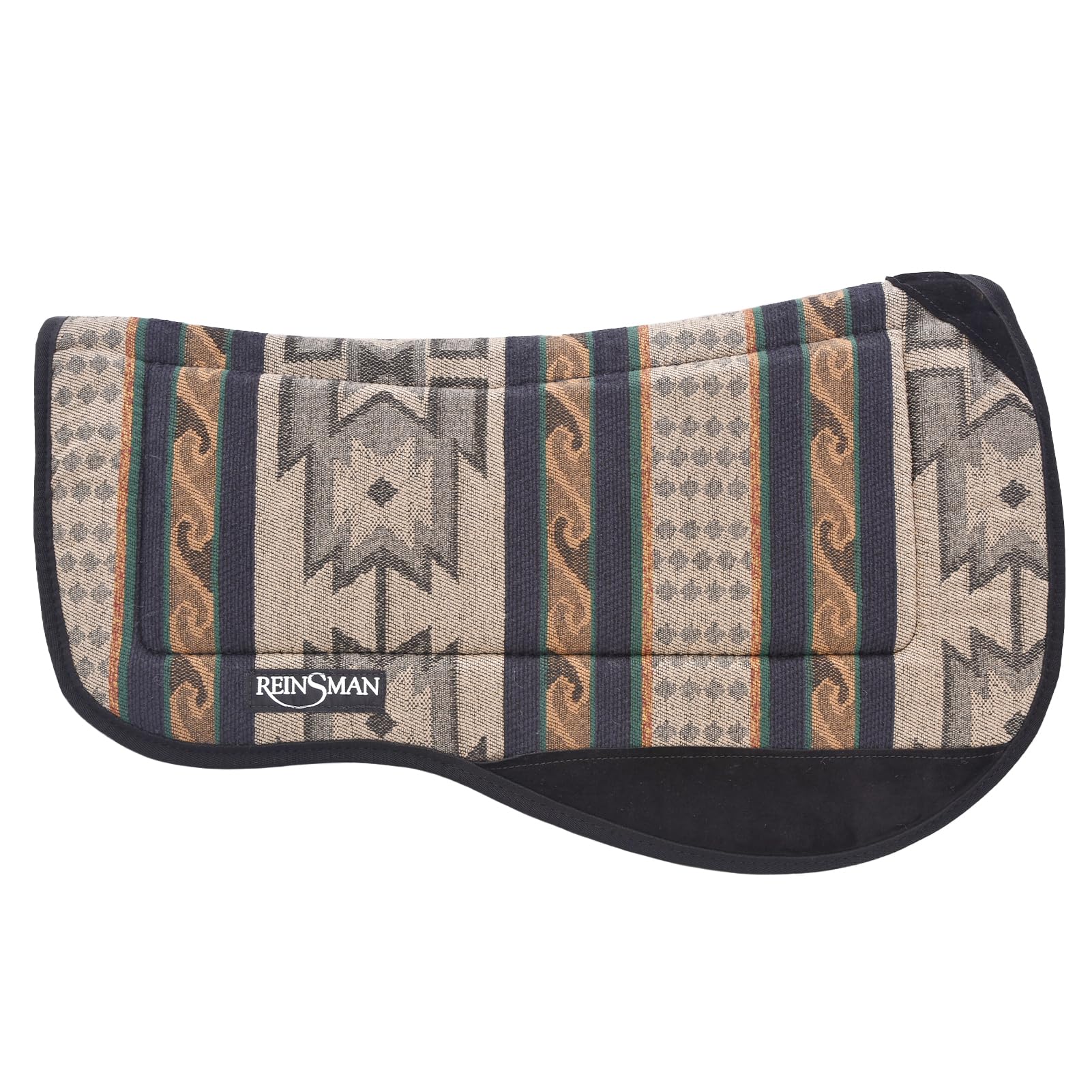
The defining feature here is the Tacky Too bottom — a breathable, non-slip material that grips without pinching hair. Riders on dropped-rigging trail saddles report virtually zero slippage on steep inclines, and the 30×34-in. drop covers the full barrel of most stock-type horses.
The anatomically cut spine channel runs the full length, preventing the pad from pressing on the dorsal processes. The comfort-felt interior absorbs shock from rocky terrain while staying thin enough to maintain close-contact feel.
The UV- and stain-resistant top keeps the Running Bull Onyx color from fading in direct sun.
Why we love it
- Tacky Too bottom eliminates pad migration
- Spine relief channel reduces pressure on sensitive backs
Good to know
- Actual pad measures 28 in. including binding, not the 30 in. advertised
- Heavier than all-purpose pads — 3+ lb dry weight
3. Weaver Equine Wool Blend Felt Pad

The 1-in. wool felt density is the spec that matters here: thick enough to absorb shock from large-breed western saddles, but not so thick that it lifts the saddle off the horse’s back. The contoured shape with precise cutouts under the wear leathers keeps the rider’s leg close without bulk.
The reinforced spine and top-grain leather wear leathers add years of extra life compared to budget felt pads that compress after a season. Owners of quarter horses and paints in the 14.1-16.3 hh range report the 30×30-in. size fits most western rigs with minimal overhang.
The wool blend naturally wicks moisture away from the back and resists packing down. Riders using it for summer trail work note the tan color stays cooler than dark nylon alternatives.
Why we love it
- Dense felt provides reliable shock absorption without dead feel
- Top-grain wear leathers prevent early breakdown
Good to know
- At 6.13 lb, it is heavy for packing on long rides
- Best fit under 16 hh horses; larger frames may need custom sizing
4. ECP All-Purpose Contoured Correction Pad

This pad targets riders whose horses change shape through the season — four velcro-closed pockets hold memory-foam inserts that can be swapped, stacked, or removed entirely to level the saddle on asymmetric backs. The 22-in. spine and 19.5-in. drop fit most eventing saddles without excess fabric.
The contoured shape is cut specifically for sportier close-contact riding, eliminating the bulk that interferes with leg aids. Eventers report it stays securely in place under a jumping saddle during stadium rounds, and the color selection includes 12 options to match show tack.
One common owner note: the stock foam is dense and may restrict neck extension on sensitive horses. Replacing the shims with a softer aftermarket foam improved comfort for some riders.
Why we love it
- Four-pocket system fixes asymmetric shoulders effectively
- Streamlined shape keeps bulk minimal for jumping
Good to know
- Stock foam density may be too stiff for horses needing spine clearance
- Runs slightly short front-to-back on large-warmblood saddles
5. ECP Memory Foam Half Saddle Pad

Riders who need hyper-precise fitting under a dressage saddle reach for this half pad. The four shim pockets hold twelve memory-foam inserts in two thicknesses, all of which can be trimmed or stacked to compensate for a horse with one shoulder lower than the other or a hollow back.
The polycotton top and soft brushed underside promote airflow, a critical feature when using a wrap pad that traps heat between the saddle panels. Owners report this pad saved horses from back soreness caused by years of riding on an ill-fitting tree.
The hidden advantage is the absence of a rolled edge or fur ruff — the clean profile avoids interfering with the saddle’s panel contact, preserving the rider’s feel of the horse’s back movement through the rein.
Why we love it
- Trim/stack system solves asymmetrical fit without new saddle purchase
- Low-profile design maintains rider-horse feel
Good to know
- Hand wash only — machine washing can distort foam pockets
- Topline thinner than main padding zone
6. Tough 1 Square Saddle Pad
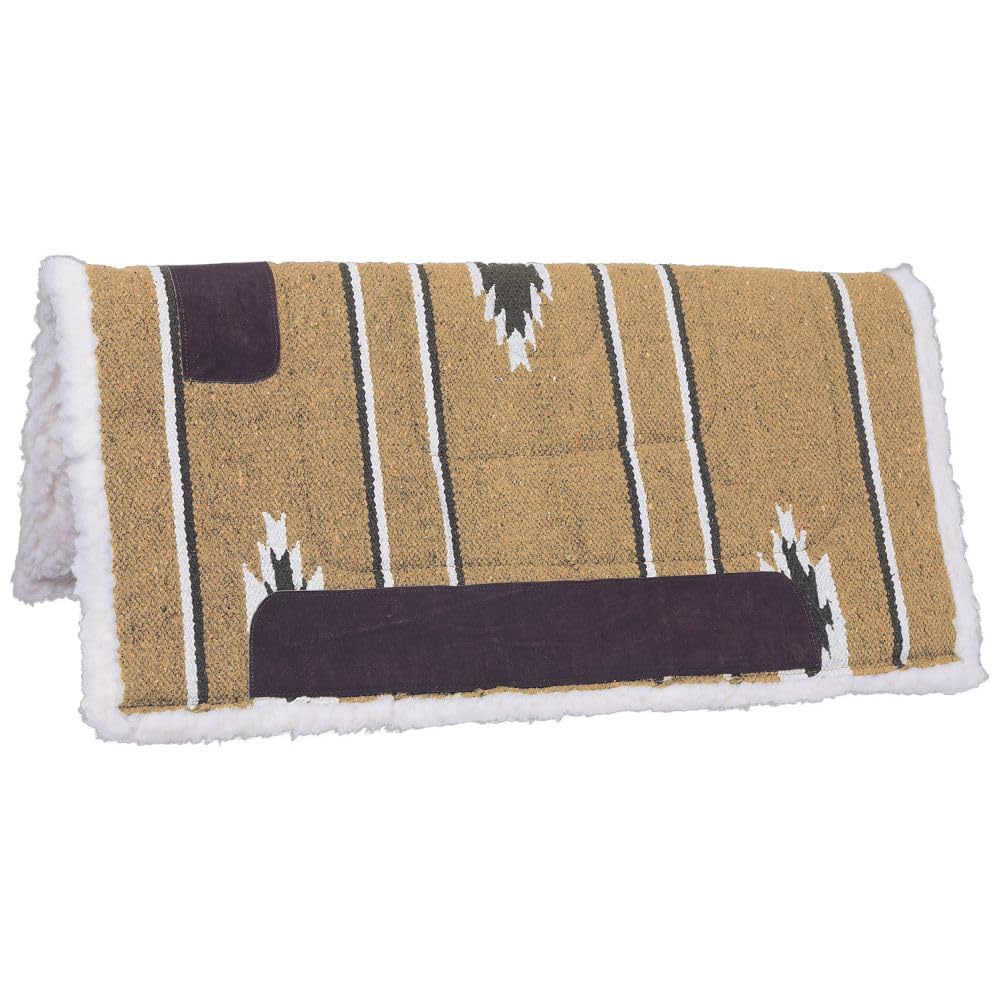
The fleece bottom combines softness with reasonable grip for arena schooling and light trail work. The 30×30-in. square accommodates most western and trail saddles, and the acrylic-blend woven top resists dirt and fading for a pad that sees daily use without looking ragged.
The wear leathers are included at the stress points where the cinch and rigging contact the material. These add structure that budget pads often omit entirely. The Southwest design is purely cosmetic but holds its color over multiple washes.
Owner feedback confirms the pad is thick and soft straight out of the package, though the price floor means the fleece will compress faster than a wool felt option. Riders at local 4-H events and lesson barns frequently stock these as spares.
Why we love it
- Soft fleece bottom provides comfortable contact for sensitive horses
- Wear leathers at stress points add surprising durability
Good to know
- Fleece compresses faster than wool or memory foam
- Color (teal shown) runs slightly greener than product images
7. Dover Saddlery Quilted All-Purpose Pad

The 600 grams of poly fill is the key spec: this is a dense stuffing that resists flattening through multiple lessons per week. The diamond-quilted poly exterior slides easily under English all-purpose and close-contact saddles without bunching up at the withers.
The 7.5-in. girth loops provide extra security, keeping the pad from creeping forward during lengthy flatwork sessions. Riders at lesson barns report the burgundy and other colors hold their hue through repeated machine washing better than cheaper poly-filled alternatives.
The topline is cut straight across rather than contoured, which means it works best on horses with average wither height. Deep-withered breeds like thoroughbreds may need a pad with built-in wither cutouts to avoid pressure at the top of the shoulder.
Why we love it
- 600g poly fill density offers consistent cushioning
- Long girth loops prevent pad migration
Good to know
- Straight topline not ideal for high-withered horses
- Poly fill may shift over time with heavy weekly use
FAQ
How tight should my saddle pad fit under the saddle?
Can a shim pad fix a poorly fitting saddle permanently?
What does spine channel width need to be for my horse?
Final Thoughts: The Verdict
For most riders looking for a high-performance daily pad, the saddle pads winner is the LeMieux Suede Dressage Square because its bamboo lining regulates heat better than any poly alternative while the suede top withstands frequent washing without fading. If you need custom correction for an asymmetric back, grab the ECP All-Purpose Contoured Correction Pad. And for non-slip security on technical trail rides, nothing beats the Reinsman Contoured Trail Pad.