
Setting up a bioactive terrarium means trusting a few hundred tiny decomposers to break down waste, aerate the soil, and keep your vivarium from turning into a toxic swamp. A healthy isopod population is the difference between a self-cleaning ecosystem and a moldy mess that needs constant manual intervention.
I’m Mo Mahin — the founder and writer behind Furric. I’ve spent years cross-referencing species-specific requirements, evaluating culture purity, and tracking owner-reported survival rates across dozens of isopod suppliers to identify which cleanup crews actually thrive under vivarium conditions.
Whether you’re starting a crestie enclosure or a dart frog vivarium, choosing the right isopods for bioactive terrarium setup determines whether your ecosystem stabilizes quickly or struggles from day one — and this guide breaks down exactly which cultures deliver.
How To Choose The Best Isopods For Bioactive Terrarium
Not all isopods perform equally in a closed vivarium. Some species burrow too deep to access surface waste, while others dry out in moderately ventilated enclosures. Three factors determine whether your culture thrives or fades.
Species Hardiness vs. Vivarium Moisture Gradient
Porcellionides pruinosus (Powder Blue, Powder Orange) is the industry standard because it tolerates a wider humidity range than most dwarf species. Dwarf whites and dwarf purples need consistently damp substrate with minimal dry zones — they work best in rain-chamber setups but can crash in enclosures with prolonged dry periods.
Culture Size and Population Density
A starter culture of 20–25 individuals is sufficient for a 20-gallon vivarium, but the mix of life stages matters more than the headcount. Cultures that include mancae (juveniles) and sub-adults establish breeding populations weeks faster than cultures of only large adults approaching end of lifespan.
Shipping Safety and Live Arrival Guarantee
Isopods die within hours in extreme temperatures or dry packaging. Look for damp sphagnum, insulation, and heat/cold packs when shipping conditions are outside 40–85°F. Vendors with explicit live-arrival policies and tracking-verification steps reduce the risk of receiving a dead culture.
Quick Comparison
On smaller screens, swipe sideways to see the full table.
| Model | Category | Best For | Key Spec | Amazon |
|---|---|---|---|---|
| Critters Direct Dwarf Purple + Springtails | Combo | Complete ecosystem starter | 25 isopods + 8oz springtail culture | Amazon |
| Critters Direct Powder Blue + Springtails | Combo | Hardy cleanup crew with food source | 20 isopods + 8oz springtail culture | Amazon |
| TC INSECTS Mixed Species Mega Mix | Variety | Budget diversity starter | 25ct random mixed species | Amazon |
| TC INSECTS Powder Blue Isopods | Species | Reliable mid-range workhorse | 25ct Porcellionides pruinosus | Amazon |
| Exo-Morphs Powder Orange Isopods | Species | Visual accent with strong breeding | 25ct mixed sizes in damp sphagnum | Amazon |
In‑Depth Reviews
1. Critters Direct Dwarf Purple Isopods & Springtails Combo

This combo eliminates the guesswork of sourcing a complete cleanup crew. You get 25+ dwarf purple isopods (1–3 mm) alongside an 8 oz mixed seeding culture of tropical white, pink, and temperate springtails — both species work different soil layers, with isopods handling surface leaf litter and springtails managing microscopic mold. The dual approach accelerates the nitrogen cycle in new setups noticeably faster than isopods alone.
The dwarf purples are fast colonizers in consistently humid enclosures. Multiple owner reports confirm established populations within a week in bearded dragon vivariums and dart frog terrariums. The springtail culture includes adults and juveniles, which provides immediate mold suppression rather than waiting weeks for a single-age culture to mature. Shipping includes insulation, moisture packs, and cold/heat protection with temperature-sensitive hold-for-pickup options.
One trade-off is the substrate choice — the springtails arrive in soil rather than lump wood charcoal, which reduces their floatability for harvest and makes it harder to maintain the ideal moist-dry gradient. Several long-term keepers recommend transferring the springtail culture into a charcoal bed within 48 hours to maximize viability. For keepers who want a turnkey bioactive startup without separate orders, this remains the most complete single-purchase solution.
Why we love it
- Two cleanup organisms in one order saves separate shipping costs
- Mixed life stages in both cultures establishes breeding populations faster
- Temperature-sensitive shipping protocol shows responsible livestock handling
Good to know
- Springtails in soil substrate complicates transfer to ideal charcoal medium
- Dwarf species need sustained high humidity; not ideal for dry vivariums
2. Critters Direct Powder Blue Isopods & Springtails Combo

Powder Blue is the go-to species for keepers who want a forgiving isopod that tolerates moderate humidity swings. This combo delivers 20+ Powder Blue isopods alongside an 8 oz mixed springtail culture, giving you the same dual-layer cleaning advantage as the Dwarf Purple combo but with a more humidity-tolerant isopod species. The Porcellionides pruinosus lineage handles drier microclimates better than dwarf varieties, making this a safer bet for enclosures with ventilation gaps.
Buyers consistently report receiving more isopods than the advertised count, with multiple verified reviews noting extras and all arriving alive. A distinctive advantage is the packaging method — the isopods ship without substrate, which allows full visual inspection of each individual upon arrival. This transparency signals strong supplier care because any unhealthy specimens would be immediately visible. The springtail culture established reliably in most reported setups, including crested gecko and bearded dragon vivariums.
The primary concern mirrors the Dwarf Purple combo: springtails arrive in soil substrate rather than charcoal, which can reduce long-term culture viability if not transferred promptly. Some buyers experienced DOA issues during extreme weather despite heat packs, though the supplier replaced dead shipments under their live-arrival guarantee. For vivarium builds that don’t require dwarf species, this Powder Blue combo offers better environmental tolerance without sacrificing the benefits of a springtail companion culture.
Why we love it
- Powder Blue species tolerates wider humidity range than dwarf varieties
- No-substrate shipping allows full inspection and indicates healthy stock
- Springtail companion accelerates mold processing from day one
Good to know
- Springtails in soil rather than charcoal complicates culture management
- Some shipments experienced losses during temperature extremes
3. TC INSECTS Mixed Species Mega Mix Isopods
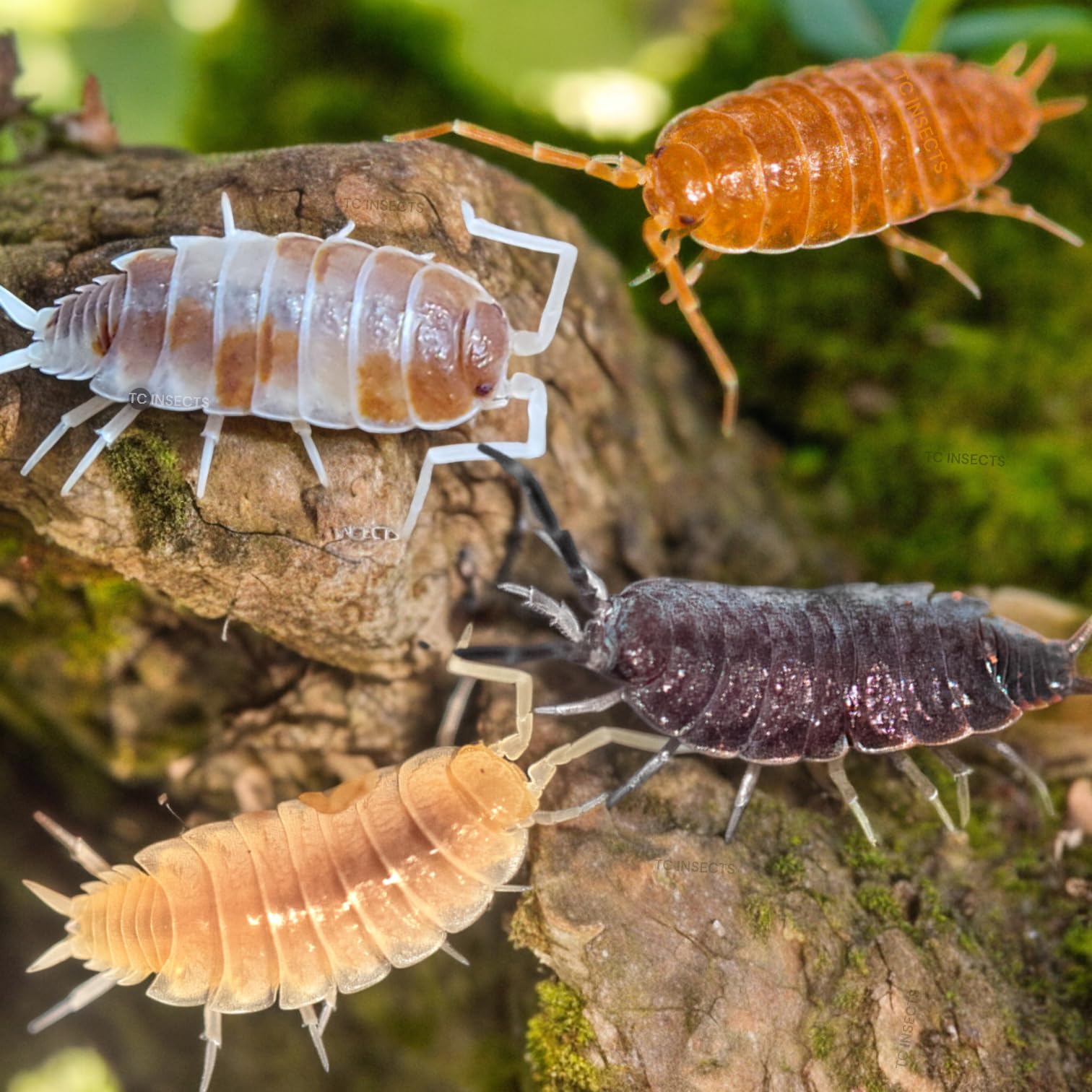
This is the highest raw count per dollar in the market — a 25-count random mix pulled from TC INSECTS’ massive production bins that combine dozens of species and color morphs. Because the supplier produces millions of isopods annually, the “Mega Mix” bin accumulates a rotating assortment of Porcellionides, Armadillidium, and Porcellio species. You will not get guaranteed rare morphs like high-grade Dairy Cows or Magic Potions, but you will get a healthy variety of sizes, colors, and species for the lowest per-unit cost.
Verified buyers consistently report receiving specimens ranging from XL adults down to mancae, with observed species including Peach/Papaya, Marbleized, Koi, White, Brown, Wild Magic, and Orange Vigor. Multiple reviews confirm the culture adjusted well to bioactive enclosures and still had survivors after 16 months. The packaging includes thermal insulation and weather-appropriate protection, though the supplier explicitly warns against shipping in temperatures below 40°F or above 90°F without hold-for-pickup.
The obvious trade-off is the lack of species guarantee — you cannot predict which morphs will arrive, and the mix may shift between orders. This doesn’t matter for pure cleanup function but will disappoint collectors chasing specific color lines. Some recipients noted the absence of premium morphs that retail individually for –50 per culture, but that’s the nature of a discounted mixed bin. For budget-focused keepers who just want a functional bioactive cleanup crew, the per-bug value is unmatched.
Why we love it
- Highest quantity per dollar with multiple species in one order
- Confirmed 16-month survival in owner-reported enclosures
- Great for experimenting with species preferences on a budget
Good to know
- No species or morph guarantee — composition varies per order
- Rare morphs unlikely; not suitable for collection-building goals
4. TC INSECTS Powder Blue Isopods 25ct

This straight species culture from TC INSECTS provides 25 Powder Blue isopods with no extras, no springtails, and no niche gimmicks — just a reliable Porcellionides pruinosus culture that does exactly what a cleanup crew should do. The brand lists the included components as “substrate,” suggesting the isopods ship with a small amount of their living medium to reduce shipping stress, which is a thoughtful touch compared to vendors that ship bare isopods in dry containers.
Owner feedback is overwhelmingly positive regarding survivability — multiple reviews confirm all isopods arrived alive and immediately became active in reptile enclosures. One keeper placed them in a Dubia roach breeding tub as a cleanup crew, while others integrated them into gecko and bearded dragon vivariums with no losses. The self-cleaning feature notation on the spec sheet references their natural decomposer function rather than any accessory.
The biggest limitation is the absence of a springtail companion or mixed life stages. You get 25 isopods of unspecified age distribution, which means colony establishment speed depends on whether mancae are present. Priced competitively as a standalone culture, it’s an excellent choice if you already have a separate springtail supply or if your vivarium doesn’t need a springtail layer. For first-time bioactive keepers, the combo packages offer better ecosystem startup value, but for experienced keepers restocking a mature vivarium, this powder blue culture hits the sweet spot of cost and reliability.
Why we love it
- Shipped with substrate to reduce transport stress and dehydration
- Consistent live arrival with active specimens across multiple reports
- Straightforward species choice with proven vivarium compatibility
Good to know
- No springtail companion culture included for dual-layer cleanup
- Age distribution not specified; unknown proportion of juveniles
5. Exo-Morphs Powder Orange Isopods 25ct

Powder Orange is a color morph of the same Porcellionides pruinosus species that makes Powder Blue so popular, but the warm orange hue adds visible aesthetic appeal in light-colored substrates or mossy enclosures. Exo-Morphs ships 25 mixed-size specimens in damp sphagnum moss, which provides better hydration stability during transit than bare containers or thin substrate layers. The 3x3x1-inch packaging is compact but effectively designed for the weight and fragility of live isopods.
Verified buyer feedback is strong on survivability — one review noted all 25 arrived alive and active despite 94°F ambient temperatures, which speaks to the effectiveness of the damp sphagnum insulation. Multiple reports confirm the culture quickly established breeding populations in new enclosures, with some keepers transferring the specimens to breeder bins and reporting exponential multiplication within weeks. Several buyers noted receiving extra individuals beyond the advertised 25 count.
The main concern to flag is shipping consistency — one buyer in Washington state received only 10 survivors out of 25 during a May delivery, suggesting that even moderate temperature swings can cause losses depending on local postal handling. While this represents a minority of reviews, it’s worth noting that the live-arrival guarantee from Exo-Morphs is less explicitly stated compared to Critters Direct’s formal policy. For keepers who prioritize visual contrast in their bioactive display and are willing to accept some shipping variance, the Powder Orange color adds lively motion and color to the terrarium floor.
Why we love it
- Warm orange coloration adds visible appeal to bioactive displays
- Damp sphagnum packaging provides stable hydration during transit
- Same hardy species tolerates moderate humidity fluctuations
Good to know
- Some shipments experienced partial losses during moderate weather
- Live-arrival guarantee less explicit than some competitor policies
FAQ
How many isopods do I need to start a bioactive terrarium?
Can I mix Powder Blue and Powder Orange isopods in the same enclosure?
Why did some isopods die during shipping?
Final Thoughts: The Verdict
For most bioactive keepers, the isopods for bioactive terrarium winner is the Critters Direct Dwarf Purple Isopods & Springtails Combo because it provides both cleanup layers — isopods for surface waste and springtails for microscopic mold — in one temperature-protected shipment with a live-arrival guarantee. If you want a humidity-tolerant species that handles drier microclimates, grab the Critters Direct Powder Blue & Springtails Combo. And for sheer quantity per dollar when species purity doesn’t matter, nothing beats the TC INSECTS Mixed Species Mega Mix.