
A rabbit that chews on its cage bars or digs at the carpet isn’t being naughty — it’s communicating a need. In the wild, rabbits spend hours foraging, gnawing, and problem-solving. Without an outlet for these instincts, boredom and dental issues become real problems. The right selection of bunny toys transforms a dull hutch into an engaging habitat, preventing destructive behavior and keeping those ever-growing incisors in check.
I’m Mo Mahin — the founder and writer behind Furric. I’ve spent years comparing small animal enrichment products, poring over veterinary dental recommendations, and analyzing thousands of owner feedback reports to identify which toys genuinely engage a rabbit’s natural behaviors rather than just looking cute in a cage.
This guide focuses specifically on materials, textures, and interactive mechanics that matter for lagomorph dental health and enrichment. If you are looking for the safest and most engaging bunny toys, the following picks represent the best balance of natural materials, chewing longevity, and behavioral stimulation available right now.
How To Choose The Best Bunny Toys
Rabbits have hypsodont teeth that grow continuously — roughly 2 to 3 millimeters per week for incisors. Chewing is not optional; it is a biological requirement. A toy that fails to provide adequate resistance or contains unsafe glues can cause more harm than good. The decision framework below focuses on the three variables that matter most in this category.
Material Safety and Edibility
Untreated wood (apple, willow, bamboo), seagrass, and timothy hay are the safest substrates because they are digestible and splinter roughly. Avoid pine and cedar shavings (phenolic oils are toxic to lagomorphs) and any toy listing “wood composite,” “MDF,” or “pressed board” — those often contain formaldehyde binders that are lethal if ingested. Stained or painted toys should never enter a rabbit’s enclosure. For chew sticks, the bark-on variety offers more texture and dental friction than peeled alternatives.
Hardness and Chew Duration
Teeth grinding requires mechanical abrasion. Soft hay-based toys are excellent for foraging but provide almost no dental filing. Applewood and bamboo sit in the ideal hardness zone — firm enough to wear down incisors gradually, soft enough that the rabbit does not damage its jaw from excessive effort. Timothy-based compressed toys are too soft for primary dental care and should be used as supplementary foraging items only. Wicker balls and seagrass mats offer a medium grind suitable for younger rabbits or those with sensitive mouths.
Enrichment Style: Passive vs. Interactive
Passive toys (sticks, balls, mats) are stationary items the rabbit chews at its leisure. These cover the dental requirement but do little for boredom if the rabbit is housed alone. Interactive toys — puzzles with sliding drawers, flip lids, or pull-cord mechanisms — engage the rabbit’s foraging drive. A rabbit that works to extract a treat experiences measurable stress reduction and increased activity levels. For a solo rabbit housed indoors for long hours, an interactive puzzle provides substantially more behavioral value per square inch of cage space than a handful of loose sticks.
Quick Comparison
On smaller screens, swipe sideways to see the full table.
| Model | Category | Best For | Key Spec | Amazon |
|---|---|---|---|---|
| SoulThink Interactive Wooden Puzzle | Interactive Puzzle | Foraging enrichment | 6.9 x 2.2 x 1.6 in pinewood | Amazon |
| Bissap Sweet Bamboo Sticks 700g | Chew Stick | Dental maintenance | 1.5 lb bag bamboo sticks | Amazon |
| JONS NTY 50-60pc Natural Variety | Variety Chew Pack | Assorted textures | 50–60 pieces total | Amazon |
| andwe Seagrass Protector Mat | Wall/Cage Mat | Cage wall protection | 11 x 7.87 in seagrass | Amazon |
| Skylety 15pc Chew Balls | Grass Ball | Light rolling play | ~1.9 in hand-woven balls | Amazon |
In‑Depth Reviews
1. SoulThink Interactive Wooden Pet Rabbit Toys (2 Sets)

This set earned its top position because it solves both dental and behavioral needs simultaneously. The patented design includes three distinct mechanisms — a sliding drawer, a flip lid, and a pull-cord lid — that mimic wild foraging actions: pushing aside grass, pulling roots, and nudging stones. Constructed from solid untreated pinewood blocks rather than glued layers, it withstands serious gnawing without shedding toxic particles. The bowl dimensions (6.9 inches long, 2.2 inches wide) are tailored specifically for rabbit-sized heads, a detail most hamster-scale puzzles miss.
Owner reports consistently highlight the behavioral change. Rabbits described as “aggressive” or “cage-biters” redirected their energy toward solving the puzzle for dried treats. The 5x thicker twine rope resists shredding longer than standard string toys. Flemish Giant owners specifically confirmed the set accommodates larger breeds comfortably. The pinewood is intended to be chewed — the toy gradually transforms from a puzzle into a gnawing block, extending its functional lifespan beyond typical plastic alternatives.
The natural wood hue means no dyes or varnishes are present. Each set comes with two puzzle units, allowing rotation or simultaneous play in multi-rabbit enclosures. A user manual is included, though the mechanics are intuitive enough that most rabbits figure out the drawer on the first attempt within minutes. The soft wood does wear faster against power-chewers — owners of aggressive gnawers reported significant reshaping after three weeks of daily use.
Why we love it
- Three distinct foraging actions in one toy
- Untreated solid pine with zero glues or paints
- Large enough for Flemish Giants and larger breeds
Good to know
- Soft pine may wear quickly with heavy chewers
- Requires daily treat refilling for sustained engagement
2. Bissap 700g Sweet Bamboo Chew Sticks

Bamboo occupies a unique position in rabbit dental care — it is harder than timothy hay or grass-based toys but softer than kiln-dried apple branches, making it accessible to rabbits of all ages without risk of jaw fatigue. Bissap delivers 700 grams (1.5 pounds) of sweet bamboo sticks in a sealed paper bag that preserves moisture content and aroma. The natural sweetness of bamboo attracts rabbits more reliably than plain applewood, according to owner reports describing pets “seeking out the bag” as soon as it enters the room.
The sticks undergo a straightforward process: felling, pruning, washing, sun-drying, and sorting. No kiln drying or chemical treatment is used, preserving the bark surface that provides the texture needed for effective dental abrasion. Veterinarians recommend bamboo specifically for trimming incisors in rodents and lagomorphs. Owners of chinchillas and guinea pigs in the same household reported cross-species enthusiasm for this product, making it versatile for multi-pet environments.
The paper bag packaging is functional rather than decorative — it breathes enough to prevent mold but seals tightly when folded. The brand suggests a feeding limit of one to two sticks per day, which translates to roughly 40–60 days of supply per bag depending on consumption rate. Subscribing provides monthly savings, a factor frequent buyers noted. The stick diameter varies naturally, which is beneficial: thinner sticks offer quick satisfaction, thicker ones provide extended grinding sessions.
Why we love it
- Sweet bamboo flavor attracts even fussy rabbits
- Long-lasting supply for multi-pet households
- Veterinarian-recommended for incisor maintenance
Good to know
- Bamboo is less abrasive than applewood for heavy chewers
- Paper bag must be resealed tightly to maintain freshness
3. JONS NTY 50-60 Pcs Natural Rabbit Chew Toys

Variety packs are useful for one critical purpose — discovering which texture your rabbit prefers before committing to a bulk purchase of a single material. JONS NTY bundles six different chew forms: dandelion timothy toast, sweet bamboo sticks, apple sticks, timothy grass sticks, timothy flower sticks, and timothy grass cakes. The total count ranges from 50 to 60 individual pieces, offering enough volume to last a single dwarf rabbit several weeks while providing diverse sensory input.
The standout feature here is the jar packaging. Unlike bagged chew sets that lose aroma and attract moisture over time, this container uses a double-sealing system — a closure device plus a screw-top lid — that keeps the contents dry and fragrant. Owners noted the apple sticks retained their scent noticeably longer than similar products stored in zip-lock bags. The jar itself is reusable for treat storage, reducing plastic waste. All materials are plant-based and allergen-free, suitable for rabbits, hamsters, chinchillas, and guinea pigs across all life stages.
The assortment’s primary limitation is that the timothy-based components (cakes, flower sticks) are soft and provide minimal dental filing. Owners of power-chewers reported these softer pieces were ignored in favor of the apple and bamboo sticks. This makes the set ideal as a supplementary enrichment pack rather than a primary dental solution. The dandelion toast pieces act as a high-value foraging reward that can be crumbled over hay to encourage eating.
Why we love it
- Jar packaging preserves freshness far longer than bags
- Six material types help identify rabbit preferences
- Suitable for multiple small animal species
Good to know
- Timothy-based pieces are too soft for effective teeth grinding
- Power-chewers may ignore hay components entirely
4. andwe Seagrass Protector Mat with Toys

This product solves an overlooked problem — wire cage floors that damage rabbit paws. The seagrass mat measures 11 by 7.87 inches and attaches to cage walls or floors, creating a protective layer that doubles as a chew toy. Seagrass is naturally fibrous, highly digestible, and provides moderate dental abrasion. The mat arrives with attached toys (small woven shapes) that can be repositioned or replaced as they wear down. Owners reported the mat lasted significantly longer than PetSmart alternatives, with thickness being the primary differentiator.
The dual function is what makes this design practical. Attached to a cage wall, it protects paws from wire flooring while giving the rabbit something to pull and shred. Laid flat on the enclosure floor, it becomes a foraging surface — owners can scatter hay or pellets across the mat to encourage grazing behavior. The material is soft enough that rabbits with dental issues or younger kits can chew without injury, yet fibrous enough to provide light dental maintenance. The attached toys act as a boredom buffer, giving the rabbit a secondary target once the main mat area is shredded.
Seagrass is not a long-term dental solution. It shreds relatively quickly compared to applewood or bamboo — owners of aggressive chewers reported the mat was fully destroyed within one to two weeks. The shredded pieces are safe if ingested but create mess that requires daily spot cleaning. The mat works best in combination with harder chew sticks, serving as the soft-texture component in a diversified enrichment setup.
Why we love it
- Dual function as paw protector and edible chew toy
- Thicker than most pet store grass mats
- Encourages natural foraging and shredding behavior
Good to know
- Shreds quickly under aggressive chewers
- Creates fibrous mess requiring daily cleanup
5. Skylety 15 Pieces Bunny Chew Balls
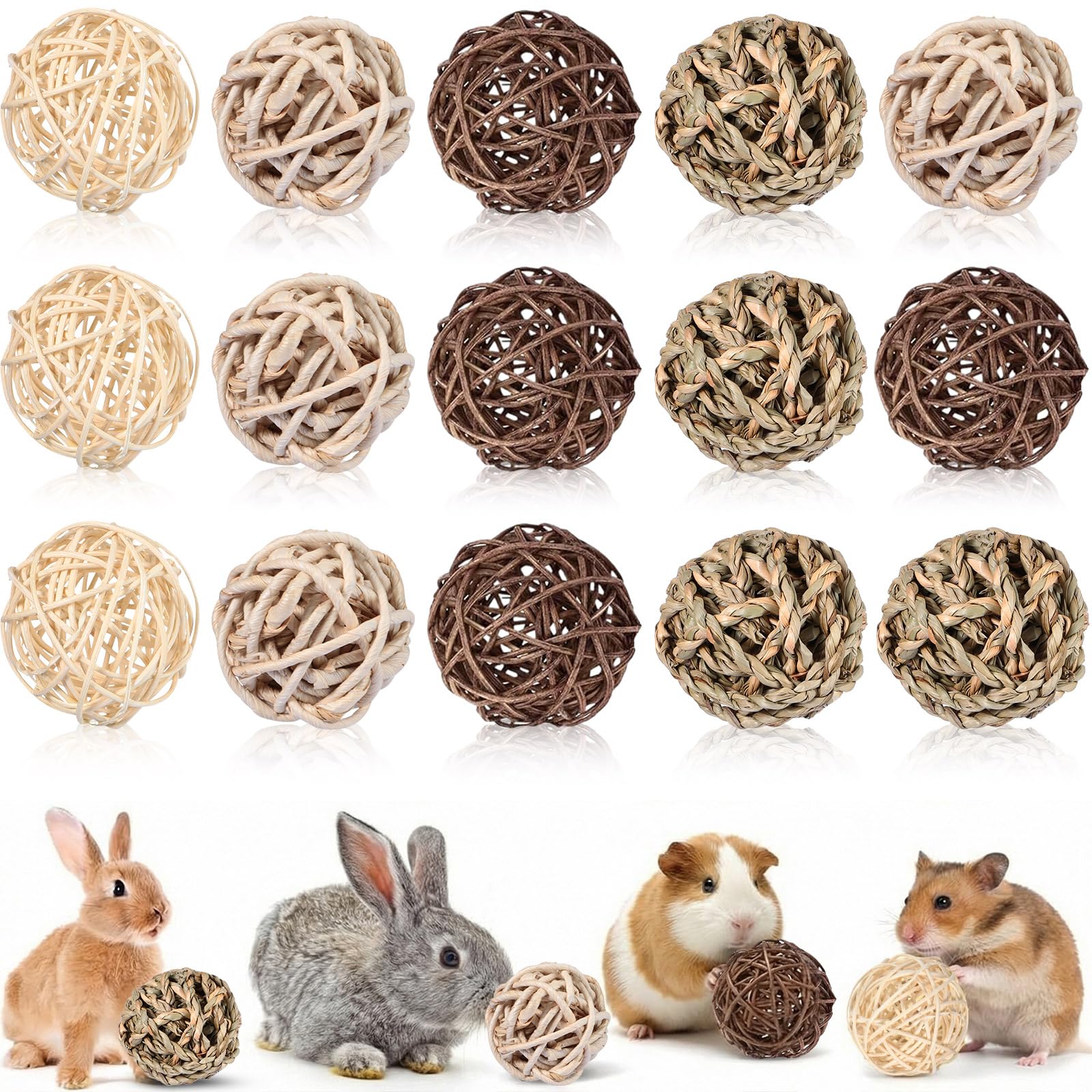
When a rabbit’s primary need is simply something to push, chase, and destroy, chew balls fill a specific niche that sticks and mats do not. Skylety offers 15 balls across four textures — aquatic plant, gourd grass, wicker, and corn — each hand-woven and heat-dried to remove excess moisture. The diameter measures approximately 1.9 inches, small enough for a Netherland Dwarf to carry but large enough that a larger breed cannot swallow it whole. The variety pack approach lets owners identify which texture triggers the most engagement.
The rolling action adds a kinetic element absent from most chew toys. Rabbits push these balls with their noses, chase them across the enclosure, and shred them for nesting material. Owners reported their rabbits engaged with these balls primarily through tossing and batting rather than sustained gnawing, which means the dental benefit is secondary to the exercise enrichment. Each ball lasts roughly one to three days under active play, making the 15-count pack a two- to three-week supply depending on rabbit intensity.
The size discrepancy noted in reviews is real — several buyers measured the balls at approximately 1.25 inches rather than the advertised 1.9 inches, making them better suited for guinea pigs, hamsters, and smaller rabbit breeds. Larger breeds like Flemish Giants or Rex rabbits may struggle to manipulate the smaller balls effectively. The corn-based balls disintegrate fastest, while wicker holds up longest. Supervision is recommended during play to prevent ingestion of large pieces.
Why we love it
- Four textured styles encourage varied play
- Lightweight rolling action provides exercise
- High quantity for multi-pet households
Good to know
- Actual diameter ~1.25 inches, too small for large breeds
- Corn balls disintegrate quickly compared to wicker
FAQ
How many chew toys does a single rabbit need at once?
Can rabbits safely eat seagrass mats and wicker balls?
What makes bamboo chew sticks better than applewood sticks?
Final Thoughts: The Verdict
For most rabbit owners, the bunny toys winner is the SoulThink Interactive Wooden Puzzle because it tackles both dental health and boredom through natural solid pine construction with three distinct foraging mechanics. If your rabbit is a heavy chewer who needs sustained tooth filing, grab the Bissap Sweet Bamboo Stick 700g bag for its long-lasting supply and veterinarian-backed dental benefits. And for owners setting up a new enclosure on a budget, the JONS NTY 50-60 piece variety pack offers the widest texture discovery range to learn what your rabbit truly loves before investing in bulk purchases.