
An overheated tank is a silent emergency. Whether you are keeping axolotls, cold-water shrimp, or a reef system, a single summer spike can destabilize the entire environment. The difference between a thriving habitat and constant stress comes down to one machine pulling excess heat out of the water column.
I’m Mo Mahin — the founder and writer behind Furric. I’ve spent years cross-referencing compressor specs, heat-exchange materials, flow-rate requirements, and owner longevity reports to separate reliable cooling hardware from short-lived disappointments.
My goal is to help you pick the right aquarium chiller by focusing on horsepower, refrigerant type, evaporator construction, and real-world duty cycles — not inflated promises.
How To Choose The Best Aquarium Chiller
Before buying any cooling unit, you need to match three variables: tank volume, target temperature drop, and ambient room temperature. A chiller rated for 40 gallons will fail if your room hits 95°F and you need a 20°F drop. Manufacturers often assume ideal conditions, so always size up one tier if you live in a warm climate.
Compressor Horsepower and Real-World Capacity
1/10 HP units handle 20–40 gallons reliably under typical home conditions. 1/3 HP models push into the 75–100 gallon range. 1/5 HP fills the gap at roughly 50–70 gallons. These numbers shrink by 30–50% if ambient temperatures exceed 85°F. If you plan to cool a cold-plunge tub, multiply your required HP by 1.5 because the target temperature is often below 50°F, which is far more demanding than a 70°F reef tank.
Evaporator Material: Titanium vs. Copper
Saltwater aquariums require a titanium evaporator. Copper reacts with salt and will corrode within weeks, dumping toxic ions into the water. Freshwater tanks can use copper or stainless steel, but titanium eliminates any risk regardless of water chemistry. Most budget-friendly chillers use stainless steel; premium models stick with pure titanium.
Refrigerant Type and Efficiency
R290 (propane) is becoming common in compact chillers because it transfers heat more efficiently than R134a, allowing smaller compressors to achieve the same BTU output. The trade-off is flammability. Chillers using R290 require at least 6 inches of clearance on all sides for ventilation. R134a remains the industry standard for larger units and is non-flammable, but it is less efficient at extreme temperature differentials.
Flow Rate and Pump Matching
Every chiller has a minimum and maximum flow rating. Too slow and the water stays in contact long enough to freeze internally or cause short-cycling. Too fast and the water passes through without losing enough heat. Most 1/10 HP units need 150–250 GPH. A dedicated pump with the correct head height matters more than raw GPH — a pump rated for 300 GPH at zero lift may deliver only 150 GPH at 4 feet of vertical rise.
Quick Comparison
On smaller screens, swipe sideways to see the full table.
| Model | Category | Best For | Key Spec | Amazon |
|---|---|---|---|---|
| Poafamx 42gal 1/10 HP | Mid-Range | Axolotl & reef | Titanium evaporator | Amazon |
| Active Aqua 1/10 HP | Premium | Small cold plunge | Boost function | Amazon |
| JBJ Arctica 1/5 HP | Premium | Large reef tanks | Memory chip recovery | Amazon |
| BAOSHISHAN 42gal 1/10 HP | Mid-Range | Hydroponics systems | R290 refrigerant | Amazon |
| YAKUST 79gal 1/3 HP | Mid-Range | Large freshwater | R134a refrigerant | Amazon |
| Ezcasch 79gal 1/3 HP | Mid-Range | Cold plunge setups | Two built-in fans | Amazon |
| Polar Revive 1/3 HP | Premium | Full-size ice baths | Complete hose kit | Amazon |
| zensui ZC-100 Alpha | Premium | Nano & pico reefs | 300W compressor | Amazon |
| Dreamtrue 42gal 1/10 HP | Budget-Friendly | Entry-level users | Remote control | Amazon |
In‑Depth Reviews
1. Poafamx 42gal 1/10 HP Aquarium Chiller

The Poafamx chiller lands at the intersection of material quality and real-world cooling performance. Its titanium evaporator resists saltwater corrosion — a feature usually reserved for units that cost twice as much. The R290 compressor drops water temperature up to 10°F below ambient and holds 64–78°F with minimal hysteresis. Owners running 28-gallon axolotl tanks report steady 62–68°F ranges even in warm rooms.
The included 264-GPH pump with a stainless steel shaft is serviceable, but several users swapped it for a 300+ GPH model to increase flow through longer hose runs. Noise levels hover around 40 dB, which is quieter than a mini-fridge compressor. The unit requires 6 inches of open space on all sides for the R290 gas to dissipate safely — follow that clearance rule strictly.
One owner measured actual power draw at roughly 200W versus the advertised 300W. That lower draw explains why the chiller runs longer if you try to push below 40°F, but for standard aquarium targets (65–75°F) it cycles efficiently. The 1-year warranty covers internal compressor defects, and the piping kit includes anti-displacement clamps and suction cups that prevent sediment disturbance.
Why we love it
- Genuine titanium evaporator ideal for long-term saltwater use
- R290 refrigerant delivers strong BTU output per watt
- Complete accessory kit with pump, hose clamps, and suction cups
Good to know
- Included pump is weaker than advertised; plan to upgrade for tanks over 30 gallons
- R290 requires strict ventilation clearance — do not enclose the unit
2. Active Aqua 0.10 HP Water Chiller with Boost
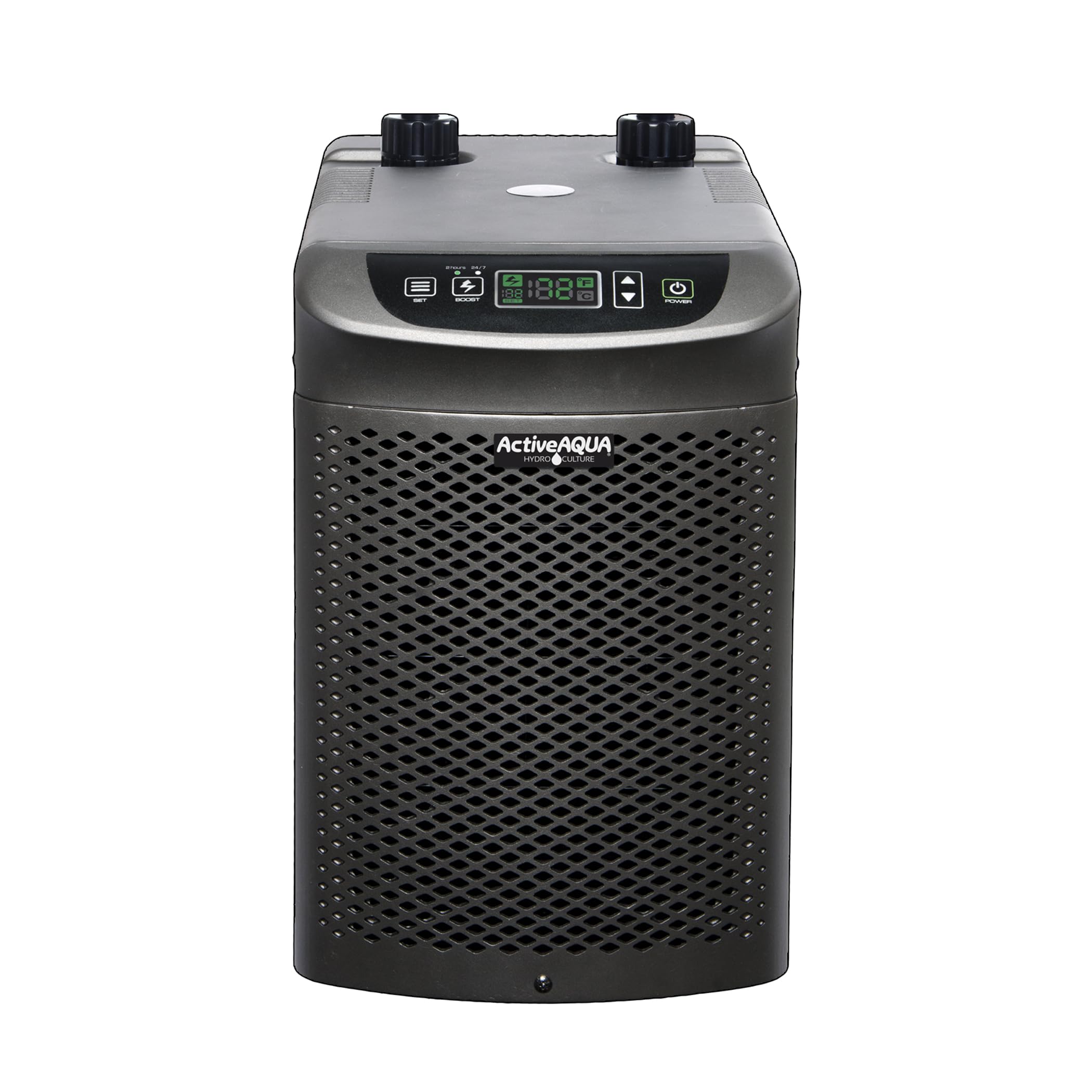
The Active Aqua carries a premium price tag for a 1/10 HP unit, but it earns that position with a dedicated Boost function that temporarily increases compressor duty cycle to pull the water temperature down faster. For a 15–30 gallon tank or a personal cold-plunge tub, that burst mode cuts initial chill time almost in half. The digital control system holds the target temperature within ±1°F, and the titanium evaporator matches the Poafamx for corrosion resistance.
Owner reports confirm that the actual power draw is roughly 180W, well below the listed 460W. The box says R410a, but the manual lists R134a — both are non-flammable, so the discrepancy is a documentation issue rather than a safety one. The unit requires an external pump; the barb fitting kit is included, but you need to supply your own pump and tubing if you want a specific size.
The 28-pound unit is portable enough to move between a hydroponic reservoir and a quarantine tank. The remote control works from across the room, so you can adjust the setpoint without walking past warm exhaust air blowing from the rear vents.
Why we love it
- Boost function provides rapid temperature drop when you need it most
- Titanium evaporator ensures long saltwater service life
- Remote control and digital interface are intuitive and responsive
Good to know
- No pump included — budget for a compatible submersible pump
- Power draw is less than advertised, which means longer runtime below 50°F
3. JBJ Aquarium Arctica Titanium Chiller 1/5 HP

The JBJ Arctica is the longest-tenured name in reef chilling for a reason. The 1/5 HP model uses a titanium heat exchanger and a smart memory chip that restores the last set temperature after a power outage — essential for unattended reef tanks. The unit is built in South Korea and uses R134a refrigerant, so clearance requirements are less restrictive than R290 models. The condenser is highly efficient; owners running 220-gallon systems report lower energy bills compared to off-brand alternatives.
Noise output is the quietest in this class. A decade-old JBJ unit is still operating in many tanks, and one reviewer noted 15 years of service before upgrading. The 1/5 HP handles 50–70 gallons comfortably and can cool a 70-gallon tank from 75°F to 68°F in about two hours with a proper external pump. The physical footprint is larger than compact units — 13 x 21 x 20 inches — so measure your cabinet space before buying.
The price is the highest in this lineup, roughly triple the cost of comparable HP units from generic brands. That premium buys South Korean assembly quality, consistent temperature control with ±0.5°F accuracy, and a service life that often exceeds a decade. One owner reported a defective unit after 2.5 weeks, which the warranty covered, but the return process required the original packaging.
Why we love it
- Proven 10+ year service life with proper maintenance
- Memory chip restores settings automatically after power loss
- Exceptionally quiet operation for a large chiller
Good to know
- High upfront cost — only makes sense for serious reef keepers
- Large size may not fit under standard aquarium cabinets
4. BAOSHISHAN 42gal 1/10 HP Aquarium Chiller

The BAOSHISHAN chiller runs on R290 refrigerant and packs two internal fans for heat dissipation. On a 30–40 gallon tank at 80°F ambient, the unit holds 68–73°F with the compressor cycling roughly two minutes every half hour. The stainless steel water pump shaft resists corrosion in freshwater setups, though saltwater users should note the evaporator is not pure titanium — it uses stainless steel, which is acceptable for occasional salt use but not 24/7 reef duty.
Installation requires planning. The intake vents are wide enough to trap small shrimp or fry, so you need to cover them with filter foam. The outflow creates a strong current that stirs up sediment unless you aim it at a rock or use a spray bar. The temperature display reads about 3°F high, which means you set the target slightly lower than your actual desired temperature. Emptying the calibration offset is a workaround that experienced owners figure out quickly.
The unit survived a year of South Texas summer heat for one axolotl keeper, but another owner reported compressor failure after 1.25 years. The R290 gas requires 6 inches of clearance on both sides for adequate ventilation — blocking those vents causes the compressor to overheat and cycle continuously. The included hose clamps and adapters work with standard Fluval tubing, making this a solid drop-in replacement for older JBJ-050 units.
Why we love it
- Dual-fan design moves heat out quickly, reducing compressor runtime
- R290 refrigerant provides efficient cooling at lower electrical draw
- Compatible with Fluval hose fittings and standard aquarium tubing
Good to know
- Intake vents require foam cover to protect small fish and invertebrates
- Temperature display runs about 3°F high — compensate during setup
5. YAKUST 79 Gallon 1/3 HP Aquarium Chiller
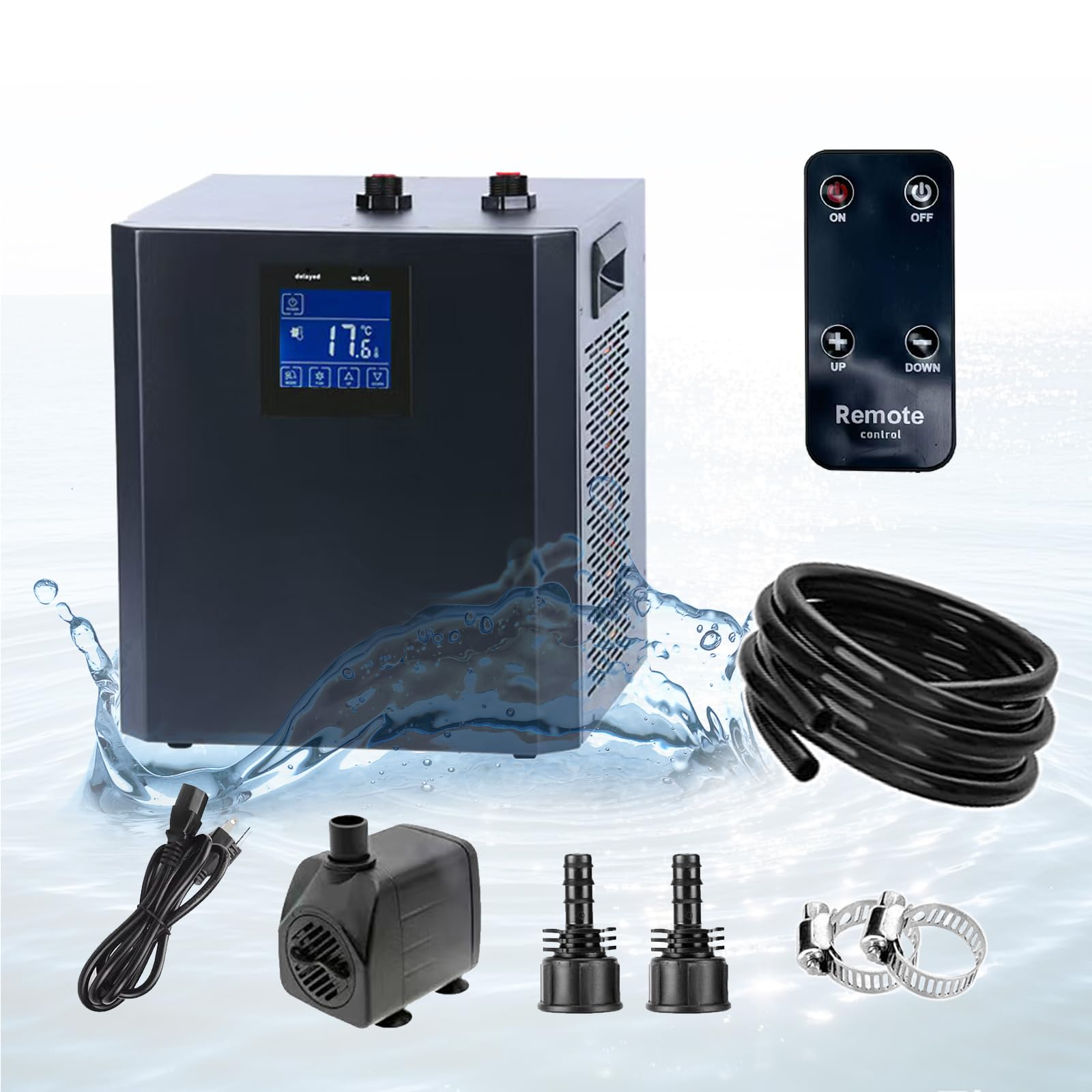
The YAKUST chiller brings 1/3 HP to the table at a price that undercuts most other high-HP units. The 79-gallon rating assumes standard ambient conditions — drop that to 50 gallons if your room regularly exceeds 85°F. The unit uses R134a refrigerant, which is non-flammable and requires less clearance than R290 models. Owners report fast, consistent cooling on 75-gallon freshwater and axolotl tanks, with the LED touchscreen providing straightforward temperature adjustment.
Noise sits between 30–50 dB according to the manufacturer, but one user described it as noticeably loud. The compressor vibration transmits through the floor if placed on a hollow stand — a foam pad or rubber vibration mat helps. The included pump and tubing are functional for straight runs, though you may need additional fittings if your tank sits more than 6 feet from the chiller. The remote control works reliably through cabinets but requires line-of-sight to the IR receiver.
A small percentage of owners reported failure after two months. The 1-year warranty covers replacement, but the inconvenience is real. The 35.4-pound weight makes it one of the heavier units in the mid-range category, so plan for a sturdy surface. The 1/3 HP compressor is loud enough that most users prefer locating the chiller in a utility room or garage rather than next to the tank.
Why we love it
- Competitive pricing for 1/3 HP cooling capacity
- R134a refrigerant eliminates the ventilation anxiety of R290 units
- Remote control and LED touchscreen make adjustments easy
Good to know
- Compressor noise is noticeable — isolate with vibration-dampening pad
- Reliability reports are mixed; keep original box for potential warranty return
6. Ezcasch 79 Gal 1/3 HP Aquarium Chiller
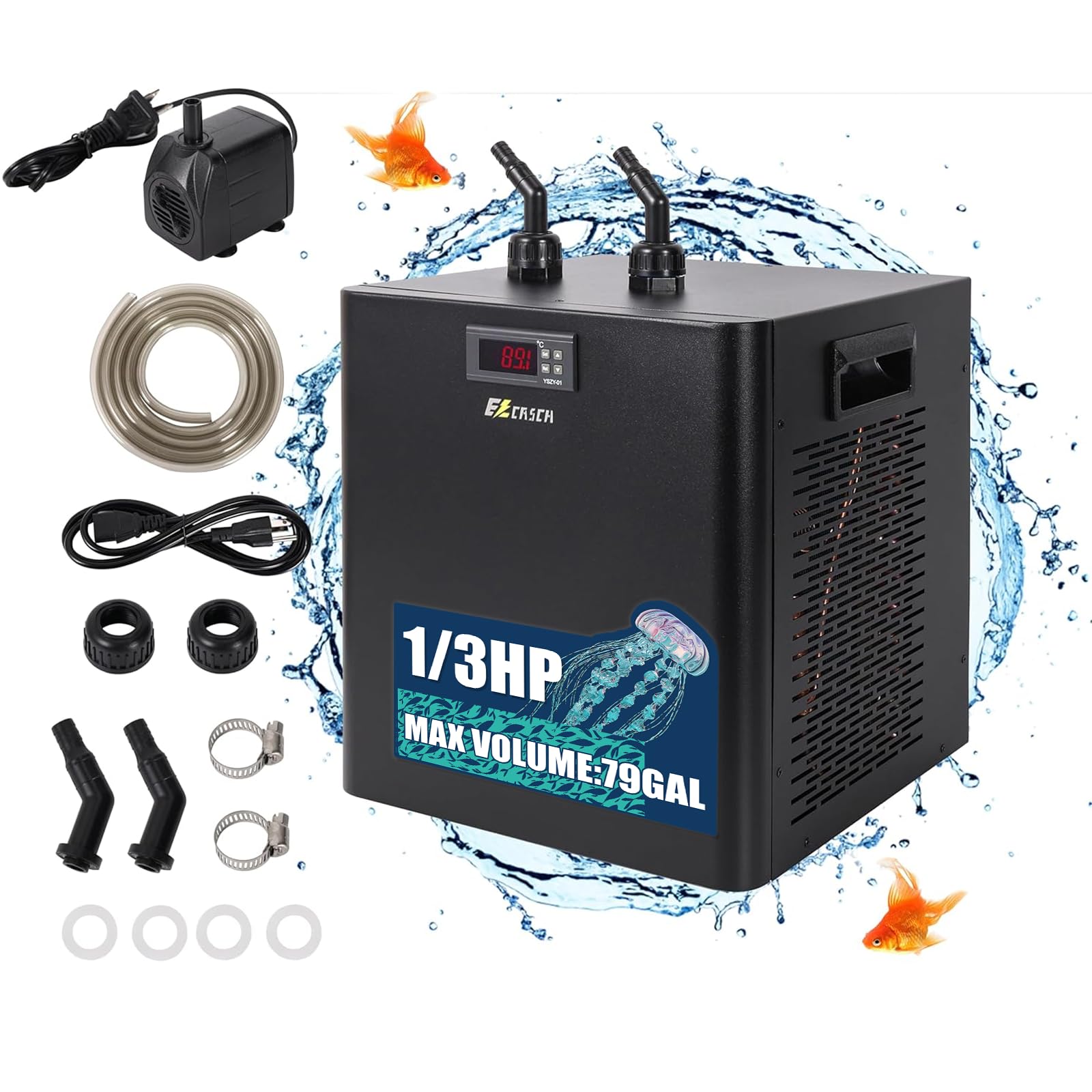
The Ezcasch chiller is structurally similar to the YAKUST, sharing the same 1/3 HP R134a compressor platform and 79-gallon rating, but with a few design differences. Two built-in fans and broad vent panels on both sides help eject heat aggressively, which matters if you plan to run the chiller inside a cabinet. An owner using this for a 100-gallon cold plunge in South Texas reported water temperatures hitting the 30s–40s range consistently.
Setup for cold-plunge use requires additional fittings. The stock pump and tubing work for a standard aquarium loop, but plunge tubs usually need longer hose runs and barb adapters to match wider inlet ports. Budget roughly in extra parts for a clean installation. The temperature calibration needs a manual offset — the chiller’s display can read 2–3°F lower than the actual tank temperature, so verify with a separate thermometer.
Durability is a concern. Multiple owners reported failure after 4 months, with the compressor simply stopping. The seller support process is handled through Amazon rather than the manufacturer, so returns are straightforward within the 30-day window. For a 75-gallon axolotl setup, one reviewer has been running the unit for several months without issue, maintaining a steady 65°F. The 38.9-pound weight makes it a heavy installation — use two people to position it.
Why we love it
- Aggressive dual-fan design handles high ambient temperatures
- Capable of chilling large cold-plunge tubs below 50°F
- English manual includes clear troubleshooting guides
Good to know
- Significant failure rate reported within the first several months
- Requires + in additional parts for cold-plunge plumbing
7. Polar Revive Chiller for Cold Plunge 1/3 HP

The Polar Revive is purpose-built for cold plunges rather than aquariums, but its 1/3 HP compressor and included pump/hose kit make it relevant for large tanks too. The unit comes fully assembled with hoses and a pump, removing the guesswork from plumbing. The digital screen lets you set the target temperature directly, and the 1/3 HP version can cool a 150-gallon insulated tub to 40–42°F in Florida summer heat when running overnight.
Performance varies dramatically with insulation. Without tub insulation, the chiller runs 24/7 and the power bill can exceed per month. With good insulation, the compressor cycles only 4.5 hours per night. The included pump is a 1/10 HP model that struggles to push water upward if the chiller sits higher than the tub — mounting the chiller at or below water level solves this. One owner reported the 1 HP model tripping a 15-amp breaker despite the manual stating a 7-amp draw, suggesting the startup surge exceeds the rating.
Reliability data is mixed. Some units failed within a week or two, while others have run for full summers without issue. The vendor offers direct customer support that many users praised as responsive. The chiller is heavy (42 pounds for the 1/3 HP model), so plan for a permanent location. The aluminum body dissipates heat effectively but can dent if you move the unit frequently.
Why we love it
- Complete all-in-one kit with pump and hoses — no extra shopping
- Can maintain sub-45°F temperatures in large insulated tubs
- Vendor customer service is responsive and helpful
Good to know
- Without insulation, operating costs spike significantly
- Some units fail early; confirm return policy before purchase
8. zensui ZC-100 Alpha Aquarium Cooler
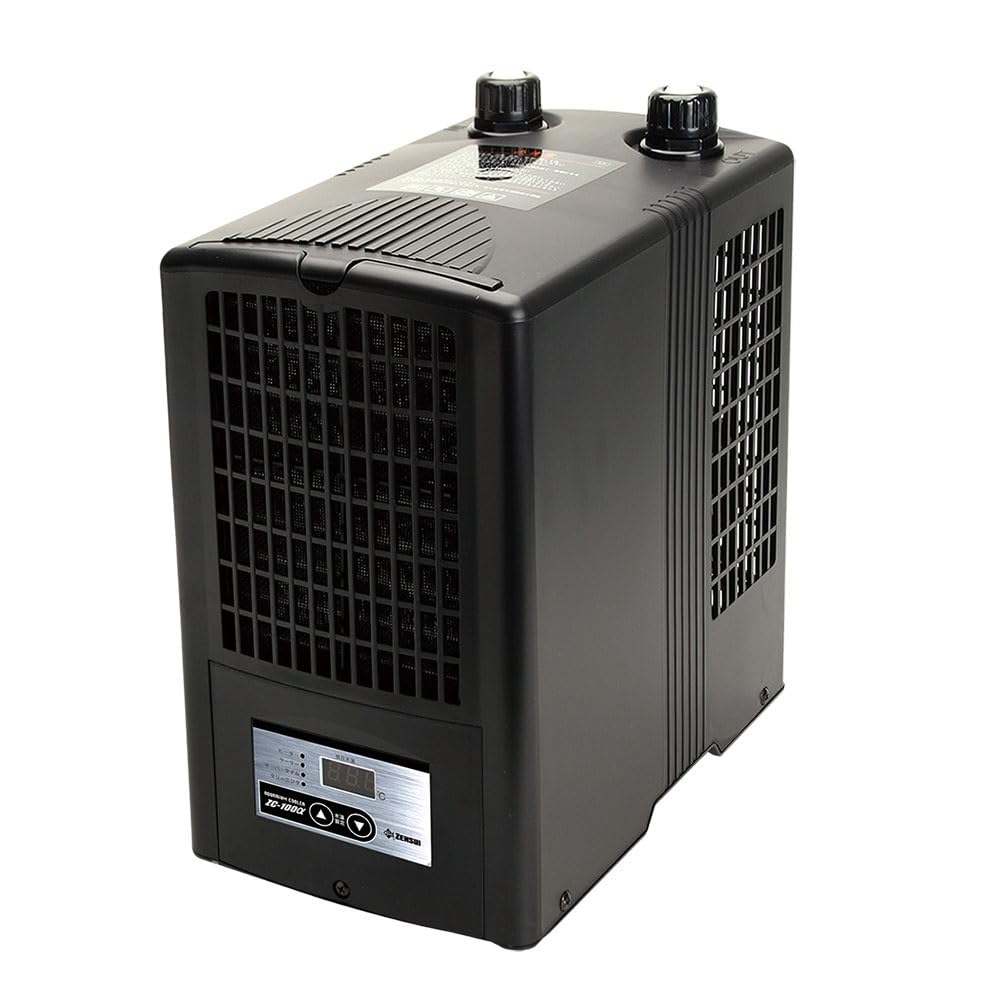
The zensui ZC-100 Alpha is a Japanese-designed chiller built for nano and pico reef tanks. The 300W compressor delivers ±0.5°C temperature control, which is tighter than most mid-range units. It uses R134a refrigerant and requires only 12mm hose connections, making it compatible with canister filters and small circulation pumps. The unit is remarkably quiet — owners upgrading from decade-old units report a drastic reduction in vibration noise.
One limitation is the lack of a built-in heater. For year-round use in temperate climates, you need a separate heater to prevent the tank from dropping below target during winter. The compressor handles ambient temperatures up to roughly 95°F, but beyond that the cooling effectiveness drops. The 21.87-pound weight is manageable for a cabinet installation, though the small hose diameter (12mm) can restrict flow if your pump exceeds 200 GPH.
Long-term data is thin for the ZC-100 because the brand is less common in the US market. One owner reported failure after 4 years, which is a reasonable lifespan for continuous compressor operation. The price sits between mid-range and premium, which makes sense for the build quality but may feel steep for the limited cooling capacity. This unit is best suited for dedicated nano-reef keepers who prioritize silence and precision over raw HP.
Why we love it
- Exceptional ±0.5°C temperature stability for sensitive coral
- Very quiet operation — genuinely suitable for a bedroom
- Compact footprint fits in small cabinets
Good to know
- No internal heater — requires separate unit for winter use
- Limited availability and sparse English documentation
9. Dreamtrue 42 Gal 1/10 HP Aquarium Chiller
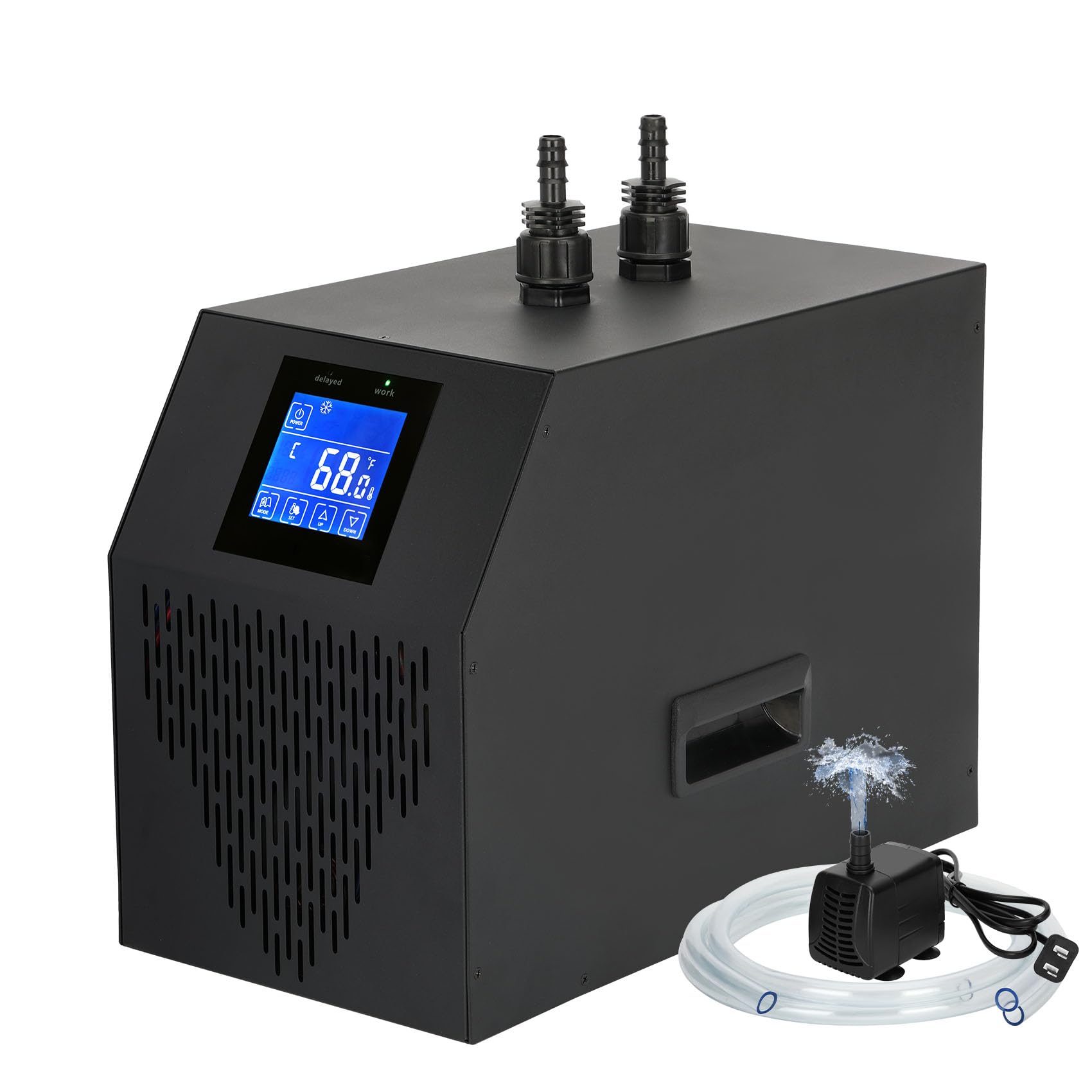
The Dreamtrue chiller is the most affordable entry point in this lineup, offering a 1/10 HP compressor rated for 42 gallons. The upgraded LED display and touch controls make temperature programming straightforward, and the included remote works from across the room (line-of-sight only). The unit includes a water pump, hose, and cable, so first-time buyers don’t need to source extra parts.
Noise output is rated at 30–40 dB, which aligns with owner reports comparing it to a window air conditioner running on low. The cooling performance is adequate for a 20–40 gallon tank in a climate-controlled home, dropping water temperature 5–15°F below ambient. One owner used it to cool an 85-gallon cold plunge tub from 70°F to the low 50s — significantly above the rated capacity, but it managed with extended runtime. A separate user on a 20-gallon tank reported the chiller maintaining tight temperature control even at 90°F+ room ambient.
The biggest drawback is documentation. The manual lacks basic information such as how to switch between Celsius and Fahrenheit, and there is no online resource for the 4th operating mode mentioned in the interface. Several customers received units with no functional manual at all. The seller support is inconsistent — Amazon directly handled returns for some, while others were unable to reach the manufacturer. For the price, the hardware works, but you need to be comfortable figuring out the setup on your own.
Why we love it
- Lowest entry cost for a 1/10 HP compressor chiller
- Complete kit with pump, hose, and remote — no extra purchases
- Quiet enough for a living room at 30–40 dB
Good to know
- Poor manual with missing instructions — expect a DIY setup experience
- Seller support is unreliable; rely on Amazon’s return policy for issues
FAQ
Do I need an external filter, or can the chiller connect to a canister filter?
How do I prevent temperature swings that stress my fish?
Can I use a 1/10 HP chiller for a cold plunge tub?
Final Thoughts: The Verdict
For most aquarium keepers, the best aquarium chiller winner is the Poafamx 42gal 1/10 HP because it combines a genuine titanium evaporator, R290 efficiency, and a complete accessory kit at a reasonable price point. If you need the quietest possible operation and the precision of a boost function, grab the Active Aqua. And for large reef tanks where reliability over a decade matters most, nothing beats the JBJ Arctica.