
Managing chronic kidney disease in cats means walking a tightrope between rigorous nutritional control and the reality that many of these cats simply stop eating. The stakes are high: malnutrition accelerates kidney failure faster than any single electrolyte imbalance. The right food must lower phosphorus, restrict sodium, and deliver highly bioavailable protein—all while smelling and tasting good enough to overcome the nausea and pickiness that defines feline renal disease.
I’m Mo Mahin — the founder and writer behind Furric. I’ve spent years cross-referencing veterinary nutritional data, analyzing owner-reported palatability scores, and mapping ingredient profiles against the specific phosphorus and protein thresholds that define a successful renal-support diet.
This guide breaks down the seven most-trusted options for managing kidney disease through diet, from prescription kibble to low-phosphorus wet food. Whether you need a cat food for cats with kidney disease that your finicky senior will actually touch or a budget-friendly daily staple approved by your vet, the picks below are built on real data and real cat feedback.
How To Choose The Best Cat Food For Cats With Kidney Disease
Not every bag or can marketed for “kidney health” meets the clinical thresholds a cat with renal disease actually needs. You are looking for a combination of three levers: phosphorus content, protein quality, and hydration profile.
Phosphorus: The Primary Target
The central objective of a renal diet is to reduce phosphorus to slow the progression of kidney damage. Most commercial cat foods far exceed the phosphorus levels safe for CKD cats. True renal-support formulas target phosphorus below 1.0% on a dry matter basis, with some non-prescription options like Weruva Wx Phos Focused aiming as low as 50% below the AAFCO minimum. Prescription diets typically restrict phosphorus even further and often add phosphate binders for additional control. Always check the guaranteed analysis; if the phosphorus percentage looks high relative to the protein, it is probably not restricted enough for a diagnosed cat.
Protein Quality vs. Quantity
Older advice recommended drastically cutting protein to “rest” the kidneys. Modern veterinary consensus favors maintaining adequate high-quality protein to prevent muscle wasting, which is a major predictor of mortality in CKD cats. The key is not low protein but low-phosphorus, highly bioavailable protein. Look for named muscle meats or eggs as the first ingredients, and avoid fillers like powdered cellulose that artificially dilute phosphorus numbers while offering no nutritional value. Prescription diets often use moderately restricted protein levels; non-prescription renal lines like Weruva rely on premium protein sources that naturally have lower phosphorus.
Moisture Content and Palatability
Chronic kidney disease leads to dehydration, which further taxes the kidneys. Wet food (canned, pouches, or stews) provides the highest moisture content and is almost always preferred over dry kibble for CKD cats. However, many cats with kidney disease experience nausea and loss of appetite, making palatability the deciding factor. If a cat refuses to eat a scientifically perfect renal diet, the diet fails. This is why variety packs and multiple texture options (pate, shreds, gravy) are invaluable — they give you tools to keep a cat eating through appetite fluctuations.
Quick Comparison
On smaller screens, swipe sideways to see the full table.
| Model | Category | Best For | Key Spec | Amazon |
|---|---|---|---|---|
| Weruva Wx Phos Focused Variety (3oz) | Wet Food | Low-phosphorus non-prescription trial | Up to 50% less phosphorus than AAFCO minimum | Amazon |
| Weruva Wx Phos Focused Chicken in Gravy | Wet Food | Picky cats who love gravy textures | Chicken shreds in low-phosphorus broth | Amazon |
| Pro Plan Veterinary Diets NF Kidney Function | Dry Food | Vet-prescribed kibble for stable CKD | Restricted phosphorus + Omega-3 fatty acids | Amazon |
| Weruva Wx Phos Focused 5.5oz Variety | Wet Food | Larger cans for multi-cat renal feeding | 5.5 oz cans, pate + gravy options | Amazon |
| Hill’s Prescription Diet k/d Ocean Fish Dry | Dry Food | Clinically proven kidney + appetite support | ActivBiome+ Kidney Defense, E.A.T. technology | Amazon |
| Blue Buffalo K+M Kidney + Mobility Dry | Dry Food | Dual kidney + joint support in one kibble | Controlled protein + glucosamine/chondroitin | Amazon |
| Hill’s Prescription Diet k/d + j/d Wet Cans | Wet Food | Kidney + mobility combo in a stew format | Chicken & vegetable stew, dual kidney + joint support | Amazon |
In‑Depth Reviews
1. Weruva Wx Phos Focused, Chicken Formulas Variety Pack, 3oz Can (Pack of 12)
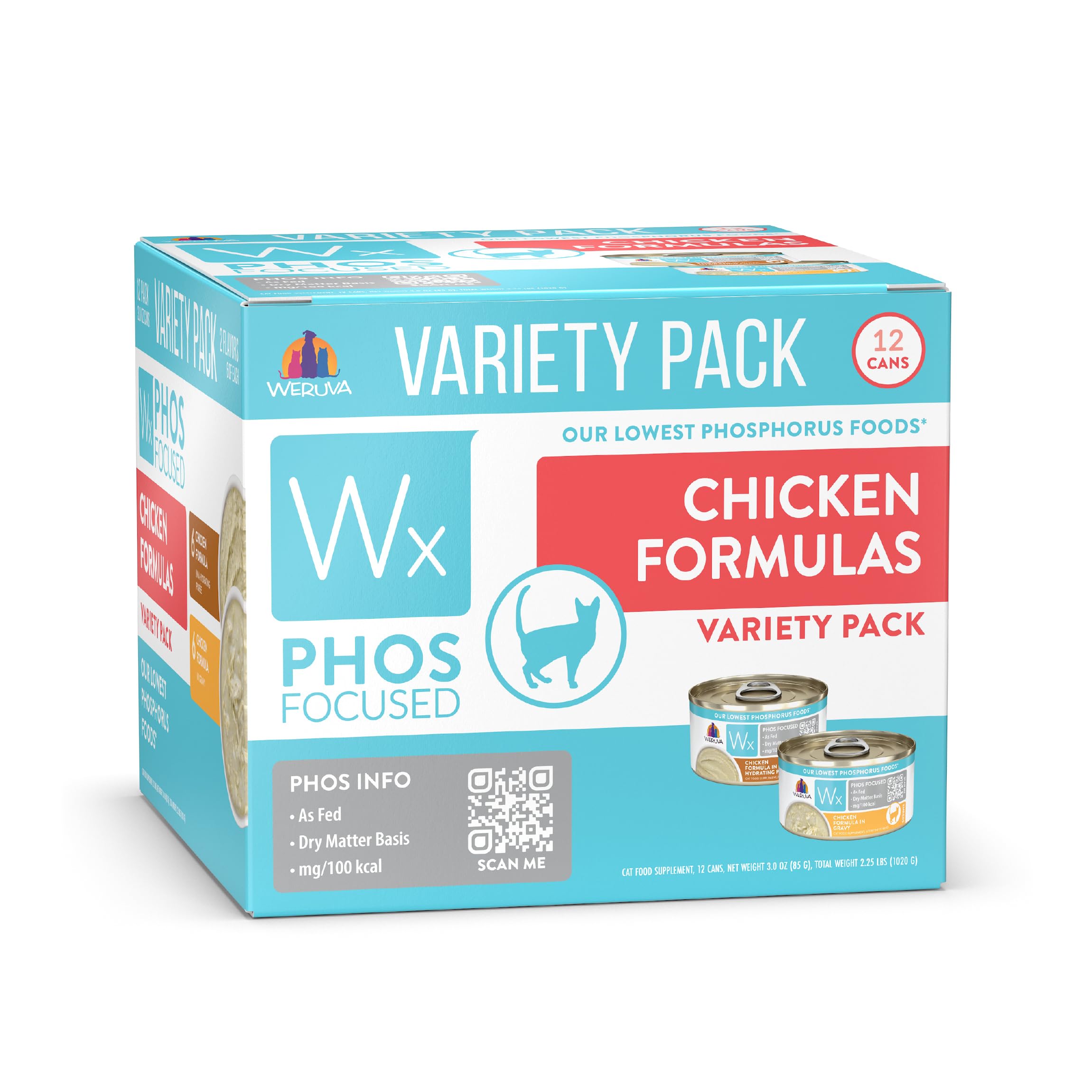
Weruva’s Wx Phos Focused line is a standout for any cat with kidney disease precisely because it achieves meaningful phosphorus restriction without falling into the trap of cheap, low-protein fillers. This variety pack gives you three chicken-based textures to test against your cat’s preferences, all formulated with up to 50% less phosphorus than the AAFCO minimum. The protein comes from real muscle meat and eggs, not powdered cellulose or carbohydrate binders that artificially lower the phosphorus percentage on paper.
Owner reports consistently show improved bloodwork markers — one cat’s kidney values dropped from 2.4 to 1.6 over a year on this diet. The chunks-in-gravy texture is highly palatable for most cats, though a minority of reviewers note that their cats rejected certain textures within the variety pack, particularly the long chicken shreds. This makes the variety pack format itself the smartest starting point: you test all three textures without committing to 12 identical cans.
The 3-ounce can size is ideal for single-cat households or for cats whose appetite varies day to day, reducing waste. Because this is a non-prescription food, you can purchase it without a veterinary authorization, though any renal diet change should still be discussed with your vet. For a mid-range option that balances phosphorus control with palatability, this pack sets the bar.
Why we love it
- True low-phosphorus formula backed by real kidney value improvements in owner reports
- All natural ingredients with no fillers or artificial content
- Variety pack allows texture testing without waste
Good to know
- Some cats reject the shredded chicken texture
- Small 3-oz cans mean more frequent ordering for multi-cat homes
2. Weruva Wx Phos Focused, Chicken Formula in Gravy 3oz Can, Pack of 12

If your cat loved the chicken shreds from the variety pack but ignored the pate, this single-flavor box of Chicken Formula in Gravy is the logical next step. The same low-phosphorus base — up to 50% below AAFCO minimums — is delivered through thin, pulled chicken strips floating in a broth-like gravy. The high moisture content is a direct advantage for CKD cats, who require extra hydration to support failing kidneys.
Reviewers consistently report that this specific flavor is the most enthusiastically accepted among the Weruva Wx lineup. One owner of a 17-year-old CKD cat who had rejected both prescription food and phosphate binders saw the cat regain appetite and stop weight loss on this formula. Another noted that blood phosphorus dropped after switching to this food alone. The trade-off is that the long chicken shreds can be messy to eat, and some cats leave the strings behind while lapping up the gravy.
At roughly 3 ounces per can, a cat eating twice daily will go through a 12-pack in about 6 days. This makes it slightly pricier per feeding than some prescription wet foods when used as a sole diet. Owners of multiple cats or heavy eaters may want to consider the 5.5-ounce variety pack for better economy. Still, for a single senior cat who refuses everything else, this is often the food that keeps them eating.
Why we love it
- Exceptionally high palatability for picky CKD cats
- High moisture content supports hydration and kidney function
- Non-prescription, low-phosphorus formula with quality protein
Good to know
- Shredded chicken texture can be messy and some cats leave it behind
- Small can size leads to frequent reordering or higher cost per feeding
3. Pro Plan Veterinary Diets Purina NF Kidney Function Advanced Care Feline Formula Dry Cat Food – 3.15 lb. Bag

Purina’s Pro Plan Veterinary Diets NF formula represents the traditional approach to renal nutrition: restricted protein paired with restricted phosphorus to reduce the workload on damaged kidneys. This dry kibble is a veterinary prescription diet, meaning you will need your vet’s authorization to purchase it, but that restriction comes with clinical validation. The formula includes omega-3 fatty acids (EPA and DHA) to support kidney function and antioxidants to manage oxidative stress common in CKD cats.
Owner feedback highlights an unexpected advantage: palatability. Multiple reviews mention that cats who previously refused other prescription renal foods — including Royal Canin’s offerings — ate this Purina formula without any transition period. One owner reported that their 18-year-old cat, who had only 10% kidney function and refused all renal wet foods, accepted this kibble enthusiastically, and after two months, her kidney function improved to 25%. This suggests the dry formula may be more appetizing to some cats than canned alternatives.
As a dry food, the moisture content is low, which is a limitation for cats who are already prone to dehydration from kidney disease. Owners should supplement with wet food, water fountains, or additional hydration strategies. The 3.15-pound bag is entry-level sizing, ideal for trialing before committing to the larger format. For a cat that needs the clinical rigor of a prescription diet but hates the taste of most renal cans, this is worth discussing with your vet.
Why we love it
- Clinically formulated with restricted phosphorus and added omega-3s
- High palatability — many cats accept it without transition
- Backed by documented kidney function improvement in advanced CKD cases
Good to know
- Requires veterinary prescription to purchase
- Dry kibble lacks the moisture content CKD cats need
4. Weruva Wx Phos Focused Gravy and Pate Formulas 5.5oz Can Variety Pack, Pack of 12

This is the large-can version of Weruva’s Wx Phos Focused line, and it addresses the primary complaint against the 3-ounce format: running out too fast. Each 5.5-ounce can contains nearly double the food, reducing the per-ounce cost and the frequency of reordering. The variety pack includes two pate formulas and two gravy/broth formulas, giving you four distinct textures to rotate through for a cat whose preferences shift with their appetite.
Owner reviews are strongly positive, particularly for the Chicken/Tilapia Gravy flavor, which multiple picky cats accept eagerly. The low-phosphorus claim holds at the same standard as the smaller cans — up to 50% below AAFCO minimums — and the ingredient list remains free of fillers, artificial colors, and GMOs. One reviewer noted that their cat who had rejected the pate still ate the broth-based flavors eagerly, making this variety pack essential for determining which texture works.
Owners of one cat may want to portion and freeze half cans. The strong scent, while a sign of real ingredients, can be off-putting to some humans but is generally a positive signal to cats. For multi-cat households or those with a cat who eats three cans a day, this format is a smart upgrade from the smaller cans.
Why we love it
- Better per-ounce value compared to 3-ounce cans
- Four-texture variety pack helps solve picky eating
- Consistent low-phosphorus formula across all flavors
Good to know
- Single-cat households may struggle to finish a can before spoilage
- Strong scent may be noticeable in the refrigerator
5. Hill’s Prescription Diet k/d Kidney Care Dry Cat Food, Ocean Fish, 4 lb. Bag

Hill’s Prescription Diet k/d is arguably the most recognized renal diet in veterinary medicine, and the Ocean Fish dry formula brings two clinically developed technologies into one bag: ActivBiome+ Kidney Defense, a proprietary prebiotic blend designed to support the gut-kidney axis, and Enhanced Appetite Trigger (E.A.T) technology to encourage food intake in cats who have lost interest in eating. The formula is restricted in phosphorus and sodium to protect kidney function while providing elevated essential amino acids to support lean muscle.
Owner reviews highlight the small, easy-to-chew kibble size as a major advantage for older cats with dental sensitivity — a common comorbidity in CKD cats. Many owners report that their cats eat this food willingly, even when they had previously rejected other prescription renal diets. One cat with stage 4 kidney disease accepted it readily. The fish flavor is notably less strong-smelling than some wet renal foods, which can make it more tolerable for the owner while still being palatable to the cat.
The downsides are consistent with any dry kibble for CKD: low moisture content and the need for a veterinary prescription. The 4-pound bag is suitable for trialing, but a cat eating this as a primary diet will need 8-10 days per bag, meaning you will be ordering frequently. Some owners also note that picky cats can lose interest after finishing the first bag, so rotation with a wet food or another renal kibble may be necessary for long-term success.
Why we love it
- ActivBiome+ Kidney Defense prebiotic technology for gut-kidney health
- Appetite Trigger technology helps counteract CKD-related anorexia
- Small, soft kibble suitable for senior cats with dental issues
Good to know
- Requires a veterinary prescription
- Dry format requires hydration management
6. Blue Buffalo Natural Veterinary Diet K+M Kidney + Mobility Support Dry Cat Food, Chicken 7-Lb Bag
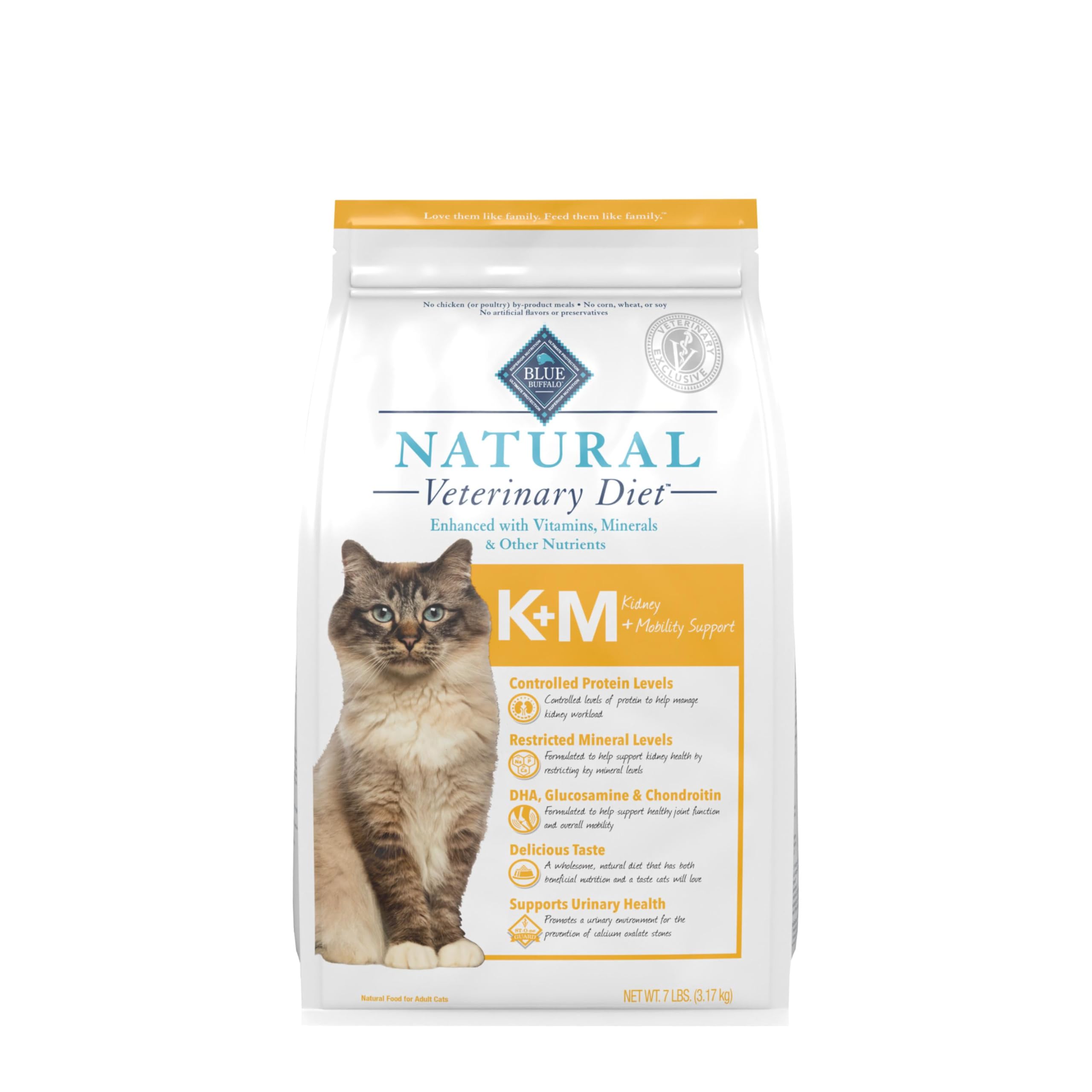
Blue Buffalo’s Natural Veterinary Diet K+M addresses a common reality for senior CKD cats: kidney disease rarely travels alone. This prescription kibble pairs controlled phosphorus and restricted protein levels with added glucosamine and chondroitin for joint health, making it a dual-purpose option for cats who also suffer from arthritis or mobility decline. The formula starts with real chicken as the first ingredient, ensuring the protein that is present is high-quality and bioavailable.
Owners report that this food is often preferred over other prescription renal diets, particularly by cats who have rejected Hill’s or Royal Canin options. One reviewer noted that their 16-year-old cat who had refused all other renal foods began eating this eagerly within five days and appeared stronger and more energetic. Another owner of a cat with both kidney disease and chronic hairballs found that the formula resolved both issues. The 7-pound bag is larger than most renal kibble entry sizes, providing better per-pound value.
As a dry food, the moisture limitation applies, and this formula requires a veterinarian’s authorization. The dual kidney-plus-joint claim is relatively unique in the prescription space, but it also means the formula is making trade-offs to serve two goals. Owners whose cats primarily need kidney support without mobility issues might find more targeted options elsewhere. For a senior cat with both diagnoses, however, this kibble simplifies the feeding regimen.
Why we love it
- Dual-action formula for kidney and joint support in one bag
- High-quality chicken as first ingredient
- Large 7-pound bag offers solid per-pound value for a prescription diet
Good to know
- Requires veterinary prescription
- Dry kibble needs supplemental moisture for CKD cats
7. Hill’s Prescription Diet k/d Kidney Care + j/d Mobility Care Wet Cat Food, Chicken & Vegetable Stew, 2.9 oz. Cans, 24-Pack

Hill’s k/d + j/d wet food combines kidney care and joint mobility support into a single chicken and vegetable stew format, targeting the two most common age-related conditions in senior cats. The stew format delivers bite-sized chunks in gravy, which many cats find more appetizing than pate textures. The formula uses ActivBiome+ Kidney Defense prebiotics, reduced phosphorus and sodium, and added L-carnitine and essential amino acids to support muscle mass while the cat’s kidneys are under stress.
Owner reports are consistent: cats who had stopped eating on other renal diets frequently accept this stew. One owner of an 18-year-old cat with stage 2 kidney disease reported that this was the only food their cat would touch, and they were able to maintain stable kidney function through consistent feeding. Another owner noted that their cat’s kidney numbers improved after switching to this formula, and the cat stopped vomiting as frequently. The 24-pack provides a solid month’s supply for a single cat eating one can per day.
The main drawbacks are the high price point, even by prescription diet standards, and the limited flavor profile — chicken and vegetable stew is the only option in this dual-formula line. Some cats initially refuse the stew texture, though many owners report that persistence pays off within a few days. Because this is a prescription product, you will need your vet’s authorization. For a cat who needs both kidney and joint support and prefers a wet stew texture, this is the most targeted option available.
Why we love it
- Combines kidney and joint support in a single stew format
- High moisture content for hydration
- Clinically tested to improve mobility in as little as 28 days
Good to know
- Requires veterinary prescription
- Only one flavor option available in this dual formula
FAQ
Can I use non-prescription low-phosphorus cat food instead of a veterinary renal diet?
How much phosphorus is too much for a cat with kidney disease?
Why does my cat with kidney disease refuse to eat?
Can I mix a renal diet with regular cat food?
Do cats with kidney disease need more or less protein?
Final Thoughts: The Verdict
For most cats with kidney disease, the cat food for cats with kidney disease winner is the Weruva Wx Phos Focused Variety Pack (3oz) because it delivers proven low-phosphorus nutrition in a non-prescription format that cats actually eat. If your cat needs the clinical rigor of a veterinary prescription diet and has trouble accepting wet food, grab the Pro Plan Veterinary Diets NF Kidney Function Dry. And for a senior cat dealing with both kidney decline and joint stiffness, the dual-action Hill’s Prescription Diet k/d + j/d Wet Stew is the most targeted option available. Whatever you choose, work with your vet on bloodwork follow-up to confirm the diet is doing its job.