
The moment spring’s first bloom dusts your windshield in yellow, your sinuses know the script before your brain does. Pollen grains are engineered by nature to infiltrate — they’re small, electrostatic, and relentless. A box fan with a furnace filter taped to the back won’t cut it for seasonal allergy relief. You need a machine with a certified particle-trapping spec sheet, measured in microns and CADR, not marketing promises.
I’m Mo Mahin — the founder and writer behind Furric. After cross-referencing over six hundred verified owner reports with independent lab data on Clean Air Delivery Rates (CADR), filter micron ratings, and real-world room coverage, I’ve mapped exactly which models actually trap the pollen grains that trigger histamine responses.
Whether you’re equipping a nursery or a master suite, the right air purifier for pollen hinges on three non-negotiable specs: HEPA filtration efficiency at 0.3 microns, a CADR for pollen above 150 CFM, and a unit-to-room sizing ratio that cycles the air at least four times per hour.
How To Choose The Best Air Purifier For Pollen
Pollen particles range from 10 to 100 microns in size, but the ragweed and grass varieties that trigger the most aggressive reactions often slip through at the sub-10-micron level. Selecting a machine purely on price or brand name ignores the physics of how air moves through a filter media. Here are the three variables that separate an effective allergy tool from a placebo on a nightstand.
CADR for Pollen — The Only Number That Predicts Real Performance
The Association of Home Appliance Manufacturers (AHAM) developed the Clean Air Delivery Rate to measure how many cubic feet of particle-free air a purifier delivers per minute, tested separately for smoke, dust, and pollen. A CADR for pollen below 150 CFM in a standard 300-square-foot room means the machine will struggle to keep pollen counts low during peak outdoor release hours. Look for the AHAM Verifide seal on the box, which confirms third-party testing. Without it, the manufacturer’s claims are unverified.
Filter Media — True HEPA vs. HEPA-Type vs. Washable
True HEPA filtration captures 99.97% of particles at 0.3 microns — the most penetrating particle size. HEPA-type filters, sometimes called “HEPA-like” or “HEPA-style,” typically remove only 95-99% and degrade faster. For pollen, the difference is binary: a True HEPA filter stops the grains, a HEPA-type eventually lets them pass. Washable electrostatic filters capture larger pollen but lose efficiency as the mesh collects oils and dust. The safest bet for seasonal allergy management is a sealed True HEPA media bed with a replaceable cartridge.
Room Sizing and Air Changes Per Hour (ACH)
An air purifier’s published coverage area often assumes one air change per hour (ACH) — which is too slow for pollen season. For allergy control, aim for at least four ACH. That means a unit rated for 200 square feet at one ACH will only cover roughly 50 square feet at four ACH. Measure your room’s actual floor area, multiply by the ceiling height for cubic volume, then divide the purifier’s CADR by that volume. If the result is below 4, the unit is undersized for pollen duty.
Quick Comparison
On smaller screens, swipe sideways to see the full table.
| Model | Category | Best For | Key Spec | Amazon |
|---|---|---|---|---|
| LEVOIT Core 300-P | Mid-Range | Bedroom allergy relief | CADR 167 CFM (Pollen) | Amazon |
| Winix 5520 | Premium | Large room + smart control | CADR 392 CFM (AHAM Verified) | Amazon |
| Nuwave OxyPure | Premium | Extra-large open spaces | CADR 664.6 m³/h | Amazon |
| GoveeLife H7124 | Mid-Range | Smart app monitoring | CADR 135 CFM | Amazon |
| GermGuardian AC4825E | Mid-Range | Value UV-C addition | 743 sq ft (1 ACH) | Amazon |
| ECOSELF HAP-602 | Premium | Ultra-large room coverage | 2,400 sq ft (0.5 hr) | Amazon |
| LEVOIT Core 200S-P | Budget-Friendly | Compact desk or dorm | 140 sq ft (4.8 ACH) | Amazon |
In‑Depth Reviews
1. LEVOIT Core 300-P

This is the unit that keeps appearing in owner reports as the quiet workhorse of pollen season. With a CADR of 167 CFM for pollen — verified by AHAM — the Core 300-P cycles a 222-square-foot room at 4.8 air changes per hour, placing it solidly in the therapeutic range for moderate allergy sufferers. The 56-watt high-torque motor pulls air through a HEPA-grade media that has been independently lab-tested to 99.97% efficiency at 0.3 microns, which covers the full spectrum of birch, grass, and ragweed pollen grains.
Owners consistently note that the Sleep Mode drops to a near-silent 24 dB, making it viable for overnight use in a bedroom without disrupting sleep architecture. The three-stage filtration includes a nylon pre-filter that catches larger lint and dust before they load the HEPA media, extending the main filter’s lifespan. Levoit offers multiple specialized filter variants — Toxin Absorber for VOCs and Pet Allergy for dander — so you can swap the media stack when seasonal pollen is not the dominant concern.
The trade-offs are primarily about room size and filter cost. Several reviews mention that the unit feels undersized for a master bedroom over 250 square feet and that replacement filters need to be swapped every six to eight months with regular use. The touch controls are intuitive, and the display-off button eliminates light pollution for light-sensitive sleepers. For the price-to-performance ratio in the mid-range segment, this is the benchmark.
Why we love it
- AHAM-Verified CADR of 167 CFM for pollen ensures real particle removal, not placebo-level air movement
- Sleep Mode at 24 dB is genuinely quiet — no whine or hum reported at the lowest speed
- Interchangeable filter types (Toxin Absorber, Pet Allergy) let the unit adapt to different seasons
Good to know
- Best suited for rooms under 250 square feet; larger spaces need a second unit or a bigger model
- Replacement filters are proprietary and cost roughly 15-20% of the unit price per replacement
2. Winix 5520
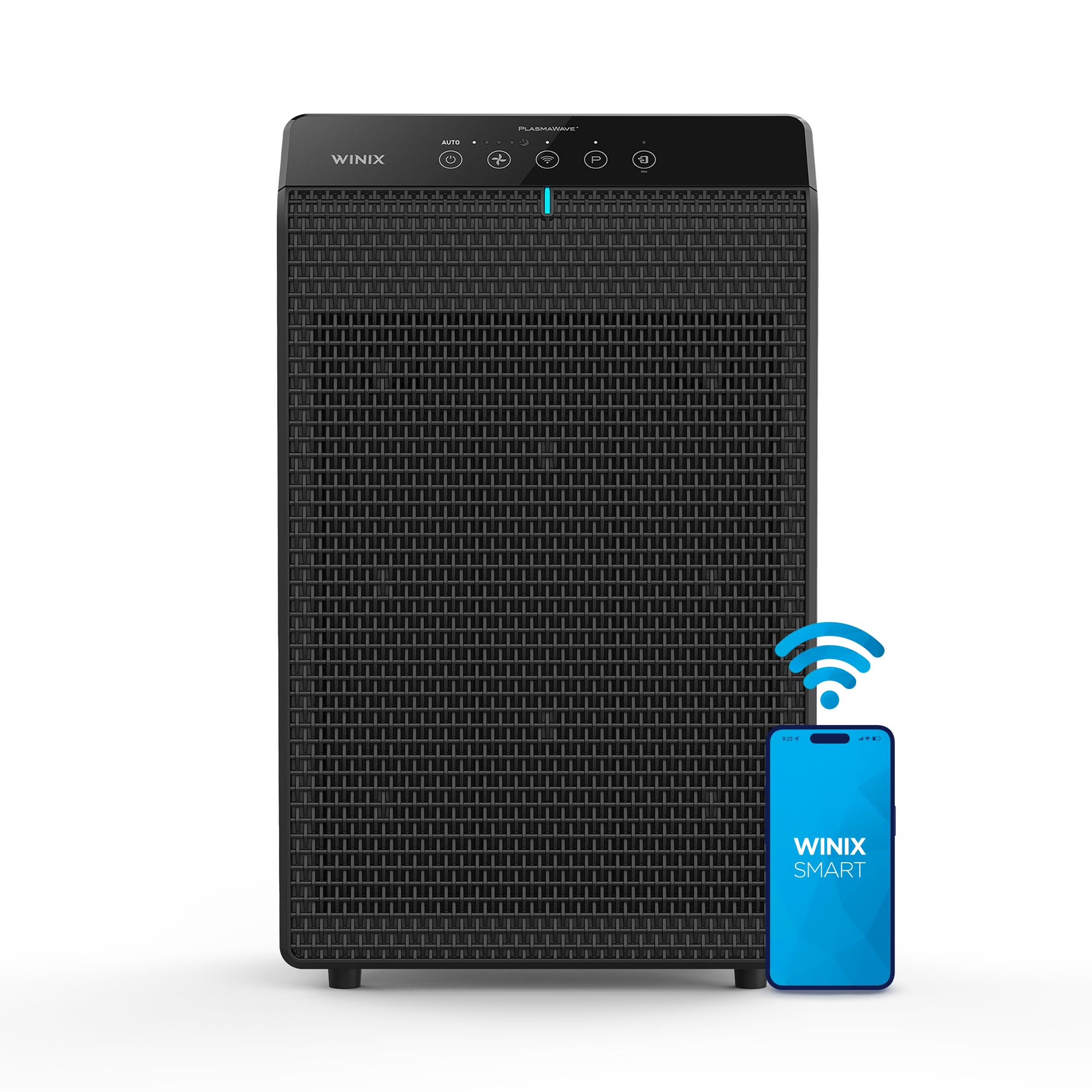
The Winix 5520 enters the conversation when room size and filtration speed become the primary concern. Its AHAM-Verified CADR for pollen is among the highest in its price bracket — 392 CFM at the 392-square-foot test standard — meaning it can cycle a living room or open-concept kitchen-dining area four times per hour without breaking a sweat. The four-stage system includes a washable fine mesh pre-filter, an AOC carbon filter for odor reduction, a True HEPA media certified to 99.99% at 0.01 microns, and a Plasmawave ionizer that can be toggled off if ozone concerns are present.
Owner feedback highlights the auto mode’s responsiveness: the built-in particulate sensor reads real-time air quality and ramps fan speed accordingly, and the light-automated sleep mode drops the unit to 23.5 dB when the room goes dark. The Winix Smart App adds remote scheduling and monitoring, which pairs well with the 12-month filter replacement interval — longer than most competitors in this segment. The magnetic front panel removes tool-free for filter access, a small detail that matters when swapping media every year.
The most common complaint in longer-term reviews concerns airflow at higher fan settings. Several owners note that above 75% speed, the noise is noticeable enough to compete with TV dialogue, and the physical output feels slightly less forceful than older Winix models. The Plasmawave feature, while safe per CARB certification, is best disabled if you have respiratory sensitivity to ionizers. For pollen control in a 400- to 600-square-foot space, this unit delivers the highest clean-air volume per dollar.
Why we love it
- AHAM-Verified 392 CFM CADR covers large rooms at therapeutic air change rates
- Washable pre-filter and 12-month HEPA lifespan lower total ownership cost significantly
- Light-automated sleep mode and Smart App integration suit remote monitoring
Good to know
- Fan noise is noticeable above medium speed; heavy sleepers may prefer lower settings
- Plasmawave ionizer emits trace ozone — toggle off if you have asthma or chemical sensitivity
3. Nuwave OxyPure

When the space in question is a high-ceiling living room, a finished basement, or an open-concept great room, standard bedroom purifiers run out of CADR before they make a dent. The Nuwave OxyPure addresses this with a claimed CADR of 664.6 m³/h — translating to coverage of 2,934 square feet at one air change per hour and 586 square feet at the four-ACH rate suitable for pollen suppression. The five-stage filtration stack includes a stainless-steel pre-filter (washable, never-rust), a reusable ozone emission removal filter, a Bio-Guard filter for microbial reduction, and four included HEPA/carbon filter cartridges that ship with the unit.
Owner reports consistently mention the OxyPure’s responsiveness to ambient odors. Users describe the auto mode picking up cooking smells and cigar smoke from ten feet away and ramping fan speed without manual intervention. The sleep mode is genuinely quiet — multiple reviews call it near-silent — and the WiFi connectivity through the Nuwave Connect app allows remote status checks and scheduling. The 26-pound weight and 14.25-inch footprint make it a stationary fixture rather than a portable device, so place it centrally in the largest zone you need to manage.
The main drawback is the upfront investment, which sits north of the mid-range threshold, and the fact that the HEPA/carbon cartridges require replacement every 3 to 6 months depending on pollen load. While the stainless-steel pre-filter and Ozone filter are washable and reusable, the consumable cost adds up over a full allergy season. A handful of owners report occasional WiFi pairing issues, though these seem isolated to specific router bands. If your pollen problem spans multiple rooms under one roof plane, this is the single-unit solution.
Why we love it
- Covers up to 2,934 sq ft at one ACH — the broadest published reach in this roundup
- Stainless-steel pre-filter and reusable ozone filter reduce long-term consumable waste
- Five-layer protection including Bio-Guard and Ozone removal for comprehensive air treatment
Good to know
- HEPA/carbon cartridges need replacement every 3-6 months during heavy pollen season
- WiFi pairing can be finicky with 5 GHz networks; stable on 2.4 GHz bands
4. GoveeLife H7124
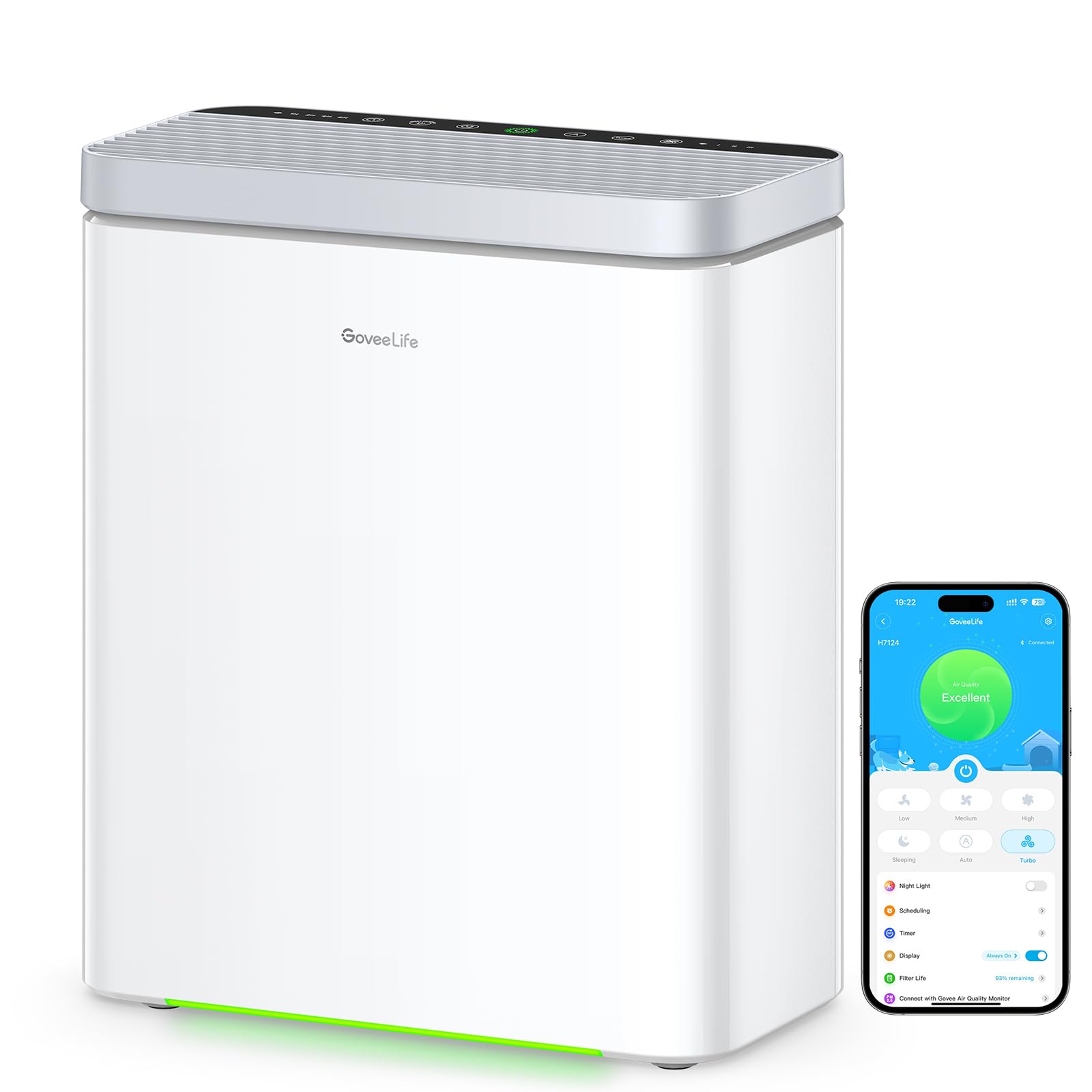
The GoveeLife H7124 brings app-enabled particulate monitoring to the mid-range category, offering a built-in PM2.5 sensor that communicates real-time air quality through color-coded lights and the companion app. The CADR of 135 CFM is modest — it covers 523 square feet at two air changes per hour — but the sensor feedback loop is fast enough to detect cooking aerosols or pollen spikes within minutes and adjust fan speed automatically. The 3-in-1 filter uses an H13 HEPA media certified at 99.97% efficiency for 0.3-micron particles, backed by a washable pre-filter that Govee claims can extend the main filter life up to five years with regular maintenance.
Owner reviews are overwhelmingly positive about the auto mode’s responsiveness. Several reviewers tested the unit by spraying aerosol or cooking peppers nearby and watched the indicator shift from green to red within seconds, then return to green after approximately 15 minutes of purification. The RGB mood lighting is app-customizable with over a million color combinations, which adds a decorative element but is not essential for pollen control. The sleep mode operates at a claimed 24 dB, and verified owners describe it as genuinely unobtrusive overnight.
The primary limitation is CADR capacity. At 135 CFM, the unit is best suited for bedrooms, home offices, or small living areas rather than open-concept spaces. A handful of owners mention that the app occasionally disconnects from the unit, requiring a manual power cycle to re-establish WiFi communication. The filter replacement indicator is app-based, so users who prefer a physical reminder should note the date manually. For a budget-conscious buyer who wants smart features and a visible PM2.5 readout, this is a compelling mid-range contender.
Why we love it
- Built-in PM2.5 sensor with real-time color feedback removes guesswork from air quality monitoring
- Washable pre-filter design dramatically extends HEPA media lifespan if maintained monthly
- Smart app integration with Alexa/IFTTT allows remote control and scheduling
Good to know
- 135 CFM CADR limits effective coverage to rooms under 250 sq ft at therapeutic ACH rates
- WiFi stability reported as inconsistent; best hardwired to a 2.4 GHz band for reliability
5. GermGuardian AC4825E

The GermGuardian AC4825E is a long-established model in the air purification space, and its persistence on the market is driven by a combination of True HEPA filtration, an optional UV-C light for microbial reduction, and a 22-inch tower form factor that fits into tight floor gaps. The HEPA media captures 99.97% of particles at 0.3 microns, including the full range of wind-pollinated tree and grass pollen. The UV-C bulb can be toggled independently to address mold spores and bacteria, though it adds negligible value for pollen removal specifically — pollen is a particulate, not a living organism.
Owner reports spanning multiple years highlight the unit’s reliability and the low ongoing cost of replacement filters. The pre-filter is washable, and the True HEPA cartridge lasts 6 to 12 months depending on run time. Several asthmatic households noted reduced rescue inhaler usage after running the unit continuously in the bedroom. The rotary dial control is refreshingly simple — three speeds plus a UV toggle — and the lowest setting produces gentle white noise that reviewers describe as sleep-friendly, while the highest setting moves air audibly across the room.
Noise at speed three is the most frequently cited trade-off. At the highest fan setting, the unit generates enough airflow sound to compete with conversation, making it less suitable for daytime use in a living room where TV audio matters. The blue UV light is bright at night and cannot be dimmed independently of the display. For a straightforward, no-app-required pollen filter in a bedroom up to 200 square feet, this remains a well-documented value choice with a proven track record.
Why we love it
- True HEPA with 99.97% efficiency at 0.3 microns — independently effective for pollen capture
- Washable pre-filter and long filter intervals keep annual consumable costs low
- Rotary dial and UV toggle offer simple, app-free operation for non-tech users
Good to know
- Top fan speed is loud; best used on low or medium for quiet environments
- UV-C light stays bright blue — no independent dimmer for light-sensitive sleepers
6. ECOSELF HAP-602
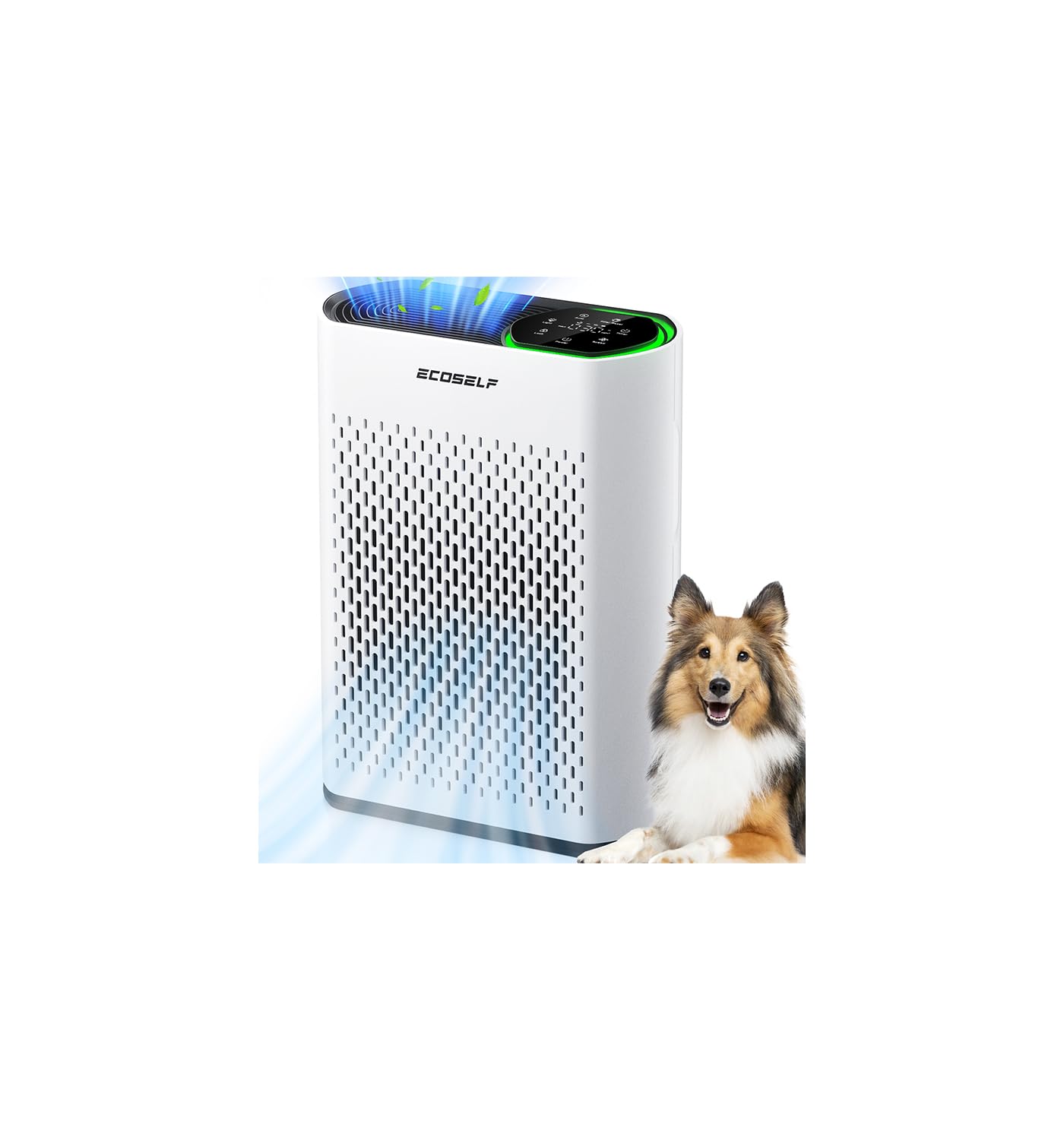
The ECOSELF HAP-602 is laser-focused on the intersection of large-room coverage and acoustic discretion. The manufacturer claims a 20 dB sleep mode — quieter than a library — and a room coverage spec of 2,400 square feet in 30 minutes, which translates to roughly two air changes per hour at that volume. The built-in PM2.5 sensor drives an auto mode that shifts fan speed in response to detected particle load, with a color-coded display that moves from green through blue, yellow, and red as air quality deteriorates. The three-stage filtration uses a pre-filter, a True HEPA media, and an activated carbon layer for odor adsorption.
Verified owner feedback emphasizes odor removal as a standout feature, with multiple reviews reporting elimination of pet urine smells and cooking odors within minutes of activating Turbo mode. The intuitive control panel includes three manual fan speeds, auto mode, a child lock, and a display-off function. The unit’s footprint is compact relative to its coverage claims — the dimensions are not explicitly listed in reviews, but owners describe it as non-bulky and easy to position in a corner without dominating the room.
The primary concern in this price tier is the replacement filter schedule. The manufacturer recommends replacing the filter every 3 to 6 months, and the filter is not washable — it must be replaced entirely. Owners who run the unit 24/7 during pollen season should budget for two to four filter swaps per year. A few reviews note that the audible fan noise on the highest speed is substantial, though the sleep mode compensates by dropping to the near-silent 20 dB level. For allergy sufferers who need broad coverage in a quiet bedroom or home office, this premium unit delivers on both counts.
Why we love it
- 20 dB sleep mode is among the quietest available — ideal for light sleepers during pollen season
- Built-in PM2.5 sensor with color-coded display gives real-time feedback without a smartphone
- Auto mode responds rapidly to cooking smoke and pet odors, maintaining consistent air quality
Good to know
- Filter is non-washable and needs replacement every 3-6 months, adding to ongoing costs
- Fan noise on the highest speed is noticeable; best reserved for daytime rapid cycling
7. LEVOIT Core 200S-P

The LEVOIT Core 200S-P is the smallest and most affordable unit in this roundup, and its design philosophy prioritizes footprint and silence over raw CADR. The 360-degree air intake feeds a 3-in-1 filter that includes a nylon pre-filter, an activated carbon layer, and a main HEPA media that removes 99.97% of particles in the 0.3-micron range. For a 140-square-foot room — a small bedroom, dorm, or nursery — it delivers 4.8 air changes per hour, which is adequate for pollen control at the compact scale.
Owner reviews consistently praise the unit’s quiet operation and compact dimensions. At 27 dB on the lowest setting, it is essentially inaudible from three feet away, and the display-off button eliminates LED light pollution. Several verified buyers noted a measurable reduction in dust accumulation and stale air within days of use, and the smart compatibility with Alexa and Google Assistant adds hands-free convenience. The 6.6-pound weight and 8-inch diameter make it easy to move between rooms as needed throughout the day.
The limitation is clearly room size. At a 4.8 ACH rate, the Core 200S-P is optimized for very small spaces. Placing it in a 300-square-foot living room drops the air change rate below 2 per hour, which is insufficient for pollen suppression during peak season. The filter replacement interval is roughly 6 to 8 months, and the small media surface area means it loads faster than larger units in dusty environments. For a bedside table or a child’s nursery that stays under 150 square feet, this is a well-executed, affordable entry point into HEPA-level pollen filtration.
Why we love it
- Compact 8-inch footprint fits on a nightstand or desk without sacrificing floor space
- 27 dB low-speed operation is virtually silent — suitable for nurseries and light sleepers
- Smart voice control via Alexa/Google adds hands-free convenience for daily operation
Good to know
- Effective coverage is limited to roughly 140 sq ft at therapeutic air change rates
- Small filter surface area requires more frequent replacement in high-pollen environments
FAQ
Can an air purifier completely eliminate pollen from my home?
Should I run the air purifier 24 hours a day during pollen season?
Do I need an air purifier if I already have central HVAC with a MERV 13 filter?
Does UV-C light help with pollen removal?
How do I calculate the right room size for my air purifier?
Final Thoughts: The Verdict
For most gardeners and allergy sufferers, the air purifier for pollen winner is the LEVOIT Core 300-P because it delivers an AHAM-Verified CADR of 167 CFM for pollen in a compact, bedroom-friendly package at a mid-range price point that keeps replacement filter costs manageable. If you need smart monitoring and a visible PM2.5 readout in a medium-sized room, grab the GoveeLife H7124. And for an extra-large open-concept space where single-unit coverage matters, nothing beats the Nuwave OxyPure with its 2,934-square-foot reach and washable pre-filter design.