
Travertine’s porous surface and soft calcite composition demand a mop that delivers moisture without leaving standing water, grime without abrasive scrubbing, and pH-neutral residue without etching or dulling the stone’s natural veining. A standard string mop or an aggressive scrub pad can strip the sealer, while leftover alkaline soap creates a white, powdery haze that permanently clouds the finish. The right tool must wring out nearly dry, glide without dragging, and trap fine sediment that would otherwise scratch the honed surface.
I’m Mo Mahin — the founder and writer behind Furric. Over the past decade I have analyzed hundreds of floor-care products side by side, studying the chemical compatibilities of cleaning solutions with natural stone and cross-referencing thousands of verified owner accounts to isolate which mop designs truly preserve travertine’s delicate finish without costing a fortune in replacement pads or proprietary refills.
This guide breaks down the seven most reliable tools I have found, sorted by their performance against the specific demands of natural stone maintenance. Whether you need a deep-cleaning spin system or a lightweight dust picker, the best mop for travertine floors matches the stone’s need for controlled moisture, soft microfiber contact, and absolute chemical neutrality.
How To Choose The Best Mop For Travertine Floors
Travertine is a sedimentary limestone with natural pits, fissures, and a Mohs hardness of only 3 to 4. A mop that works brilliantly on ceramic tile or sealed hardwood can damage travertine within weeks. Three characteristics separate a safe mop from a risky one: the pad’s material density, the wringing mechanism’s efficiency, and the handle’s ability to apply even pressure without scraping.
Microfiber Density and Pad Construction
Cheap, loosely woven microfiber pads release grit rather than trapping it, turning a mopping session into a microscopic sanding event. For travertine, you need a pad with at least 300 GSM (grams per square meter) and a dual-layer construction — a plush inner layer for water absorption and a tight outer layer for particle capture. The pad must also rinse clean easily; trapped calcite dust that dries inside the fibers becomes abrasive on the next pass. Machine-washable pads that survive 50+ cycles without fraying are the baseline for maintaining the stone’s honed surface over years of use.
Wringing Efficiency and Moisture Control
Standing water is the primary enemy of travertine. The stone’s pores absorb moisture, which can lift the sealer, promote efflorescence (white salt crystals), and encourage mold growth in the substrate. A mop that leaves the floor damp for more than 60 seconds is too wet. Spin mops with a centrifugal wringer that extracts 90% or more of the water are ideal — they deliver a nearly dry pad that picks up dirt without saturating the stone. Flat mops with a bucket system that uses a scraping blade to squeeze the pad are a close second, provided the blade is clean and the user wrings firmly before every pass.
Handle Stability and Head Maneuverability
Travertine floors often have uneven surfaces — tumbled tiles with lippage, chiseled edges, or filled pits that create micro-valleys. A mop head that locks rigidly forces the user to rock the handle to reach low spots, which drags the pad’s edge against the stone and creates localized abrasion. A 360-degree swivel head allows the pad to conform to the floor’s natural contours. The handle must be telescoping (48 to 60 inches) so the user can apply light, consistent pressure from a standing position without leaning, which would concentrate force through the mop head and scratch the tile. Stainless steel or reinforced aluminum handles resist corrosion from repeated damp use and avoid the squeaking that plastic joints develop over time.
Quick Comparison
On smaller screens, swipe sideways to see the full table.
| Model | Category | Best For | Key Spec | Amazon |
|---|---|---|---|---|
| O-Cedar EasyWring Spin Mop | Spin System | Moisture-sensitive stone | Centrifugal wringer, 48-inch handle, 360° triangle head | Amazon |
| MR.SIGA Professional Microfiber Mop | Flat Mop | Large-area maintenance | 15×5-inch pad, 300+ GSM dual-side microfiber | Amazon |
| JOYMOOP Flat Mop and Bucket System | Flat + Bucket | All-in-one convenience | 13×4.9-inch pad, scraping blade wringer, 50-inch handle | Amazon |
| 24″ Commercial Dust Mop | Dust Mop | Daily dust pick-up | 24-inch cotton pad, 59-inch telescopic metal handle | Amazon |
| Swiffer PowerMop | Spray Mop | Quick touch-ups | Electric spray, 2x larger pad than WetJet, swivel head | Amazon |
| FlexiClamp Sweep & Mop Kit | Clamp Mop | Budget-conscious versatility | One-button clamp, 51-inch adjustable pole, any cloth | Amazon |
| Bona Pro Series Luxury Vinyl Floor Mop | Spray Mop | Small-area precision | Refillable cartridge, wide head, pH-neutral formula | Amazon |
In‑Depth Reviews
1. O-Cedar EasyWring Microfiber Spin Mop

The O-Cedar EasyWring is the closest thing to a travertine-specific mop that a mass-market brand offers, and its centrifugal wringer is the reason. By spinning the mop head inside a sealed basket, this system extracts roughly 95% of the water before the pad touches the floor — a critical factor for travertine’s porous surface. The triangle-shaped head reaches into tile corners and along baseboards where dust settles, and the 360-degree swivel keeps the pad flat against uneven tumbled edges without requiring the user to tilt the handle and gouge the stone.
The microfiber strands (millions of them per pad) trap fine calcite dust that a standard cotton mop would simply push around. Owners report that floors dry within three to five minutes, leaving no streaks or white residue — exactly what a neutral sealer needs to remain intact. The pad is machine-washable and, with proper care, lasts through 60 to 70 cleaning cycles before the fibers begin to fray. When combined with a pH-neutral stone cleaner (never vinegar or bleach), this system maintains the honed finish without chemical degradation.
The handle extends fully to 48 inches, which lets a standing user apply even, light pressure across the full pad surface. The bucket’s splash guard minimizes mess during transport, and the spin mechanism requires no electricity or batteries — just a firm pump of the foot pedal. The only real consideration is that the triangular head covers less surface area per pass than a wide rectangular mop, so cleaning a large great room may take two extra minutes. For the safety of your travertine, that trade-off is trivial.
Why we love it
- Centrifugal wringer delivers near-dry pad — ideal for moisture-sensitive stone.
- Triangle head reaches into tile fissures and corners without scraping.
- Machine-washable microfiber pad lasts through dozens of cycles with no lint shedding.
Good to know
- Triangle shape covers less ground per pass than a rectangular flat mop.
- Foot pedal pump requires moderate effort — not ideal for users with limited mobility.
2. MR.SIGA Professional Microfiber Mop

The MR.SIGA Professional covers 75 square inches of floor per swipe — roughly twice the surface area of the O-Cedar triangle head. For owners of travertine-floored great rooms, open kitchens, or commercial reception areas, this mop slashes cleaning time without sacrificing the soft contact required by natural stone. The 15-by-5-inch pad uses a dual-layer microfiber construction: the blue side traps wet debris and fine dust, while the beige plush side distributes wax or sealant evenly across the stone. Both sides exceed 300 GSM, ensuring grit is captured within the fibers rather than dragged across the honed surface.
The handle employs a double-lock telescoping system of stainless steel that extends to 59 inches, allowing users to maintain an upright posture and apply consistent pressure. The 360-degree swivel head flexes to follow travertine’s natural height variations — tumbled edges, filled pits, and chiseled rims — without the pad lifting or the handle scraping. Owners report that the pad clings to pet hair and fine calcite dust like Velcro, often eliminating the need for a separate sweep before mopping. The included dirt removal scrubber (a plastic comb) strips debris from the pad without requiring the user to touch the grime.
Three reusable pads ship with the mop, and each pad withstands 50-plus machine washes before the loop pile begins to degrade. The pad attachment mechanism uses a clip-on design that feels secure during aggressive scrubbing, though a small number of users note that the pad can flip if the mop is dragged backward while dry. The solution is simple: always push forward. For travertine maintenance, forward-only motion is actually preferred because it prevents back-scratching of the stone’s surface.
Why we love it
- Large 15×5-inch pad cleans open travertine areas in half the passes of a triangle mop.
- Dual-side microfiber handles both wet cleaning and dry dusting without cross-contamination.
- Stainless steel telescopic handle with double lock stays rigid — no sliding during use.
Good to know
- Pad can flip if dragged backward while dry — forward-only motion is recommended.
- No built-in wringing system — user must hand-wring or pair with a separate bucket.
3. JOYMOOP Flat Mop and Bucket System

The JOYMOOP system integrates the bucket and mop into a single storage unit, with two separate chambers — one for washing and one for drying — and a scraping blade that squeezes the pad as the user pulls it through. This blade wringer is gentler on the microfiber than a centrifugal spinner and allows precise control over moisture level: a single pass through the dry chamber leaves the pad damp enough to pick up dirt without saturating travertine’s pores. The 13-by-4.9-inch pad is smaller than the MR.SIGA’s, but it is perfectly sized for navigating the tight corners and narrow hallways common in travertine-tiled homes.
The handle extends from 26.5 to 50 inches, making it adaptable for both upright adult use and lower-angle scrubbing along baseboards. The 360-degree rotation head keeps the pad flat against uneven tumbled surfaces, and the scraping blade in the wash chamber actively removes hair and grit that would otherwise be redeposited onto the stone during the next dip. Owners consistently mention that the clean-water/dirty-water separation is effective — the dirty chamber collects the runoff while the clean chamber remains clear for the final rinse pass.
The bucket’s compact footprint stores all components nested inside, so it occupies a closet corner no larger than a shoebox. The included single microfiber pad is adequate for starting, but the manufacturer recommends replacement every one to two months under regular use — a faster cadence than thicker pads like the MR.SIGA’s. For travertine owners who want a self-contained system that eliminates hand-wringing and keeps dirty water isolated, this is the most thoughtfully engineered entry-level spin alternative on the market.
Why we love it
- Scraping blade wringer provides precise moisture control — critical for travertine’s porous surface.
- Self-contained bucket stores all components; no separate wringer or spin basket needed.
- Clean-water/dirty-water separation prevents redepositing grit onto the stone.
Good to know
- Only one microfiber pad included; replacements recommended every 1-2 months.
- Smaller pad surface requires more passes for large open areas.
4. 24″ Commercial Dust Mop for Floor Cleaning
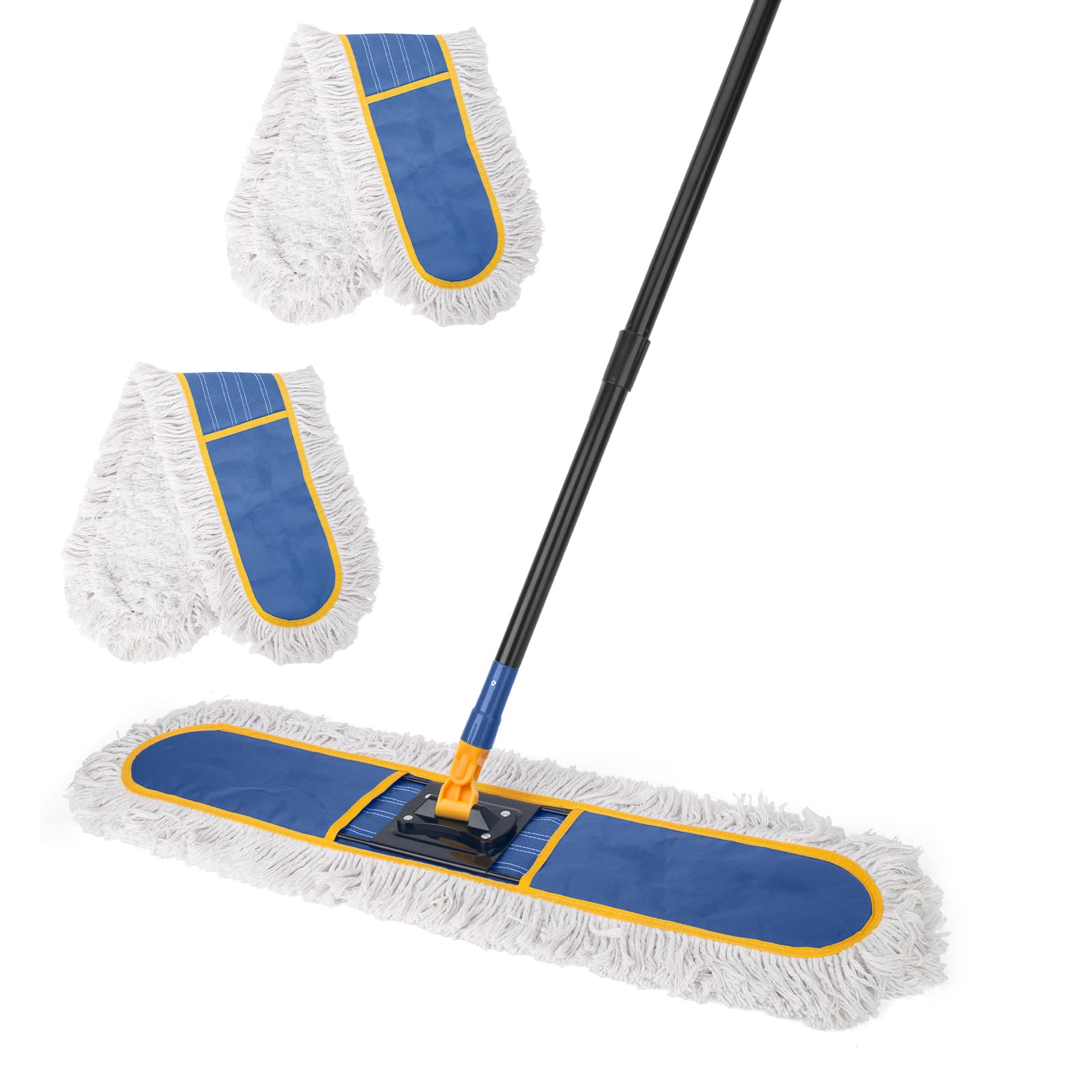
Travertine floors generate a surprising amount of fine calcite dust between deep cleanings — loose particles that scratch the surface if walked on or swept with a bristle broom that flicks grit across the stone. This 24-inch commercial dust mop is designed for daily dry maintenance, using thick cotton pads (machine-washable and reusable) that glide across the floor without abrading the honed finish. The 59-inch telescopic handle keeps the user upright, and the 360-degree swivel head slides under furniture and around the uneven edges of tumbled travertine without catching or scraping.
The 24-inch head covers ground at nearly twice the speed of a standard 12-inch dust mop, making it the most efficient tool for routine dust pickup in spaces with expansive travertine flooring. Owners note that the cotton pad attracts and holds fine sediment — even the microscopic dust that settles in the stone’s pits and fissures — and releases it easily during machine washing. The metal pole is constructed in two screw-together sections, which is functional for disassembly but introduces a potential weak point if over-torqued; a single-piece handle would be sturdier for heavy commercial use, but for home maintenance the joint holds well.
When used dry, this mop eliminates the need for daily wet mopping, which is the fastest way to wear down travertine’s sealer. For weekly wet cleaning, the cotton pads can be dampened and used with a pH-neutral solution — just be sure to wring thoroughly until the pad is barely moist. The pads hold up to repeated laundering without shedding lint, and the metal construction resists rust even in humid climates. For travertine owners who want to extend the time between deep wet cleans, this dust mop is an essential first line of defense.
Why we love it
- 24-inch head covers large travertine areas in minimal passes — ideal for daily dusting.
- Thick cotton pads trap fine calcite dust without scratching the honed surface.
- 59-inch handle keeps user upright, reducing back strain during extended cleaning.
Good to know
- Two-piece handle can loosen at the joint if not tightened firmly.
- Cotton pads require thorough drying to prevent mildew between uses.
5. Swiffer PowerMop Mopping Kit
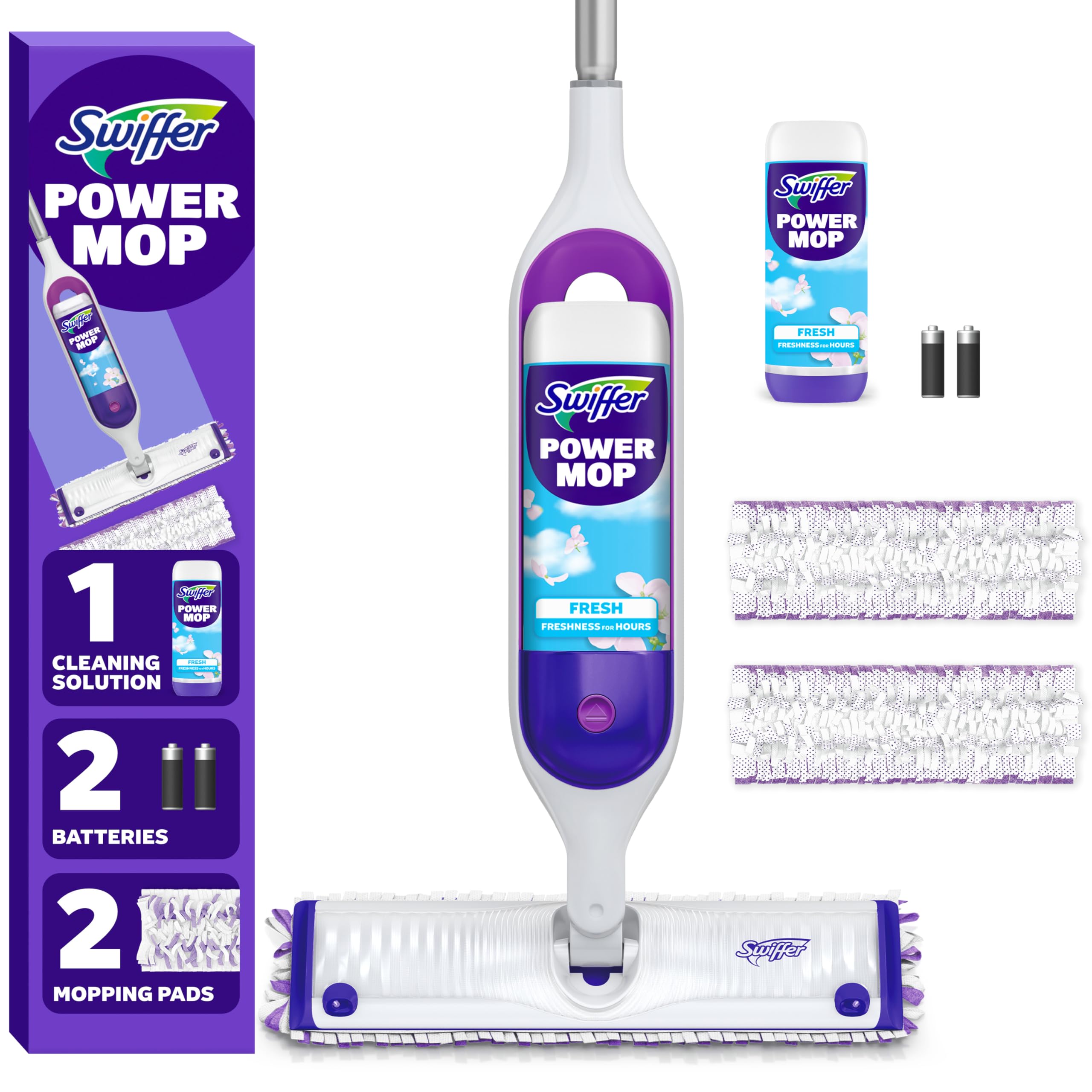
The Swiffer PowerMop is the first spray mop in this guide, and its inclusion comes with a critical caveat for travertine owners: the pre-mixed cleaning solution is not explicitly labeled as pH-neutral for natural stone. While many owners of sealed travertine report no issues when using the PowerMop for quick touch-ups, the solution’s formulation is optimized for general finished floors, not specifically for calcite-based stone. The safest approach is to refill the cartridge with a dedicated pH-neutral stone cleaner (available from brands like StoneTech or Method) and use the mop exclusively for its mechanical advantages.
Those mechanical advantages are real: the mop head is twice the size of the older Swiffer WetJet, the pad uses hundreds of scrubbing strips to lift sticky residue, and the large swivel head locks flat for baseboard cleaning. The electric spray trigger (powered by two AA batteries) lets the user spot-apply solution to isolated messes without saturating the entire floor — a major benefit for travertine, where excess moisture is the primary risk. Owners report that the pads absorb and lock in dirt effectively, and that floors dry streak-free within minutes when used with a light spray.
The long-term cost is the main drawback. Replacement pads cost roughly for a four-pack, and each pad lasts only two to four uses before it begins to fray or lose absorbency. For a 1,000-square-foot travertine floor cleaned weekly, that adds up to roughly per year in consumables. For owners who mop infrequently or have a small tiled entryway, the convenience may justify the expense. For those with large expanses of travertine, a reusable pad system like the MR.SIGA or O-Cedar is far more economical.
Why we love it
- Electric spray trigger allows spot-application — minimizes oversaturation of travertine.
- Large swivel head reaches under furniture and locks for baseboard cleaning.
- Pad scrubbing strips lift sticky residue without aggressive manual scrubbing.
Good to know
- Stock solution is not explicitly pH-neutral for stone — refill with a dedicated cleaner.
- Disposable pads cost roughly per 4-pack and degrade after 2-4 uses.
6. FlexiClamp Sweep & Mop Kit
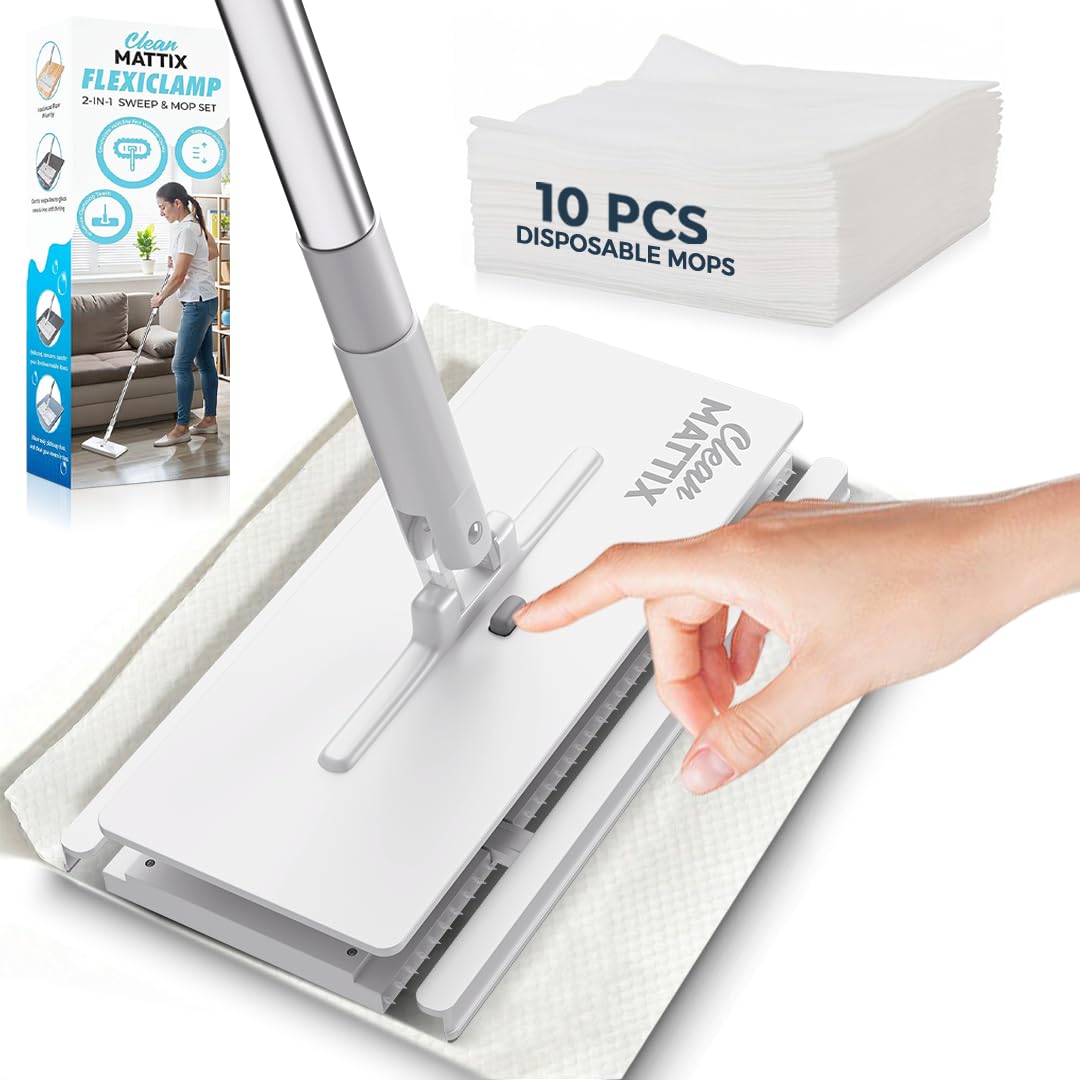
The FlexiClamp reimagines the flat mop by replacing the adhesive or pocket-based pad attachment with a one-button clamping mechanism that grips any cloth — microfiber, cotton, old towel — between slip-proof teeth. For travertine owners, this means total control over the pad material: you can use a high-GSM microfiber cloth that you already trust, or a lint-free cotton rag for ultra-dry dusting. The clamp holds the cloth tight during aggressive scrubbing without bunching or sliding, preventing the abrasive fabric folds that can scratch soft stone.
The 51-inch adjustable aluminum pole is reinforced and resists flexing, allowing the user to apply even pressure across the full mop head. The 360-degree swivel head maintains flush contact with uneven travertine surfaces, and the one-button ejection system lets the user swap from a damp cleaning pad to a dry polish pad without touching the soiled fabric — a practical feature for homes with pets or young children where the mop transitions between rooms with different debris types. The included 10 dry cloths are adequate for starting, but the real value is the ability to use any household cloth, eliminating the recurring cost of proprietary pads.
Owners consistently note that the FlexiClamp feels sturdier than a standard Swiffer — the aluminum handle doesn’t flex or squeak, and the clamp mechanism shows no loosening after thousands of cycles. The head’s built-in tweezers lift the dirty cloth without hand contact, which is a minor but appreciated hygiene detail. The only limitation for travertine is that the mop has no built-in wringing system, so the user must manually dampen the cloth to the desired moisture level before clamping — a step that requires deliberate attention to avoid oversaturation.
Why we love it
- One-button clamp accepts any cloth — no proprietary pads, lower long-term cost.
- Reinforced aluminum handle stays rigid during scrubbing, no flex or squeak.
- Built-in tweezers lift dirty cloths without hand contact — hygienic for pet homes.
Good to know
- No built-in wringing mechanism — user must manually control cloth moisture.
- Smaller cloth surface requires more passes for large travertine areas.
7. Bona Pro Series Luxury Vinyl Floor Mop
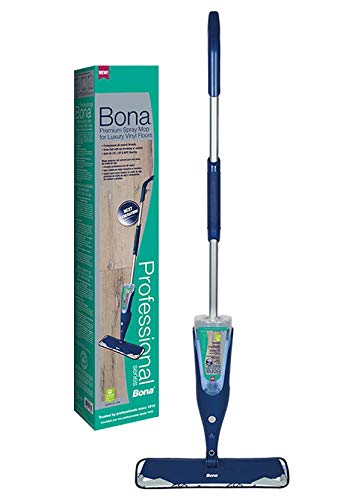
The Bona Pro Series is engineered for luxury vinyl plank, but its design principles — pH-neutral cleaning, fast-drying microfiber, and controlled spray application — translate directly to travertine maintenance. The wide rectangular head covers a generous surface area per swipe, and the refillable cartridge accepts any pH-neutral stone cleaner, allowing the user to tailor the solution to the stone’s specific needs. The spray trigger delivers a fine mist that saturates the pad without pooling on the floor, keeping moisture away from travertine’s porous seams and fissures.
The microfiber pad is dense enough to trap fine dust and pet hair on the first pass, and it dries quickly after machine washing, reducing the risk of mildew that can transfer to the stone. The handle assembly is simple and the mop head swivels fully, though the plastic components of the cartridge release mechanism have been reported as a weak point under frequent use — several owners report that the cartridge clip snaps after six to twelve months of weekly cleaning. Bona’s customer service is responsive about replacements, but the fragility suggests this mop is best suited for periodic touch-ups rather than daily commercial-level use.
For owners of small travertine areas — a bathroom floor, a mudroom, a kitchen backsplash — the Bona Pro Series offers the most precise moisture control of any spray mop in this guide. The trade-off is the cartridge cost and the plastic durability. If you plan to use this mop weekly for a full 1,500-square-foot travertine great room, the cartridge will need frequent refilling and the clip may eventually fail. For spot-cleaning and small spaces, it is a nearly ideal tool that delivers stone-safe cleaning with zero guesswork.
Why we love it
- Refillable cartridge accepts any pH-neutral stone cleaner — total solution control.
- Fine-mist spray applies moisture only to the pad, not the floor surface.
- Wide microfiber head covers area efficiently with streak-free drying.
Good to know
- Plastic cartridge clip can snap under frequent use — best for periodic touch-ups.
- Pad replacements are proprietary and cost more than generic microfiber cloths.
FAQ
Can I use a steam mop on travertine floors?
How often should I replace the mop pad for travertine?
Can I use a Swiffer WetJet or PowerMop on travertine?
Why does my travertine look dull after mopping?
Final Thoughts: The Verdict
For most gardeners, the best mop for travertine floors winner is the O-Cedar EasyWring Spin Mop because its centrifugal wringer delivers the near-dry pad that porous travertine demands, and its triangle head navigates tumbled edges without scraping. If you want to cover large open areas quickly, grab the MR.SIGA Professional Microfiber Mop with its 15-by-5-inch pad and dual-side microfiber. And for a self-contained system that isolates dirty water and stores everything in a compact bucket, nothing beats the JOYMOOP Flat Mop and Bucket System.