
A rat’s incisors grow continuously, and without the right material to grind them down, dental overgrowth leads to pain, infection, and serious health issues. Choosing chew toys for your pet rats isn’t about simple entertainment—it is a core component of their physical well-being and behavioral enrichment.
I’m Mo Mahin — the founder and writer behind Furric. I analyze product specifications, synthetic and natural material compositions, and thousands of verified owner experiences in the small pet accessory category to identify what truly delivers durable, safe, and effective dental care for rats.
After cross-referencing material hardness, texture variety, and safety profiles, this guide presents best chew toys for rats that combine dental maintenance, mental stimulation, and lasting engagement for your mischief.
How To Choose The Best Chew Toys For Rats
Rats are intelligent, curious, and powerful chewers. Selecting the right toy requires matching material density to your rat’s chewing style, providing enough texture diversity to keep them engaged, and verifying safety standards. Here are the three decisive factors to evaluate.
Material Hardness and Tooth Wear
Rats need materials hard enough to file down their incisors but not so dense that they cause tooth fracture or jaw fatigue. Apple wood offers a firm yet splinter-safe chew surface that wears teeth gradually. Lava rock blocks provide a rougher, mineral-rich abrasive that grinds down teeth quickly. Soft materials like grass balls and seagrass offer light chewing exercise and are better suited for entertainment than primary dental care. A well-stocked cage includes at least one hard-wood chew and one medium-density abrasive option.
Texture and Shape Variety for Enrichment
Rats learn and explore through texture and manipulation. A flat wooden block may be ignored after one session, while a hanging ladder, a rolling bell toy, or a woven ball triggers curiosity and play. Combining dangling toys, chewable bridges, and loose balls encourages foraging behavior, climbing, and problem-solving. A mix of at least three different toy shapes prevents habituation and keeps your rats mentally stimulated.
Safety and Chemical-Free Construction
Chew toys must be free from glues, artificial colors, chemical preservatives, and toxic wood species. Apple wood, bamboo, and willow are safe; cedar, pine (with aromatic oils), and pressure-treated lumber are toxic to rats. Lava blocks should be natural pumice with no synthetic binders. Grass toys must be timothy hay or similar grass without added flavors. Always inspect for loose wires, sharp staples, or metal components inside woven toys that could cause internal injury if ingested.
Quick Comparison
On smaller screens, swipe sideways to see the full table.
| Model | Category | Best For | Key Spec | Amazon |
|---|---|---|---|---|
| ERKOON New 12 Pack | Variety Kit | Maximum enrichment | 12-piece mixed wood set | Amazon |
| Hamiledyi 20 Pcs Lava Blocks | Abrasive Stone | Fast tooth grinding | Natural lava rock 1.57″ cubes | Amazon |
| Sosation 24 Packs Grass Balls | Hay Chew Toy | Light play and foraging | 4 styles: grass, wicker, corn | Amazon |
| ERKOON 11 Pack | Activity Kit | Entry-level variety | 11-piece with ladder and roller | Amazon |
| Petawi 700g Apple Sticks | Bulk Wood Sticks | High-volume daily chewing | 200 pcs, up to 5″ each | Amazon |
In‑Depth Reviews
1. ERKOON New 12 Pack Hamster Chew Toys

This kit delivers the broadest range of textures in a single purchase — apple wood blocks, a grass ladder, seagrass and willow balls, a bell roller, a Timothy grass ball, an apple stick ring, aquare molar block with rope, 50g apple sticks, and 50g sweet bamboo. Every piece is natural wood or grass with no artificial colors or chemical treatment. The bell roller adds sound stimulation that rats find highly engaging, and the hanging toys encourage climbing activity inside the cage.
Rats with moderate to heavy chewing drive will work through the softer grass and seagrass pieces within a week, while the apple wood blocks and bamboo sticks provide sustained abrasion that lasts two to three weeks. The variety means you can rotate pieces daily to keep the enclosure fresh — offering a new shape each time your rats lose interest in the previous one. Several owner reports note that chinchillas and rats both consistently return to this kit over single-texture alternatives.
The only practical limitation is that the bell roller relies on a small metal bell; while the wooden cylinder protects the bell from direct chewing, rats that access the internal mechanism may create a noise that some owners find distracting. For a cage of two to four rats, this 12-piece set provides roughly a month of combined dental wear and foraging entertainment before needing a full restock.
Why we love it
- Seven distinct textures in one package — unmatched variety for enrichment
- Natural sun-dried wood with no glues or synthetic binders
- Bell roller adds auditory stimulation rats actively seek out
Good to know
- Grass and seagrass pieces are consumed quickly by heavy chewers
- Bell roller may produce noise if rats access the internal clapper
2. Hamiledyi 20 Pcs Chinchilla Lava Blocks
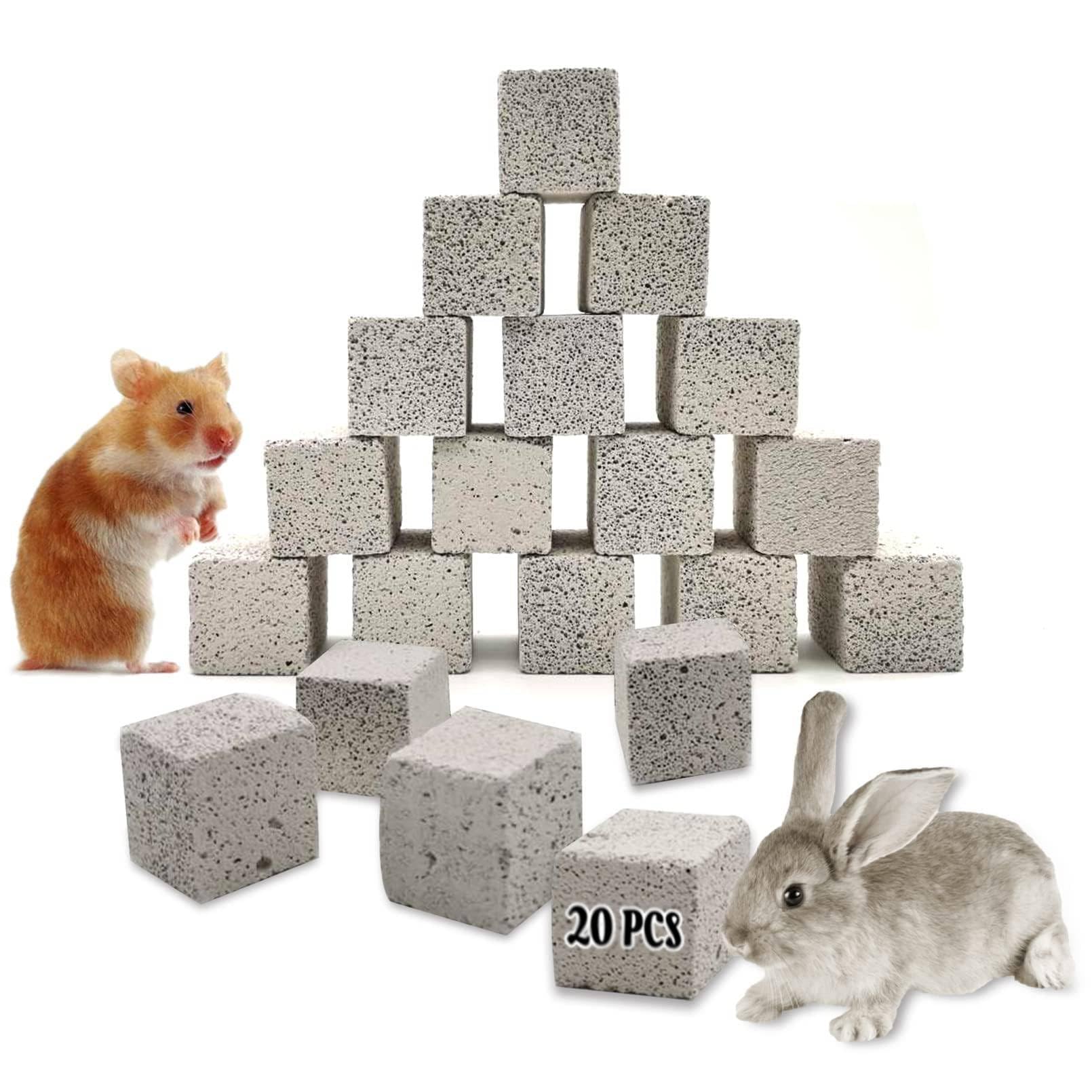
Natural lava rock offers an entirely different chewing experience compared to wood — the porous, gritty surface acts as a coarse file that rapidly wears down incisor tips. Each cube measures 1.57 inches, small enough for rats to grip with both paws and gnaw from any angle. The mineral content (volcanic pumice) also provides trace calcium and other micronutrients that rats can ingest in minimal amounts during chewing.
Where wood chews require continuous nibbling over days to achieve noticeable tooth shortening, one session on a lava cube can visibly reduce the length of overgrown incisors. This makes the blocks particularly useful for older rats whose chewing drive has diminished, or for rats recovering from dental malocclusion. Owners report that ratties will actively carry the blocks to their sleeping area and work on them during quiet periods.
The main drawback is that lava rock produces a fine gray dust as it wears. This is not harmful but does require periodic cage wipe-downs to prevent accumulation. Also, some rats ignore lava entirely in favor of wood — so this product works best as a supplementary abrasive station rather than a sole chew source. Each block lasts one to two weeks depending on the rat’s chewing frequency.
Why we love it
- Fastest tooth abrasion of any chew type — visible results after a single session
- Natural volcanic pumice with trace minerals, no synthetic additives
- Cube shape allows easy paw-gripping and multi-angle gnawing
Good to know
- Produces fine mineral dust during use — requires periodic cage cleaning
- Some rats show no interest in lava and prefer wood textures
3. Sosation 24 Packs Guinea Pigs Toys Play Balls
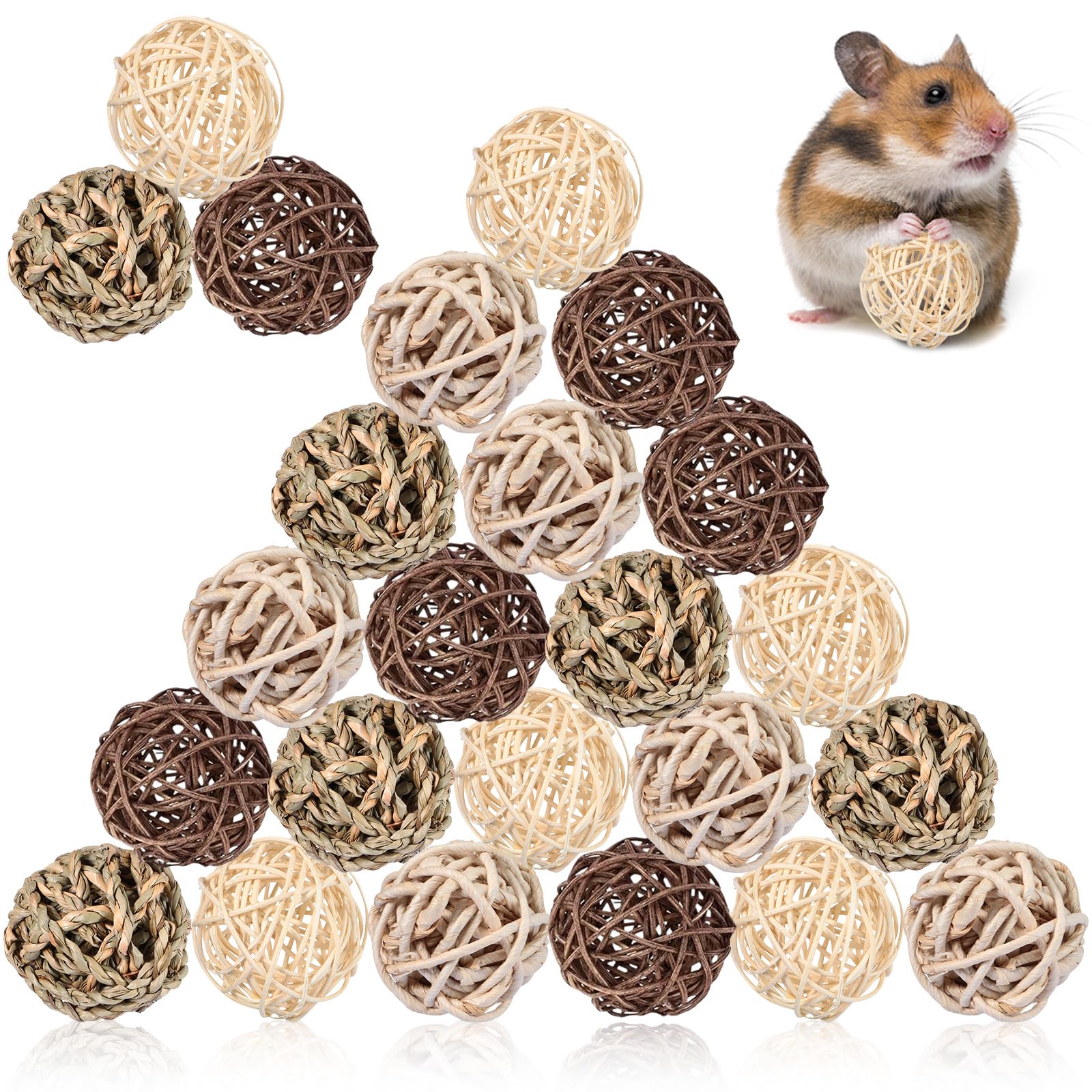
These 1.97-inch woven balls come in four styles — aquatic plant, gourd grass, wicker, and corn husk — providing a lightweight, rollable toy rats can chase, hoard, and shred. The materials are natural and safe for ingestion, meaning rats that chew off small pieces suffer no digestive harm. This product’s primary value is foraging enrichment: scatter 8 to 10 balls around the cage and let your rats hunt for them, then watch them toss, kick, and dismantle each one over the next hour.
The balls are not dense enough to serve as a primary dental wear tool — they are consumed too quickly for sustained abrasion. A pair of determined rats can destroy a wicker ball in under three minutes, as confirmed by multiple owner reviews. However, for reducing cage boredom, encouraging exercise, and satisfying the rat’s instinct to shred nest materials, these balls outperform nearly any plastic alternative.
One key consideration: the balls are significantly smaller than standard guinea-pig-sized toys (roughly half the diameter of some rabbit chews). For rats, this smaller size actually improves portability — they can drag them through tube tunnels and into hideouts. The corn husk balls have the most fibrous texture and hold up slightly longer than the grass varieties. Stored in a dry container, the unused balls maintain their freshness for months.
Why we love it
- Four distinct textures in one bulk pack — excellent scatter-foraging value
- Lightweight and portable — rats can carry them through tubes and tunnels
- 100% natural materials, safe if ingested during shredding
Good to know
- Not dense enough for significant dental wear — supplement with wood or lava
- Heavy chewers destroy one ball in under five minutes
4. ERKOON 11 Pack Chinchillas Chew Toys
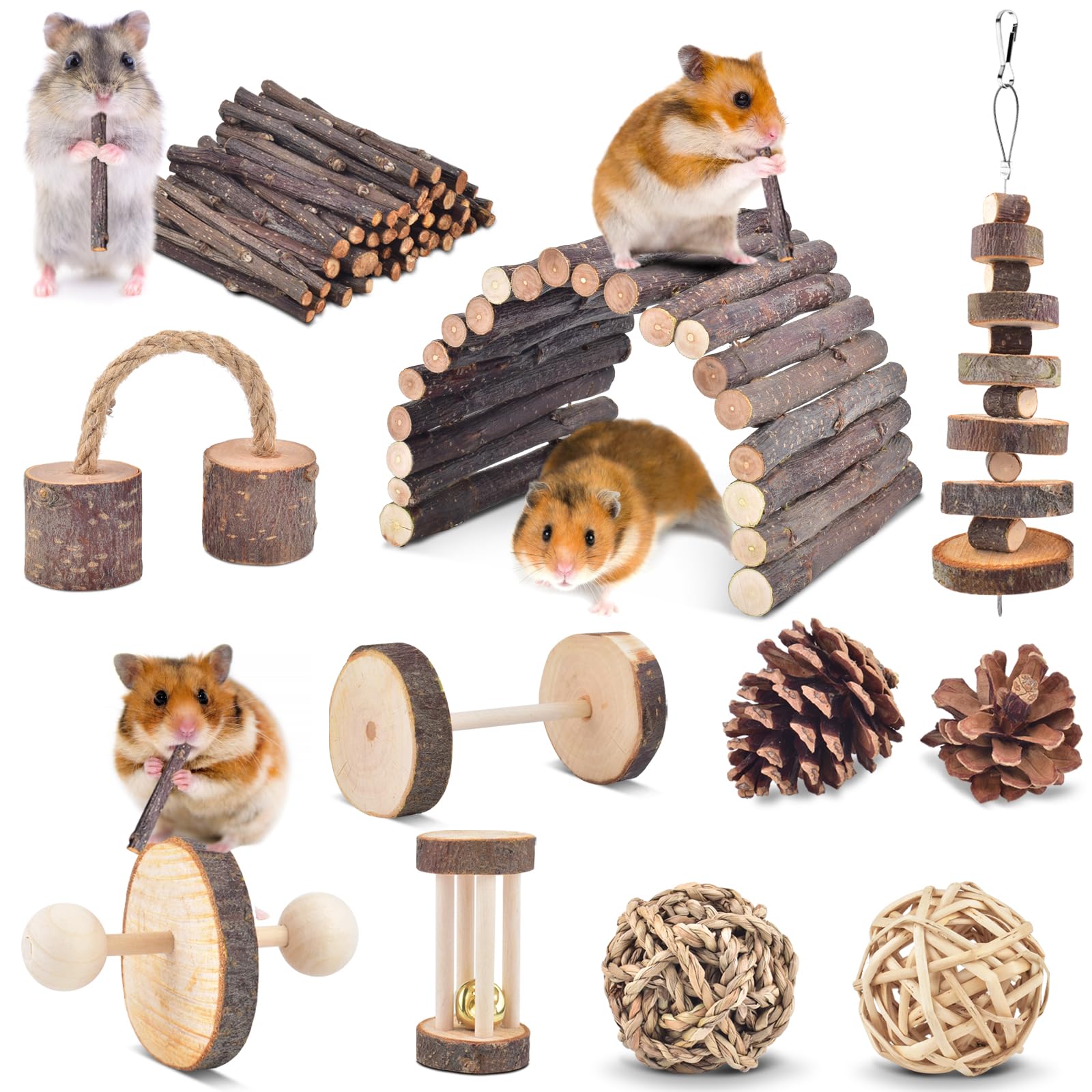
This set places a heavy emphasis on wooden structures — an apple wood ladder, a dumbbell, a square block, a unicycle, plus 50g of apple branches, two pinecones, a seagrass ball, and a willow rattan ball. The ladder and unicycle are built from solid apple wood slats held together by wire or string, providing a climbing element that doubles as a chew surface. The 50g apple branches offer thin sticks rats can strip the bark from, which acts as both dental exercise and digestive fiber.
The pinecones in this kit are natural and unbleached, offering a biting texture that is less dense than apple wood but more abrasive than grass. Owners of multiple small-animal species (rats, chinchillas, hedgehogs) report universal engagement with the wooden dumbbell and bridge-style ladder. The square molar block is particularly effective for rats that prefer a stationary chew they can grip against the cage floor.
One reported issue involves the ladder and bridge having exposed internal wires or string. If rats are determined chewers, they may reach the wire core, which poses a potential ingestion or paw-injury hazard. Inspect these pieces before introducing them to your cage, and remove the wire if necessary — the wood itself is safe and highly durable. At this price point, the 11-piece count provides strong value for owners with multiple rats.
Why we love it
- Solid apple wood structures (ladder, dumbbell, unicycle) offer long-lasting wear
- 11 pieces allow simultaneous enrichment for multiple rats
- Natural pinecones provide a rare chewing texture rats enjoy
Good to know
- Ladder and bridge contain internal wire — inspect and remove before use
- May arrive dusty from manufacturing; rinse and dry before placing in cage
5. Petawi 700g Apple Sticks Molar Wood Treats

If your goal is an abundant, long-term supply of apple wood chews without worrying about variety, this 700-gram bag delivers over 200 sticks, each up to 5 inches long. Petawi sources 100% fresh apple branches — no artificial flavors, no chemical preservatives, no synthetic colors. The sticks are dried to a controlled moisture level that prevents mold without being so brittle that they shatter into sharp shards. Sealed kraft paper packaging maintains dryness during storage.
For a pair of rats, a single stick typically lasts one to three days depending on chewing intensity. The bark is the most attractive part — rats strip it first, then gnaw the inner wood once the outer layer is gone. This dual texture (rough bark followed by smoother wood) provides a longer engagement than uniform blocks. Owners report that even picky rats that ignore novelty toys will consistently return to apple sticks, making this a reliable staple for daily dental maintenance.
The sticks are thin (roughly pencil-thickness), which means enthusiastic chewers can snap them in half and leave the pieces. This is not a problem — rats will come back to the fragments — but it does mean the product is best used as a continuous supply rather than a durable toy you place once. Store the bag in a cool, dry cabinet; with proper storage, these sticks remain fresh for over six months.
Why we love it
- Massive volume — over 200 sticks for a multi-month supply
- All-natural apple wood with no artificial flavors or preservatives
- Sealed packaging prevents moisture absorption and mold
Good to know
- Sticks are thin — heavy chewers snap them into smaller fragments
- No variety in texture or shape; best used alongside other toy types
FAQ
How long does an apple wood stick last for one rat?
Can lava blocks damage rat teeth?
How often should I replace woven grass balls?
Are pinecones safe for rats to chew?
What wood species are toxic to rats?
Final Thoughts: The Verdict
For most rat owners, the best chew toys for rats winner is the ERKOON New 12 Pack because its 12-piece mix of apple wood, seagrass, bell roller, and bamboo covers every need — dental abrasion, climbing enrichment, and foraging stimulation — in one purchase. If you want maximum tooth-grinding efficiency, grab the Hamiledyi 20 Pcs Lava Blocks for rapid incisor wear with mineral benefit. And for a bulk supply of reliable daily chews that every rat will accept, nothing beats the Petawi 700g Apple Sticks — over 200 sticks that keep your mischief’s teeth healthy for months.