
A birdhouse that doesn’t attract birds is just expensive garden decor. The difference between a vacant box and a nest full of eggs comes down to three specific specs: entrance diameter, material thickness, and ventilation. Get those wrong and birds will treat your handiwork like a splintered storage shed.
I’m Mo Mahin — the founder and writer behind Furric. I spend my time cross-referencing wood types, entrance-hole dimensions, and predator-guard data against aggregated owner feedback to separate functional nest boxes from purely ornamental birdhouses.
After analyzing hundreds of real-world reports and comparing critical build specifications, I’ve assembled a tightly curated guide to the best birdhouse for birds — focused on designs that wrens, chickadees, bluebirds, and swallows actually claim as their own.
How To Choose The Best Birdhouse For Birds
A birdhouse is not a one-size-fits-all product. Calling a design a “songbird house” is meaningless — you need to match the entrance hole, interior volume, and mounting position to the species you want to host. Here are the five factors that separate a functional nest box from a decorative ornament.
Entrance Hole Diameter
This is the gatekeeper. A 1-inch hole perfectly targets house wrens and excludes larger bully birds like starlings. A 1.25-inch hole invites chickadees and nuthatches. Anything over 1.5 inches opens the door to house sparrows, starlings, and even squirrel invasions. Beginners often buy a house with a wide entrance thinking “any bird can fit” — that logic backfires because aggressive species will dominate the box.
Material and Wood Thickness
Cedar and New Zealand Pine are the gold standards because they resist rot, repel moisture, and provide natural insulation. Thin plywood houses (under half-inch walls) heat up like an oven in direct sun and warp within one season. Look for walls at least 3/4 of an inch thick — that mass stabilizes internal temperature and blocks wind.
Predator Guard
A simple metal ring or plate around the entrance hole prevents raccoons, cats, and squirrels from chewing the opening wider to reach inside. A guard that extends outward by at least an inch makes it physically difficult for a predator to grab eggs or chicks. Without this feature, a birdhouse is vulnerable even if it’s mounted high.
Ventilation and Drainage
Birds will reject a house that feels stuffy or damp. Vents on the side or near the roof allow hot air to escape, preventing heat stress in the nestlings. Small drainage holes in the floor keep the interior dry during rain. Models without these features force birds to choose between overheating and leaving.
Clean-Out Access
A removable roof, side door, or back panel lets you clear out old nesting material at the end of the season. Failing to clean a birdhouse allows parasites and bacteria to accumulate, making the box less attractive the following spring. A house that requires tools to open will rarely get cleaned.
Quick Comparison
On smaller screens, swipe sideways to see the full table.
| Model | Category | Best For | Key Spec | Amazon |
|---|---|---|---|---|
| SISTERBIRD Wren Bird House | Premium Wood | Wrens, Chickadees, Titmice | 1.125” entrance with copper ring guard | Amazon |
| Kingsyard with Predator Guard | Solid Cedar | Wren nesting in exposed yards | 1” entrance, metal guard, floor vents | Amazon |
| Auslar Wooden Bird House | Cedar / Blue Roof | Multi-species, hanging mount | 1.57” entrance with smooth edges | Amazon |
| Glitzhome Cottage Bird House | Eco Wood | Decorative accent, small songbirds | 1.18” entrance, removable rear panel | Amazon |
| K KILIPES Rustic Wood House | Wood/Metal Blend | Decorative yard display, budget | 1.37” entrance, metal sunflower decor | Amazon |
In‑Depth Reviews
1. SISTERBIRD Wren Bird House

The SISTERBIRD model uses a 1.125-inch entrance hole with an integrated copper ring that prevents predators from chewing the opening wider — a feature usually found only on premium boxes costing twice as much. The body is constructed from solid, weatherproof-coated wood that arrived pre-assembled with no plywood or particle board in sight. Owners consistently describe the wood density as significantly higher than budget options, and the 304 stainless steel hanging hook resists rust in humid climates.
Ventilation is handled through multiple routed slots rather than a single gap, and the side-door design makes end-of-season cleaning straightforward without needing tools. The interior includes a built-in ladder for fledglings to climb up to the entrance, a thoughtful addition that reduces the chance of nestlings getting trapped inside. Multiple reviews confirm that birds — particularly wrens, chickadees, and titmice — began inspecting the box within hours of installation.
One minor note: the front latch can be jostled open by determined squirrels, so some owners secure it with a twist tie. The missing perch on some units is actually a positive — perches help invasive house sparrows more than they help target species. For the construction quality, predator defenses, and species-matched entrance size, this is the most technically complete house in this price tier.
Why we love it
- Solid wood with genuine weatherproof coating — not thin plywood
- Copper ring around entrance stops raccoons and squirrels from enlarging the hole
- Built-in fledgling ladder helps young birds exit safely
Good to know
- Front latch can be popped open by persistent squirrels — a small twist tie solves this
- Perch rod was missing from some units (not necessary for target species)
2. Kingsyard Wooden Bird House with Predator Guard

The Kingsyard house is specifically engineered for wrens, using a tight 1-inch entrance that excludes all larger, more aggressive species. Constructed from thick New Zealand Pine (not the thinner cedar used in many mid-tier models), the walls provide meaningful insulation during temperature swings. The metal predator guard encircles the entrance hole flush with the wood, preventing claw-based enlargement attempts — a common failure point in houses without reinforced openings.
Airflow is addressed with floor and wall vents that create passive convection, which keeps the interior from becoming dangerously hot in midday sun. The roof lifts off without any screws or latches for cleaning, yet it locks firmly enough that predators cannot pry it open. Multiple repeat buyers note that wrens and chickadees typically inspect the box within the first week, and several users report successful nesting within ten days of mounting.
The green exterior blends naturally into garden foliage, and the 30-day warranty provides a safety net uncommon at this price. The only trade-off is that the 1-inch hole limits you strictly to small cavity nesters — you will not attract bluebirds or tree swallows with this model. That specificity is actually the point: a house that targets one species effectively is better than a generic box that attracts no one.
Why we love it
- Thick New Zealand Pine walls provide real thermal insulation
- Metal predator guard flush to the wood prevents hole enlargement
- Floor vents plus wall vents create true passive airflow
Good to know
- 1-inch entrance is ideal for wrens only — not suitable for bluebirds
- Requires mounting at least 6 feet high with entrance away from prevailing wind
3. Auslar Wooden Bird House
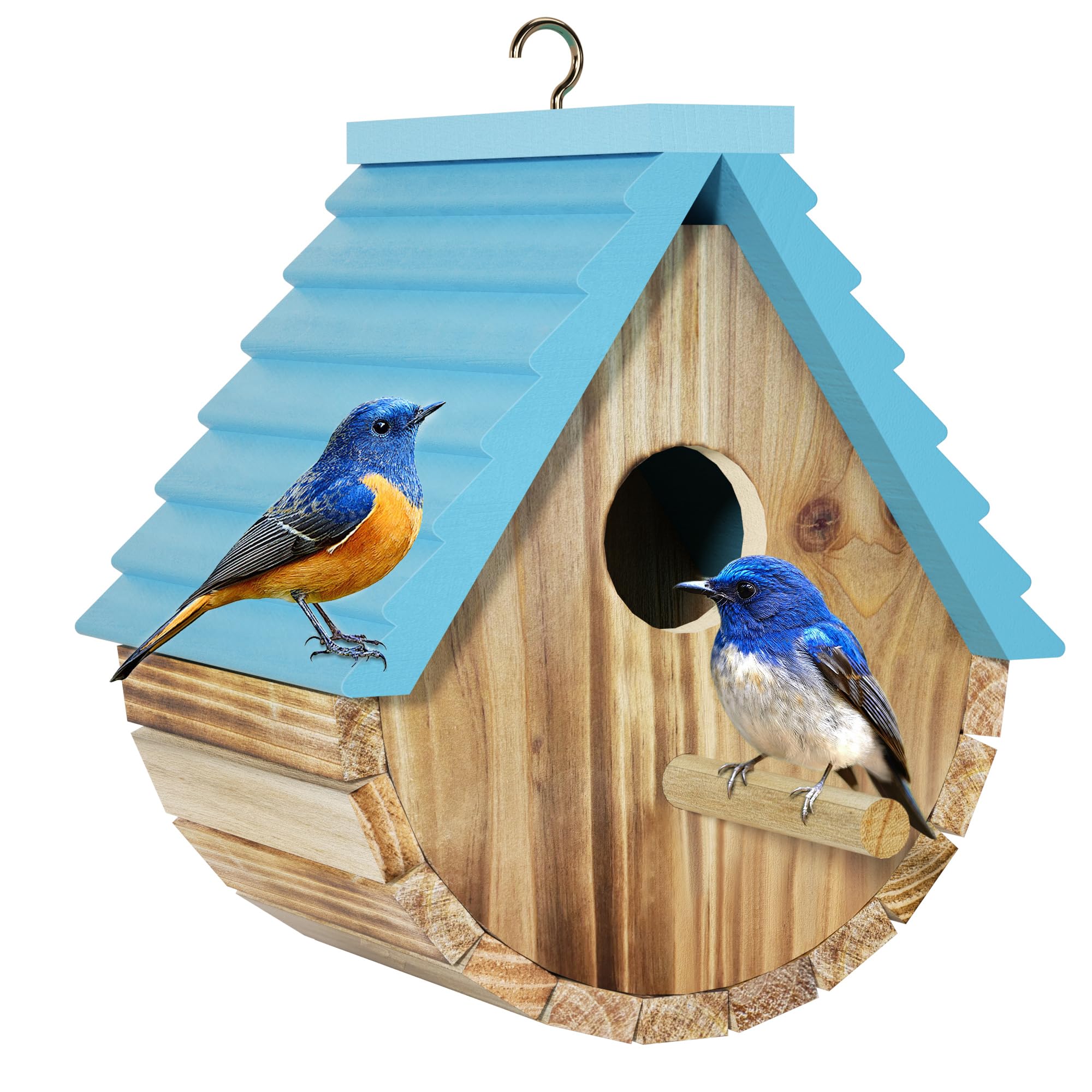
The Auslar house stands out for its two-installation flexibility: you can hang it from the roof hook or mount it via the back screws (which are included). That may sound trivial, but many birdhouses force you into a single mounting approach, limiting placement options. The body is made from premium cedar with a carbonized finish and a vibrant blue roof that adds visible color contrast — something that helps birds spot the house in a dense garden.
The 1.57-inch entrance is larger than the other houses here, making this model suitable for bluebirds, tree swallows, and even small kestrels. The edges are sanded smooth, which prevents feather damage on entry and exit. A swivel back door allows quick cleaning access, and the 80mm perch platform provides a stable landing spot for parent birds carrying food. The herringbone shape is distinct from the standard box silhouette, adding architectural interest to any garden setup.
Some owners noted that the roof does not extend far enough to fully shield the ventilation gap on the back door, and one reviewer considered drilling an extra vent hole for better airflow. The larger entrance also means that starlings and house sparrows can access the box, so this house works best in areas where those species are less aggressive. For a pre-assembled, dual-mount house with bluebird capacity, the Auslar delivers category coverage that most competitors skip.
Why we love it
- Cedar construction arrives fully assembled with zero DIY required
- Dual mount system — hang or screw — fits nearly any placement scenario
- Sanded entrance edges prevent feather snagging on entry
Good to know
- 1.57-inch hole allows starlings and sparrows to enter
- Limited roof overhang may not fully protect the rear vent gap from rain
4. Glitzhome Bird Houses for Outside

The Glitzhome house leans into aesthetic appeal with a hand-painted cottage silhouette, 3D wood detailing, and a distressed rustic palette that looks intentionally aged. However, the build quality supports its looks: the solid wood walls withstand rain and wind without warping, and multiple owners report it survived raccoon and squirrel encounters that would have shattered cheaper plywood houses. The 1.18-inch entrance is ideal for bluebirds, wrens, and chickadees, while excluding larger invasive species.
A removable rear clean-out panel makes seasonal maintenance simple, and the included metal hanger is thick enough to support the 1.1-pound weight without bending. The overall dimensions (5.5 inches deep by 4.5 inches wide by 9 inches tall) create a cozy interior volume that matches the preferences of cavity-nesting small songbirds. Several owners noted that birds moved into this house within 24 hours of hanging, suggesting the proportions and finish feel natural rather than chemically treated.
The color scheme in delivery does differ slightly from the stock photography — some buyers found the walls more green-toned than the advertised off-white, and the metal roof appeared bronze rather than orange. These shifts do not affect bird occupancy, but they may matter if you are buying primarily as a porch ornament. Backed by a one-year warranty, the Glitzhome is the strongest choice if you want a decorative statement piece that still functions as a real nest box.
Why we love it
- Durable solid wood survived outdoor storms and predator attempts
- 1.18-inch entrance targets three common songbird species
- Rear clean-out panel simplifies end-of-season maintenance
Good to know
- Paint colors may differ from product images — more muted green than bright white
- Shallow interior depth may be too warm in direct all-day sun without supplemental venting
5. K KILIPES Wood Bird House
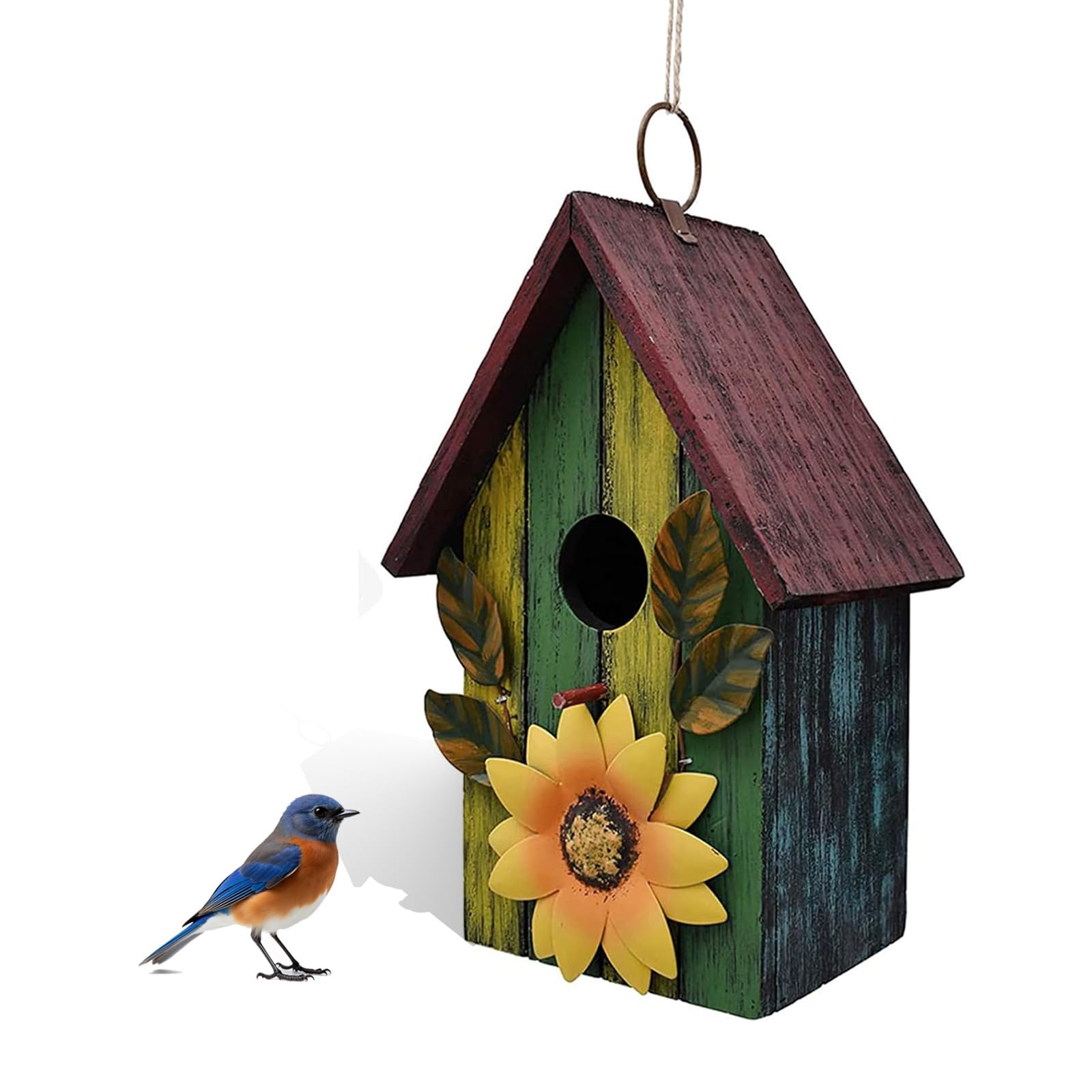
The K KILIPES house is the most visually playful entry in this lineup, featuring a hand-painted rustic finish and a prominent metal sunflower accent on the front. The body uses a wood-and-metal blend that provides moderate weather resistance, and the 1.37-inch entrance is broad enough to accommodate finches, wrens, and chickadees while still blocking larger bully birds. The interior volume is compact, which matches the nesting preferences of small species and discourages starlings from settling.
Installation is genuinely tool-free: the house arrives fully assembled with a rope and metal hanging hook, so you can hang it from a garden hook, tree branch, or fence within seconds. The removable clean-out panel on the back is a welcome feature at this entry-level price, and the perch pole offers a resting spot that small birds reliably use. The cheerful yellow-green color scheme stands out against foliage, making the house easy for both birds and humans to locate.
Occupancy rates are less predictable than the more targeted designs above — some owners reported birds moved in within days, while others have had the house hang for weeks without a single inspection. This variability likely stems from the painted finish, which may retain a chemical odor longer than untreated cedar houses, and the lack of dedicated ventilation slots. If your priority is a budget-friendly decorative piece that occasionally hosts birds, this fits the bill. If fast occupancy is non-negotiable, the Kingsyard or SISTERBIRD models are safer bets.
Why we love it
- Fully assembled with rope and hook — hang it straight out of the box
- Metal sunflower accent adds distinct visual personality to gardens
- Rear clean-out panel allows basic seasonal maintenance
Good to know
- Paint finish may have a residual odor that deters immediate bird occupancy
- No dedicated side vents — interior can trap heat in full sun
FAQ
Should I buy a birdhouse with a perch below the entrance hole?
What diameter entrance hole attracts bluebirds and excludes starlings?
How often should I clean a birdhouse during the nesting season?
Do birds prefer unpainted wood or painted birdhouses?
How do I prevent ants and wasps from taking over the birdhouse?
Final Thoughts: The Verdict
For most gardeners, the best birdhouse for birds winner is the SISTERBIRD Wren Bird House because it combines a predator-proof copper ring, solid wood construction, and a species-matched 1.125-inch entrance at a price that undercuts comparable premium boxes. If you want a house that wrens, chickadees, and titmice occupy within hours, this is the one. For yard owners who need dedicated wren targeting with proven ventilation, grab the Kingsyard with Predator Guard. And for budget-conscious decor that still functions, the K KILIPES Rustic House delivers visual charm with basic nesting capability.