
Every winter, community cats face a brutal choice: find shelter or freeze. A proper outdoor shelter changes that equation entirely, offering a dry, insulated refuge that traps body heat and blocks wind, rain, and snow. The material, the raised floor, and the interior insulation are what separate a lifesaving haven from a wet cardboard box.
I’m Mo Mahin — the founder and writer behind Furric. I’ve spent over a decade analyzing outdoor pet shelter materials, thermal retention data, and field-tested owner feedback to determine which designs actually work for feral colonies in harsh climates.
Whether you need a simple budget structure or a heated winter fortress, this guide breaks down the specs that matter, including proofing for moisture and wind. The result is a curated list of the top bedding for feral cats that prioritizes durability, warmth, and practical safety for outdoor use.
How To Choose The Best Bedding For Feral Cats
Buying a shelter for a feral cat is different from buying a pet bed. You need a structure that survives the elements, traps heat without electricity (or with safe heating), and gives the cat a quick escape route. Here are the three factors that matter most.
Insulation and Thermal Retention
Without a layer of reflective or foam insulation, body heat escapes through the walls. Look for shelters with aluminum foil linings, honeycomb panels, or thick PVC covers. The spec to check is the interior warmth without an external heat source — self-warming models rely on the cat’s own heat reflecting back, while heated models provide steady temperatures between 95°F and 113°F.
Weatherproofing and Base Elevation
Ground moisture is the enemy. A shelter must have an elevated base — at least 2 to 5 inches off the ground — to prevent water seepage and cold transfer. The roof should be sloped or pitched to shed rain and snow, and the outer fabric must be waterproof Oxford cloth or treated PVC. Check if ground stakes or clips are included for wind resistance.
Safety Features: Escape Doors and Pad Certification
Feral cats are prey animals. A shelter with only one entrance can become a trap if a predator blocks the door. Designs with a rear escape door are safer. For heated shelters, the heating pad should have UL certification, a thermostatic control, and a flame-retardant outer shell. Avoid pads without auto-shutoff features.
Quick Comparison
On smaller screens, swipe sideways to see the full table.
| Model | Category | Best For | Key Spec | Amazon |
|---|---|---|---|---|
| GASUR Heated Cat House | Heated/Premium | Sub-zero winters, multiple cats | 20″ x 17″ x 18″, double escape doors, UL-certified heating pad | Amazon |
| TailTastic Elevated Shelter | Elevated/Large | Wet ground, colony of 2-3 cats | 24″ x 15.7″ x 13″, 900D Oxford fabric, elevated platform | Amazon |
| Pawaboo Heated Shelter | Heated/Insulated | All-season use, escape door priority | 19.3″ x 12.6″ x 20.9″, aluminum foil insulation, heating pad | Amazon |
| Rest-Eazzzy Insulated House (Small) | Budget | Single cat on porch, tight budget | 13″ x 13″ x 14″, waterproof Oxford cloth, Velcro roof | Amazon |
| Rest-Eazzzy Weatherproof House | Budget | Quick setup, single small cat | 13″ x 13″ x 14″, built-in visible insulation, long clips | Amazon |
In‑Depth Reviews
1. GASUR Large Heated Cat House

The GASUR shelter measures 20″ x 17″ x 18″, enough for three to four adult cats, making it the best option for colony caretakers. The outer shell uses a weatherproof PVC cover over an insulated core, and the 7-layer thermostatic heating pad is UL-certified with a flame-retardant outer shell, so it delivers steady warmth without burn risk. Owner reports confirm feral cats used it immediately during sub-zero Midwest winters.
A key safety advantage here is the double-door layout. Both entrances have door flaps that block rain and wind while providing an alternate escape if a predator blocks one opening. The raised footed base lifts the structure off cold, wet ground — a critical spec that prevents hypothermia from moisture transfer.
Setup requires no tools, and the whole unit folds flat for off-season storage. A few owners noted the cover is tight-fitting but very effective at shedding water. For caretakers prioritizing safety and capacity in extreme cold, this is the most reliable all-in-one heated shelter.
Why we love it
- UL-certified heating pad eliminates burn risk
- Double escape doors improve predator safety
- Elevated base blocks ground moisture
- Easy tool-free setup and flat storage
Good to know
- Heavier than non-heated options at 11.3 pounds
- Some cats may take a few days to trust the enclosed space
2. TailTastic Elevated Outdoor Cat House

At 24″ x 15.7″ x 13″, the TailTastic model is the longest shelter in this review, designed to accommodate two to three adult cats comfortably. The elevated platform uses a flexible design with six ground stakes, which significantly improves wind resistance and prevents water pooling underneath during heavy rain.
The material choice is a major durability upgrade: 900D waterproof Oxford fabric on all four sides, with a premium leather fabric for the roof. This combination resists UV degradation better than standard 600D cloth, and the sloped roof prevents snow accumulation. A zippered flap entrance keeps the warmth in while giving the cat a sense of security.
One limitation is the single exit. Owners recommend adding a secondary escape port if predators are present in your area. Another note: without a heating pad, this shelter is better suited for spring, fall, and mild winter climates. Some users added a heat-reflective cushion to boost insulation, which is a smart upgrade for colder nights.
Why we love it
- Longest interior space fits 2-3 cats
- 900D Oxford fabric resists tearing and UV damage
- Elevated platform with six ground stakes for wind stability
- Sloped roof prevents snow buildup
Good to know
- Single entrance is a predator risk
- Needs added insulation or heating pad for harsh winters
3. Pawaboo Heated Cat House

The Pawaboo shelter integrates a heating pad that maintains a stable 95°F to 113°F range, paired with internal aluminum foil walls that enhance thermal reflection. The overall dimensions are 19.3″ x 12.6″ x 20.9″, with a 5-inch elevated base that provides a significant moisture barrier against wet ground and snowmelt.
What sets this model apart is the escape door design. It includes multiple exit routes to prevent feral cats from being trapped by other animals. The inverted V-shaped roof blocks heavy rain and strong winds from entering the main opening. Owners report that three feral cats fit inside comfortably, and one cat used it on the first night.
The main criticism concerns the interior door flaps. Some owners found them flimsy and reported that they didn’t fully block airflow. A simple DIY fix involves adding a heavier flap or a strip of heavy-duty vinyl. The heating pad works reliably but lacks auto-shutoff on some units, so pairing it with a smart plug is a smart precaution.
Why we love it
- Multiple escape routes for predator safety
- Aluminum foil walls maximize heat reflection
- Heating pad provides consistent 95°F–113°F warmth
- 5-inch elevated base blocks ground moisture
Good to know
- Interior door flaps are thin and need reinforcement
- Heating pad may be too small for larger cats to fully cover
4. Rest-Eazzzy Outdoor Cat House with Mat
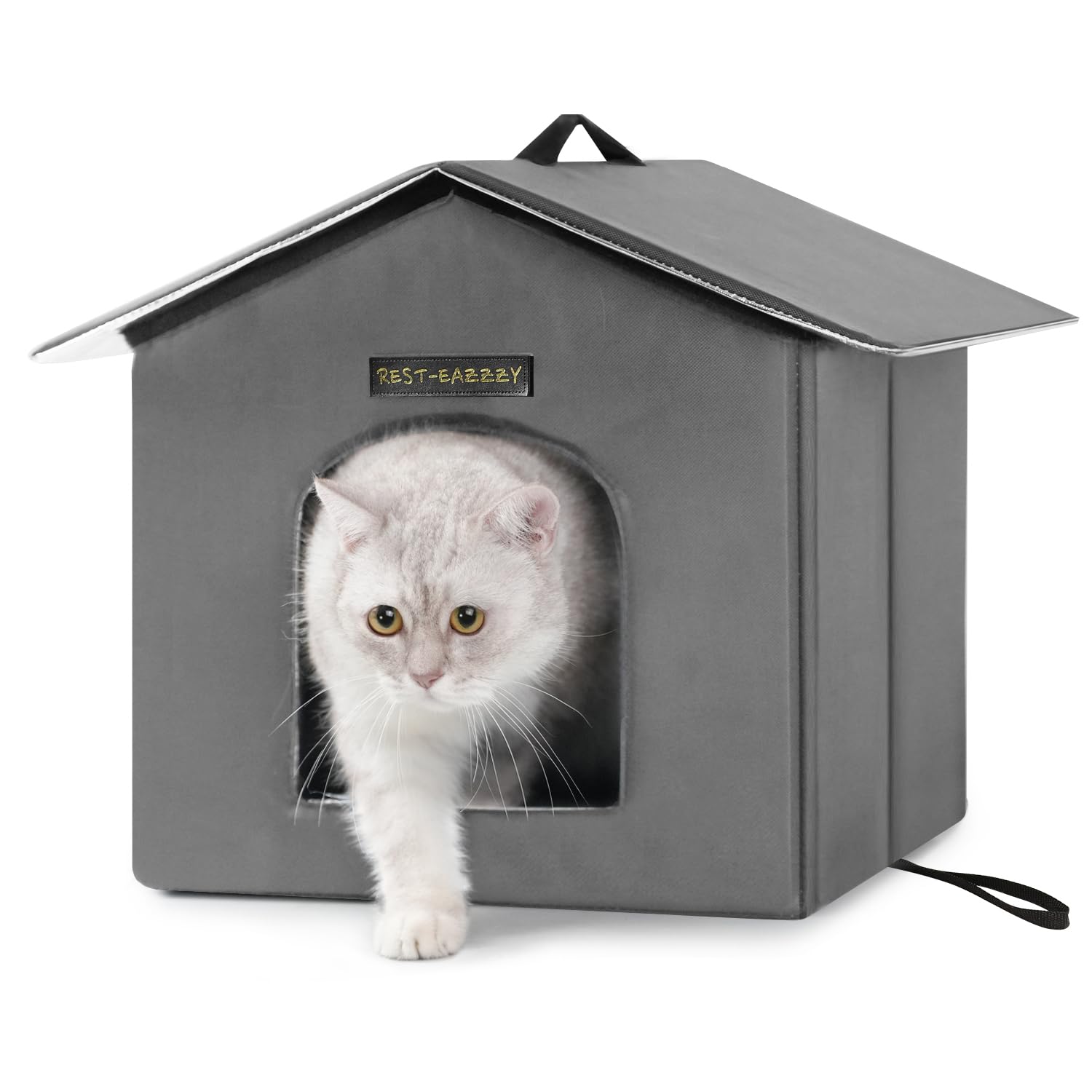
This Rest-Eazzzy model measures 13″ x 13″ x 14″ and is built with waterproof Oxford cloth and a sandwich-design insulation layer that includes foil for heat retention. The compact footprint makes it ideal for placing on a covered porch, in a garage corner, or under a deck where space is tight. Assembly takes about five minutes with no tools required.
An included mat and carry ring add convenience, and the Velcro-attached roof makes it easy to access the interior for cleaning. Owners describe the walls as thick and the build as solid for the price point. Two anchorage clips are included to prevent the shelter from blowing away in gusty conditions.
The biggest drawback is the lack of an escape door. For outdoor placement where predators are present, this is a liability. A few owners also reported that the UV resistance is limited — the fabric shows sun damage after a full summer. For mild climates or shaded placement, this is a strong entry-level shelter.
Why we love it
- Quick five-minute tool-free assembly
- Included mat and anchorage clips add value
- Thick foil-lined walls for heat retention
- Portable carry ring for relocation
Good to know
- No secondary escape door creates predator trap risk
- Fabric degrades faster in direct sun
5. Rest-Eazzzy Weatherproof Feral Cat House

This variant from Rest-Eazzzy uses the same 13″ x 13″ x 14″ footprint but distinguishes itself with built-in visible insulation layers and a waterproof house canopy. The dark grey color scheme is intentionally non-reflective to reduce a feral cat’s wariness — a subtle but important detail for first-time users trying to lure a stray to shelter.
The package includes two long clips designed to hold the house against wind displacement. Owners report that the Velcro roof makes assembly trivial and that cats adapt quickly, with one farm cat using it inside a kennel on the very first night. The included mat is machine-washable, which simplifies hygiene maintenance for colony caretakers.
Size is the main constraint. This is a single-cat shelter, and multiple reviewers noted it is too small for an average adult cat to turn around comfortably. The lightweight construction also means it will shift in strong winds even with the clips. It works best when placed in a sheltered nook — under an eave, inside a garage, or behind a windbreak.
Why we love it
- Dark color reduces feral cat wariness
- Machine-washable mat for easy cleaning
- Long anchorage clips improve wind resistance
- Visible insulation layer adds thermal retention
Good to know
- Sized for a single small cat only
- Lightweight frame shifts in gusty winds
FAQ
Should I use hay, straw, or blankets inside a feral cat shelter?
What temperature is safe for a heated outdoor cat house?
Does a shelter need an escape door if it has a flap?
How do I stop a shelter from blowing away in the wind?
How often should I clean an outdoor cat shelter?
Final Thoughts: The Verdict
For most caretakers, the bedding for feral cats winner is the GASUR Heated Cat House because it combines a UL-certified heating pad, predator-safe double doors, and an elevated base in one tool-free assembly. If you need a spacious unheated shelter for a small colony, grab the TailTastic Elevated Shelter. And for a tight-budget option that still offers foil insulation and weatherproofing, the Rest-Eazzzy Outdoor Cat House is a capable starter shelter for mild climates.