
That telltale sound of dog nails clicking across a once-pristine floor—followed by the discovery of hairline scratches that make freshly refinished planks look aged—is the single most common complaint among pet owners with hardwood. The difference between a floor that shows every paw and one that shrugs off the daily romp comes down to one choice: the molecular armor sitting on top of the wood.
I’m Mo Mahin — the founder and writer behind Furric. I’ve spent countless hours cross-referencing chemical resistance data, VOC thresholds, and scratch-martens hardness benchmarks against thousands of verified owner experiences to isolate which finishes actually survive the canine lifestyle.
This guide breaks down the specific polymers, solid loads, and curing behaviors that separate a temporary shine from a true barrier, helping you find the right finish for hardwood floors with dogs without sacrificing health or appearance.
How To Choose The Best Finish For Hardwood Floors With Dogs
Dog claws act like coarse sandpaper on a microscopic level. The wrong finish looks good for a week then reveals every run, slide, and sudden stop. These four specs determine real-world survival.
Scratch Resistance and Abrasion Hardness
A finish’s ability to resist claw marks comes down to its cross-link density. Oxygen-crosslinking polyurethanes (like Bona’s OCP formula) and aluminum-oxide-reinforced water-based polyurethanes build a crystalline surface that deflects point loads rather than compressing. Oil-based polyurethanes, while thick, remain slightly softer and tend to micro-fracture under repeated paw impact.
VOC Levels and Odor During Application
Low-VOC water-based finishes emit negligible fumes and allow pets back onto the surface within hours rather than days—critical if you can’t isolate your dog for a full weekend. Plant-based formulations further reduce off-gassing, making them safer for both the applicator and the animals that will live directly on the treated surface.
Cure Time Versus Dry Time
A finish that feels dry to the touch after two hours may still be chemically soft for up to seven days. Placing furniture or allowing energetic dogs onto a partially cured finish guarantees dents and embedded debris. Premium finishes specify both walk-dry time (hours) and full-cure time (days), and the difference between those two numbers is exactly when your dog should stay off the floor.
Recoat Practicality and Maintenance
Some finishes require sanding between coats; others self-level with a simple pad applicator. For a home with dogs, the ability to spot-recoat a trafficked hallway without resanding the entire room saves months of labor over the floor’s lifetime. Look for products that explicitly mention “no sanding between coats” or “direct recoat” within the same day.
Quick Comparison
On smaller screens, swipe sideways to see the full table.
| Model | Category | Best For | Key Spec | Amazon |
|---|---|---|---|---|
| Bona Traffic HD Semi-Gloss | Premium Commercial | Maximum scratch & scuff defense | 1,000 sq ft coverage per gallon | Amazon |
| Bona Mega Satin | Mid-Range Pro | Self-leveling, flawless DIY finish | 500–600 sq ft per gallon | Amazon |
| Rust-Oleum Varathane Diamond Satin | Premium Consumer | Aluminum-oxide nano-tech protection | 100 sq ft per gallon | Amazon |
| Minwax Polycrylic Satin | Mid-Range Consumer | Furniture & low-traffic hardwood | 2-hour recoat window | Amazon |
| EcoProCote Eco-Poly Satin | Eco-Friendly | Non-toxic, pet-safe application | 525 sq ft per gallon | Amazon |
| Zep Commercial High-Traffic Polish | Budget Restorative | Cost-effective temporary shine | 20% solids formula | Amazon |
| Rejuvenate All Floors Restorer | Budget Restorative | Quick scratch concealment | Single-coat application | Amazon |
In‑Depth Reviews
1. Bona Traffic HD Commercial Semi-Gloss

Bona Traffic HD is the commercial-grade standard for a reason: its oxygen-crosslinking polyurethane chemistry creates a denser polymer matrix than standard water-based finishes, which translates into measurably higher abrasion resistance. Owners report zero visible wear after a decade on stair treads and zero scratches after months of heavy dog traffic—even in high-heat, high-humidity commercial exhibits where animals walk directly on the finish. The semi-gloss sheen delivers a subtle luster that enhances grain without looking plasticky, and the low-VOC formula allows pets back into the room within hours rather than days.
Application requires a bit more precision than consumer cans: you’ll want a Bona applicator pad and a steady hand to avoid lap marks. The five-to-six-coat recommendation for ultra-high-traffic zones can feel labor-intensive, but the product’s self-leveling behavior smooths out minor imperfections between coats. The 1,000-square-foot coverage per gallon makes it surprisingly economical for large open-plan homes where a single gallon handles the entire main level.
One reviewer noted that even three coats of Traffic HD didn’t completely stop scratches from a heavy dog on yellow pine, which is a softer species than red oak or maple. For owners with pine or fir floors, an extra coat—or a switch to a harder wood species—may be necessary to achieve full scratch immunity. On hardwoods, however, this finish consistently outlasts everything else in the category by a significant margin.
Why we love it
- Scratch and scuff resistance that survives commercial traffic and large dogs
- Low odor and low VOCs let pets return quickly
- Outstanding coverage per gallon reduces project cost
Good to know
- Requires careful application technique to avoid lap marks
- Soft woods like pine may need 4+ coats for full protection
2. Bona Mega Wood Floor Finish Satin 1 Gallon

Bona Mega uses the same oxygen-crosslinking polymer structure as Traffic HD but packages it in a more DIY-friendly viscosity that self-levels beautifully across sanded planks. First-time users consistently describe the application as “foolproof”—the milky liquid dries to a crystal-clear satin that highlights wood’s natural grain without the amber tint that oil-based finishes impart. On an old fir floor or a set of 1930s oak boards, the finish brings out depth without darkening, making the room feel brighter immediately.
The 500-to-600-square-foot coverage per gallon is generous for a water-based poly, and the recoat window—under two hours in average conditions—means you can lay down three coats in a single day. Owners report that the finish hardens enough for gentle foot traffic the next morning and cures fully within five days. The absence of strong odor is a genuine relief for homeowners who can’t isolate pets for a weekend; ventilation requirements are minimal compared to solvent-based alternatives.
On oak sanded to 100 grit, some users note that the water-based formula raises the grain slightly, requiring a light scuff sand between the first and second coats. While the initial cost is higher than big-box water-based polys, reviewers consistently point out that the durability justifies the premium—one false start with a cheap finish that peels forces a full sand-and-refinish cycle that costs ten times the price of the premium gallon.
Why we love it
- Exceptional self-leveling for a smooth, professional finish
- Low odor and fast recoat for one-day application
- Crystal clear—no ambering on light woods
Good to know
- May raise grain on oak sanded below 120 grit
- Full cure takes 5 days before heavy furniture or pet traffic
3. Rust-Oleum Varathane Diamond Water-Based Floor Polyurethane Satin

Varathane Diamond brings aluminum-oxide nanotechnology—the same material used in ceramic tile glazes—into a consumer-grade water-based polyurethane. The result is a satin finish that maintains rock-hard integrity after two years of heavy traffic in a commercial ice cream shop, where mopping, furniture drags, and continuous foot traffic would degrade a standard finish in months. For home users with large dogs, the nano-particles create a surface that resists micro-scratches from paw pads and claws, keeping the satin sheen uniform across high-traffic zones.
The fast-dry formula allows three coats in a single day, and the low-odor profile means you can work without a respirator in a well-ventilated space. Soap-and-water cleanup eliminates the solvent waste associated with oil-based urethanes, and the non-yellowing chemistry keeps light woods like pine and maple looking natural. A professional furniture maker with three decades of experience tested this on furniture pieces and found the tactile quality and durability impressive enough to keep it as a workshop staple.
Coverage is notably lower than the Bona products—roughly 100 square feet per gallon—which means a 400-square-foot living room requires a full gallon plus part of a second. Some users report that achieving a flawless satin sheen requires four coats rather than the label’s recommended two, especially on porous or previously stained wood. The final sheen leans closer to matte-eggshell than traditional satin, so if you prefer a higher gloss, consider the semi-gloss variant.
Why we love it
- Aluminum-oxide reinforcement resists scratches from claws
- Fast recoat allows 3 coats in one day
- Non-yellowing formula keeps light woods true
Good to know
- Lower coverage per gallon—budget extra for larger rooms
- May need 4 coats for optimal durability on soft wood
4. Minwax Polycrylic Water-Based Protective Finish Satin

Minwax Polycrylic is a staple for woodworkers because it delivers a crystal-clear, non-yellowing topcoat that applies easily with a synthetic brush and cleans up with soap and water. On hardwood floors with dogs, however, context matters: Minwax explicitly states this product is not recommended for floors. In lower-traffic areas like home offices or spare bedrooms, some owners have successfully used Polycrylic on tongue-and-groove flooring with good results, noting that the finish resists scuffs and mops well after a week-long cure.
The standout advantage here is the 2-hour recoat window, which allows a full three-coat build in a single evening. The milky-white liquid dries invisible, so even on white oak or maple there’s no amber shift. Odor is minimal—dramatically less than oil-based poly. For small surfaces like cabinet doors, trim, or a single accent wall, Polycrylic is an excellent choice. It also serves as a barrier over Minwax stains if you’ve already applied a stain and need a durable clear coat.
The product simply lacks the abrasion resistance necessary for daily dog traffic. Multiple owners report that on heavily trafficked hallways, the finish wears thin within a year, requiring recoating or conversion to a floor-grade poly. The thin viscosity also makes vertical applications tricky; runs can form on door edges if you aren’t careful. For true floor protection with dogs, stick with the Bona or Rust-Oleum options designed specifically for horizontal wear.
Why we love it
- Ultra-fast recoat—perfect for quick projects
- Crystal clear and non-yellowing on light woods
- Low odor and easy water cleanup
Good to know
- Not recommended for floor use by the manufacturer
- Wears quickly under daily dog traffic
5. EcoProCote Eco-Poly Polyurethane Sealer Satin
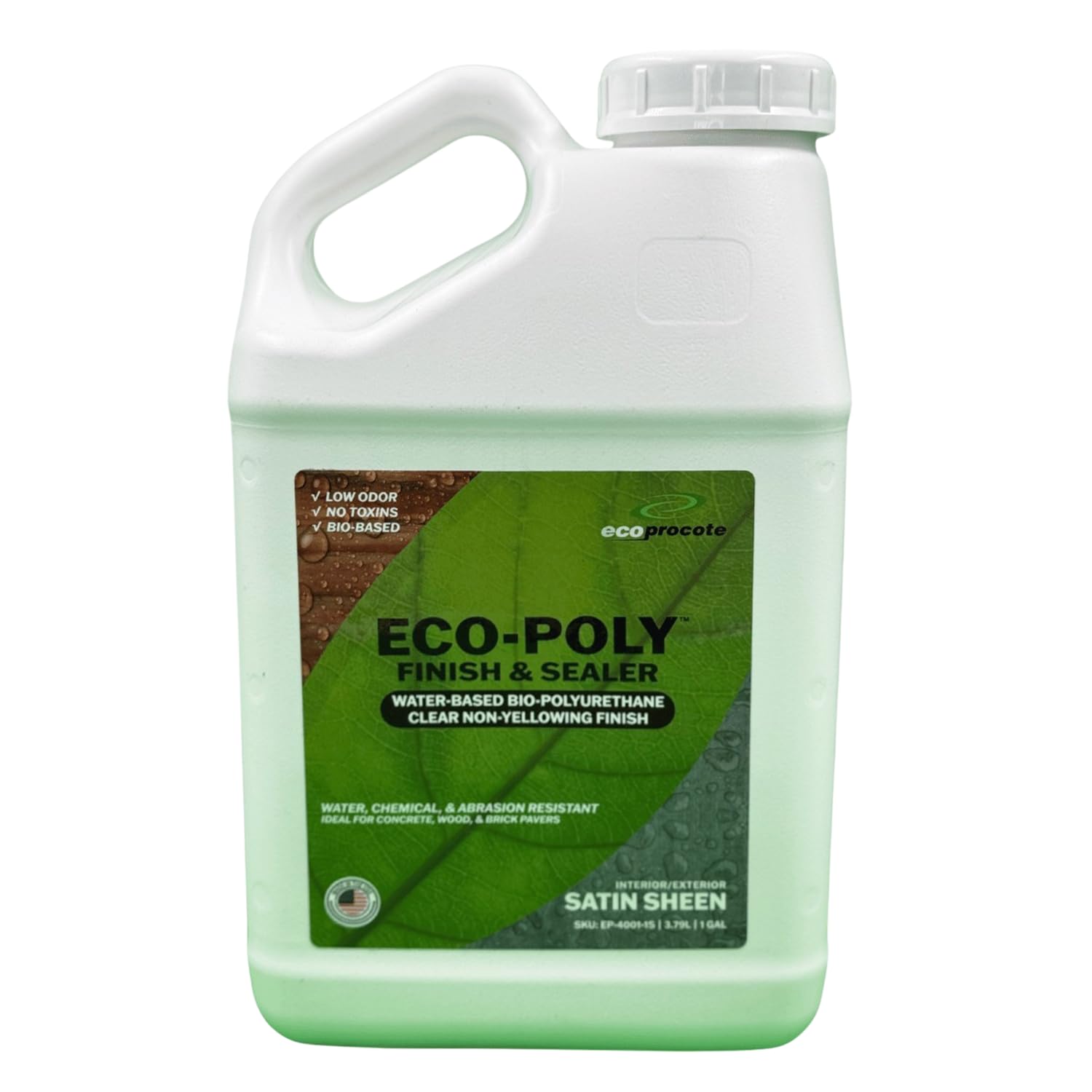
Eco-Poly uses plant-based waterborne polymers and bio-emulsion resins to eliminate toxic off-gassing entirely, making it one of the safest finishes to apply in an occupied home with pets. The satin version dries to a low-sheen natural look that complements farmhouse and Scandinavian interiors, and the 30-minute dry time lets you walk in socks after a few hours and place furniture within 24. Owners have used it on butcher-block countertops, van conversions, and painted wood floors with excellent water resistance and scratch protection.
The 525-square-foot-per-gallon coverage is solid for a water-based product, and the self-leveling character minimizes brush marks even when applied with a microfiber mop. Multiple reviewers note that the finish dries remarkably hard—hard enough that sanding between coats requires actual effort. On whitewashed parquet, two coats of Eco-Poly resisted water beading and scratching far better than bare whitewash or beeswax, making it a viable option for light-traffic floors in homes with small breeds or well-trimmed nails.
This is not a commercial-grade floor finish. Owners expecting a glossy mirror shine will be disappointed; Eco-Poly’s satin is closer to a matte appearance, and the finish is less abrasion-resistant than Bona Traffic HD or Varathane Diamond. For large, energetic dogs that run laps through the hallway, the coating may show wear within 12 to 18 months. It’s best suited for homes where non-toxicity and environmental footprint rank above brute durability, or for use on furniture and trim adjacent to the floor.
Why we love it
- Virtually odorless and non-toxic—safe for pets and kids
- Plant-based formula with low environmental impact
- Quick dry time and decent coverage per gallon
Good to know
- Not as scratch-resistant as commercial-grade water-based poly
- Satin sheen is very low—near matte
6. Zep Commercial High-Traffic Floor Polish (4-Pack)
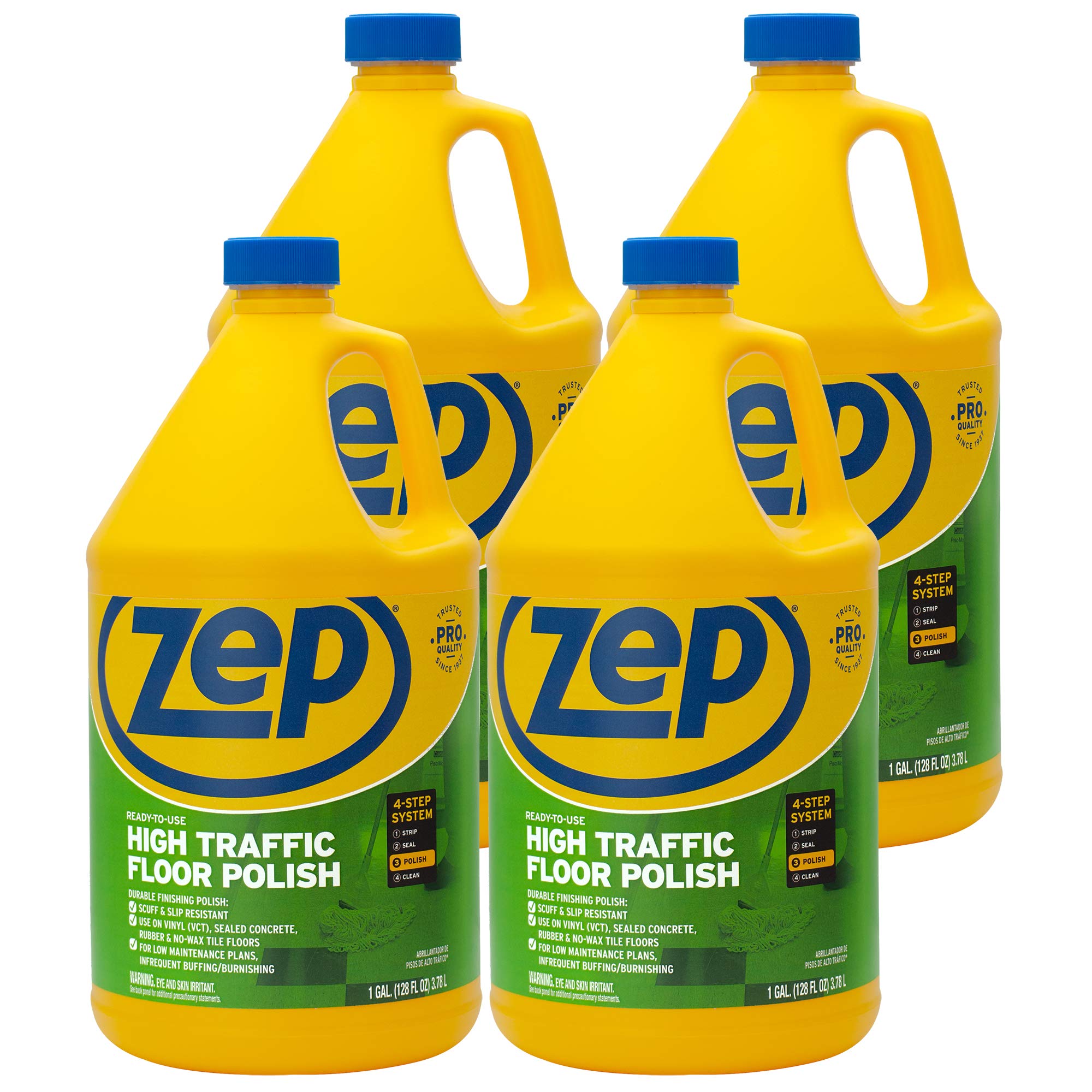
Zep Commercial Floor Polish is a sacrificially applied acrylic finish designed for resilient surfaces like vinyl, linoleum, rubber, and sealed concrete. Its 20% solids formula produces a high-gloss, slip-resistant coating that resists scuffs and heel marks, and reviewers have successfully used it on unsealed stone and bluestone porch floors with impressive results—three thin coats cured into a tough, waterproof barrier that held up all summer under grilling foot traffic and rain. For homeowners with sealed concrete basements or laundry rooms that see dog traffic, Zep is a budget-friendly way to restore shine and protect against moisture tracked in from wet paws.
The application process is straightforward: strip any existing wax, apply thin coats with a string mop or microfiber applicator, and allow each coat to dry in about 30 minutes. The four-gallon case covers a substantial area, making it economical for large spaces. Users report that the finish lasts for months with weekly damp-mopping, and that it can be stripped and reapplied when it eventually dulls, avoiding the need for permanent coating removal.
This product is not a urethane floor finish—it’s a temporary polish that sits on top of the substrate rather than bonding chemically with it. On hardwood, Zep is not appropriate because the acrylic layer will not adhere to wood’s open grain and will peel. Even on appropriate surfaces, the gloss level is very high; if you prefer a satin or matte appearance, this finish will feel shiny and commercial. It also requires periodic stripping and reapplication, which adds long-term maintenance labor that a permanent finish does not.
Why we love it
- Cost-effective for large areas of vinyl or sealed concrete
- High-gloss shine and scuff resistance
- Easy to apply and strip for reapplication
Good to know
- Not designed for hardwood—use only on resilient flooring
- Requires periodic stripping; not a permanent finish
7. Rejuvenate All Floors Restorer Fills Scratches

Rejuvenate All Floors Restorer is a water-based polymer emulsion designed to fill light surface scratches and restore a high-gloss shine to tired hardwood, laminate, vinyl, and tile floors. It goes on as a clear liquid that dries into a thin sacrificial layer, optically hiding fine hairline scratches and adding a uniform gloss that makes worn traffic lanes disappear. On engineered hardwood and vinyl plank, single-coat users report floors that look “like new” within hours, with the effect lasting several months before reapplication is needed.
The application is genuinely simple: mop the floor clean, pour the restorer onto a microfiber pad, and spread it evenly. The 1-hour walk-dry time and 24-hour furniture wait are manageable for most households. The product is labeled safe for pets and kids once dry, and the odor, while noticeable during application, dissipates within a few hours. For renters or homeowners not ready to sand and refinish, Rejuvenate provides a cosmetic solution that delays the major renovation by six months to a year.
Multiple owners report that the product fills scratches visually but does not fill them physically—deep gouges from dog claws remain visible, and the coating does not bond strongly enough to prevent new scratches from forming on top. On LVP floors, it restores shine beautifully but may build up with multiple applications, creating a cloudy haze if applied too thickly. It’s a maintenance product, not a permanent finish, and repeated use over years can create a layered film that eventually requires stripping.
Why we love it
- Simple one-coat application with quick results
- Effectively hides light surface scratches
- Safe for pets and kids when dry
Good to know
- Does not fill deep scratches—visual only
- Requires periodic reapplication; not a permanent fix
FAQ
Can I use Minwax Polycrylic on my hardwood floors with dogs?
How many coats of water-based polyurethane do I need for dog protection?
What is the difference between satin, semi-gloss, and gloss for dog-occupied floors?
Does oil-based polyurethane hold up better against dogs than water-based?
Final Thoughts: The Verdict
For most homeowners, the clear winner in the finish for hardwood floors with dogs category is the Bona Traffic HD because its oxygen-crosslinking chemistry and commercial-grade abrasion resistance deliver proven scratch protection across hardwoods like oak, maple, and hickory. If you are a first-time DIYer who wants a self-leveling finish that looks professional on the first try, the Bona Mega delivers the same polymer technology in a more forgiving viscosity. If budget is your primary constraint and you need a quick cosmetic refresh while you save for a full sand-and-finish, the Rejuvenate Restorer provides enough optical scratch concealment to get you through a year of living with a dog on tired floors.