
The defining test of a large-area wireless fence isn’t the transmitter power—it’s whether the system can hold a consistent virtual boundary when your dog hits full stride at the far end of a 5-acre pasture. Radio-frequency units degrade with distance, and GPS-based collars drift if the satellite lock is weak. The wrong choice means a runaway dog, a false sense of security, and hundreds of dollars wasted on a system that can’t match your property’s real footprint.
I’m Mo Mahin — the founder and writer behind Furric. Over the past few years, I’ve studied containment-system specifications, cross-referenced satellite and radio signal data against yard layouts, and analyzed several hundred owner reports on long-term reliability for large-property setups.
Whether your land is a sprawling rural plot or a multi-acre suburban lot, finding a dependable wireless dog fence for large area requires matching the signal technology—be it in-ground wire, GPS satellite, or radio-frequency broadcast—to your specific terrain and dog’s temperament.
How To Choose The Best Wireless Dog Fence For Large Area
Large properties amplify every weakness in a containment system. A 50-foot GPS drift that goes unnoticed on a quarter-acre lot becomes a 200-foot escape corridor on 10 acres. Radio fences that work flawlessly inside 1.5 acres will leave dead zones near the edges of a 3-acre boundary. Here are the specs that separate an adequate fence from a truly large-area solution.
Signal Technology: Radio Vs. GPS Vs. In-Ground
Radio-frequency wireless fences broadcast a circular signal from a central transmitter. Coverage is limited to roughly 1 to 1.5 acres at best, and the signal degrades near metal structures or uneven terrain. GPS-based fences use satellite positioning and can theoretically cover hundreds of acres, but they suffer from drift (3 to 10 yards is common) and require a clear sky view. In-ground wire fences, while not wireless in the truest sense, offer the most precise and reliable boundary for large, irregularly shaped properties—the physical wire eliminates drift entirely. For properties over 2 acres, a GPS or in-ground system is almost always the better bet.
Collar Receiver Battery Life
A large-area containment system forces the collar to transmit or check positioning more frequently. A radio collar on a 1/3-acre boundary might last 2 months on a battery. A GPS collar constantly pinging satellites often lasts only 1-2 days per charge. If your property has deep coverage zones, a collar that dies mid-day leaves your dog without a boundary. Look for collars with at least 24 hours of real-world battery life for GPS units, or 2-month battery life for radio/in-ground collars.
Boundary Zone Adjustability And Width
The “warning zone” is the area just inside the boundary where the collar beeps or vibrates before delivering a correction. On large properties, a too-narrow zone (10-15 feet) can cause a dog running fast to blow through the correction zone without enough time to stop. Adjustable zone widths of 15-30 feet allow you to create a safe buffer proportional to your dog’s speed. Also check the static correction levels—more is not better, but a system with 5 to 100 levels lets you dial in the minimum effective setting.
Multi-Dog Support And Expandability
Large properties often house multiple dogs. Some systems limit you to 2 or 3 collars before needing additional transmitters. In-ground systems typically support unlimited dogs with extra collars, but each collar pairs to the same transmitter. GPS systems vary—some allow you to manage up to 30 fences per account, but each collar operates independently. If you have more than two dogs, check the maximum collar count before committing to a system.
Quick Comparison
On smaller screens, swipe sideways to see the full table.
| Model | Category | Best For | Key Spec | Amazon |
|---|---|---|---|---|
| SportDOG Contain + Train | In-Ground + Remote | Combining fence & training on acreage | 100-acre expandable coverage | Amazon |
| Dogtra Pathfinder 2 | GPS + Training | Hunting & farm tracking with containment | 9-mile tracking, GEO Fence alerts | Amazon |
| Extreme Dog Fence Pro | In-Ground Pro Grade | Maximum durability & heavy-duty wire | 10-acre coverage, 16-gauge wire | Amazon |
| Halo Collar 5 | GPS Subscription | Remote areas & instant boundary creation | L1 + L5 GPS with cellular fixes | Amazon |
| Dogtra GPS Fence | GPS No-Sub | Budget-friendly GPS with no fees | 4 concentric fences, 100 correction levels | Amazon |
| PetSafe Wireless Extra Transmitter | Radio Extender | Expanding existing PetSafe radio zone | 1/2-acre add-on coverage | Amazon |
| PetSafe Stubborn Dog In-Ground | In-Ground Entry | Budget in-ground for determined dogs | 5 correction levels + vibration mode | Amazon |
| DJNFGQ GPS Wireless Fence | GPS Budget | Simple GPS fence at entry price | Circular & polygonal fence modes | Amazon |
| Jhsomdr Dog Playpen 40in | Physical Pen | Physical containment for temporary use | 36 panels, 669 sq ft max space | Amazon |
In‑Depth Reviews
1. SportDOG Brand Contain + Train System
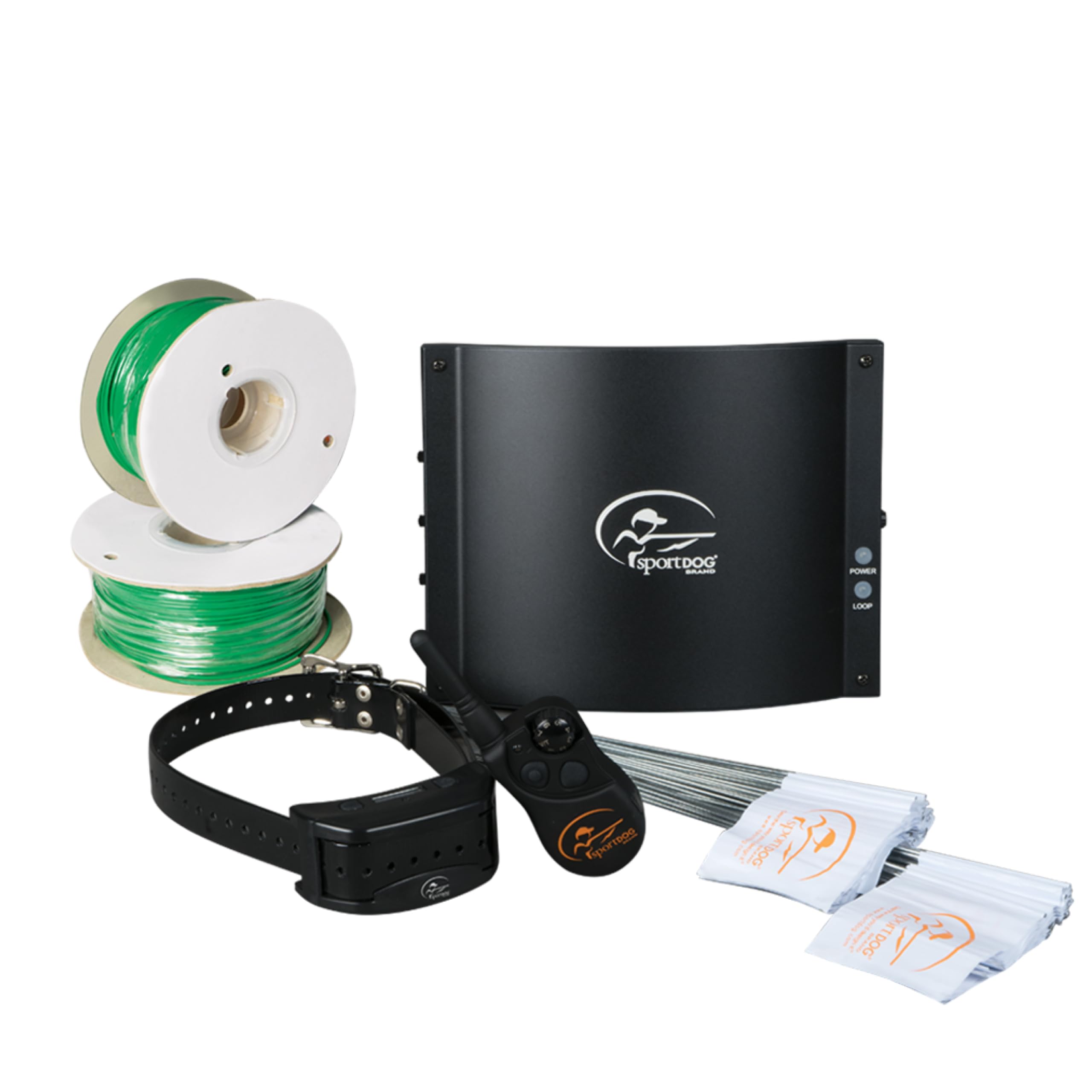
The SportDOG Contain + Train is a dual-purpose powerhouse that combines a 1 1/3-acre starter fence with a handheld remote trainer, all expandable to 100+ acres. The transmitter includes a wire-break alarm and a built-in lightning protector—two features that matter enormously when you’re burying wire across uneven ground where a stray rock or a utility strike could sever the loop. The collar receiver switches seamlessly between fence mode and handheld training mode, giving you both a boundary and a recall correction tool in one 11-pound box.
Owner reports confirm the system works reliably over 5-6 years on 4-acre perimeters, with only minor consumable replacements (charger, collar strap). The collar offers tone, vibration, and 7 static correction levels—enough to find the minimum effective setting for stubborn breeds like Anatolian Shepherds or Great Pyrenees. The included 1,000 feet of 20-gauge wire covers the starter area; upgrading to 14-gauge or 16-gauge wire for longer runs is recommended to reduce resistance over distance, and the transmitter’s sensitivity can be adjusted to compensate.
The battery life on the collar receiver is the main trade-off, averaging about 2 weeks between 9-volt battery changes. Frequent checks are needed, but owners who bought in bulk packages of 9V batteries found the routine manageable. The training remote adds a separate dimension—owners of puppies used the correction function to stop biting, effectively replacing a standalone e-collar. For large-area containment with training flexibility, this is the most versatile in-ground solution.
Why we love it
- Expandable to 100 acres with additional wire—no new transmitter needed
- Built-in lightning protector and wire-break alarm prevent surprise escapes
- Dual fence and remote trainer modes in one collar
Good to know
- Collar battery lasts 1-2 weeks, requiring regular monitoring
- Terminal connectors are flimsy with thicker gauge wire—consider soldering
- No small-dog-specific collar option for dogs under 8 pounds
2. Dogtra Pathfinder 2 GPS Training Collar

The Dogtra Pathfinder 2 is designed for hunting and farm environments where a standard wireless fence simply won’t cut it. It offers a 9-mile tracking range combined with tone, vibration, and 100 levels of nick and constant stimulation. The GEO Fence (e-fence) feature lets you draw a virtual boundary on a map within the smartphone app, with alerts if your dog crosses. For a 16-acre farm or a multi-thousand acre hunting property, this is the only type of containment that scales without physical wire.
The Pathfinder 2 uses an app-powered interface (no subscription required) that includes terrain and satellite maps. The collar updates its GPS position every 2 seconds—industry-leading frequency. Owners of Great Pyrenees and St. Bernard mixes reported successful containment using only the vibration mode, which is a strong indicator that the feedback is effective without needing static correction. The collar is IPX9K waterproof, rechargeable, and fits neck sizes 12-22 inches. The remote can also control a single function per button for quick access.
The biggest caveat is the app requirement. The e-fence must be manually re-enabled each time you open the app, and the system relies on Bluetooth proximity to the handler’s phone—if you leave the phone inside, the fence is inactive. The GPS accuracy can drift 50-80 feet on some properties, which is significant enough to require a generous safety buffer. For owners who need live tracking and geo-fencing in a single collar, this is the top-tier choice, but it demands more active management than a static in-ground or radio fence.
Why we love it
- 9-mile GPS tracking with 2-second updates for real-time location
- No subscription fees for the e-fence or tracking features
- 100 stimulation levels plus vibration and tone for precise training
Good to know
- App required for e-fence operation—Bluetooth range limits function
- GPS drift of 50-80 feet reported on some properties
- Collar battery life around 24 hours, draining phone battery when used
3. Extreme Dog Fence Ultimate Pro Grade Kit

The Extreme Dog Fence Ultimate kit is built for owners who want to install a fence once and never think about it again. It ships with heavy-duty 16-gauge twisted boundary wire (500 feet included, expandable to 10 acres), a digital transmitter with three antennas, a battery check, a temperature check, and a wire check. The collar receiver is completely waterproof and submersible to 10 feet—meaning your dog can swim freely without compromising the containment. The system is manufactured in the USA with imported parts, and the build quality feels industrial-grade.
Owners who installed 1,200-foot perimeters (using PVC conduit for driveway crossings) reported that the factory antenna strength was sufficient for shock level 4 out of possible levels, and dogs learned the boundaries in a single day. The system uses tone activation as a consistent warning signal, and the static correction is adjustable. The collars are light and comfortable, though one owner noted the training flags are smaller than typical and could be easier to miss during the initial setup.
The labor-intensive installation is the main barrier. Digging a trench for the wire across a large yard is a serious project, even with a trencher rental. The customer support team is excellent—one owner had their transmitter replaced overnight after a lightning strike, and another received a free collar replacement promptly. Wet weather can cause slight boundary variation near wire that isn’t fully buried, but submerging the wire completely resolves this. For a set-and-forget system on a 3-10 acre property, this is the most rugged option.
Why we love it
- Completely waterproof collar rated for 10-foot submersion
- 16-gauge twisted wire is heavy-duty and resistant to damage
- Excellent customer support with overnight replacements available
Good to know
- Installation requires trenching or burying wire—no quick setup
- No vibrate mode on the collar, only tone and static
- Transmitter may need replacement after lightning damage (support helps)
4. Halo Collar 5 Wireless Dog Fence
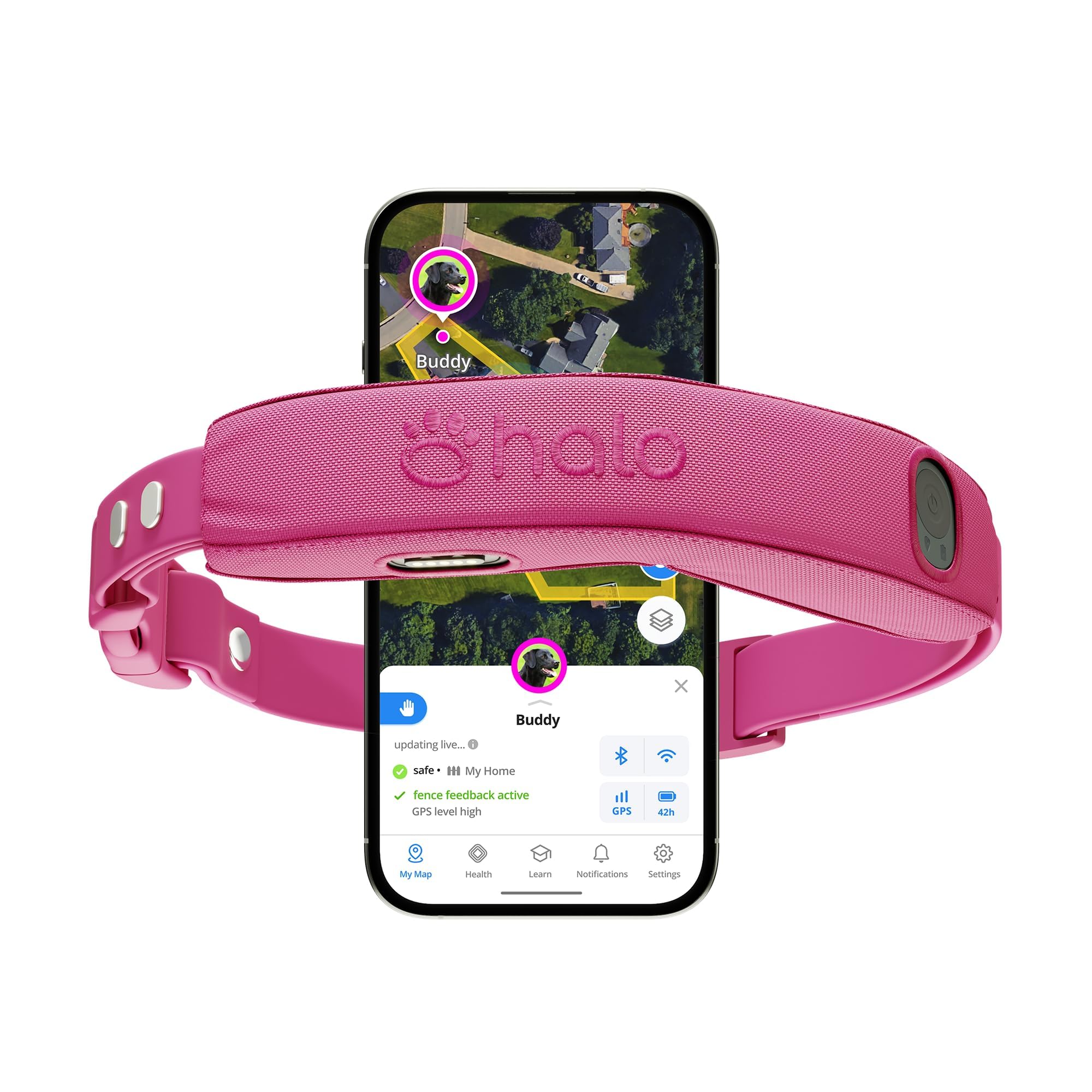
The Halo Collar 5 uses Precision+ technology, combining dual-frequency L1 and L5 GPS satellites with real-time ground-station corrections to achieve accuracy within 2 feet of your dog’s actual location. This is a significant leap over standard GPS collars, which can drift 10-50 feet. The collar updates your dog’s location 20 times per second and uses Wi-Fi, Bluetooth, and cellular connections to maintain a lock even in remote areas where other GPS collars fail. It includes a training program designed by Cesar Millan to teach the dog the boundary using automatic sound, vibration, and optional static correction.
Owner reports on large properties (3+ acres) are generally positive, though the subscription requirement is a dealbreaker for many. The subscription unlocks GPS tracking, unlimited cellular data, virtual fence creation, training guidance, live support, and activity reports. For rural properties where cellular coverage is spotty, the Halo’s ability to use multiple connection types is a real advantage. Owners of thick-coated breeds (Alaskan Malamute, Great Pyrenees) emphasized that the long contact adapters are crucial for effective static correction through the coat.
The most common complaint is reliability. One owner reported that the collar worked great for the first week, then became completely unreliable—the static correction failed intermittently, the dog walked through the boundary, and random shocks occurred. The GPS tracking function remained accurate, but the containment aspect failed, forcing the owner to pen the dog. Other owners reported flawless performance for months. The battery requires daily charging (about 1 hour for a full charge), and the collar cannot be turned off, which some owners dislike. For those willing to manage the subscription and the daily charging, the Halo offers the most accurate boundary in the GPS category.
Why we love it
- Dual-frequency GPS with ground-station corrections for 2-foot accuracy
- Works in remote areas using Wi-Fi, BT, and cellular—no base station needed
- Quick charging (about 1 hour) with all-day battery life
Good to know
- Subscription required to activate GPS, fence, and tracking features
- Reliability issues reported—some collars fail after a few weeks
- Needs daily charging and cannot be turned off when not in use
5. Dogtra GPS Fence

At roughly half the price of premium GPS systems, the Dogtra GPS Fence delivers a no-subscription virtual fence with a clever four-fence safety design: a warning zone (tone or vibration), a primary fence, and two backup fences, each with 100 adjustable correction levels. The collar operates independently after the initial app setup, requiring no phone connection for day-to-day containment. The IPX9K waterproof rating and rechargeable battery (approximately 24-hour life) make it suitable for all-weather use on properties 3/4 acre or larger.
Owner feedback shows the system is effective for containing Irish Wolfhounds, Catahoula/Pit mixes, and Labrador Retrievers after proper satellite sync and flag training. The Google Maps-based boundary setup supports up to 26 vertices for polygonal shapes, which is enough to match most irregular property lines. The four concentric zones allow for layered training—dogs learn the tone in the outermost zone, the vibration in the next, and rarely need the static backup zones. The collar is lightweight at 8 ounces and fits neck sizes 10-22 inches.
The main limitations are GPS drift (3-7 yards), the lack of live tracking, and the Bluetooth-only phone connection. If the dog escapes all four fences, there is no GPS location update—you won’t know where the dog went. The zone settings reset if the collar is turned off, requiring a re-sync through the app. The battery lasts about 20-24 hours, which means a daily charging routine. For a budget-friendly entry into GPS containment with no ongoing fees, this is a strong contender, but it’s not a replacement for a tracking collar.
Why we love it
- No subscription required for GPS fence operation
- 4 fence zones (tone, vib, 2 static) for layered safety
- Supports up to 30 custom fences via the free app
Good to know
- No live tracking if dog escapes all 4 perimeters
- GPS drift of 3-7 yards requires a generous buffer zone
- Battery lasts about 20-24 hours, requiring daily charging
6. PetSafe Wireless Fence Extra Transmitter (IF-100)
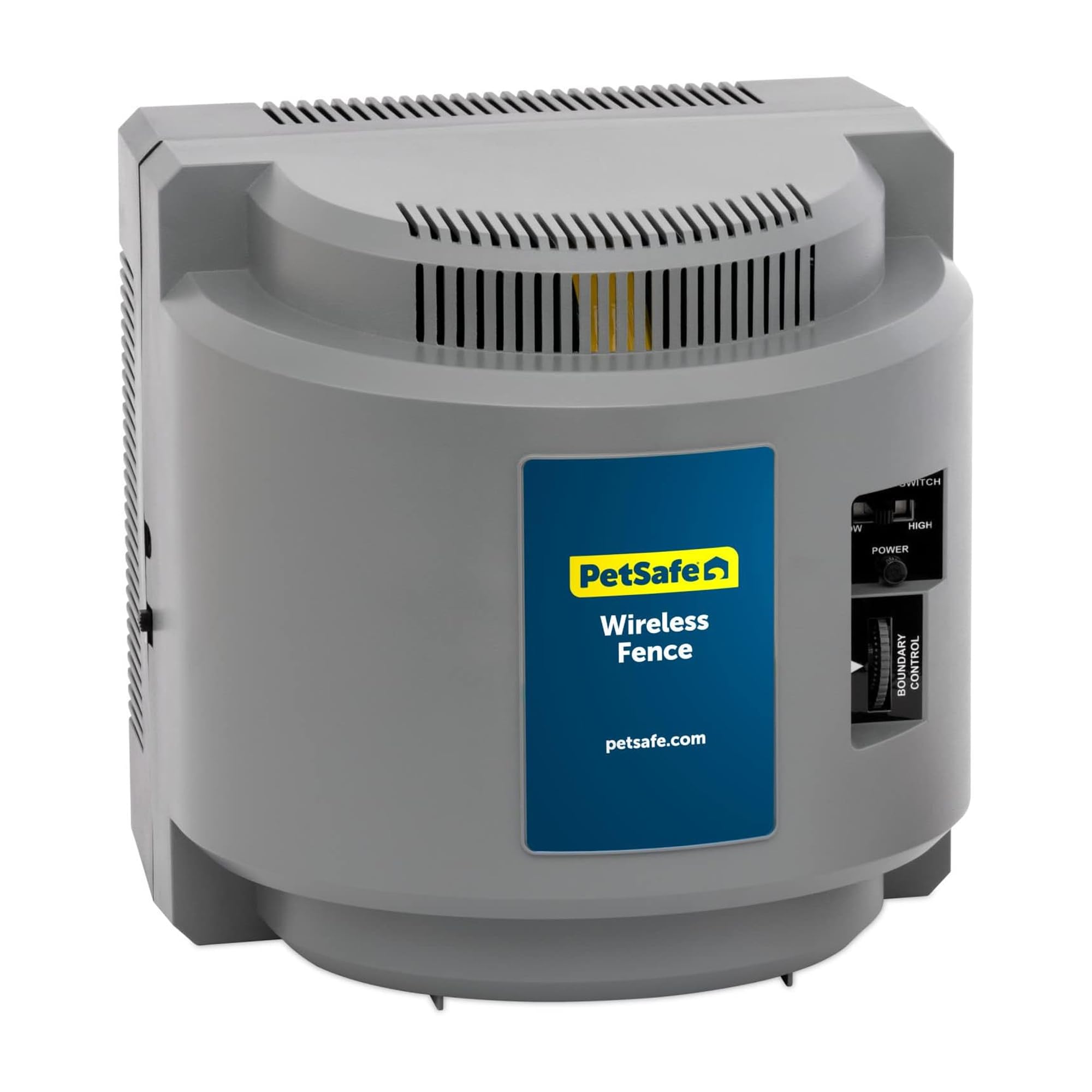
The PetSafe IF-100 is an extra transmitter designed specifically to expand the coverage of an existing PetSafe wireless containment system. Each unit adds up to 1/2 acre of circular coverage, and owners have successfully daisy-chained multiple transmitters to cover properties up to 6 acres. One reviewer used 5 transmitters to cover a farm for a Golden Retriever, with overlapping signals that did not interfere with each other—a critical detail for irregularly shaped properties that can’t fit inside a single circular broadcast.
The system uses the same proprietary circular boundary technology as PetSafe’s main units. The transmitter is lightweight and unplugs for portability to vacation homes or RVs (outlet required). The collar receiver uses a 9-volt battery that lasts 2-3 months with typical use, significantly better than GPS collars. Owners of large and stubborn dogs (rescue dogs that previously ran through lower settings) reported that increasing the correction persistence and level was effective—the dog eventually learned to stop at the warning buzzer.
The limitation is that each transmitter requires its own power outlet and a clear line of sight for best signal propagation. The 1/2-acre per unit limitation means covering 3 acres may require 6 transmitters plus a receiver collar for each dog. The system also does not support custom shapes—it’s strictly circular. For owners who already have a PetSafe transmitter and need to cover an oddly shaped or large property, this is the most practical way to expand without buying a completely new system.
Why we love it
- Adds 1/2-acre circular coverage to existing PetSafe systems
- Multiple transmitters can be used on the same property without interference
- Portable for travel or vacation home use
Good to know
- Each transmitter covers only 1/2 acre—large properties need multiple units
- Circular boundary only, no custom shapes for irregular lots
- Requires a power outlet and clear line of sight for best coverage
7. PetSafe Stubborn Dog In-Ground Pet Fence

The PetSafe Stubborn Dog is the most budget-conscious entry into in-ground containment for large areas. It’s designed for determined dogs, with the highest static correction intensity in PetSafe’s lineup and 5 adjustable levels plus a tone + vibration mode that works well for hearing-impaired dogs. The system includes 100 feet of pre-twisted boundary wire and can be expanded with additional wire (sold separately) to cover multiple acres. The collar is waterproof to 3 feet and fits neck sizes 6-28 inches, accommodating both small and large breeds.
Owner reports confirm the system’s effectiveness for escape artists. One owner installed it along a 3-acre border after their dog was chewing through a chain-link fence; the wire was initially laid on the ground but had to be buried in a shallow trench after the dog chewed through segments. The twisted-pair signal neutralization works perfectly—the wire must be twisted back to the transmitter to cancel the signal inside the containment area. Another owner containing a 140-lb St. Bernard reported the dog was shocked once and never approached the boundary again.
The most persistent mechanical issue is the battery compartment. The collar uses a 9-volt battery housed behind tiny phillips-head screws that are notoriously difficult to remove without stripping. Multiple owners described a 3-5 minute battery change turning into a 45-minute struggle. The red terminal buttons on the transmitter are also fragile and prone to breaking off, though PetSafe’s customer care team has been responsive about replacing the box for free. For owners willing to work through these quirks, this is a reliable and proven in-ground fence at an entry-level price.
Why we love it
- Highest correction intensity designed specifically for stubborn, escape-prone dogs
- Unlimited dog capacity with purchase of additional collars
- Proven effectiveness for 140-lb+ dogs and 3+ acre perimeters
Good to know
- Battery compartment screws are very small and prone to stripping
- Boundary wire not included with all kits—sold separately for large areas
- Red terminal buttons on transmitter can break off with regular use
8. DJNFGQ GPS Wireless Dog Fence System (2-Pack)
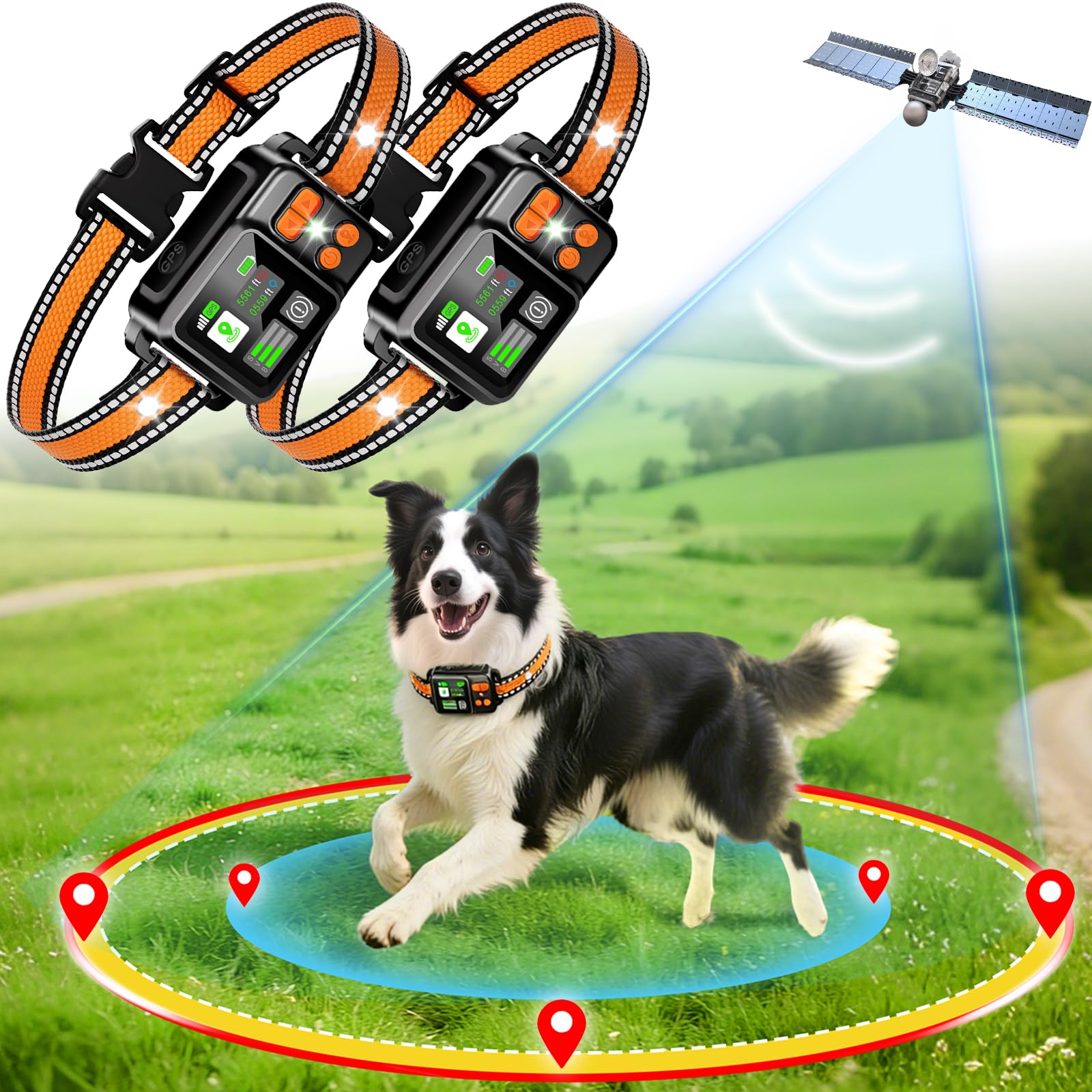
The DJNFGQ GPS Fence system is an ultra-entry-level GPS containment solution that ships with two collars in the box. It supports both circular (49-ft to 6,561-ft radius) and custom polygonal fence shapes, giving you the flexibility to match irregular property lines. The collars are IPX7 waterproof, rechargeable (3-hour full charge for ~24 hours of operation), and adjustable for medium-to-large dogs. The setup is straightforward—the user selects a center point and radius for circular mode, or places multiple vertices for a free-form boundary.
Owner reports highlight the ease of setup and the immediate training effect. One owner in a rural area used the custom boundary to match their property shape, and their dog learned to stop at the beep after one or two corrections. The system uses GPS satellite signals only (no cell or Wi-Fi needed), making it suitable for remote locations where other systems might fail. The two-pack configuration is a significant value add for multi-dog households that would otherwise need to buy a second collar separately.
The main drawbacks are the GPS drift (approximately 10 feet) and occasional false alerts. The collar lacks a button lock, so dogs can accidentally change settings by rubbing the collar against objects. The beep tones for boundary entry, collar power-on/off, and GPS signal loss all sound the same, which can confuse a dog during training. The manufacturer has been responsive to firmware feedback, planning chip upgrades and button lock improvements. For a budget-friendly two-collar GPS system for a mid-sized property (1-5 acres), this is a functional starting point.
Why we love it
- Two collars included at a single-collar price point
- Both circular and custom polygonal fence modes for irregular lots
- IPX7 waterproof and 24-hour battery life per charge
Good to know
- GPS drift of about 10 feet requires a safety buffer zone
- No button lock—dogs can accidentally change settings
- Single beep tone used for multiple functions, confusing for training
9. Jhsomdr Dog Playpen 40 Inch 36 Panels
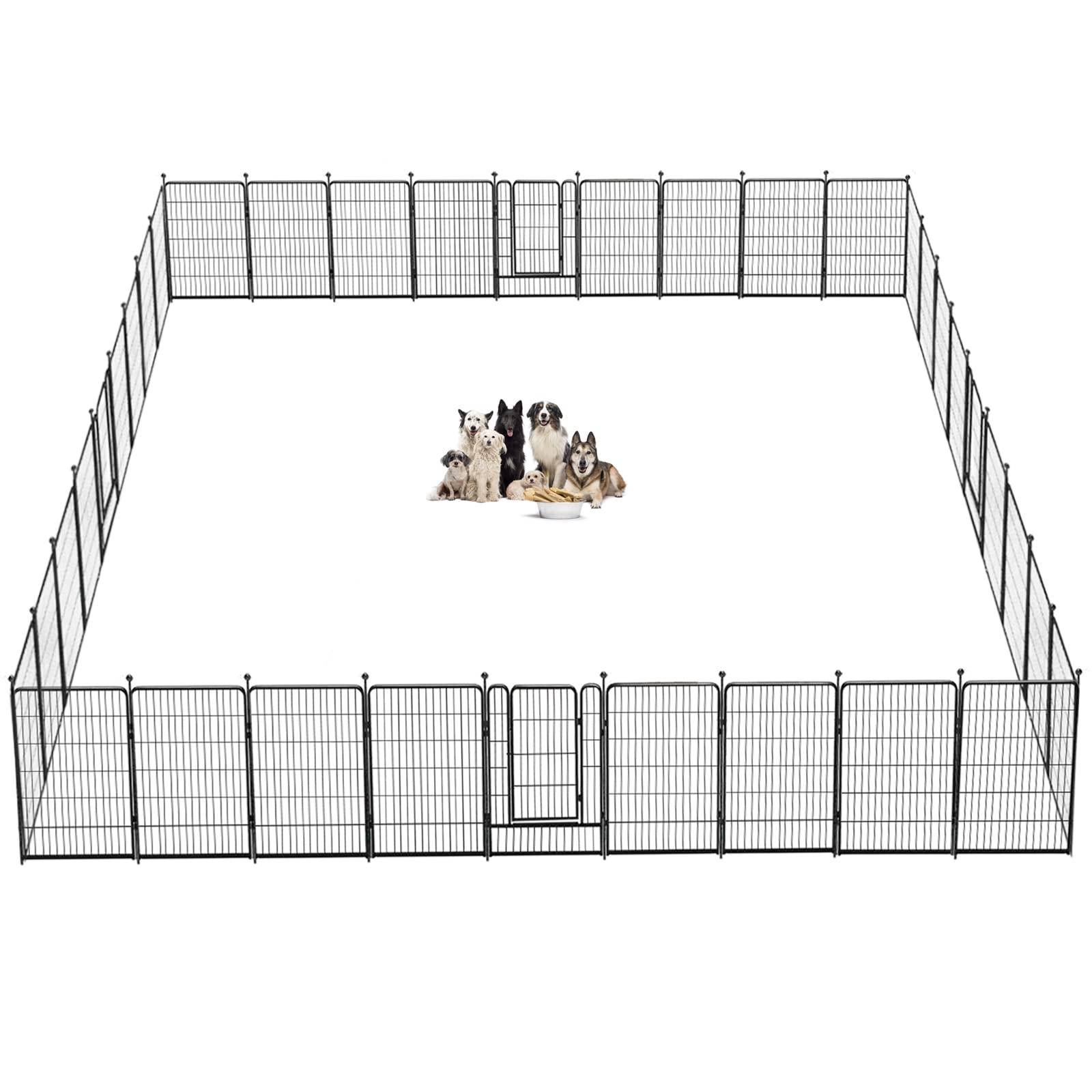
This heavy-duty physical playpen is the only 100% foolproof containment solution on this list—it has no electronics, no batteries, no signal drift, and no subscription. The 36-panel kit provides a maximum area of 669 square feet (roughly 26×26 ft) with 40-inch height panels, making it suitable for large breeds up to 110 lbs. The panels are made of thickened steel wire with a double-layer rust-proof and waterproof coating. The rod-connection design allows free shaping (square, rectangle, octagon) and easy disassembly for portability.
Owner reports emphasize the surprising sturdiness of the assembly. One owner containing a 110-lb Shepherd recovering from ACL surgery found the pen stable even when the dog pushed against it. Another owner with two dogs, one being an escape-prone digger, reported the heavy-gauge metal panels withstood weeks of barking and running without bending. The ground stakes and anti-slip foot pads provide decent stability on grass, though owners recommended driving the stakes deeper in soft soil. The automatic door lock latches securely and prevents determined dogs from popping the gate open.
The primary limitation is that 669 square feet is a fraction of even a small yard—this is not a replacement for a full-boundary containment system. It is a temporary or supplementary enclosure for supervised outdoor time, travel, or post-surgery confinement. The 40-inch height may not be sufficient for athletic jumpers like Belgian Malinois or athletic Huskies, who could clear it. For owners who need a zero-tech, guaranteed-safe space for large dogs on a deck, in a camping site, or for recovery, this physical pen is the most reliable option.
Why we love it
- Zero electronics required—no signal, battery, or subscription concerns
- Heavy-duty steel with rust-proof coating withstands large dog pressure
- Easy assembly, free-form shaping, and portable for travel
Good to know
- Maximum 669 sq ft is too small for full-yard containment
- 40-inch height may not contain athletic jumping breeds
- Ground stakes needed for outdoor stability on soft ground
FAQ
How much acreage can a wireless dog fence cover without physical wire?
Can I use a GPS dog fence if my property has no cellular service?
What is the difference between a warning zone and a correction zone in a GPS fence?
How long does training take for a large area wireless fence?
Will a wireless fence work in snowy or heavily wooded areas?
Final Thoughts: The Verdict
For most gardeners, the wireless dog fence for large area winner is the SportDOG Contain + Train System because it combines proven in-ground reliability with the flexibility of a handheld training remote, all expandable to 100 acres. If you want GPS tracking and containment without wires, grab the Dogtra Pathfinder 2 for its industry-leading 9-mile range and no-subscription e-fence. And for budget-conscious owners who need a simple GPS entry point, nothing beats the DJNFGQ GPS System with two collars included at a single-collar price.