
Watching your horse rub raw against a fence or gnaw at its own tail is a clear sign the lice have taken hold. But grabbing just any insecticide risks wasting time while these wingless pests keep multiplying, leaving your mount miserable and your pastures infested. The right formula delivers contact kill, residual protection, and coat safety all at once.
I’m Mo Mahin — the founder and writer behind Furric. I’ve spent years cross-referencing entomology data against owner-reported outcomes to separate fly-by-night remedies from actual veterinary-grade solutions for equine ectoparasites.
After sifting through dozens of active-ingredient profiles, permethrin concentrations, and hundreds of verified stable reports, I’ve filtered the field down to the most effective candidates for a true horse lice treatment that balances safety with efficacy.
How To Choose The Best Horse Lice Treatment
Lice are host-specific and spread fast through shared tack, blankets, and fence posts. The wrong product may paralyze a fly but leave a louse egg intact. You need a treatment designed to break the full life cycle while respecting your horse’s dermal sensitivity.
Active Ingredient & Concentration
Permethrin at 0.5% to 1% is the standard on-animal kill rate for lice. Lower concentrations found in general fly sprays may suppress adult lice but fail against nymphs. Look for products listing permethrin as the primary active — and verify the percentage on the label.
Residual & Reapplication Frequency
Lice eggs (nits) resist most contact sprays. Even if you kill every adult louse today, nits hatch in 7–14 days. Treatments with six or more days of residual protection buy you enough time to spray again before the next generation matures, breaking the cycle in two applications.
Carrier: Oil vs. Water Base
Oil-based formulas (lanolin, citronella) adhere to the coat longer and condition the hair, which helps in dry climates. Water-based formulas dry fast and irritate sensitive skin less, but they may require more frequent reapplication after sweating under a blanket.
Quick Comparison
On smaller screens, swipe sideways to see the full table.
| Model | Category | Best For | Key Spec | Amazon |
|---|---|---|---|---|
| Pyranha Nulli-Fly | Ready-to-Use | Sensitive skin / daily use | Permethrin water‑based, no shake | Amazon |
| Farnam Bronco Gold | Oil‑Based | Dry coats / shine + lice kill | Permethrin + lanolin, citronella | Amazon |
| Neogen Insectrin X | Concentrate | Large barn / multicrop farms | 10% permethrin concentrate | Amazon |
| Durvet Permethrin EC 10% | Concentrate | Budget / versatile farm use | 10% permethrin concentrate | Amazon |
| Bonide Revenge Barn & Stable | Concentrate | Premise + on‑animal combo | 13.3% permethrin concentrate | Amazon |
In‑Depth Reviews
1. Pyranha Nulli-Fly Horse Fly Spray – Water-Based

The Pyranha Nulli-Fly is engineered for horses that flinch at the first puff of an oil-based aerosol. Its water carrier dries fast, leaving no greasy film that attracts dust, which is critical when treating lice in dry, arid turnouts. The formula stays evenly mixed without shaking, so every spray delivers a consistent permethrin dose to kill lice on contact.
Stable owners report that this spray holds residual repellency against lice and ticks for roughly 24 hours in moderate weather. The citronella scent is mild enough that sensitive horses actually lean into the application instead of pinning their ears — a real advantage when you’re treating a full barn twice during the egg-hatch window.
Because it’s ready to use, there is no dilution guesswork. You lose the cost-per-gallon advantage of a concentrate, but you gain immediate, uniform coverage across your herd. For a boarding operation where every horse reacts differently, this consistency is worth the premium.
Why we love it
- Water-based formula dries clear and dust-repelling
- Gentle enough for horses with prior skin reactions
- Pre-mixed, no shaking or dilution errors
Good to know
- Higher per-ounce cost than concentrates
- Residual declines noticeably in heavy sweat
2. Farnam Bronco Gold 2-in-1 Horse Fly Spray
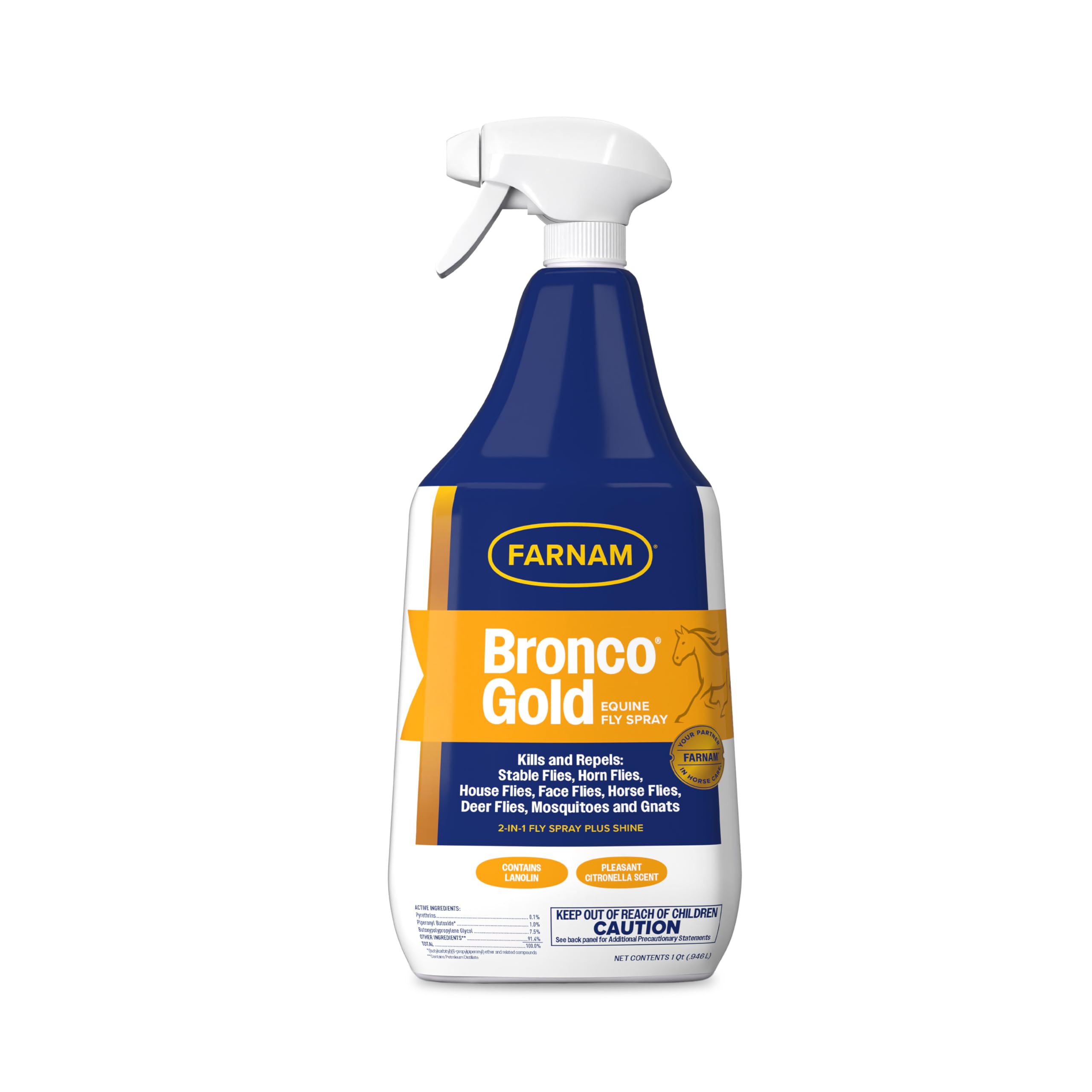
Farnam Bronco Gold merges lice-killing permethrin with lanolin and citronella to tackle both the infestation and a brittle winter coat. The oil base adheres to the hair shaft longer than water sprays, which is essential when treating lice that hide deep in the mane and tail base.
Owner feedback consistently highlights that this formula lasts up to two days in moderate heat, but requires thorough shaking before each application to emulsify the oil layer. Without shaking, the lanolin can concentrate in the first spritz and cause a greasy patch that some horses rub against — negating the treatment.
The ready-to-use spray makes reapplication during the 7-14 day nit hatch simple. A 32 oz bottle covers one horse for roughly a week of twice-daily light spraying. The citronella scent is strong but tolerable, and most horses grow accustomed after two applications.
Why we love it
- Lanolin soothes and conditions dry, louse-irritated skin
- Superior adhesion to mane and tail hair
- Two-day residual in normal conditions
Good to know
- Must shake vigorously before every use to avoid hot spots
- Strong citronella odor may linger on hands
3. Neogen Insectrin X – 32 Ounce Concentrate
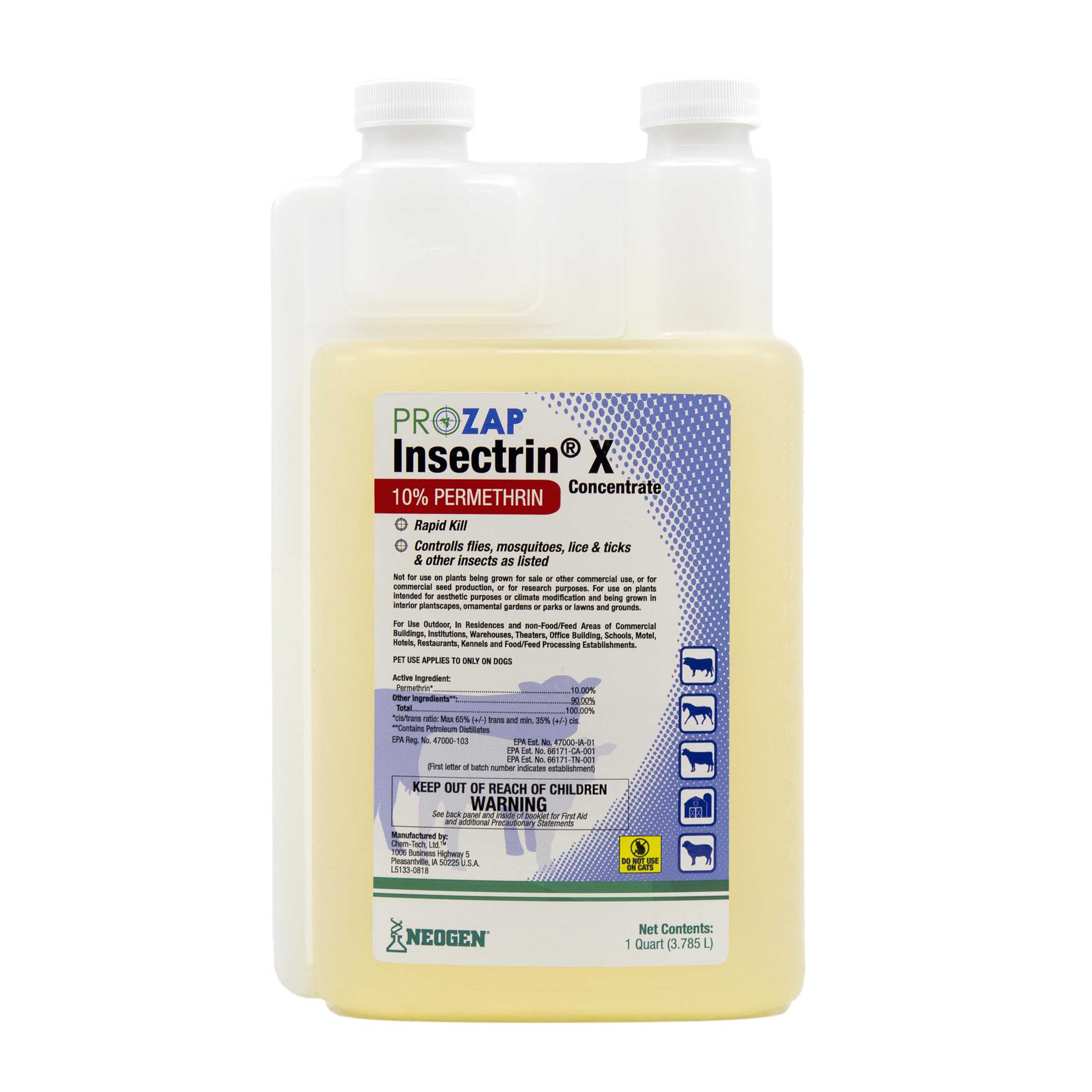
Insectrin X hits the 10% permethrin threshold that entomology guides recommend for breaking hard-to-shift louse populations. As a concentrate, one 32 oz bottle dilutes into gallons of on-animal spray (1 oz per quart of water), giving a multi-horse barn weeks of supply at a fraction of ready-to-use sticker shock.
The residual action is the strongest in this lineup — owners report effective knockdown of lice, mites, and ticks for up to a week after a single thorough soak. The trade-off is the chemical odor, which is noticeably stronger than water-based alternatives and persists on tack and stall walls for hours.
Application precision matters because the 10% concentration can cause white burns on soft vegetation and skin irritation if used undiluted. Dilute strictly per the livestock rate (1 oz per quart), wear gloves, and avoid direct contact with your horse’s eyes, nostrils, and genital area.
Why we love it
- Excellent residual action against lice and mites
- Economical for multiple horses and premise spraying
- Approved for livestock, poultry, and premise use
Good to know
- Strong persistent chemical odor
- Requires careful dilution to avoid skin irritation
4. Durvet Permethrin EC 10%

Durvet Permethrin EC 10% serves the same base chemistry as Neogen Insectrin X but in a smaller 16 oz bottle and at a lower per-milliliter cost. It’s a straight permethrin emulsifiable concentrate — no added conditioners, no scents, no frills — aimed at farm operators who already stock dilution bottles and sprayers.
Because lice are slow-moving and dose-sensitive, the 10% strength gives you the flexibility to mix a strong spot treatment (2 oz per quart) for a severe mane infestation or a lighter whole-body rinse (0.5 oz per quart) for routine knockdown. The concentrate is also safe for premise spraying on stall walls and blankets, breaking the louse cycle in the environment.
A few users note the strong chemical smell, which is typical for high-percentage permethrin solutions. This product also kills beneficial insects (bees, butterflies) if sprayed indiscriminately outdoors, so confine application to the barn and the horse’s body.
Why we love it
- Extremely cost-effective for large or repeated applications
- Flexible dilution for body, spot, or premise use
- Trusted livestock manufacturer with consistent potency
Good to know
- No added skin conditioners; can dry the coat
- Strong odor requires ventilation during application
5. Bonide Revenge Barn & Stable Fly Spray Concentrate

Bonide Revenge carries the highest permethrin percentage in this roundup at 13.3%, making it a formidable weapon for simultaneous on-animal and premise use. It’s labeled for horses, beef and dairy cattle, goats, sheep, swine, poultry, and dogs, which is useful for mixed-species farms where lice can lurk on shared equipment.
Reviews are split between users who spray it directly on horse coats to combat flies and those who rely on it for stall and manure-pile treatment. For lice specifically, the concentrate is best diluted to the on-animal rate and applied as a full-body drench, then used full-strength as a stall spray to hit nits hiding in bedding crevices.
The main weakness is inconsistency in louse-specific reviews — several buyers found it effective for general fly suppression but noted that heavy louse infestations required multiple applications at 7-day intervals. This is not a precision louse tool; it’s a high-volume farm spray that can handle lice when applied systematically.
Why we love it
- Highest permethrin content at 13.3%
- Multi-species label simplifies farm-wide treatment
- Effective for both on-animal and premise spraying
Good to know
- Not a dedicated louse formulation; requires strategic reapplication
- Some users report limited efficacy against heavy fly loads without repeat spraying
FAQ
Can I use a general fly spray as a horse lice treatment?
How often should I retreat my horse for lice?
Is permethrin safe for pregnant mares or foals?
Why does my horse still rub after treatment?
Final Thoughts: The Verdict
For most horse owners, the horse lice treatment winner is the Pyranha Nulli-Fly because its water-based carrier kills lice reliably without irritating sensitive skin or attracting dust. If you prioritize a long-lasting residual that conditions a dry winter coat at the same time, grab the Farnam Bronco Gold. For multi-horse barns or farms that need to treat both animals and stalls on a budget, nothing beats the economy and versatility of Neogen Insectrin X concentrate.