
A seed-heavy diet is the single fastest route to fatty liver disease and feather-plucking in conures. The solution lies in a nutritionally complete, formulated pellet that mimics the balanced intake wild parrots forage for. But not all pellets are created equal — some are packed with GMO corn fillers and synthetic vitamins that offer empty calories.
I’m Mo Mahin — the founder and writer behind Furric. I’ve spent years analyzing ingredient panels, studying avian nutritional data, and cross-referencing owner feedback to separate the genuinely healthy pellet formulas from the marketing fluff.
Whether you’re weaning a stubborn sun conure off seeds or maintaining a senior green-cheek’s vitality, finding the right pellets for conures means prioritizing organic ingredients, appropriate pellet size, and species-specific protein ratios.
How To Choose The Best Pellets For Conures
Conures have fast metabolisms and a natural instinct to crack seeds, which makes switching to a uniform pellet challenging. The right pellet must be small enough to fit their beak (typically 3/32″ to 1/8″) and dense enough in protein (14–18%) to support their active lifestyle. Here’s what to scrutinize on the back of the bag.
Ingredient Purity: Corn & Soy Fillers vs. Whole Foods
The first ingredient should never be ground corn or soybean meal — these are cheap GMO fillers that spike blood sugar and contribute to obesity. Look for whole grains like hulled millet, oat groats, or quinoa as the base, followed by visible dehydrated vegetables and legumes. TOP’s Parrot Food is the only major brand that is completely corn-free and USDA Organic.
Pellet Size & Shape: Why Mini Matters
A 3/32″ mini pellet is ideal for green-cheeked and sun conures. Pellets that are too large (like standard 1/4″ cockatiel sizes) get broken apart and wasted, while dust-sized crumbles fail to satisfy the bird’s natural foraging instinct. The Mazuri Small Bird pellet uses a mixed particle size specifically to encourage picking and sorting behavior.
Preservation Method: Cold-Pressed vs. Extruded
Extruded pellets (like Psittacus and Mazuri) are cooked under high heat and pressure, which kills bacteria but can degrade heat-sensitive vitamins like B-complex and vitamin C. Cold-pressed pellets (like TOP’s) are formed without heat, preserving the natural enzyme profile of the ingredients. If your conure has a history of digestive sensitivity, cold-pressed is the safer bet.
Omega-3 & Vitamin E for Feather Health
Sun conures and jenday conures are prone to self-mutilation when stressed or nutrient-deficient. Pellets containing ground flaxseed, chia, or fish oil provide the omega-3 fatty acids (ALA/EPA) that reduce inflammation and support a glossy, intact plumage. Vitamin E acts as a natural antioxidant to protect cell membranes — look for it listed as “mixed tocopherols” in the ingredient panel.
Quick Comparison
On smaller screens, swipe sideways to see the full table.
| Model | Category | Best For | Key Spec | Amazon |
|---|---|---|---|---|
| TOP’s Parrot Food Mini Pellets | Premium | Organic, corn-free daily diet | 3/32″ cold-pressed pellet | Amazon |
| Psittacus Mini | Premium | No-GMO extruded staple | Low-fat, 100% non-GMO | Amazon |
| Kaytee Fiesta Big Bites | Mid-Range | Variety blend with foraging appeal | Assorted fruits, nuts, vegetables | Amazon |
| Mazuri Small Bird | Mid-Range | Budget-friendly all-life-stage pellet | Mixed particle size with flaxseed | Amazon |
| Vitakraft VitaSmart Conure | Entry-Level | Seed-based introduction to formulated food | Includes real vegetables & chili | Amazon |
In‑Depth Reviews
1. TOP’s Parrot Food Mini Pellets
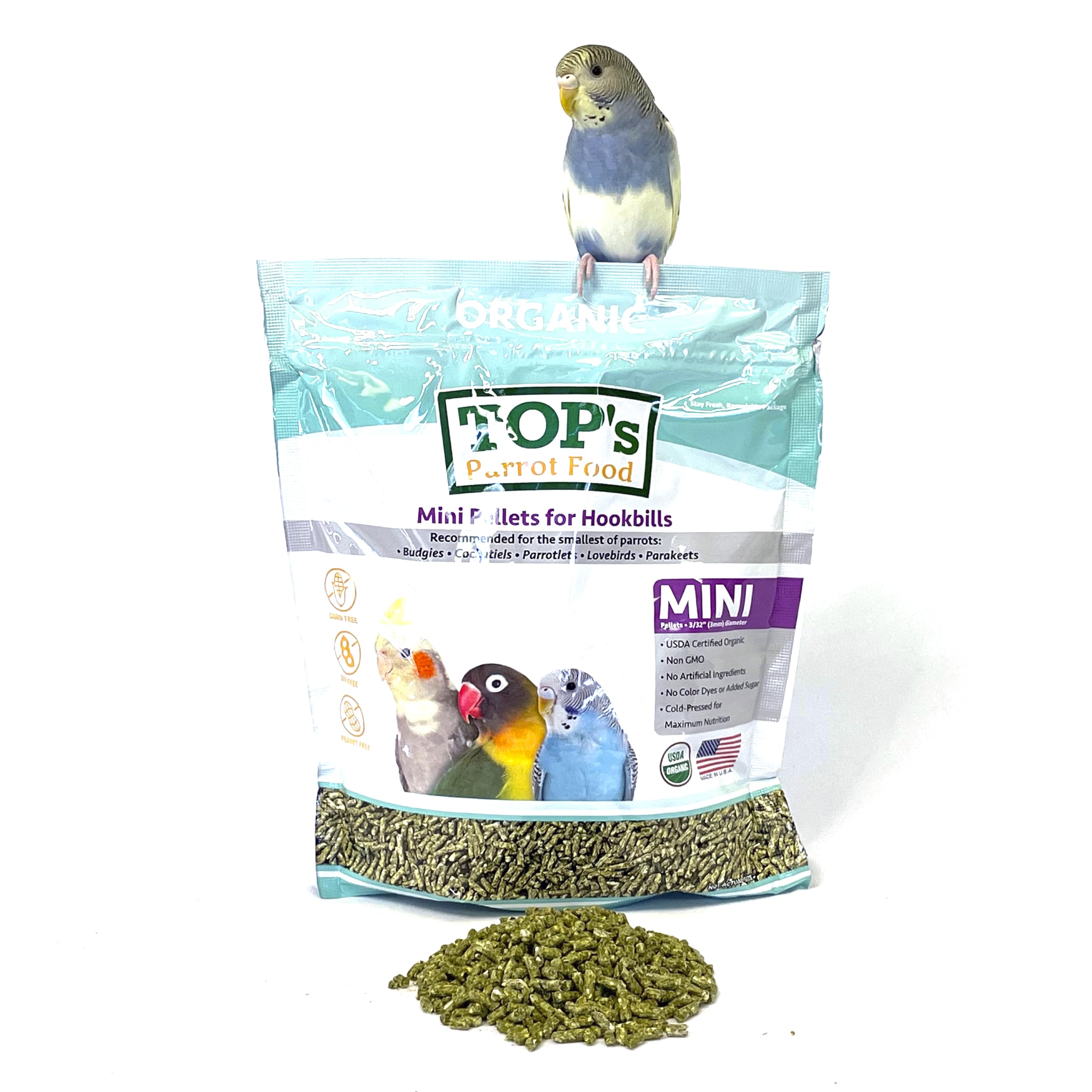
TOP’s is the only USDA Certified Organic, corn-free complete pellet on this list — and it’s cold-pressed, meaning the vitamins and live enzymes survive the manufacturing process intact. The 3/32″ mini size is spot-on for green-cheeked, sun, and jenday conures, leaving virtually zero waste compared to larger pellets that get crumbled into dust. Owner reports confirm that even seed-addicted conures accept TOP’s within two weeks when mixed with their old food and gradually increased.
The ingredient list reads like a human health food label: hulled millet, oat groats, quinoa, alfalfa, rose hips, and rosemary extract as a natural preservative. There are zero artificial colors, flavors, or BHA/BHT — just the natural green and brown tones of whole grains. The 1 lb bag is compact, but a single 4 lb purchase lasts a solo conure 3–4 months, making the per-ounce cost competitive with mid-range extruded brands.
The one consistent criticism is pellet size: at 3/32″, some budgie owners find it too large for their parakeets, though for conures it’s nearly perfect. A minority of fussy eaters require the pellets to be lightly moistened for the first week to soften the texture. Once integrated, owners report noticeably brighter feathers and more consistent droppings.
Why we love it
- USDA Organic & completely corn- and soy-free
- Cold-pressed preserves natural nutrients
- Minimal waste due to appropriate mini size
- No artificial preservatives or colors
Good to know
- 1 lb bag is expensive upfront per ounce
- May need short wetting period for transition
- Some budgie users find pellet too large
2. Psittacus Mini

Psittacus Mini is an extruded pellet developed specifically for species that naturally consume low-fat seeds — including sun conures, green-cheeked conures, and Galah cockatoos. The 450 g bag is air-sealed for freshness, and the pellet itself has a faint fruity aroma from natural flavors rather than artificial scents. Multiple owner reviews note that Psittacus is often accepted faster than other extruded brands because of its mild smell and uniform 2 mm size.
The protein profile is 14.5%, which sits in the sweet spot for non-breeding adult conures — high enough to maintain muscle without triggering hormonal overdrive. It’s 100% non-GMO and free of synthetic antioxidants, relying instead on mixed tocopherols (vitamin E) for preservation. The manufacturer recommends it constitute 70–80% of the total diet, supplemented with fresh produce and PSITTACUS Silex Grit for mechanical digestion.
A minority of customers express concern about the ingredient depth compared to organic brands; the first ingredient is corn, which is a GMO risk in non-organic grains. However, Psittacus sources European corn verified as non-GMO, and the absence of artificial colors keeps the pellet uniform beige. The price is competitive for a premium import at roughly per pound.
Why we love it
- Specifically formulated for low-fat seed-eating species
- 100% non-GMO and no synthetic antioxidants
- Mild fruity smell aids seed-to-pellet transition
- European manufacturing quality control
Good to know
- First ingredient is corn (though verified non-GMO)
- Not suitable for breeding birds without supplementation
- Small 450 g bag — reorder frequency is higher
3. Kaytee Fiesta Big Bites

Kaytee Fiesta Big Bites is not a pure pellet — it’s a blend of extruded pellets, seeds, dried fruits (pineapple, carrot), and nuts, designed to encourage natural foraging behavior. The “Big Bites” name refers to the larger particle size suitable for conures and small parrots, and the mix includes probiotics and prebiotics for digestive support plus omega-3s for feather health. Owner reviews consistently report that sun conures and green-cheeks stay engaged with the variety, reducing boredom-related screaming.
The downside of a blended mix is selective feeding: conures will often pick out the safflower seeds and dried pineapple first, leaving the pellets behind. To counter this, many owners use Fiesta as a treat or training reward rather than a full staple, mixing it with a complete pellet like TOP’s or Psittacus. The ingredient panel lists ground corn as the first ingredient, which is typical for mass-market bird food but less ideal for owners prioritizing whole foods.
At roughly per pound (4 lb bag), it’s one of the most economical options for conure owners on a budget. The probiotics are a genuine plus for the digestive health of conures prone to yeast infections. If your conure already eats a solid pellet base and needs a boredom-busting topper, this blend adds texture and taste without breaking the bank.
Why we love it
- Engages natural foraging with varied textures
- Probiotics and prebiotics support gut health
- Excellent value for a multi-ingredient blend
- Omega-3s for feather and skin condition
Good to know
- Birds may selectively eat seeds and leave pellets
- First ingredient is ground corn
- Not a complete pellet; use as supplement
4. Mazuri Small Bird Pellets

Mazuri’s Small Bird formula uses a mixed particle size — some pellets are dust-fine, others pea-sized — which triggers the conure’s natural sifting and foraging instincts. The inclusion of ground flaxseed adds a reliable source of omega-3 ALA, which supports the feather quality that green-cheek and sun conure owners prize. At roughly per pound (2.5 lb bag), it’s the cheapest pellet on this list by raw cost.
The ingredient list is straightforward and free of artificial colors or flavors. Vitamin E is included as the primary antioxidant, which helps slow the oxidation of the flax oil. Customer feedback is overwhelmingly positive for budget-conscious multi-bird households, with many owners noting that even picky cockatiels and conures eat it readily. However, the inconsistent particle size means larger crumbs can be rejected by smaller conures, leading to some waste.
One limitation: the nutritional profile is generic “small bird” rather than conure-specific. The protein sits around 14%, which is fine for maintenance but may be slightly low for active sun conures or breeding pairs. If you’re looking for the cheapest way to transition a flock of conures to a pellet-based diet, this is the most practical starting point — just plan to supplement with fresh greens and vegetables for complete nutrition.
Why we love it
- Lowest cost per pound of any pellet reviewed
- Ground flaxseed provides natural omega-3 source
- Mixed particle sizes encourage natural foraging
- No artificial colors or flavors
Good to know
- Generic formula not optimized for conure metabolism
- Larger crumbs rejected by some birds
- Higher waste percentage than uniform mini pellets
5. Vitakraft VitaSmart Conure & Small Parrot Food

Vitakraft VitaSmart is a seed-heavy blend that includes a small percentage of extruded pellets, real dried vegetables (bell pepper, carrot, chili), and grains like millet and flaxseed. It’s specifically formulated to include chili pepper, which birds metabolize without heat sensation but which deters mammals and insects — a clever storage advantage. For conure owners who have tried multiple pellets and been rejected, this mix offers a halfway point that still looks familiar to a seed-addicted bird.
The ingredient panel shows safflower seeds as a major component — a healthier fat source than sunflower seeds, but still a seed. The extruded pellets make up only about 20% of the bag by volume, so it cannot serve as a complete pellet diet. Owners report that conures love the variety, with many birds eating the seeds first and leaving the pellets behind. The best use case is as a transitional mix: blend with a complete pellet like TOP’s or Psittacus, slowly reducing the ratio over 4–6 weeks.
At roughly per pound, it’s the cheapest option by weight, and the long 180-year heritage of Vitakraft provides consistency. If your conure is still on a 100% seed diet and refuses extruded pellets, this mix can start the weaning process without causing hunger strikes. Just know that it’s a stepping stone, not a destination.
Why we love it
- Excellent bridge for seed-addicted conures
- Chili pepper deters pests and adds natural variety
- Low in sunflower seeds — healthier fat profile
- Very low cost per pound
Good to know
- Predominantly seed-based, not a complete pellet
- Birds selectively eat seeds, wasting pellets
- Must be used as a transitional blend, not staple
FAQ
What size pellet is best for a sun conure?
Can I feed my conure only pellets without fresh food?
How do I know if a pellet brand uses GMO ingredients?
My conure only eats the seeds from a blend — what should I do?
Are cold-pressed pellets better than extruded pellets for conures?
Final Thoughts: The Verdict
For most conure owners, the pellets for conures winner is the TOP’s Parrot Food Mini Pellets because it’s the only USDA Organic, corn-free, cold-pressed formula that provides complete nutrition without fillers or synthetic preservatives. If you want a proven European extruded pellet with a mild fruity scent that aids seed-to-pellet transition, grab the Psittacus Mini. And for budget-conscious multi-bird households seeking a reliable all-life-stages pellet, nothing beats the value of Mazuri Small Bird.