
Shedding season never ends when you share your home with a furry friend. Every day brings a fresh layer of hair, dander, and debris that sticks to carpets, clings to baseboards, and drifts into corners — and a traditional vacuum means dragging a heavy machine out of the closet daily. A self-emptying robot vacuum built for pet hair changes that routine: it roams your floors on autopilot, collects the fur, and empties itself into a base you only touch once every few weeks.
I’m Mo Mahin — the founder and writer behind Furric. I spend my time dissecting manufacturer spec sheets, analyzing owner feedback across hundreds of units, and comparing real-world cleaning data to help pet owners find a robot that actually handles the hair load without breaking the bank.
After researching dozens of models with LiDAR navigation, self-emptying bases, and anti-tangle brush systems, I’ve sorted through the specs to flag the top performers. This guide covers the affordable robot vacuum for pet hair options that deliver reliable daily cleaning without the premium price tag.
How To Choose The Best Affordable Robot Vacuum For Pet Hair
Not every robot vacuum on the market handles the unique demands of a pet-owning household. Hair strands wrap around roller brushes, dander clogs standard filters, and low-cost units often skim debris rather than lifting embedded fur from carpet fibers. Focusing on a few specific specs ensures you get a machine that keeps up with daily shedding rather than leaving you frustrated.
Suction Power and Floor Type Compatibility
Pet hair on hard floors is easy: any 2,000 Pa unit picks it up. The real test is carpet — especially medium-pile or Berber where hair embeds deep into the fibers. Models rated at 4,000 Pa or higher (like the 5,000 Pa and 6,000 Pa units in this list) create enough airflow to pull embedded fur loose during a single pass. If your home mixes tile and low-pile rugs, a 4,000 Pa unit works fine. If you have thicker carpets, aim for at least 5,000 Pa.
Anti-Tangle Brush System
The number-one headache pet owners report is cutting hair off the roller brush every few days. Anti-tangle designs vary: some use a rubber spiral brush that sheds hair naturally, others pair an asymmetrical side brush with a specialized main brush to prevent wrap. A 0% hair-tangling certified brush saves you from regular maintenance. If the brush is a standard bristle or a basic rubber strip without anti-wrap claims, expect to clean it weekly.
Self-Emptying Base Capacity
With daily pet hair pickup, the onboard dustbin fills fast — sometimes within one or two cleaning sessions. A self-emptying base that holds 2.5 to 3 liters (roughly 60 to 90 days of debris for a single-pet home) eliminates the need to empty the robot manually. Check whether the base uses disposable bags or a bagless system. Bagless bases save ongoing costs but require emptying the base chamber into the trash, which can stir up dust. Sealed bag systems trap allergens better but need periodic refills.
LiDAR Navigation and No-Go Zones
Budget robots often rely on random bump navigation that misses spots and takes twice as long. LiDAR-based units scan the room in real time, create accurate floor maps, and clean in efficient rows. The ability to set no-go zones or virtual walls via the app is essential for pet owners: you can block off the water bowl area, the dog bed zone, or a rug you don’t want mopped. Multi-floor mapping (saving up to 4 or 5 maps) is a bonus if you have a multi-level home.
Battery Runtime and Recharge/Resume
A 150-minute runtime covers roughly 1,500 to 1,800 square feet on standard suction. If your home is larger, look for models with auto-recharge-and-resume — the robot returns to the dock, recharges, then picks up cleaning exactly where it stopped. This feature is non-negotiable for homes above 2,000 square feet. For small apartments (under 1,000 square feet), a 120-minute runtime with no resume function still works because the robot can finish the whole floor on one charge.
Quick Comparison
On smaller screens, swipe sideways to see the full table.
| Model | Category | Best For | Key Spec | Amazon |
|---|---|---|---|---|
| roborock Qrevo QV 35A | Premium | Auto-mop washing & top-tier suction | 8,000 Pa suction | Amazon |
| Bissell FlexClean FurForce 4270L | Premium | Pet hair pickup with liftable mop pad | 2X stronger suction at motor | Amazon |
| Shark PowerDetect AV2820S | Premium | Self-emptying bagless base & object detection | NeverStuck Technology | Amazon |
| roborock Q7 M5+ | Mid-Range | Dual anti-tangle & 10,000 Pa suction | 10,000 Pa suction | Amazon |
| Shark Navigator RV2120AE | Mid-Range | Bagless self-emptying & object detection | 60-day bagless base | Amazon |
| ILIFE A30 Pro | Mid-Range | Long-term hands-free with five dust bags | 5,000 Pa suction | Amazon |
| Kilgone Robot Vacuum | Value | LiDAR mapping at a budget-friendly price | 6,000 Pa suction | Amazon |
| Tikom L8000 Plus | Value | Large 3L self-emptying base | 6,000 Pa suction | Amazon |
| eufy C10 | Value | Ultra-slim design for low furniture clearance | 2.85-inch height | Amazon |
In‑Depth Reviews
1. roborock Qrevo QV 35A

The roborock Qrevo QV 35A sits at the top of this list because it delivers premium features — 8,000 Pa HyperForce suction, a tangle-free brush system, and a fully automatic dock that washes and dries the mop pads — at a mid-range price that undercuts most high-end competitors. For pet owners, the 0% hair tangling rate on the asymmetrical side brush means you never break out scissors to extract long hair. The full-rubber spiral main brush further prevents wrap, so daily cleaning with a heavy-shedding dog or cat won’t grind the roller to a halt.
The all-in-one dock is where this model separates itself from cheaper alternatives. The 2.7-liter sealed dust bag lasts 7 to 9 weeks between changes, the 4-liter clean water tank covers up to 3,552 square feet of mopping, and the dock automatically washes the rotating mop pads with hot water and then dries them — a feature normally reserved for models costing hundreds more. Reactive Tech obstacle avoidance uses structured light to detect shoes, charging cords, and pet bowls, then navigates around them without bumping. The 10-millimeter mop lift keeps the wet pads off low-pile carpets, which is essential if you have a mix of rugs and hard floors.
The Roborock app offers granular control: custom routing, per-room scheduling, no-go zones, and map management for up to four floors. One minor limitation is that it works only with 2.4 GHz Wi-Fi, and the 180-minute battery on standard suction covers most homes without needing the recharge-and-resume function. For daily pet hair pickup on carpets and hard floors with the convenience of a self-maintaining dock, the QV 35A is the strongest overall value on this list.
Why we love it
- 8,000 Pa suction lifts embedded pet hair from medium-pile carpets in one pass
- Dock auto-washes and dries mop pads for true hands-off mopping
- SGS-certified 0% hair tangling brush system eliminates weekly maintenance
Good to know
- Dock footprint is large — needs a dedicated floor space of about 17 by 23 inches
- Only supports 2.4 GHz Wi-Fi networks; no 5 GHz compatibility
2. Bissell FlexClean FurForce 4270L
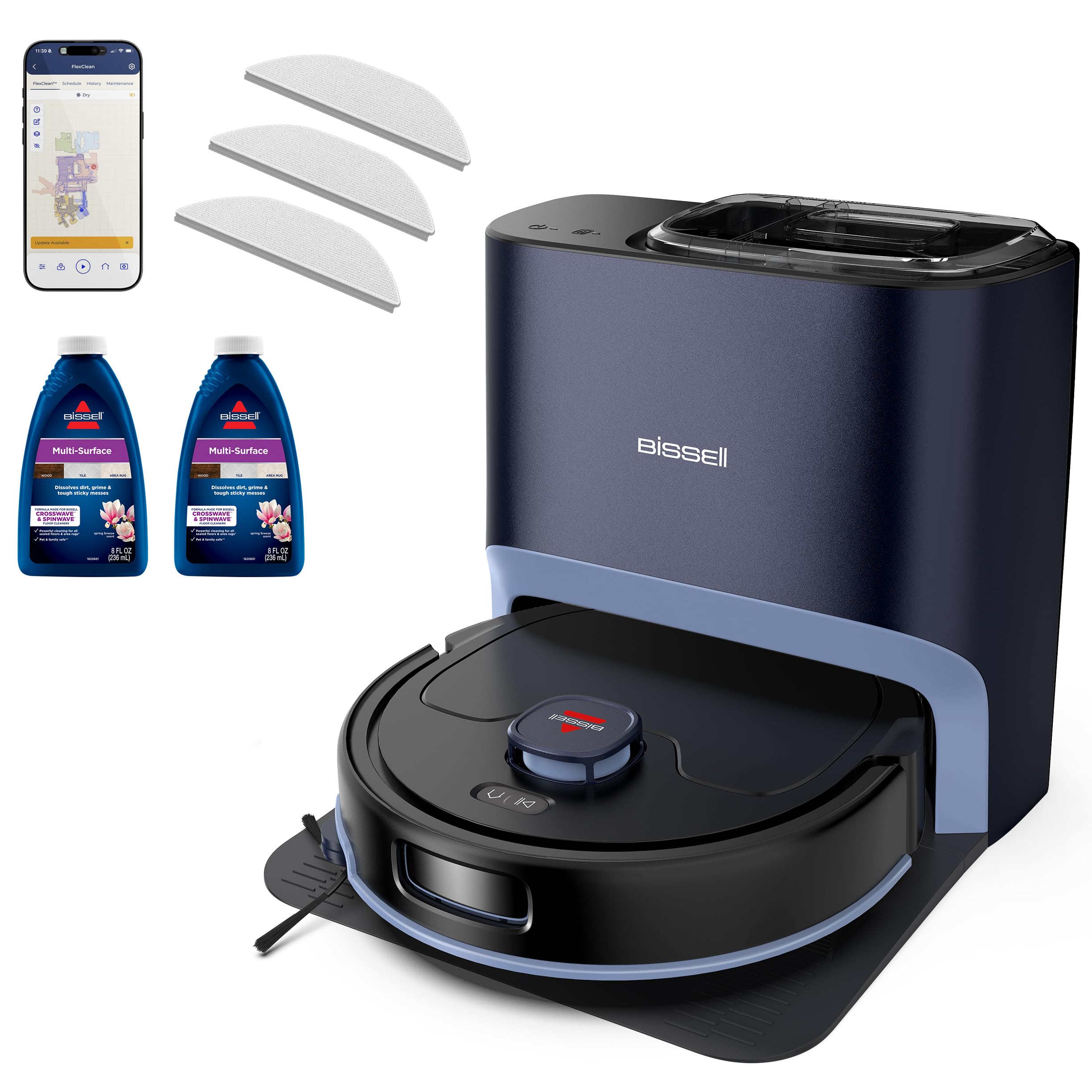
Bissell designed the FlexClean FurForce specifically with pet households in mind, and it shows in the details. The motor delivers 2X stronger suction at the source compared to previous Bissell robot models, translating to up to 30% more hair pickup on hard floors and low-pile carpets. The NeverTangle brush roll uses a specialized rubber-and-bristle pattern that prevents hair from spiraling around the axle — a common failure point on standard rollers. In daily use, you can run this unit for a week without having to pull a single dog hair off the brush.
One of the most practical features for mixed-floor homes is the liftable mop pad. When the robot detects a rug or carpet, the entire mop module raises off the surface so the wet pad doesn’t soak your wool rug or leave damp streaks on low-pile carpet. The 360React LiDAR navigation maps your home in a single cleaning cycle, and the app lets you set no-mop zones around area rugs and no-go zones near pet bowls. The bagless self-empty base holds up to 8 weeks of debris and uses HEPA filtration that captures 99.97% of particles at 0.3 microns — a significant benefit if someone in your home has pet-dander allergies.
The 180-minute runtime on standard mode gives you enough battery to handle a 2,500-square-foot home on a single charge. The dock doesn’t wash the mop pads automatically (unlike the roborock QV 35A), so you’ll need to remove and rinse the pads manually every few days. But for a pet-specific robot that prioritizes hair pickup and carpet-safe mopping, the FlexClean FurForce is a well-engineered option that justifies its premium tier.
Why we love it
- Liftable mop pad prevents wetting rugs and carpets automatically
- HEPA filter in the docking station traps pet dander and dust particles
- NeverTangle brush roll stays hair-free through heavy shedding periods
Good to know
- Mop pad must be removed and hand-rinsed — no auto-wash in the dock
- Full mopping features require the app; physical button controls are limited
3. Shark PowerDetect AV2820S

The Shark PowerDetect AV2820S focuses on eliminating the two biggest frustrations pet owners face: the robot getting stuck under furniture and the cost of replacement dust bags. The NeverStuck Technology uses a chassis that lifts and lowers autonomously to clear obstacles like rug fringe, low-clearance sofa edges, and thick door thresholds up to about 0.8 inches. In real-world testing, this translates to up to 2X more coverage area per cleaning cycle compared to older Shark models, because the robot isn’t wasting battery spinning its wheels in a trapped position.
The bagless self-empty base holds 30 days of debris and doesn’t require any consumable dust bags — you simply empty the dirt cup in the base into your trash can. This is a meaningful savings over the long term if you’re replacing bags every 2 months. The DirtDetect feature automatically boosts suction when the robot senses heavy debris zones, and EdgeDetect uses air blasts to pull hair and dust from corners where pet fur tends to accumulate. True HEPA filtration in the base captures 99.97% of particles down to 0.3 microns, including pet dander that causes allergic reactions.
The 110-minute battery life is slightly shorter than some competitors, but the recharge-and-resume function allows the robot to finish a multi-room clean even if it needs a mid-session top-up. The 3D Object Detection system identifies both low-profile obstacles (charging cables, pet toys) and taller furniture legs, then routes around them. If you prefer a bagless maintenance experience and want a robot that doesn’t require rescuing from furniture traps, the PowerDetect is a solid mid-range choice.
Why we love it
- Bagless base eliminates ongoing cost of replacement dust bags
- NeverStuck chassis avoids common entrapment points under low furniture
- True HEPA filtration traps pet dander and allergens in the base
Good to know
- 110-minute runtime is lower than average for this price tier
- Emptying the base cup is messier than pulling a sealed bag
4. roborock Q7 M5+

The roborock Q7 M5+ packs the highest suction power on this list — 10,000 Pa HyperForce suction — making it the most effective option for homes with dense, high-pile carpets where pet hair embeds deep into the fibers. This raw airflow pulls out sand, dirt, and stubborn fur that standard 4,000 Pa robots leave behind after multiple passes. The upgrade from the Q5 Max+ includes a more powerful motor and refined brush geometry without a significant price jump, giving you essentially premium extraction at a mid-range cost.
The Dual Anti-Tangle system combines a JawScrapers main brush with a 0% hair-tangling side brush. The JawScrapers brush uses angled rubber scrapers that self-clean as they rotate, preventing hair from accumulating around the spindle. The side brush uses a specialized asymmetrical paddle shape that avoids hair wrap even from long-haired breeds like Golden Retrievers or Maine Coon cats. The self-emptying RockDock Plus uses sealed 2.7-liter dust bags that hold 7 to 9 weeks of debris, and the bag captures dust during disposal to minimize allergen exposure.
The PreciSense LiDAR navigation produces accurate multi-floor maps, and the mopping module includes three adjustable water flow settings. The app offers zone cleaning, no-go zones, and schedule automation. One trade-off relative to the more expensive QV 35A is the lack of automatic mop washing and drying — the mop pad stays wet after cleaning, so you’ll want to remove it between mopping sessions to avoid odors. But if raw suction power and tangle-free operation are your top priorities for carpet-heavy homes, the Q7 M5+ delivers unmatched pulling force at its price point.
Why we love it
- 10,000 Pa suction is the strongest on this list — handles high-pile carpets with ease
- Dual anti-tangle system (main brush + side brush) requires zero manual hair removal
- Sealed dust bags trap allergens during disposal
Good to know
- No auto mop washing or drying — pad must be removed and cleaned manually
- App only supports 2.4 GHz Wi-Fi; no 5 GHz connectivity
5. Shark Navigator RV2120AE

The Shark Navigator RV2120AE brings bagless self-emptying convenience into the mid-range conversation with a 60-day capacity base that requires no additional purchase of dust bags — a recurring expense that adds up over the life of a bagged robot. The bagless design means you dump the accumulated debris directly into the trash, and the base uses a pre-motor filter that you rinse periodically. For a two-dog household shedding daily, the 60-day window means you empty the base about every two months.
SmartPath navigation uses spot LiDAR technology to map the home row by row, claiming up to 1.5X more coverage than traditional Shark ION models. The object detection sensors recognize cords, pet bowls, and small toys, allowing the robot to clean without prep work — you don’t need to pick up the floor before starting a cycle. The Self-Cleaning Brushroll is engineered to directly engage both hard floors and carpets while resisting hair wrap, and the anti-hair-wrap design reduces the frequency of manual cleaning. The 120-minute battery supports recharge-and-resume, so the robot finishes even if it needs a mid-cycle charge.
The app and voice control let you start a whole-home clean or target a specific room, and the mapping interface allows room labeling and no-go zone creation. One common owner note is that the dust bin on the robot itself is small (0.22 quarts), so you’ll rely heavily on the self-emptying base to keep the robot running without interruption. If the base is full, the robot may stop mid-clean. The RV2120AE works best for homes where you remember to empty the base every 60 days and appreciate the bagless economics.
Why we love it
- Bagless base eliminates forever costs of disposable dust bags
- Spot LiDAR navigation offers accurate room mapping at this price point
- Self-Cleaning Brushroll resists pet hair wrap on carpets and hard floors
Good to know
- Robot bin is small at 0.22 quarts — depends on base for uninterrupted runs
- Pre-motor filter needs periodic rinsing to maintain suction power
6. ILIFE A30 Pro

The ILIFE A30 Pro takes the concept of “hands-free” to an extreme: it ships with five 2.5-liter dust bags, each rated to hold 8 weeks of debris, totaling up to 280 days (40 weeks) of cleaning before you need to purchase more. For pet owners who travel frequently or simply want the longest possible interval between maintenance tasks, this is a standout feature. The self-emptying station automatically vacuums the robot’s dustbin into the bag after each cleaning cycle, so you never touch the debris until the bag fills.
LiDAR navigation with the SLAM algorithm creates accurate home maps during the first cleaning pass, and the ILIFEClean app allows you to set no-go zones, virtual walls, and cleaning schedules. The 5,000 Pa maximum suction operates at four levels — Quiet (500 Pa), Standard (1,000 Pa), Strong (1,800 Pa), and Max (5,000 Pa) — so you can adjust based on floor type and noise tolerance. The 2-in-1 dustbin and water tank (200 ml each) enables simultaneous vacuuming and mopping without swapping components, which reduces the total cleaning time by about 30% compared to separate-bin designs.
The 150-minute battery on standard mode covers most single-floor layouts, and the 3.7-inch height allows it to slide under standard sofa and bed frames. Owners note that the dustbin capacity on the robot itself is small (the 200 ml bin fills quickly in a heavy-shedding home), but the self-empty base compensates by clearing it after each run. If you want a robot that you can set up and basically ignore for the better part of a year — and appreciate the long-term bag supply included — the A30 Pro delivers exceptional low-maintenance value.
Why we love it
- Five included dust bags provide up to 280 days of hands-free operation
- LiDAR navigation with SLAM algorithm creates accurate multi-floor maps
- 4-level adjustable suction allows quiet daytime cleaning or deep carpet mode
Good to know
- Robot dustbin is only 200 ml — self-empty base is essential for daily pet hair
- Mopping requires removing the mop holder or setting a no-go zone on carpet
7. Kilgone Robot Vacuum and Mop
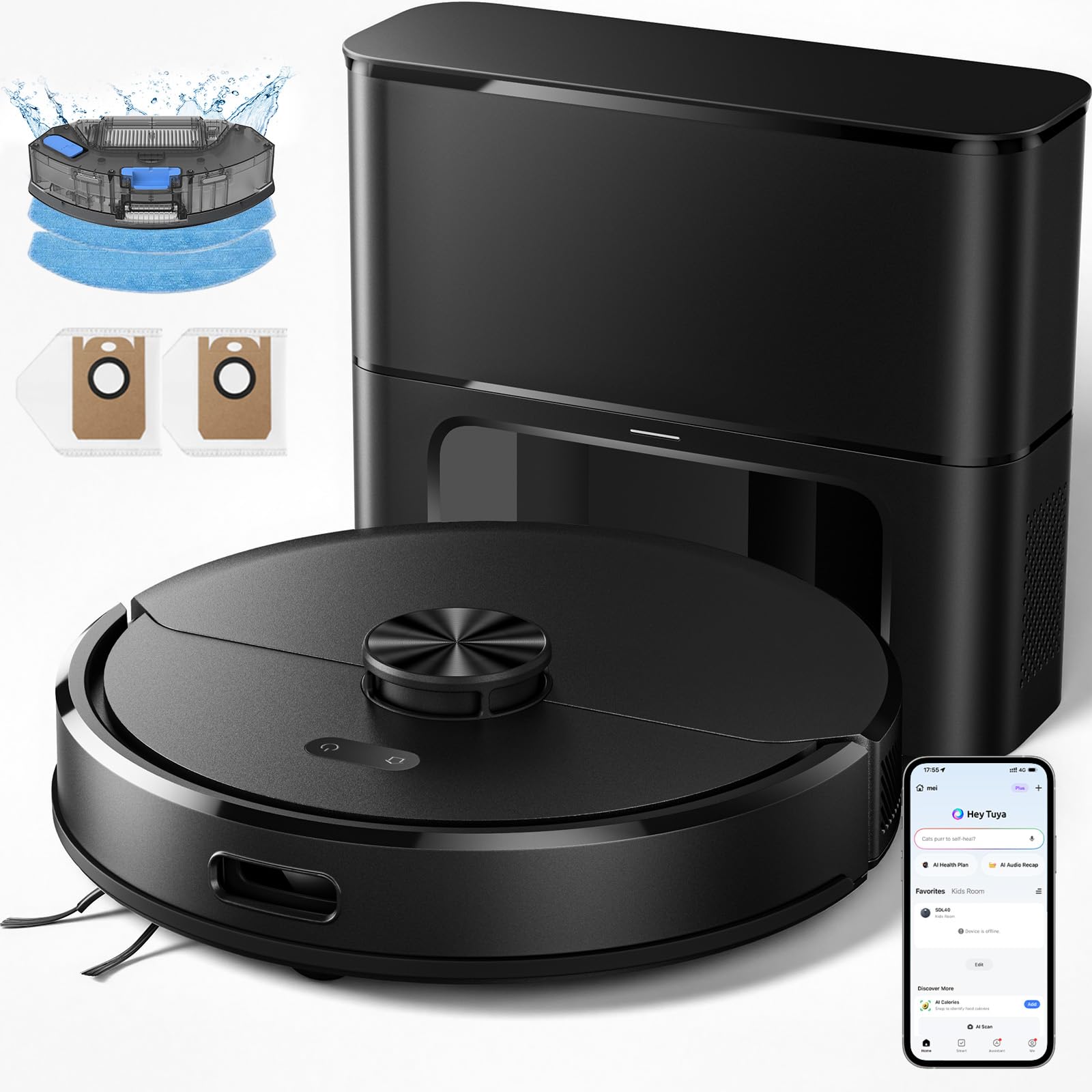
The Kilgone Robot Vacuum bridges the gap between entry-level pricing and serious pet hair performance. With 6,000 Pa maximum suction — more than many models costing significantly more — it pulls embedded fur from both carpets and hard floors in a single pass. The anti-tangle brush prevents long hair and pet fur from wrapping around the roller, which owner reviews consistently highlight as the feature that eliminates the frustration they had with previous robots.
The LiDAR smart mapping system scans the home 360 degrees in minutes, creating a real-time floor plan for efficient row-by-row cleaning. The 2.5-liter self-emptying dustbag holds weeks of debris, so you can run it daily without touching the bag for about 90 days for a single-pet household. The app allows you to set no-go zones (useful for blocking pet bowls), schedule cleaning times, and switch between room, zone, or full-home modes. The 150-minute battery covers up to 1,615 square feet on a full charge, and auto-recharge-and-resume handles larger homes by returning to the dock, recharging, and continuing where it left off.
The 3.64-inch profile fits under most furniture, and the included side brushes and mopping assembly give you a full cleaning suite out of the box. The mop function is basic (you attach the water tank and mop pad), but for light wet-dusting of tile or wood floors, it is a useful add-on. At an entry-level price point with LiDAR navigation, anti-tangle brush, and 6,000 Pa suction, the Kilgone offers the strongest feature-to-dollar ratio for budget-constrained pet owners who don’t want to compromise on daily hair pickup.
Why we love it
- 6,000 Pa suction at a budget-friendly price outperforms many mid-range models
- LiDAR mapping with no-go zones and multi-floor saving handles complex layouts
- Anti-tangle brush eliminates hair wrap maintenance for long-haired pets
Good to know
- Mopping pad is passive — no active water spray or scrubbing action
- Dust bag is 2.5 liters (90 days), not the largest capacity on this list
8. Tikom L8000 Plus
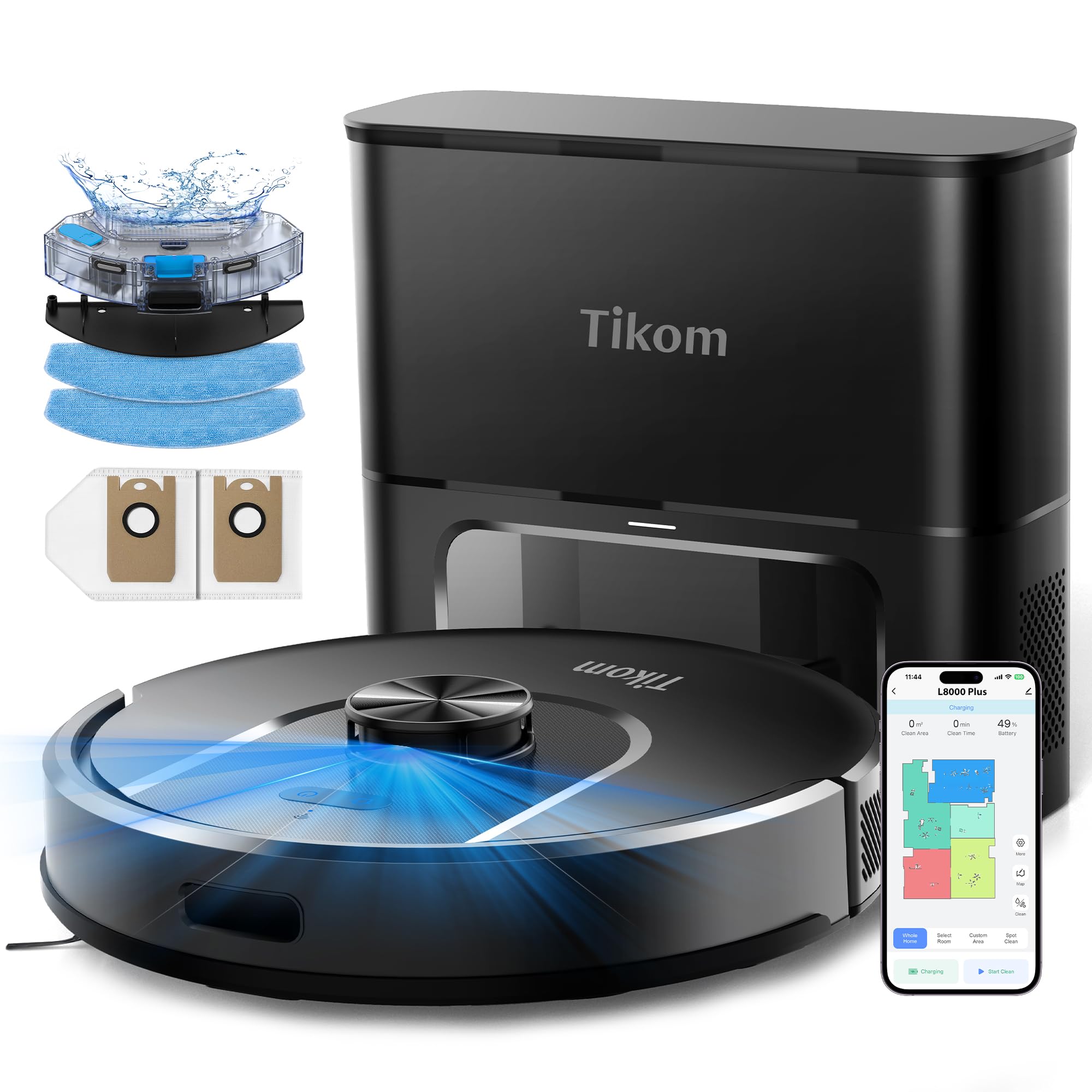
The Tikom L8000 Plus is designed around the idea that bigger dust bags mean less interaction. The 3-liter self-emptying base holds about 90 days of debris for homes with one to two pets, and the bag is sealed to trap dust and dander during disposal — a significant health consideration for allergy-prone owners. The vacuum pulls 6,000 Pa of suction at max power and automatically boosts to that level when the LiDAR sensors detect a carpet surface, ensuring deep-pile carpets get the full cleaning force needed to dislodge embedded pet hair.
The 360-degree LiDAR navigation scans and maps the home during the first run, saving up to five floor maps for multi-level homes. The app provides control over no-go zones, no-mop zones, virtual walls, room-specific cleaning, and scheduling. The 150-minute runtime on gentle mode covers a typical floor plan, and auto-recharge-and-resume allows the robot to finish cleaning even if the battery runs low mid-cycle. The unit also supports both 2.4 GHz and 5 GHz Wi-Fi — a rare convenience at this price point that eliminates router compatibility headaches.
The 2-in-1 sweeping and mopping system offers three suction levels and three water flow settings, and the mop holder should be removed or blocked with a no-go zone if you don’t want wet pads dragged over carpet. The physical dimensions (13.5 x 7.6 x 13.2 inches for the station) mean the base is relatively compact compared to larger docks. If your main priority is maximizing the time between base maintenance with a 3-liter bag capacity and reliable carpet detection, the Tikom L8000 Plus delivers that value in a straightforward package.
Why we love it
- 3-liter self-emptying bag provides up to 90 days of hands-free operation per pet
- Supports both 2.4 GHz and 5 GHz Wi-Fi for worry-free router pairing
- Auto carpet boost increases suction to 6,000 Pa when sensors detect rug surface
Good to know
- Mopping pad drags on carpet unless you manually remove the mop holder
- No customer review data is available yet to confirm long-term reliability
9. eufy C10
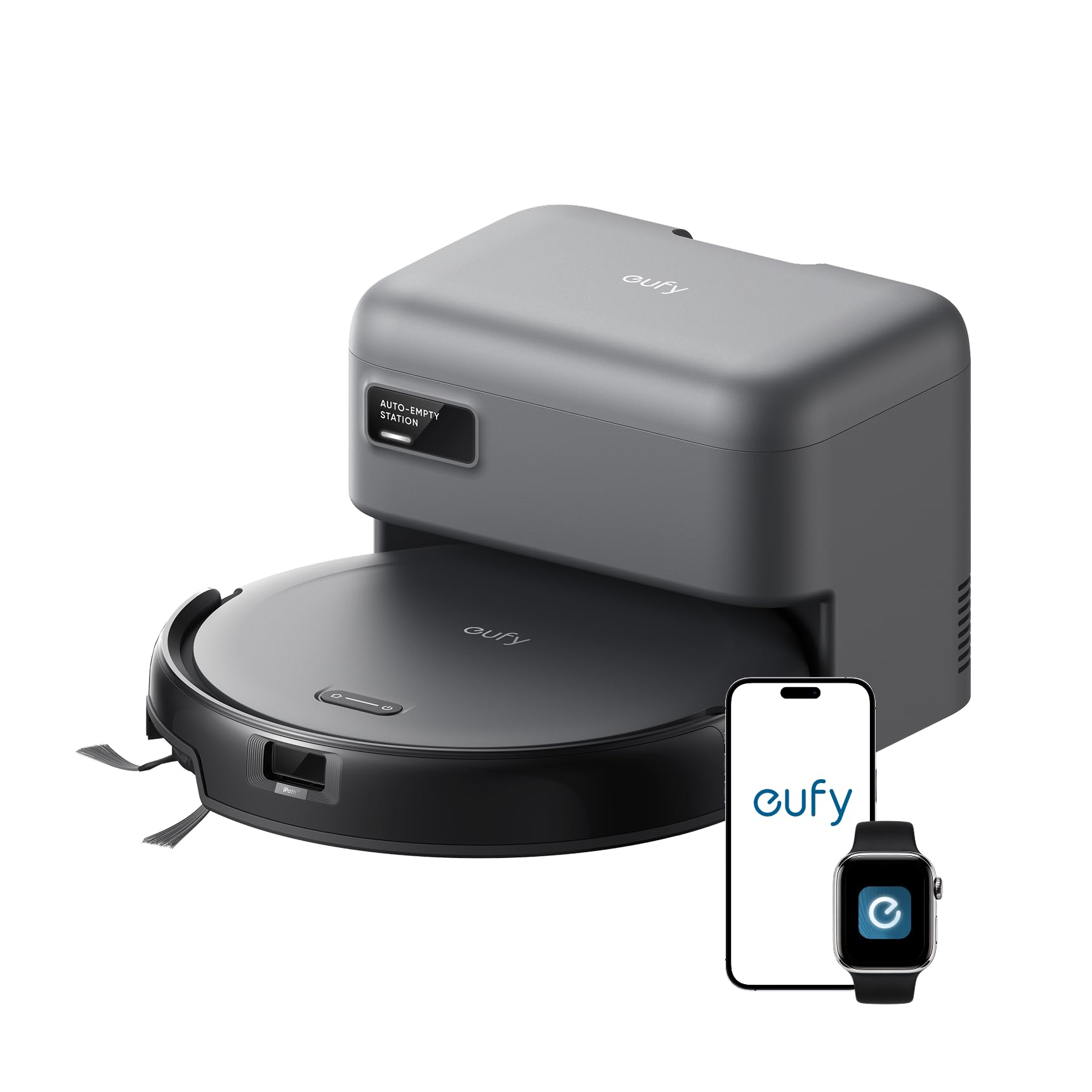
The eufy C10 solves a very specific problem that many robot vacuums ignore: furniture clearance. At just 2.85 inches tall, this is the slimmest unit on the list, enabling it to slide under sofas with 3-inch legs, beneath bed frames with low clearance, and into tight crawl spaces where taller robots bump their LiDAR domes and stop. For homes with low-profile furniture where pet hair accumulates in dark, unreachable spots, the C10 reaches areas that 3.7-inch-tall robots simply cannot access.
The 4,000 Pa suction power is lower than the 5,000 to 10,000 Pa options elsewhere in this guide, but it is sufficient for hard floors and low-pile carpets where the embedded hair layer is light. The unique Corner Rover arm — an extendable side brush mechanism — pushes pet hair out from corners and along baseboards into the cleaning path, addressing the edge-cleaning blind spot common on robots with fixed side brushes. The self-empty station holds a 3-liter dust bag that eufy rates at 60 days of capacity, so you keep the robot running with minimal base maintenance.
LiDAR navigation provides accurate mapping and optimized cleaning routes, and the app supports custom cleaning schedules and no-go zones for areas like pet bedding or food stations. The 120-minute battery covers most apartments and smaller homes, but it lacks the recharge-and-resume feature, so larger spaces may require a manual restart. The filter is washable, reducing replacement costs. The C10 fits a specific use case: if you own a home with low furniture that blocks standard-sized robots, the 2.85-inch profile makes it the only viable option on this list for reaching those hideaway fur piles.
Why we love it
- 2.85-inch height fits under low-profile furniture that blocks taller robots
- Corner Rover extendable side brush pulls pet hair from baseboard edges
- Washable filter reduces long-term replacement costs
Good to know
- 4,000 Pa suction is lower than most competitors — best for hard floors and low-pile carpet
- No recharge-and-resume; may not finish a large 2,000+ sq ft home on one charge
FAQ
How many Pa of suction do I need for pet hair on medium-pile carpet?
What is the advantage of a bagless self-emptying base for pet hair?
Can I set up no-go zones so the robot avoids my pet’s food station?
How often do I need to replace the dust bag in a self-emptying base?
Do robot vacuums with mopping work well on carpet?
Final Thoughts: The Verdict
For most gardeners, the affordable robot vacuum for pet hair winner is the roborock Qrevo QV 35A because it combines 8,000 Pa suction, a tangle-free brush, and a dock that washes and dries the mop pads — all at a price that undercuts far-less-capable competitors. If you want the strongest carpet suction on the market, grab the roborock Q7 M5+ with its 10,000 Pa motor and dual anti-tangle brushes. And for a budget-friendly entry with LiDAR navigation and 6,000 Pa of cleaning power, nothing beats the Kilgone Robot Vacuum.