
The nutritional foundation of an African Grey Parrot directly dictates its feather quality, cognitive sharpness, and lifespan. Choosing a diet that mimics the high-fat, high-calcium profile of their wild intake is non-negotiable for avoiding common issues like feather plucking and calcium deficiency. This guide cuts through the marketing to compare the actual macronutrient profiles, ingredient sources, and species-specific formulations of the leading options on the market.
I’m Mo Mahin — the founder and writer behind Furric. My recommendations here stem from analyzing veterinary nutritional standards, cross-referencing ingredient lists against avian dietary requirements, and synthesizing hundreds of verified owner experiences on the specific palatability and long-term health effects of each formula.
Whether you are converting a seed-junkie or supplementing a pellet base, this analysis will help you select the best african grey parrot food for your bird’s unique metabolic needs.
How To Choose The Best African Grey Parrot Food
Selecting a diet for an African Grey requires understanding their specific metabolic need for high dietary fat and extra calcium. A wrong choice can lead to nutritional deficiencies that manifest as poor feather quality or lethargy.
The Pellet vs. Seed Ratio
A complete pellet should form the base of the diet—ideally 70-80% of total intake. Seed blends should be treated as a supplementary foraging reward (up to 30% of the diet). Pellets like the Psittacus High Energy are formulated to be a 100% nutritionally complete diet, while products like ZuPreem Sensible Seed are designed specifically as a seed/pellet blend for enrichment.
Calcium and Fat Content
African Greys require higher calcium levels than many other parrots to support bone density and egg production in hens. Look for formulas that explicitly state “Extra Calcium” or are species-specific for African birds. An 8% fat content is adequate for sedentary adult birds, while high-energy formulas are necessary for young birds or during reproductive inactivity periods.
Ingredient Sourcing and Additives
Prioritize foods that are non-GMO and free from artificial colors and synthetic antioxidants. Premium options like the Psittacus line use natural flavors and avoid fillers. Vegetable-based pellets, such as ZuPreem VeggieBlend, offer a natural source of phytonutrients from real ingredients like celery, beets, and parsley.
Quick Comparison
On smaller screens, swipe sideways to see the full table.
| Model | Category | Best For | Key Spec | Amazon |
|---|---|---|---|---|
| Psittacus High Energy 1.76lb | Complete Pellet | Primary daily diet | 100% No-GMO, Extruded Pellet | Amazon |
| ZuPreem VeggieBlend 3.25lb | Veggie Pellet | Vegetable-based nutrition | Real Vegetables, Medium/Large Pellet | Amazon |
| Pretty Bird African Species 3lb | Species Specific Morsel | Extra calcium support | 14% Protein, 8% Fat, Extra Calcium | Amazon |
| ABBA Premium Blend 5lb | Seed Blend | Foraging enrichment | Whole Eggs, Fruits, Nuts, Legumes | Amazon |
| ZuPreem Sensible Seed 2lb | Seed/Pellet Blend | Transitional or treat food | Safflower Seeds, Buckwheat, Squash Seeds | Amazon |
In‑Depth Reviews
1. Psittacus High Energy 1.76lb

The Psittacus High Energy pellet is engineered specifically for species like the African Grey that require a high-fat diet in nature. This is a fully extruded, 100% non-GMO pellet formulated to constitute 70-80% of the bird’s total diet, making it a true complete daily meal rather than a supplement. The manufacturer, with over 20 years in avian nutrition, avoids artificial colors and synthetic antioxidants, focusing on maximum nutritional concentration through high-quality ingredients.
This pellet is explicitly designed for maintenance periods—when the bird is reproductively inactive—which aligns perfectly with the metabolic needs of a typical pet African Grey. Its “Yaco” flavor profile and European manufacturing standards indicate a premium formulation that targets the specific digestive biology of African parrots. This is not a treat or a foraging mix; it is a serious nutritional tool for keepers who want a precise, science-backed foundation for their bird’s diet.
For the owner who wants a single, authoritative food source that eliminates guesswork, this is the most species-correct option. The 1.76 lb bag is a commitment to a pellet-heavy diet, and the results in feather condition and energy levels often speak for themselves. It is the closest you can get to a tailor-made prescription diet for an African Grey without a veterinary script.
Why we love it
- Complete, 100% nutritionally balanced diet
- No artificial colors, flavors, or GMOs
- Formulated specifically for high-metabolic African species
Good to know
- Smaller bag size (1.76 lb) will deplete quickly with larger birds
- Palatability can vary; some birds need a slow transition from seed diets
2. ZuPreem VeggieBlend 3.25lb

ZuPreem VeggieBlend takes a unique approach by incorporating real, visible vegetable ingredients like celery, green beans, carrots, parsley, and beets into its pellet matrix. This plant-based, additive-free formula provides a wholesome way to introduce phytonutrients and natural variety without the mess of fresh produce. It is a complete diet designed for medium to large parrots, including African Greys, cockatoos, and eclectus.
Veterinarians frequently recommend this line because it takes the guesswork out of daily nutrition. The medium/large pellet size is appropriate for an African Grey’s beak, and the vegetable blend is intended to support long-term health and vitality. The packaging indicates 100% daily nutrition, meaning you can feed this as the sole dry component of the diet without needing additional vitamin supplements.
Owner feedback heavily emphasizes that birds enjoy the flavor and texture, though some owners of smaller conures noted the orange discs and green pellets can be a bit large and prone to dropping. For the African Grey, however, these pellet dimensions are ideal for encouraging proper beak use. It represents a premium step up from basic seed blends and offers a clear path to a nutritionally complete, vegetable-rich diet.
Why we love it
- Made with real, identifiable vegetables
- Complete and balanced for daily feeding
- No artificial additives or preservatives
Good to know
- Some pellets have mixed sizes; slightly larger pieces may be dropped
- Priced at a premium compared to standard pellet blends
3. Pretty Bird International African Bird Food 3lb

Pretty Bird International’s formula is explicitly marketed as “Species Specific” for African birds, which is a rarity even among premium brands. The standout spec here is the “Extra Calcium” claim, a direct nod to the African Grey’s heightened requirement for this mineral. With a macronutrient profile of 14% protein and 8% fat in medium-sized morsels, this diet is calibrated for adult birds that need robust bone and feather support without excess weight gain.
The morsel format is a departure from standard round pellets or loose seed blends. These are designed to be kibble-like, offering a different mouthfeel that can be beneficial for birds that are picky about texture. The formula is chicken meat-free and marketed as a veterinary diet, suggesting it was developed with clinical nutritional standards in mind for maintaining optimal health in African species and medium-to-large conures.
For keepers looking specifically to address calcium intake—especially for egg-laying hens or birds with a history of feather issues—this is an excellent targeted choice. The 3-pound bag offers a solid value for a species-specific formula, positioning it as a smart mid-range option that bridges the gap between generic blends and high-end European imports.
Why we love it
- Explicitly formulated for African species with extra calcium
- Veterinary diet designation for confident feeding
- Unique morsel shape may appeal to picky eaters
Good to know
- Unflavored; some birds accustomed to fruity flavors may reject it
- Not intended as a high-energy formula for young or breeding birds
4. ABBA Premium Blend 5lb

ABBA’s 1400 Premium Blend is a dense, forage-focused seed mix that leans into diversity as its core strength. Unlike the pellet-only options, this is a blend of safflower seeds, sunflower, cracked corn, peanuts, papaya, sorghum, and a full array of legumes (navy, kidney, pinto, azuki beans). The inclusion of whole eggs and mollusk shells provides direct protein and calcium-boosting ingredients that are often missing from standard seed mixes.
This food is best understood as a high-quality enrichment tool rather than a complete diet base. The variety encourages natural foraging behavior, which is mentally stimulating for an African Grey. The 5-pound bag offers the lowest cost-per-pound in this lineup, making it an attractive option for owners who feed fresh vegetables daily and want a robust, protein-packed seed mix to offer in a foraging wheel or as a treat.
The inclusion of multiple nut types (Brazil nuts, cashews, walnuts) means this mix is energy-dense, which is excellent for active or young birds. However, because it is a seed blend, it should not constitute the majority of the diet to avoid selective feeding and nutritional imbalance. It is a fantastic supplementary product for those who have a solid pellet foundation.
Why we love it
- Massive 5-pound bag for a great value
- Includes whole eggs for superior feather and skin health
- Excellent variety of legumes, nuts, and seeds for foraging
Good to know
- Primarily a seed mix; not a nutritionally complete diet
- High nut content makes it calorie-dense; portion control needed
5. ZuPreem Sensible Seed 2lb
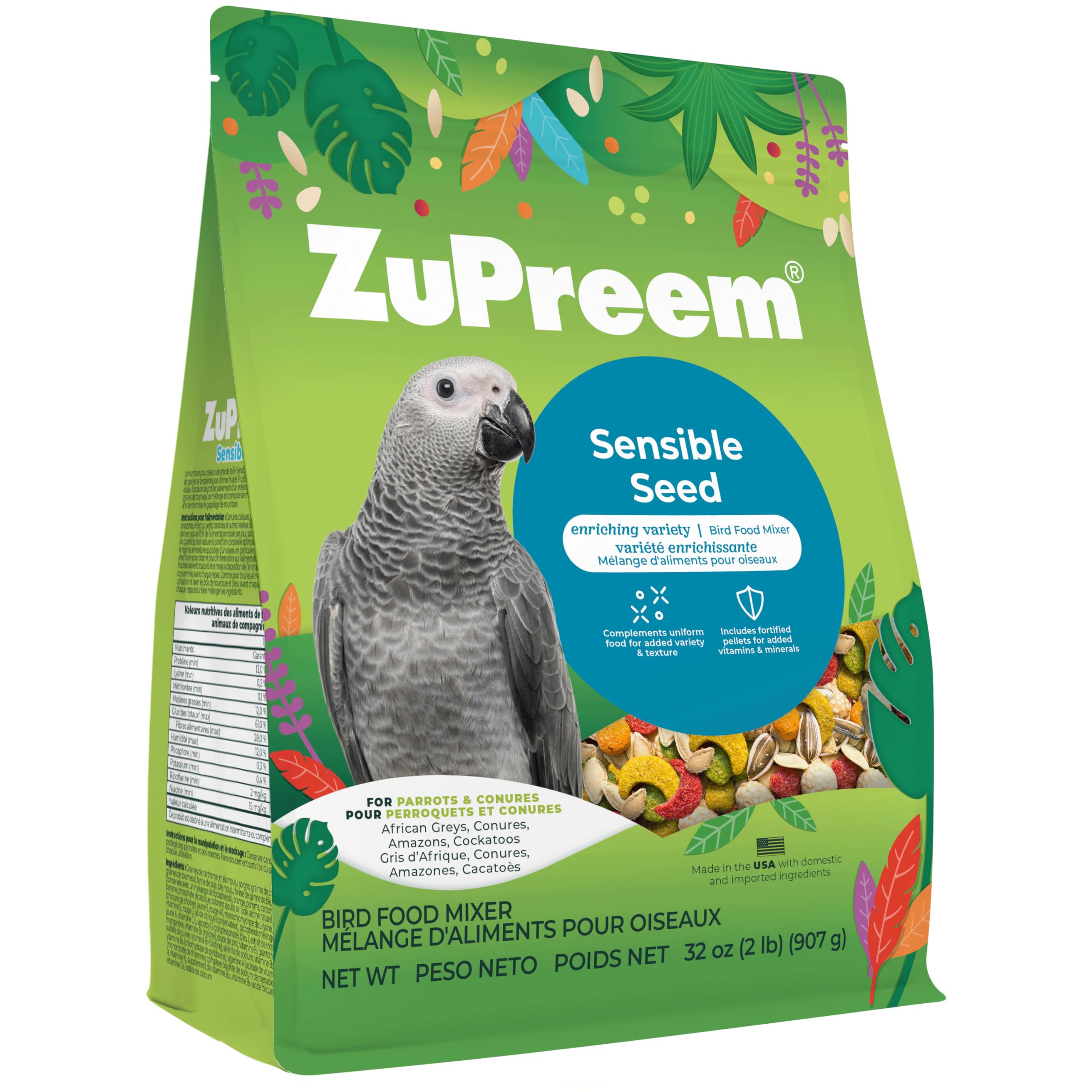
ZuPreem Sensible Seed positions itself as the transitional solution—a “sensible” seed blend that incorporates pellets to nudge seed-loving birds toward a more balanced diet. The mix includes ground corn, safflower seeds, white milo, squash seeds, and whole buckwheat, designed to encourage foraging instincts. The manufacturer recommends serving this as up to 30% of the bird’s diet, explicitly framing it as an interactive feed rather than a staple.
The 2-pound bag size makes it ideal for owners who want to test a new mix without a significant investment. For an African Grey that stubbornly refuses pellets, the presence of familiar seed shapes alongside pellet pieces can serve as a gateway to better nutrition over time. It is labeled as suitable for a wide range of medium-large birds including conures, caiques, and eclectus.
It is important to note that some owner reviews mention a formula change that removed “little sesame seed balls,” which was a favorite component for some birds. This means current palatability may differ from older batches. As a daily main course, it falls short of a complete diet, but as a tool for enriching foraging behavior and transitioning a seed-addicted bird, it is a practical and affordable option.
Why we love it
- Great for transitioning birds from all-seed to pellet-based diets
- Encourages natural foraging behavior with varied textures
- Backed by a 100% satisfaction guarantee
Good to know
- Recent formula change may affect palatability for some birds
- Intended only as a supplemental blend, not a complete diet
FAQ
What is the ideal calcium-to-phosphorus ratio in African Grey parrot food?
Can I feed my African Grey a seed-only diet?
How do I convert my African Grey from a seed diet to pellets?
Why do African Greys need higher fat content in their food?
Final Thoughts: The Verdict
For most keepers seeking a truly complete and species-accurate daily diet, the winner is the Psittacus High Energy 1.76lb because it is a 100% no-GMO pellet engineered specifically for the metabolic needs of African parrots. If you want a vegetable-enriched pellet that birds find highly palatable, grab the ZuPreem VeggieBlend 3.25lb. And for building a cost-effective foraging routine with premium ingredients like whole eggs and legumes, nothing beats the ABBA Premium Blend 5lb.