
That musty basement smell isn’t just unpleasant—it’s a warning sign of airborne mold spores, mildew, and volatile organic compounds that thrive in damp, stagnant air. A standard living-room air purifier often lacks the filtration muscle to handle the unique cocktail of microbial VOCs, high humidity particulates, and persistent damp odors that define a true musty basement environment.
I’m Mo Mahin — the founder and writer behind Furric. I’ve spent years analyzing CADR ratings, filter layer counts, and real-world owner feedback in the battle against below-grade air, cross-referencing laboratory test data against the specific needs of moisture-prone spaces to separate the appliances that truly dry the air from those that just recirculate the stink.
Whether you are fighting a finished walk-out or a dirt-floor crawl space, this guide evaluates eight units purpose-built to tackle stale subterranean air and identifies the best air purifier for musty basement conditions based on sustained performance, filter longevity, and cost-effective operation.
How To Choose The Best Air Purifier For Musty Basement
Selecting an air purifier for a musty basement goes beyond choosing the highest CADR number. The constant presence of moisture and biological contaminants demands specific design features that a typical bedroom unit simply does not have. Here are the three most important criteria to evaluate before you buy.
Filter Media and Odor Neutralization
A standard H13 HEPA filter captures 99.97% of particulate matter like dust and mold spores, but it does almost nothing to remove the gaseous molecules that create that classic musty basement smell. For that, you need a thick, high-quality activated carbon layer with a substantial weight of media—measured in pounds, not ounces. Look for units that specify a “premium” or “heavy-duty” carbon filter, or a multi-layer system that combines HEPA with carbon and an optional UV-C or ionizer stage specifically designed to break down microbial VOCs (mVOCs). Filters that can be washed or are rated for annual replacement also reduce the long-term cost of treating a high-particle-load environment.
Airflow, Coverage, and Humidity Tolerance
Basements are often heavily cluttered and have low ceilings, which restricts natural air circulation. An effective unit needs a Clean Air Delivery Rate (CADR) that matches the space—typically at least 200 CFM for a standard 500-800 square foot basement. More important, the unit’s electronics and fan motor must be resilient to continuous operation in relative humidity levels that often exceed 60%. Look for Energy Star-certified designs with sealed motors or coatings that resist corrosion. Units with an “Auto” mode that relies on a particle sensor are valuable, but the sensor itself must be accurate in a humid environment where particulates may be damp and heavy.
Maintenance Costs and Filter Accessibility
Because a musty basement generates a much higher volume of captured material—mold spores, large dust particles, and pet dander if the basement is a living area—filters clog faster. You should calculate the cost of replacement filter sets per year. Units with washable pre-filters or “never replace” permanent filter systems have a higher upfront cost but can save significantly over three years. Also consider the ease of finding and replacing the filter; a unit with a simple slide-out mechanism and a filter-change indicator will be used more consistently than one that requires disassembly and guesswork.
Quick Comparison
On smaller screens, swipe sideways to see the full table.
| Model | Category | Best For | Key Spec | Amazon |
|---|---|---|---|---|
| Nuwave Forever Smart | Purifier | Zero ongoing filter costs | 7-stage washable system | Amazon |
| Dhyala 3620 sqft | Purifier | Smart control & 360° intake | 271 CFM CADR | Amazon |
| AEOCKY 2300 sqft | Purifier | Long filter life & low energy | 240 m³/h Turbo CADR | Amazon |
| LUNINO K3 | Purifier | Ultra-quiet sleep mode | 15dB Sleep Mode | Amazon |
| GermGuardian AC4825W | Purifier | Budget-minded odor control | UV-C light + HEPA | Amazon |
| AEOCKY Leo-Lite Dehumidifier | Dehumidifier | High-volume moisture removal | 74 pint/day (95°F, 95%RH) | Amazon |
| Vellgoo DryTank Dehumidifier | Dehumidifier | Energy Star efficiency | 64 pint/day (90°F, 90%RH) | Amazon |
| AirDoctor AD4000 | Purifier | Hospital-grade particle capture | UltraHEPA 0.003 microns | Amazon |
In‑Depth Reviews
1. Nuwave Forever Smart Air Purifier

The Nuwave Forever is a category-defining unit for musty basements because it eliminates the single biggest recurring expense: replacement filters. The patented 7-stage system uses stainless-steel pre-filters, Bio-Guard media, and an ozone-removal filter—all of which are washable and reusable. This makes it uniquely suited to the high-particulate environment of a basement, where standard HEPA filters would clog in two to three months. The unit covers up to 2,002 square feet in one hour, with an adjustable flow panel that lets you direct clean air toward a specific workbench or seating area.
In a musty space, the odor sensor in auto mode is a standout feature: it detects VOCs and increases fan speed proactively, rather than waiting for particles to accumulate. The adjustable flow panel—able to tilt 30°, 60°, or 90°—is surprisingly practical for a basement where ceiling height or shelving might block typical top-mounted vents. The unit is Energy Star certified and runs continuously for a minimal annual electricity cost. Owner feedback consistently highlights a dramatic reduction in “wet dog” and “mildew” smells within the first 24 hours of operation.
The main trade-off is the upfront investment, which is roughly double that of a standard mid-range purifier. The unit is also heavier at 21.9 pounds, so moving it between rooms is less convenient. However, for a permanent basement installation, the build quality and the elimination of filter subscription costs make it a cost-effective choice over three to five years.
Why we love it
- No replacement filter costs ever (all washable)
- Odor sensor in auto mode catches mVOCs quickly
- Adjustable flow panel directs air where needed
Good to know
- Higher upfront cost than most mid-range units
- Washable filters require 24 hours to fully dry after cleaning
2. Dhyala 3620 sqft Air Purifier
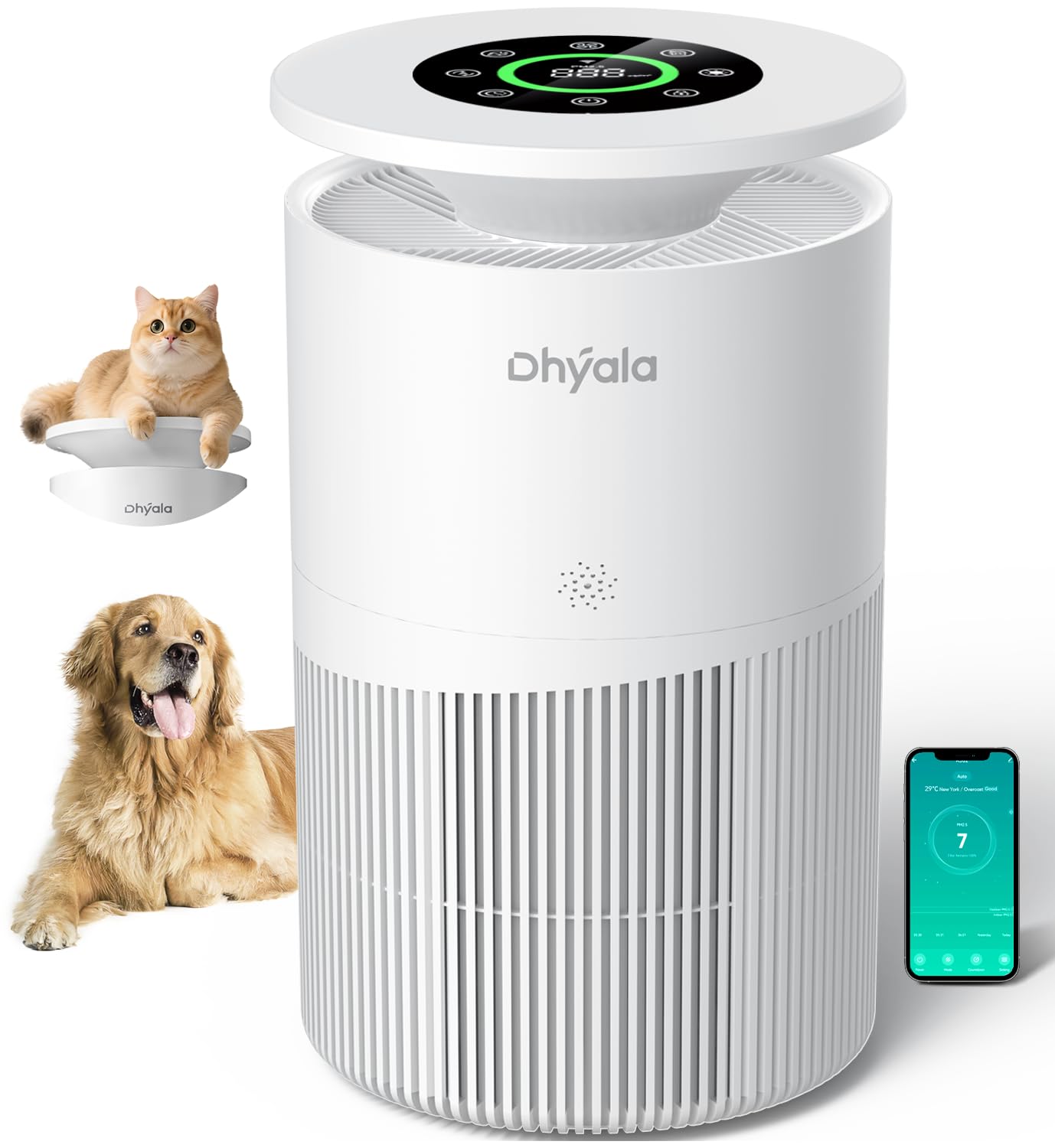
The Dhyala is built around a 5-stage filtration system that places a heavy emphasis on the pre-filter stage, which uses electrostatic adsorption to capture 40% more pet dander and large dust before they reach the HEPA media. This design is ideal for a finished basement that doubles as a family room with pets. The 360° wide grid intake, combined with a 271 CFM CADR, allows it to cycle the air in a large basement (up to 3,620 sq ft) once per hour, which is the gold standard for maintaining low spore counts.
Smart features are a strong point here: the unit connects via WiFi to an app that allows remote monitoring and control, and it works with Alexa and Google Assistant for hands-free operation. The built-in PM2.5 sensor auto-adjusts fan speed in real time, and the pet lock feature prevents accidental setting changes if the basement is used as a pet space. The unit also operates at a low 22 dB in sleep mode, making it suitable if a basement bedroom is in use.
On the downside, the main filter replacement cost is not as budget-friendly as the Nuwave. The unit weighs 9 pounds and is compact enough for a shelf, but the 5-stage filter packs are proprietary and need replacing every 6 to 8 months depending on load. For a heavy-use, high-humidity basement, that could be a significant annual expense.
Why we love it
- Electrostatic pre-filter catches large particles first
- Smart app and voice control for remote adjustments
- Very quiet at 22 dB in sleep mode
Good to know
- Proprietary filters require regular replacement
- Sensor performance may degrade in very high humidity
3. AEOCKY 2300 sqft Air Purifier
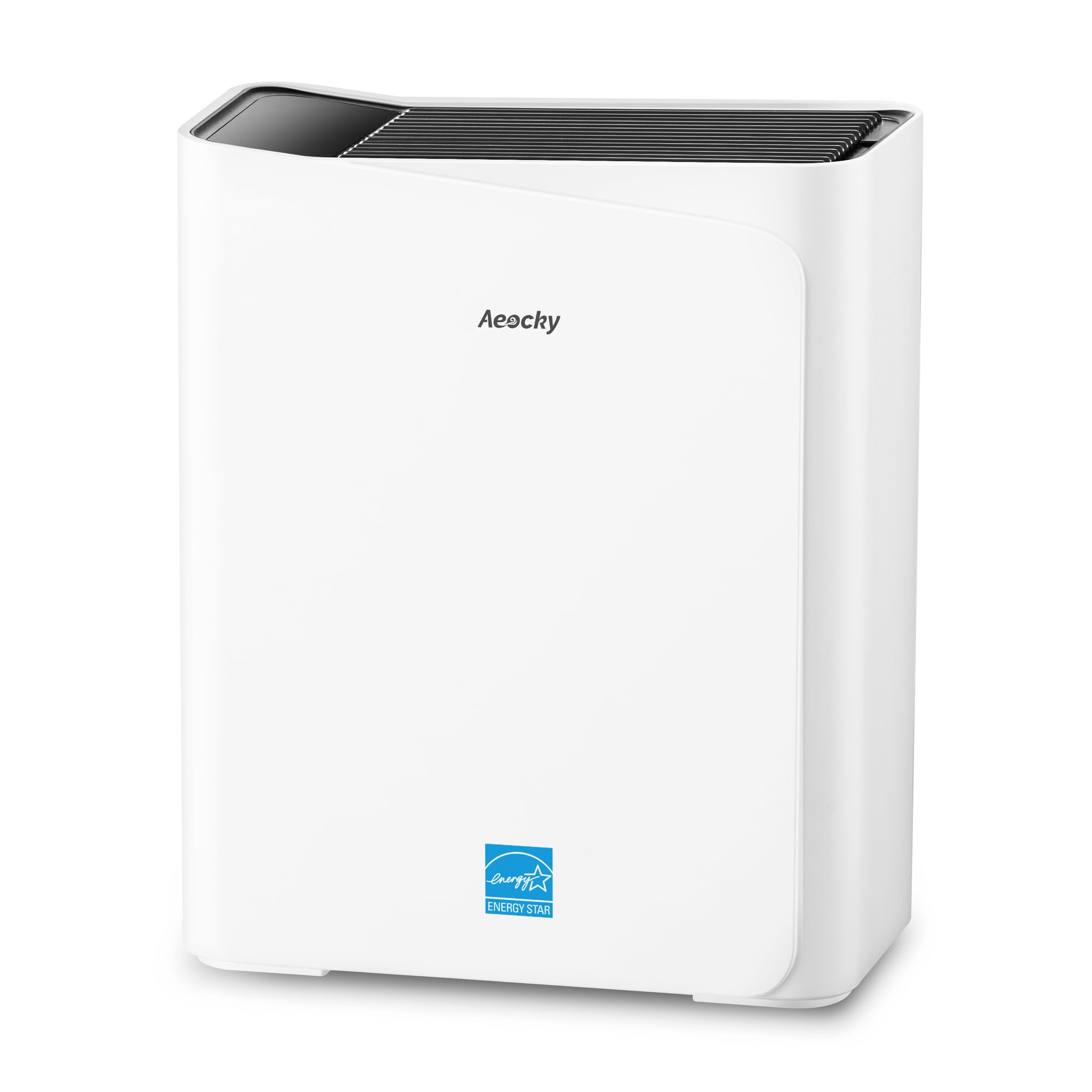
AEOCKY’s approach to the musty basement problem focuses on longevity: their proprietary YearChange filter technology uses a 5-layer multi-effect media that lasts over five times longer than a conventional HEPA filter. In a dusty, particulate-heavy basement, this means you change the main filter only once per year, reducing the yearly maintenance chore significantly. The unit achieves a Turbo CADR of 240 m³/h (141 CFM for dust) and can cover up to 2,300 sq ft at one air change per hour, though for a musty room you’d want to run it on high speed to maintain 4.8 ACH in a smaller 480 sq ft basement.
The Natural Breath Capsule is a unique addition—a compartment for a scent capsule that provides active deodorization alongside passive filtration. While this is not essential for technical performance, in a musty basement it adds a freshness that neutralizes odors rather than just filtering particles. The AI-driven air quality monitor in auto mode adjusts fan speed with a claimed 35% higher accuracy than standard sensors, which prevents the unit from running unnecessarily hard during moderate humidity swings.
One limitation: the unit is relatively compact (13.3 inches tall) and may not move as much air as larger units in a very open basement with cathedral ceilings. The DC brushless inverter motor is energy efficient, consuming only 0.42 kWh per day at high speed, but the turbo mode is notably loud. For a basement used as a workshop or TV room, the noise on turbo may be a distraction.
Why we love it
- YearChange filter lasts 12 months in heavy use
- Active deodorization with scent capsule
- Extremely energy efficient at 0.42 kWh/day
Good to know
- Turbo mode is quite loud
- Limited total airflow for very large open basements
4. LUNINO K3 Air Purifier
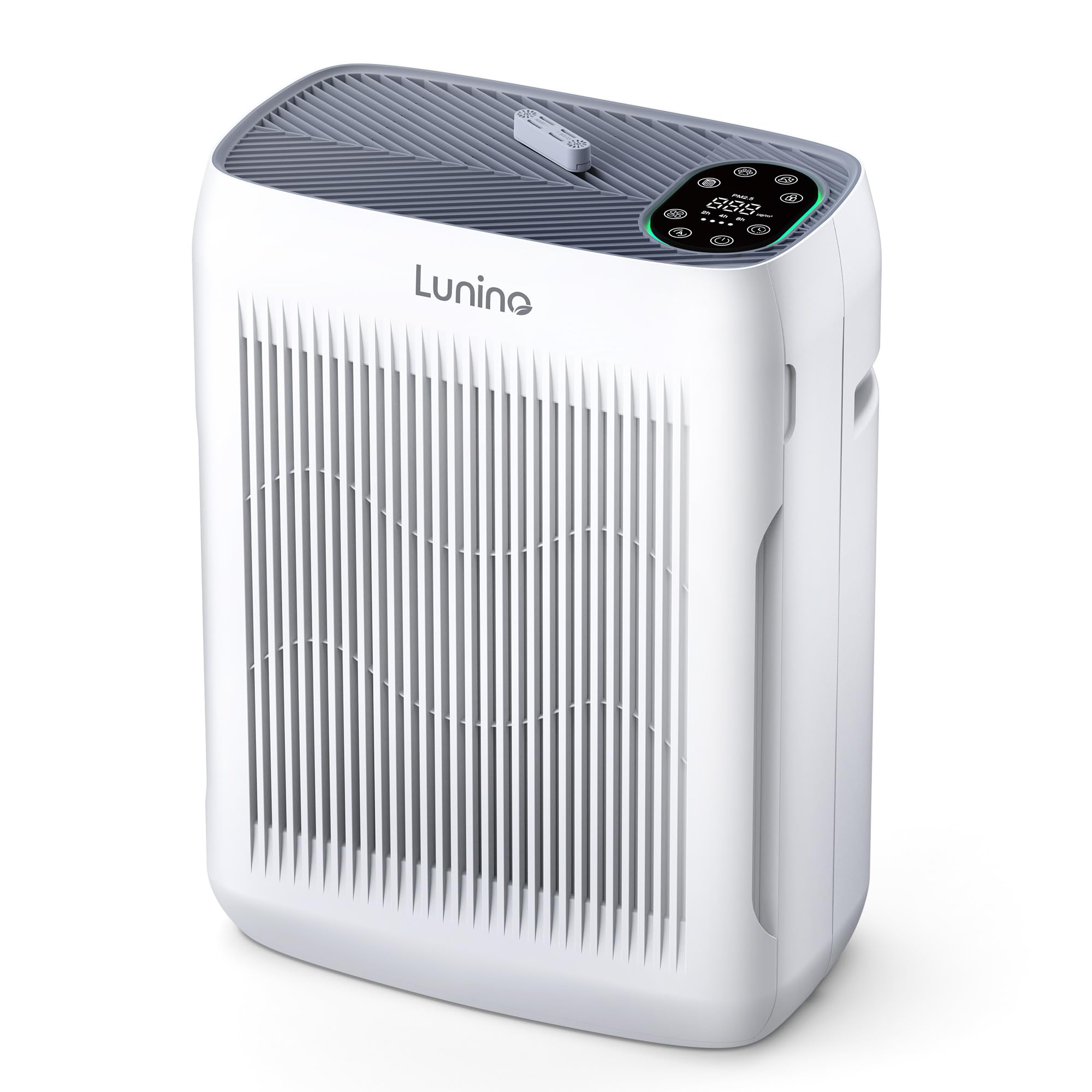
The LUNINO K3 is designed for spaces where noise must be minimized—such as a basement bedroom or a home office below grade. The H13 HEPA 3-stage filtration system is paired with a washable pre-filter that improves filtration efficiency by 30% when rinsed. The unit can cover up to 3,000 sq ft at one air change per hour, but the standout spec for basement use is the 15 dB sleep mode, which is virtually inaudible. For light sleepers or families with a basement nursery, this is a decisive advantage.
Pet Mode is another practical feature: it increases fan suction while engaging both side air intakes to capture floating pet hair and dander. For a basement that houses litter boxes or dog crates, this targeted mode is more effective than a general auto setting. The unit also includes an aroma diffuser compartment for essential oils, which can be used to add a pleasant scent on top of the mechanical odor removal.
On the less positive side, the single-sided filter design is more affordable to replace than double-sided units, but it also means the unit may need to run at a higher speed to achieve the same coverage in a very large basement. The build quality is solid, but the plastic housing may not feel as premium as units in a higher price tier. For the price, however, it offers an exceptional noise-to-performance ratio.
Why we love it
- Nearly silent at 15 dB in sleep mode
- Dedicated Pet Mode with dual intakes
- Washable pre-filter reduces replacement frequency
Good to know
- Single-sided filter may limit high-speed airflow
- Plastic housing feels less durable than premium rivals
5. GermGuardian AC4825W

The GermGuardian AC4825W is a well-established, budget-friendly entry point for addressing mild musty basement odors. It uses a True HEPA filter to capture 99.97% of particles down to 0.1 microns, with an additional UV-C light that targets airborne mold spores and bacteria. The unit covers up to 743 sq ft per hour, which is adequate for a small to medium basement room (roughly 150-200 sq ft at 4.8 ACH). The optional UV-C mode is particularly useful for basements with visible mold growth or persistent dampness, as it actively kills spores passing through the chamber.
The three-speed fan with a simple dial control is straightforward, and the low setting produces a gentle white noise that many users find restful. The filter change indicator light is a helpful reminder in a busy household. Owner reports consistently note a reduction in cooking odors and stuffiness within minutes of turning the unit on. The washable first-stage pre-filter captures large dust and pet hair, extending the life of the main HEPA filter.
However, the unit is relatively loud on the highest setting (55 dB), and it is not designed for continuous operation in very high humidity—the UV-C bulb and electronic components are not sealed against moisture. The coverage at one air change per hour is limited to 743 sq ft, meaning it may need to run continuously in a larger basement to keep up. For a small basement workshop or a guest room, it works well; for a sprawling 1,500 sq ft musty basement, it will struggle.
Why we love it
- UV-C light kills mold spores and bacteria actively
- Zero Ozone certified for safe continuous use
- Low initial cost and widely available replacement filters
Good to know
- Limited to 743 sq ft for effective ACH
- High setting is noticeably loud (55 dB)
- Not sealed for high-humidity environments
6. AEOCKY Leo-Lite Dehumidifier 74 Pint
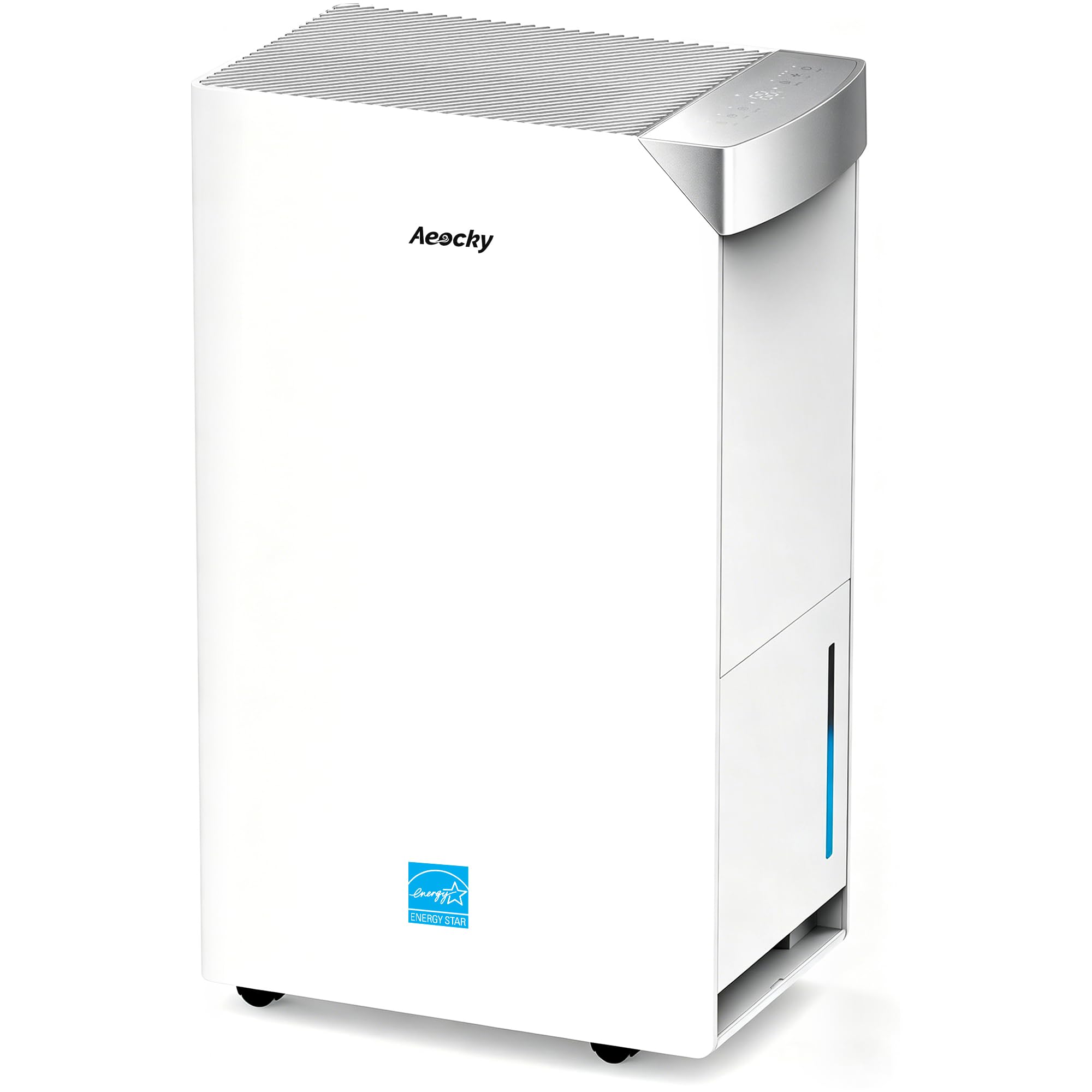
The AEOCKY Leo-Lite is a dehumidifier, not an air purifier, and this distinction is critical for a musty basement. The source of the odor is moisture, and until you reduce relative humidity below 50%, a purifier is merely treating a symptom. This unit is Energy Star Version 6.0 certified, removing 74 pints per day in extreme conditions (95°F, 95% RH) and 52 pints per day in cooler basement conditions (86°F, 80% RH). It covers up to 4,500 sq ft, making it suitable for the largest basement spaces.
The “3+2” evaporator-condenser system uses pure copper tubing with 7mm diameter high-tooth internal threads and blue hydrophilic aluminum fins, which is a construction rarely found outside commercial-grade units. The auto-defrost system is essential for basements that dip below 65°F, because it prevents frost buildup on the coils—a failure point for many standard dehumidifiers. The unit operates at a low 44 dB on its lowest speed, which is quieter than many similarly sized dehumidifiers.
On the downside, the water tank is relatively small (1.45 gallons) given the high extraction rate, which means frequent manual emptying unless you set up continuous drainage via the included hose. The unit is also heavy at 31 pounds, making it less portable than smaller units. It is designed as a dedicated moisture-removal appliance, so it does not include particle filtration beyond a washable pre-filter; for true musty basement remediation, it is best paired with one of the air purifiers in this list.
Why we love it
- Removes 74 pints/day to kill moisture at the source
- Auto-defrost operates reliably in cool basements
- Quiet operation at 44 dB
Good to know
- Small tank requires continuous drain setup
- Heavy (31 lbs) and less portable
- Does not include HEPA filtration
7. Vellgoo DryTank Dehumidifier 64 Pint

The Vellgoo DryTank is another specialized dehumidifier that directly addresses the root cause of mustiness. It is recognized as one of the Most Efficient Energy Star dehumidifiers, removing 64 pints per day in peak summer conditions while using up to 50% less energy than non-certified models. It covers up to 4,000 sq ft, with a high-efficiency rotary compressor and an upgraded “3+3” evaporator-condenser system with pure copper tubing and hydrophilic aluminum fins.
The unit offers three drainage options: a 5.5-liter tank that can be manually emptied, continuous drain via the included 6.56-foot hose, or connection to a standard garden hose. The Smart Humidity Control allows you to set the target RH between 40% and 80% with digital precision. User feedback highlights the unit’s effectiveness in reducing basement humidity quickly, often dropping from 70% to 50% in a matter of hours in a 1,200 sq ft space. The auto shut-off feature and child lock add safety for homes with young children.
The main limitation is that, like the AEOCKY Leo-Lite, this is a moisture removal tool only. It does not include any HEPA or carbon filtration for particles or gases. To fully tackle a musty basement, you will still need a separate air purifier. Additionally, the unit has only three speed settings, which limits fine-grained control, and some users note that the compressor generates a noticeable hum on the highest setting.
Why we love it
- Energy Star Most Efficient with up to 50% energy savings
- Three drainage options for hands-off operation
- Digital humidity control down to 40% RH
Good to know
- No HEPA or carbon filtration
- Three speeds limit fine airflow control
- Compressor hum audible on highest setting
8. AirDoctor AD4000
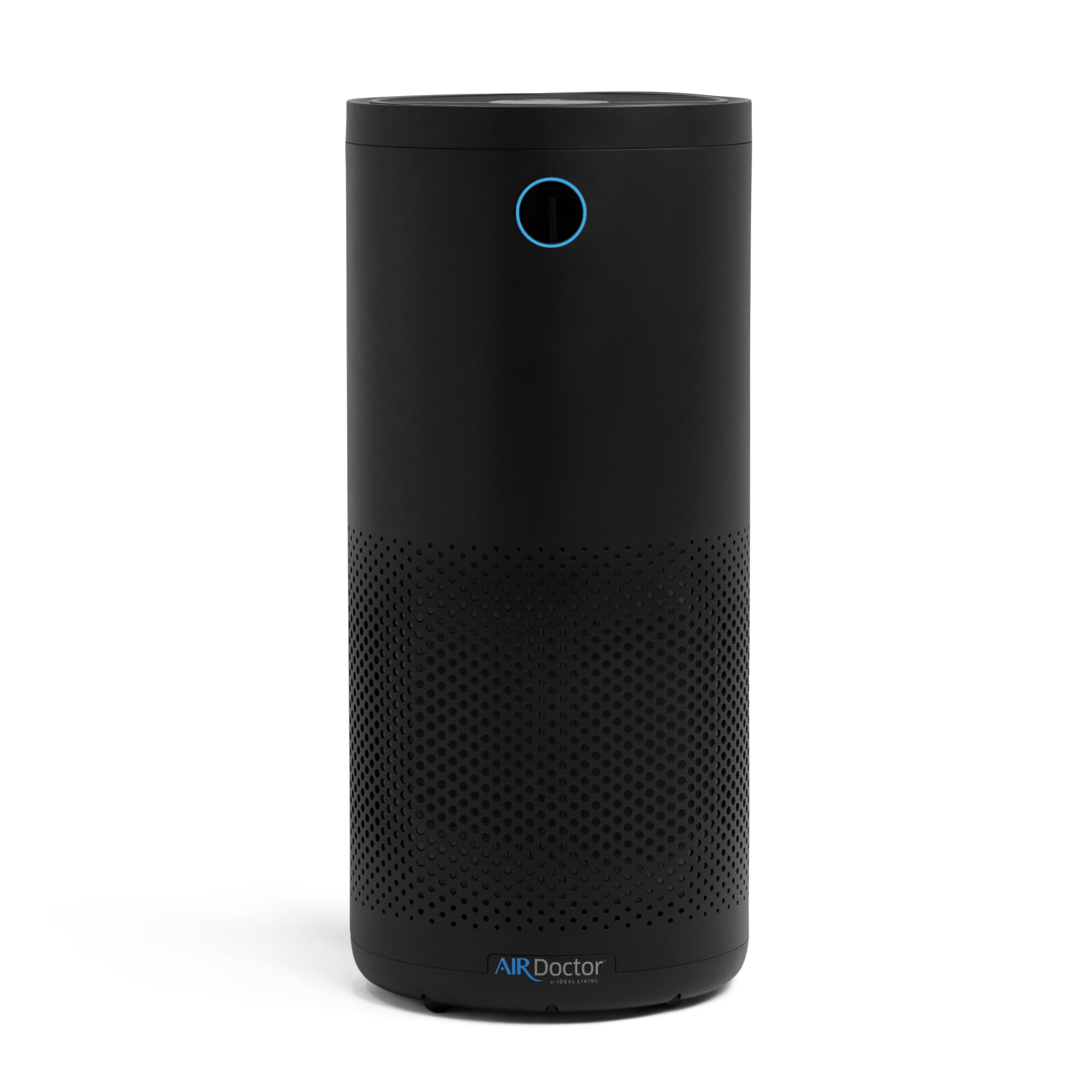
The AirDoctor AD4000 represents a different price tier entirely, but for a musty basement with documented mold issues or for someone with respiratory sensitivity, it offers filtration performance that no other unit in this list can match. The UltraHEPA filter captures 99.99% of airborne particles at 0.003 microns—100 times smaller than the standard HEPA test standard. This means it captures not just mold spores but also mold fragments, bacterial endotoxins, and viral particles that cause musty odors at the molecular level.
The Premium Activated Carbon filter is loaded with both activated carbon and potassium permanganate, a combination that is particularly effective at breaking down VOCs and gaseous odors common in musty basements. The unit covers up to 2,520 sq ft in one hour and can clean a standard 630 sq ft room in 15 minutes. The integrated AirDoctor Halo sensor provides real-time PM2.5 monitoring with a color-coded display, and auto mode adjusts fan speed and activates Boost when it detects spikes in pollution. Owner feedback notes a dramatic and rapid reduction in basement odor within minutes of starting the unit.
The major drawbacks are the upfront cost and ongoing filter expenses. The all-in-one filter packs need replacing every 6 months, costing roughly per year. The auto mode on the highest setting is also quite loud, which may be disruptive if the basement is used for conversation or entertainment. At nearly 20 inches deep and 32 inches wide, it is also a physically large unit. However, for those who need the highest available level of particle and gas removal, the AD4000 is the definitive choice.
Why we love it
- Captures 99.99% of particles at 0.003 microns (UltraHEPA)
- Carbon + potassium permanganate breaks down VOCs and odors
- Rapid 15-minute room clean for a 630 sq ft space
Good to know
- High ongoing filter cost (~/year)
- Very large footprint (32″W x 20″D)
- Auto mode is loud on high setting
FAQ
Will an air purifier alone fix a musty basement smell?
What filter type is most effective against musty basement odors?
How often should I replace the filter in a basement air purifier?
Final Thoughts: The Verdict
For most gardeners, the best air purifier for musty basement winner is the Nuwave Forever Smart because it eliminates the continuous cost of replacement filters while providing powerful coverage up to 2,002 sq ft and a dedicated odor sensor that tackles mVOCs at the source. If you want ultra-quiet operation for a basement bedroom, grab the LUNINO K3. And for the highest level of filtration—capturing particles down to 0.003 microns and breaking down stubborn chemical odors—nothing beats the AirDoctor AD4000.