
The wrong bed means stunted roots, lingering ammonia spikes, and fish that never quite thrive. An aquarium substrate is not just decoration — it defines your entire tank’s chemistry, biological filtration capacity, and the structural support every rooted plant depends on.
I’m Mo Mahin — the founder and writer behind Furric. I’ve spent years analyzing water chemistry data, comparing grain size distributions, studying buffering capacities, and cross-referencing thousands of owner-reported outcomes to separate genuinely functional substrates from inert filler.
Whether you’re scaping a high-tech planted display or setting up a low-maintenance community tank, choosing the best aquarium substrate comes down to matching grain texture, nutrient content, and buffering chemistry to your specific inhabitants and aquascaping goals.
How To Choose The Best Aquarium Substrate
The biggest mistake beginners make is treating substrate as pure decoration. In reality, your choice dictates nitrate cycling speed, plant rooting depth, and whether delicate bottom-dwellers can forage safely. Here are the three specs that separate a smart buy from a regret.
Grain Size and Texture
Particles smaller than 1 mm (fine sand) pack tightly, creating anaerobic zones that trap waste and produce hydrogen sulfide. Particles larger than 5 mm (coarse gravel) leave large gaps where food sinks beyond fish reach, fouling water. For rooted stem plants, aim for 2–4 mm grains — the sweet spot that allows root channels while staying compact enough for the plant to anchor. For corydoras and loaches, choose rounded sand around 1–2 mm to protect their barbels.
Buffering Chemistry vs. Inert Material
Active aqua soils (like those containing volcanic ash or baked clay) buffer pH downward, often stabilizing at 6.0–6.8, and soften kH. This is ideal for Amazon biotopes, Caridina shrimp, and demanding carpet plants. Inert sands and gravels do not alter water chemistry — suitable for rift lake cichlids that need hard alkaline water or for keepers who rely exclusively on liquid fertilizers. If you use active soil, be aware most release a mild ammonia pulse for the first 1–2 weeks; plan a fishless cycle or heavy water changes during that window.
Nutrient Content and CEC
Cation Exchange Capacity (CEC) measures how well the substrate holds onto positively charged nutrients (ammonium, potassium, calcium) and releases them to plant roots. Organic-rich aqua soils have high CEC — they store fertilizer and reduce the frequency of root-tab replacements. Inert sands have negligible CEC, meaning all nutrition must come from water-column dosing or root tabs placed directly beneath each plant. For a low-tech setup, high-CEC soil is more forgiving; for a high-tech CO2 injection tank, either works as long as you adjust your fertilization strategy.
Quick Comparison
On smaller screens, swipe sideways to see the full table.
| Model | Category | Best For | Key Spec | Amazon |
|---|---|---|---|---|
| LANDEN Aqua Soil | Active Soil | Planted tanks & shrimp | 3–5 mm grain, 5 L, buffering | Amazon |
| Ultum Nature Systems Controsoil | Active Soil | Aquascaping & low-ammonia | 6.8 pH buffering, volcanic ash | Amazon |
| Aqua Natural Galaxy Sand | Inert Sand | Community & nano tanks | 0.5–1 mm, 20 lb, sparkle finish | Amazon |
| Imagitarium Blue Gravel | Inert Gravel | Beginner & goldfish tanks | 3–6 mm, 20 lb, non-toxic dye | Amazon |
| Imagitarium Black Sand | Inert Sand | Budget dark substrate | 0.5–1 mm, 20 lb, matte black | Amazon |
In‑Depth Reviews
1. LANDEN Aqua Soil Substrate 5L

LANDEN’s aqua soil is baked from natural earth materials, giving it a porous structure that houses nitrifying bacteria and provides a high CEC for nutrient retention. The 3–5 mm grain size is ideal for rooted stem plants like Rotala rotundifolia and carpet species such as Monte Carlo — roots grip the granules without the soil compacting into a hard pan. The bag contains 5 liters (roughly 10 pounds), which covers a 20-gallon tank at a 2-inch depth.
This substrate buffers pH downward into the 6.0–6.8 range and softens general hardness, making it a strong match for Caridina shrimp, crystal red shrimp, and soft-water Amazon biotopes. The manufacturer recommends a one-week wait before adding fish due to the initial ammonia release — typical for active soils. Owners report water clarity returning within 24 hours of filling when a bowl-and-bag pour method is used.
Compared to budget inert options, LANDEN delivers genuine nutrient exchange rather than relying solely on root tabs. The black color provides high contrast for bright greenery and red plants. For a dedicated planted or shrimp setup at a mid-range price point, this is the most complete active soil option in the lineup.
Why we love it
- High CEC reduces need for frequent root tab dosing
- Porous granules support robust biological filtration
- Buffers pH to ideal range for most planted tanks
Good to know
- Releases ammonia during first 1–2 weeks; cycle tank beforehand
- Only 5 L per bag — larger tanks need multiple units
2. Ultum Nature Systems Controsoil

Ultum Nature Systems Controsoil is engineered around one problem that plagues many active soils: excessive ammonia leaching. Using volcanic ash as the base material, this substrate buffers to a relatively mild 6.8 pH while producing far less ammonia than traditional aqua soils. The 1-liter bag (sold per liter) allows scapers to buy exactly the volume needed for nano tanks or layered accents, though larger tanks will require multiple bags.
No rinsing is required — the granules are pre-washed and ready to pour directly into a dry tank before flooding. The porous structure actively absorbs dissolved organic compounds, helping keep water clear during the first few weeks. This design is particularly valuable for shrimp breeders who need stable, soft, slightly acidic water without a prolonged cycle delay. The black color is uniform and natural-looking under LED lighting.
The trade-off is price per liter versus bulk inert options. For a 10-gallon planted nano, a single liter provides about 1 inch of depth in a standard footprint — enough for foreground plants and shrimp. For deeper rooting plants like Amazon swords, you will need two to three liters to reach the recommended 2–3 inch layer. The low-ammonia formulation makes it the safest active soil for biotopes where fish or shrimp are added within days.
Why we love it
- Lowest ammonia release among active soils tested
- Volcanic ash base provides excellent porosity
- No rinsing needed — pour and flood directly
Good to know
- Sold per liter — costs add up for larger tanks
- Grain size is small (2–3 mm); not ideal for very large root systems
3. Aqua Natural Galaxy Sand 20lb

Aqua Natural Galaxy Sand is a fine, black inert sand with tiny reflective particles that catch light and create a subtle shimmer — a visual effect that makes fish colors and green plant leaves stand out sharply. The 0.5–1 mm grain size is safe for corydoras and loaches, whose barbels can be damaged by sharp gravel. The 20-pound bag provides enough material for a 20-gallon tank at a depth of about 1.5 inches.
Multiple owner reports note the sand arrives cleaner than many competitors — rinsing for roughly ten minutes in a bucket produces clear runoff, and the final layer settles into a deep, even black without blotchy patches. The sand is sourced and packaged in the USA, which appeals to buyers prioritizing domestic supply chains. The fine particle size compacts enough to keep most plants rooted, though nutrient-demanding species will need root tabs since the sand itself is inert with negligible CEC.
The sparkle effect is subtle enough to look natural — not like glitter or synthetic shimmer. For aquascapers building a dark, dramatic backdrop or for shrimp tanks where visual contrast matters, this is the most attractive inert sand at this weight class. It does not buffer pH or hardness, making it suitable for any water chemistry regime.
Why we love it
- Deep black color with natural subtle sparkle
- Fine rounded grains safe for sensitive bottom-dwellers
- Minimal dust — short rinse cycle before use
Good to know
- Inert — requires root tabs for heavy root-feeders
- Can cloud tank briefly if poured too fast
4. Imagitarium Blue Gravel 20 lbs
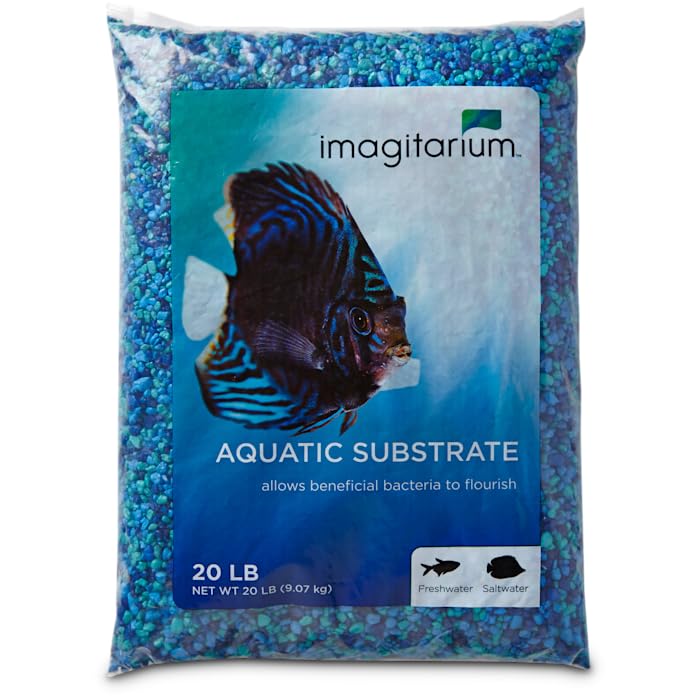
The Imagitarium Blue Jean gravel is a pre-colored, non-toxic inert gravel made for beginners and kids’ tanks. The 3–6 mm grain size is too large for rooted plants to anchor easily, but it works well for goldfish tanks, African cichlid setups, or as a decorative topper layer over soil in a planted tank. The 20-pound bag covers a standard 10-gallon tank at a 2-inch depth, making it a volume leader at its tier.
Because this is a coated gravel, the color is consistent and does not fade over time — the blue hue is designed to simulate a bright underwater environment. The manufacturer specifies rinsing before use to remove loose dust from transport. Owner feedback indicates a single rinse cycle clears the water, and the gravel remains stable without chipping. It does not buffer pH or affect water hardness, so it works with any water type.
For the budget-conscious keeper who wants a clean, uniform look without chemistry complexity, this gravel delivers the highest square-footage coverage per dollar. The trade-off is aesthetic flexibility: the bright blue color is a specific stylistic choice that limits natural scaping options. It also offers no nutrient value, meaning any plants beyond hardy Java fern or Anubias will require heavy fertilization.
Why we love it
- Highest volume per dollar in this lineup
- Non-toxic color stays vibrant long-term
- Simple rinse and pour — no cycling delay
Good to know
- Large grain size makes plant rooting difficult
- Bright color limits natural aquascaping options
5. Imagitarium Black Aquarium Sand 20 lbs
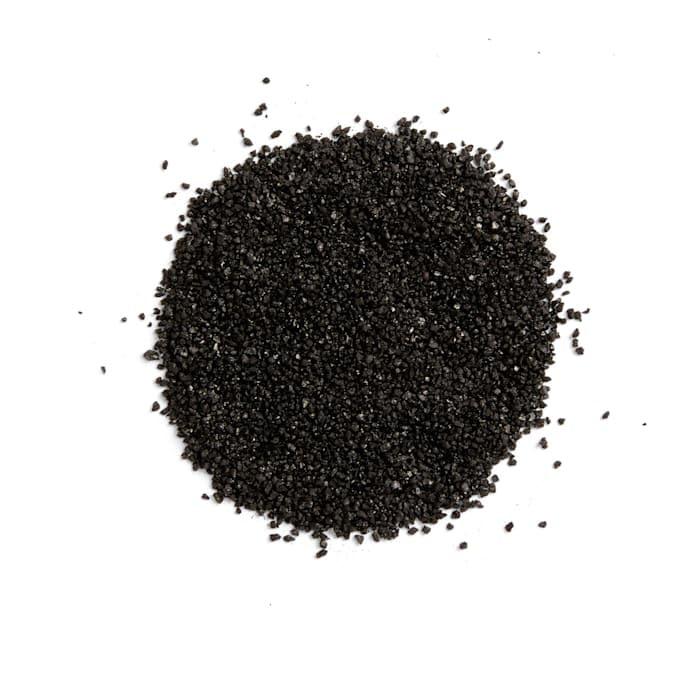
Imagitarium’s black sand is an inert, fine-grained option (roughly 0.5–1 mm) that creates a matte dark floor ideal for highlighting brightly colored fish like neon tetras, guppies, or cherry barbs. The 20-pound bag is heavy enough for a standard 20-gallon long tank at a 1.5-inch depth. The sand is non-toxic and safe for all freshwater species, including scaleless fish and shrimp.
Owner experiences vary on cleanliness — early batches drew complaints about clouding, but recent reviews consistently report that 5–10 minutes of rinsing produces clear water. Once settled, the sand compacts into a stable bed that does not shift with moderate filter flow. It does not contain any buffering agents, so it will not alter pH or hardness — a neutral canvas for keepers who dose their own chemistry.
For the price, this is the most cost-effective way to achieve a dark, natural-looking sand bed in a community tank. The fine grain size compacts tightly, so regular light vacuuming is needed to avoid debris accumulation. Because it is inert, heavy root-feeders like Vallisneria or Cryptocoryne will require root tabs placed directly in the sand. Overall, it is a reliable entry-level sand that performs well when expectations match its inert nature.
Why we love it
- Lowest cost per pound for black sand
- Matte finish creates excellent visual contrast
- Safe for all freshwater fish and shrimp
Good to know
- Batch consistency varies — some bags need more rinsing
- Inert — no nutrient value for rooted plants
FAQ
How thick should my aquarium substrate layer be?
Should I rinse active aqua soil before using it?
How long does the ammonia spike last with new soil?
Can I mix aquarium sand and gravel together?
Final Thoughts: The Verdict
For most hobbyists building a planted tank, the best aquarium substrate winner is the LANDEN Aqua Soil because it combines high CEC, buffering chemistry, and a 3–5 mm grain size that supports both delicate roots and strong biological filtration at a reasonable per-liter cost. If you prioritize the safest, lowest-ammonia active soil for shrimp or nano tanks, grab the Ultum Nature Systems Controsoil. And for a dramatic inert backdrop that makes fish pop without any chemistry management, nothing beats the Aqua Natural Galaxy Sand.