
A lifeless tank with stagnant water stresses fish, fuels algae blooms, and undermines every hour you spend on maintenance. The right aquarium water pump transforms that same tank into a thriving ecosystem where circulation mimics a natural current, waste collects in filters instead of settling on the substrate, and oxygen exchange keeps every inhabitant active. This is not an accessory you add after the tank is set up — it is the central organ that keeps the entire system alive.
I’m Mo Mahin — the founder and writer behind Furric. I spend my days digging through manufacturer spec sheets, cross-referencing pump curves against real-world lift heights, and analyzing thousands of owner-reported failure points so you don’t have to gamble on a pump that dies after three months.
After comparing flow rates, lift capacities, noise levels, and build quality across dozens of models, I have compiled the definitive guide to the best aquarium water pump for setups ranging from compact nano tanks to large koi ponds.
How To Choose The Best Aquarium Water Pump
An aquarium water pump is not a one-size-fits-all purchase. The pump that keeps a 200-gallon koi pond crystal clear will shred the fins of fish in a 20-gallon nano reef. You need to match three variables — flow rate, lift height, and power type — to your specific setup before you even look at price tags.
Match GPH to your tank volume
The rule of thumb is that your pump should circulate the entire tank volume 4 to 10 times per hour. A 50-gallon tank needs a pump rated for 200 to 500 GPH. Going lower leaves dead spots where detritus collects; going higher creates a current too strong for most freshwater community fish. For reef tanks with live rock, aim toward the higher end of that range to ensure proper gas exchange across the rock surface.
Lift height determines real flow at the outlet
Manufacturers advertise the maximum flow rate at zero vertical lift. The moment you push water upward — through a sump return, a waterfall outlet, or a canister filter — that flow drops. A pump rated for 1000 GPH at 0 feet might deliver only 400 GPH at a 5-foot lift. Always check the pump curve or the GPH rating at your specific lift height. If you run a sump system 4 feet below the tank, do not buy a pump whose max lift is 5 feet — it will barely move water.
DC vs AC: more than just voltage
DC pumps run on 24-volt power, consume less electricity, and include speed controllers that let you dial in the exact flow rate. They also run significantly quieter because the impeller is magnetically driven and the motor produces less vibration. AC pumps are simpler, cheaper upfront, and often last longer without electronic controllers to fail, but they lack adjustability and consume more power. For a display tank in a living room, the DC premium is worth it for the silence alone. For a basement sump or outdoor pond, a robust AC pump gives you more flow per dollar.
Ceramic shaft vs stainless steel
The pump shaft is the first component to wear out. Ceramic shafts resist corrosion in both freshwater and saltwater, run cooler, and last well beyond 20,000 hours in continuous operation. Stainless steel shafts corrode in saltwater environments over time, especially if the stainless grade is 304 instead of 316. For any saltwater or brackish setup, insist on a ceramic shaft. For freshwater ponds where the pump runs 24/7, ceramic shafts also justify a slightly higher upfront cost by skipping mid-life replacements.
Quick Comparison
On smaller screens, swipe sideways to see the full table.
| Model | Category | Best For | Key Spec | Amazon |
|---|---|---|---|---|
| JEREPOND Nano 660 GPH | DC Controllable | Sump return on nano to mid-size tanks | 25W DC motor, 20 speed controller | Amazon |
| hygger Cross Flow 1850 GPH | Wave Maker | Reef tanks and freshwater circulation | 18W DC, 5 wave modes, magnetic mount | Amazon |
| TONGCHANT 1600 GPH | Premium Pond | Koi ponds and backyard waterfalls | 100W, 14 ft lift, 180° rotatable outlet | Amazon |
| VIVOHOME 1800 GPH | Heavy Duty | Large ponds and outdoor water features | 100W, 13.8 ft lift, thermal overload | Amazon |
| Uniclife 1000 GPH | Mid-Range | Large tanks, sumps, and small ponds | 80W AC, 10 ft lift, ceramic shaft | Amazon |
| Knifel 1056 GPH | Budget AC | Fountains, hydroponics, medium tanks | 85W, adjustable flow knob, copper motor | Amazon |
| GADFISH Water Changer | Siphon System | Water changes and gravel vacuuming | 30 ft hose, faucet pressure powered | Amazon |
In‑Depth Reviews
1. JEREPOND Nano 660 GPH DC Controllable Pump

The JEREPOND Nano delivers 660 GPH of adjustable flow from a 25-watt DC motor that sips power compared to any AC pump in its class. The LCD controller lets you set flow from 30 to 100 percent across 20 discrete speed levels, and the five-minute feeding mode pauses circulation so food stays suspended instead of sucked into the sump. The pump body measures just 5.4 by 2.6 by 3.4 inches, making it shoehorn-friendly for tight sump chambers and nano tank cabinets.
The ceramic shaft and sealed impeller keep noise below 25 dBA — quieter than most aquarium lids. Owners running 100-gallon saltwater sumps report zero noise complaints and no leaks after four months of continuous operation. The controller includes a wave maker mode that cycles flow to simulate tidal movement, though the wave action is gentle enough for freshwater planted tanks that need circulation without uprooting stem plants.
The included low-water intake screen cover lets the pump draw from as little as an inch of water, a feature that saves your impeller if your sump evaporation goes unchecked. The auto-shutoff protection kicks in during dry-run or block conditions, which protects the pump from the most common failure mode in the category. For a mid-range price, you get DC efficiency, controller versatility, and build quality that competes with pumps costing twice as much.
Why we love it
- Ultra quiet operation at 25 dBA with no vibration transfer
- 20-speed controller with LCD display for precise flow tuning
- Dry-run and blockage auto shutoff protects the pump from user error
Good to know
- Max flow of 660 GPH limits it to tanks under 100 gallons as a primary return
- Output fitting is 3/4 inch, not the 1 inch some larger sump plumbing expects
2. hygger Cross Flow Aquarium Wave Maker 1850 GPH

The hygger Cross Flow pump uses a cylindrical impeller that pushes water laterally instead of axially, creating a 360-degree spread that eliminates dead spots without the jet-like blast of traditional powerheads. The 18-watt DC motor drives up to 1850 GPH while drawing so little power that running it 24/7 adds less than two dollars to your monthly electric bill. The LED controller offers pulse, sine, constant, random, and cross flow wave modes, each adjustable across 30 to 100 percent flow and frequency levels.
The magnetic base holds the 8.5-inch pump securely to tank glass up to half an inch thick, and the rotatable head can be angled to direct flow upward for surface agitation or downward to sweep the substrate. Owners running 75-gallon reefs and cichlid tanks confirm that the pump keeps the bottom clean on its lowest setting of 30 percent. The random wave mode cycles through varying intensities that mimic natural currents, and the feeding mode ramps flow down temporarily so food does not get swept into overflows.
Noise output is near-silent at speeds below 50 percent, though a faint hum becomes audible at the highest settings. The sine wave control technology reduces the electronic whine that plagues cheaper DC pumps, making this a strong candidate for bedroom tanks. One reviewer noted that the slow ramp-up during startup was too gentle for a small frog, so nano inhabitants should be observed during initial configuration. For reef keepers who want controllable flow without the bulk of two separate powerheads, this single unit covers that territory effectively.
Why we love it
- Cross flow technology spreads water movement 360 degrees without a direct jet
- Five distinct wave modes with independent flow and frequency adjustment
- Magnetic mount allows tool-free repositioning anywhere on the glass
Good to know
- Audible hum develops at flow settings above 70 percent
- Random wave mode may startle very small or delicate fish during ramp-ups
3. TONGCHANT Pond Pump 1600 GPH
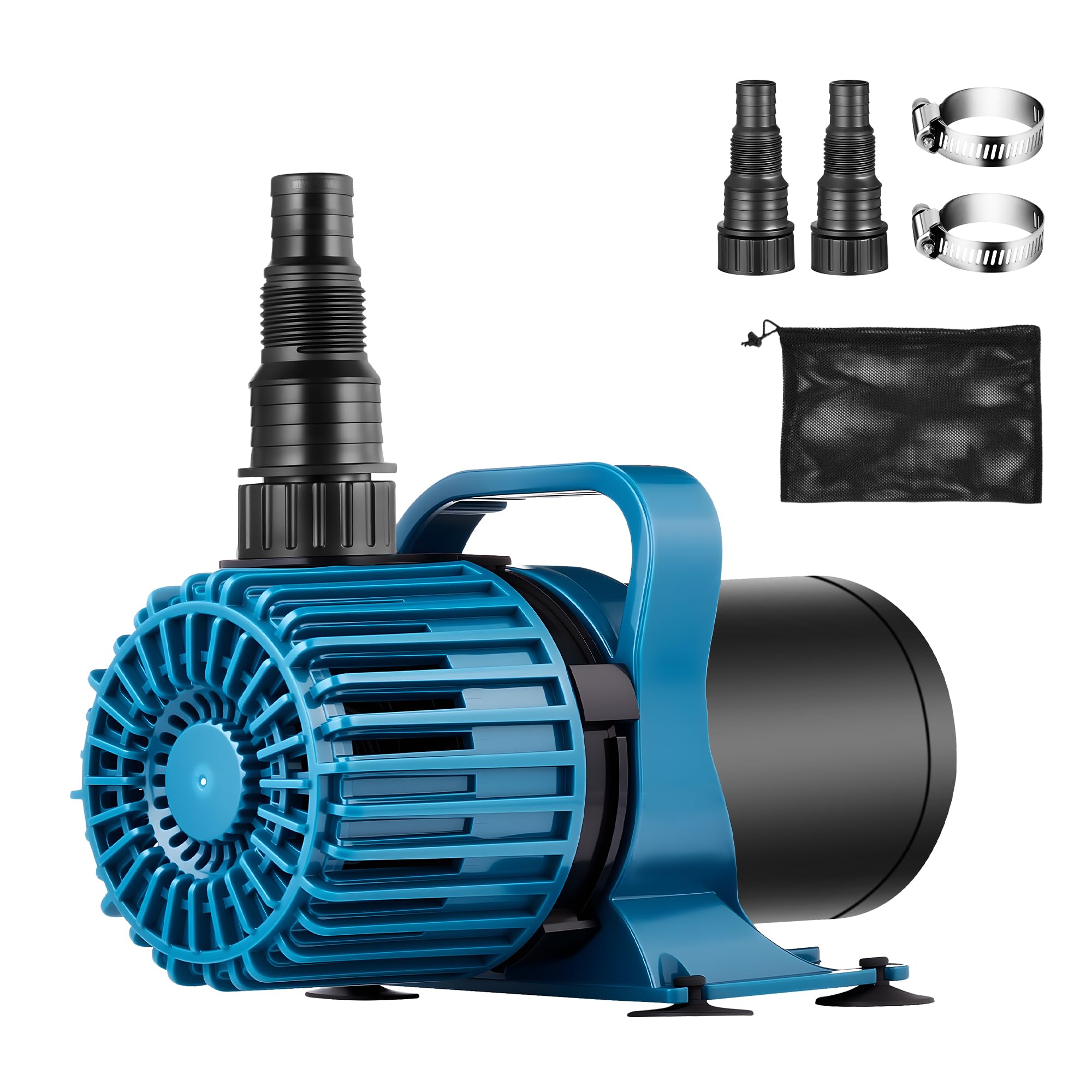
The TONGCHANT 1600 GPH pump is built for heavy lifting — literally. Its 100-watt copper-wire motor pushes water up to 14 feet vertically while maintaining enough remaining flow to feed a waterfall, spitter, or filter return. The 180-degree seamless rotatable outlet lets you direct the outflow without fixed-step limitations, so you can adjust the waterfall angle continuously as water levels change. The ABS housing and ceramic shaft resist rust and mineral buildup even in hard water pond conditions.
The double filter system combines a mesh intake cover with a nylon barrier bag that traps leaves and string algae before they reach the impeller. Both filter stages remove without tools, and the impeller housing and rotor detach for deep cleaning when flow drops. Owners running koi ponds report that the pump ran continuously for a full year without a single shutdown, handling sub-freezing winter temperatures when fully submerged. The four suction cups hold the pump steady on smooth pond liners and prevent the vibration noise that loose pumps create.
The pump includes 3/4 inch, 3/4 inch NPT, and 1-1/4 inch nozzle adapters, plus a 20-foot power cord long enough for most pond-to-outlet distances. The thermal overload protection shuts the motor down if it overheats, which adds a safety layer for installations where debris might partially block the intake. For the flow and lift it delivers, this pump occupies a sweet spot where pond owners get professional-grade output without stepping up to commercial pump pricing.
Why we love it
- 14-foot max lift delivers strong flow even to elevated waterfalls
- Double filtration system with tool-free cleaning access
- 180-degree rotatable outlet for precise water direction
Good to know
- Flow drops significantly at full lift height — expect roughly 900 GPH at 10 feet
- Barrier bag requires periodic rinsing in debris-heavy ponds
4. VIVOHOME 1800 GPH Submersible Water Pump

The VIVOHOME 1800 GPH pump pairs a 100-watt copper-wire motor with an epoxy-resin-sealed magnetic drive to achieve IPX8 waterproofing, meaning it can remain fully submerged indefinitely without moisture ingress. The maximum lift of 13.8 feet supports medium-to-large pond waterfalls and elevated filter returns, while the 0-to-180-degree seamless nozzle adjustment lets you aim the outlet precisely. The pump uses a ceramic shaft paired with a silicon carbide drive ring, a combination that outlasts standard ceramic-on-ceramic surfaces by reducing friction wear.
The package includes a filter mesh bag, two hose adapters, and four rubber suction cups that reduce resonance noise to a measured 30 to 40 dB range. Owners of 175-gallon koi ponds bypassed their external canister pumps and saw better flow, reduced algae clogging, and lower nitrite readings after switching. The thermal overload protection triggers at 221 degrees Fahrenheit to prevent motor burnout if the pump runs dry or the intake gets blocked — a critical safeguard for outdoor installations where maintenance is less frequent.
The 20-foot power cord gives flexibility for pond placements that are far from outlets, and the suction cups hold the pump stable even on textured pond liners. One owner noted that the pump introduced bubbles into the pond initially, which resolved as the system broke in over a few days. The VIVOHOME lacks a built-in flow controller, so you regulate output by adding a ball valve on the discharge line. For pond keepers who prioritize raw flow and durability over adjustability, this pump delivers reliable circulation with minimal maintenance.
Why we love it
- IPX8 epoxy-sealed motor runs indefinitely underwater without corrosion
- Silicon carbide drive ring extends shaft life beyond standard ceramic pumps
- High flow output prevents algae blooms and biofilm accumulation
Good to know
- No integrated flow control valve — requires external ball valve for adjustment
- Bubbles may appear during the first few days of operation until the system stabilizes
5. Uniclife 1000 GPH Submersible and Inline Pump

The Uniclife 1000 GPH pump earns its reputation from a single spec: the ceramic shaft and bearing are rated for over 25,000 hours of continuous runtime — that is nearly three years of non-stop operation. The 80-watt AC motor delivers a maximum lift of 10 feet, making it suitable for large freshwater tanks with sump returns, outdoor ponds up to mid-size, and hydroponic systems where constant circulation prevents root rot. The pump can be used fully submerged or placed inline externally, and the package includes one inlet nozzle for 1-1/2 inch pipe and two outlet nozzles for 3/4 inch and 1 inch connections.
The four suction cups hold the pump steady and damp vibration, keeping noise low enough that owners forget it is running. One reviewer using it for a 50-gallon bog filter reported that the pump, despite its size, returned roughly 400 GPH to the waterfall after a 4-foot lift, showing realistic performance that matches common installation scenarios. The detachable design lets you separate the motor head from the impeller housing without tools, and every part that contacts water can be rinsed under a faucet. The 3-prong grounded plug and 10-foot cord meet electrical safety standards for aquarium use.
At 7.6 by 3.6 by 4.7 inches and weighing over 4.5 pounds, the Uniclife is physically larger than many pumps in its flow class, which reflects the thicker case and larger motor windings that contribute to its longevity. An owner who left the pump running through sub-freezing temperatures in an outdoor pond reported no damage after the ice thawed. The pump does not feature any flow control or speed adjustment, so installation with a ball valve is recommended for tanks that need reduced circulation.
Why we love it
- Ceramic shaft and bearing rated for 25,000-plus hours of continuous use
- Tool-free disassembly makes cleaning fast and complete
- Versatile submersible or inline operation with multiple nozzle sizes
Good to know
- Larger and heavier than comparable GPH pumps — verify sump clearance before buying
- No integrated flow control requires an external valve for flow restriction
6. Knifel Submersible Pump 1056 GPH

The Knifel 1056 GPH pump brings a welcome feature at its price point: a built-in adjustable flow knob that lets you throttle output without buying or plumbing an external valve. The 85-watt copper-wire motor pushes water to a maximum lift of 13 feet, and the pump body measures 5.3 by 3.5 by 6.1 inches — compact enough for most sump chambers, hydroponic reservoirs, and backyard fountains. The ABS housing protects the internal rotor and ceramic shaft, and the tool-free detachable design means you can pull the impeller for cleaning in under a minute.
Owners running this pump in medium-sized aquariums and fountains consistently report near-silent operation. The adjustable knob ranges from a trickle up to full 1056 GPH, so you can dial in a gentle current for betta tanks or crank it up for cichlid circulation. One user powered a 10-foot-high rain chain by adapting the pump to a 1/4-inch irrigation line, demonstrating that the lift rating is accurate even when restricted to small-diameter tubing. The three included nozzles cover most common hose sizes for fountains and waterfalls.
There is a durability caveat that surfaces in longer-term reviews: some owners of outdoor duck pond installations reported impeller breakage after several months, suggesting the pump is better suited for indoor or protected outdoor use where debris load is low. The pump also lacks the ceramic shaft reinforcement of higher-priced models, meaning the plastic impeller assembly bears more wear. For indoor display tanks, hydroponic setups, and seasonal fountains where you can monitor water quality, the Knifel delivers excellent value — just do not bury it in a muddy pond and expect it to survive a full season without maintenance.
Why we love it
- Built-in flow knob eliminates the need for external ball valves
- Compact footprint fits tight sump chambers and under-tank cabinets
- Near-silent operation suitable for living room display tanks
Good to know
- Impeller assembly is plastic and may fail in heavy-debris outdoor ponds
- Does not include a 1/4-inch nozzle for small fountain tubing
7. GADFISH Gravel Vacuum Aquarium Water Changer 30ft

The GADFISH Water Changer is not a pump in the traditional sense — it uses your existing faucet water pressure to create suction through a venturi effect, draining the tank while simultaneously vacuuming gravel. The two-valve system lets you switch from draining to refilling without moving any equipment, and the 30-foot hose reaches from most sinks to nearby tanks without extension. The process eliminates the bucket brigade entirely: connect the unit to your faucet, turn on the water, and the siphon pulls dirty water from the tank into the sink.
The 14.5-inch cleaning tube has a built-in gravel filter that traps debris while allowing sand and small gravel to fall back in place. Owners with multiple tanks — including a 125-gallon and 75-gallon setup — report completing full water changes in under an hour, a task that previously required two hours of lifting buckets. The included metal faucet adapters cover 3/4-inch garden hose threads, 15/16-inch, 55/64-inch, and 13/16-inch threaded faucets, and the quick-connect valve snaps onto any of them without tools.
The system is not suitable for tanks located far from a threaded faucet unless you buy an adapter for a shower head or hose bib. The water pressure in your home directly determines the suction strength — low-pressure households may find vacuuming less effective. Users with arthritis or back problems specifically praise this unit because it eliminates the lifting and bending that traditional water changes require. While it does not replace a circulation pump for daily filtration, this device addresses the most dreaded maintenance task in the aquarium hobby and cuts the labor by 75 percent.
Why we love it
- Eliminates carrying buckets for water changes and gravel cleaning
- Two-valve design switches between drain and refill without disconnecting
- Multiple metal faucet adapters fit most standard sink threads
Good to know
- Requires access to a threaded faucet or compatible adapter
- Drain rate depends on your home water pressure — slower in low-pressure systems
FAQ
What size pump do I need for a 75 gallon aquarium?
Can I use a pond pump inside my aquarium?
How do I reduce pump noise in my aquarium?
Final Thoughts: The Verdict
For most gardeners, the best aquarium water pump winner is the JEREPOND Nano 660 GPH because its DC motor, LCD controller, and silent operation deliver premium adjustability at a mid-range investment. If you want raw flow for a large koi pond or waterfall feature, grab the TONGCHANT 1600 GPH for its 14-foot lift and double filtration system. And for anyone who dreads water change day, nothing beats the GADFISH Water Changer for cutting manual labor by hours.