
Invisible water chemistry is the silent killer of freshwater and marine aquariums. A sudden ammonia spike or an undetected nitrate buildup can stress or kill your fish before any visible symptom appears, which is why a reliable reagent-based diagnostic tool is non-negotiable for any serious tank owner.
I’m Mo Mahin — the founder and writer behind Furric.
Whether you run a nano reef, a planted community tank, or a cichlid-only setup, you need a tool that delivers lab-grade readings without breaking a budget. This roundup of the best aquarium water test kit breaks down which liquid reagent kits and multi-parameter strips actually earn their shelf space.
How To Choose The Best Aquarium Water Test Kit
Selecting the right test kit is a trade-off between granular accuracy, ease of use, and the total number of tests per bottle. Here are the three specs every buyer should evaluate before clicking add-to-cart.
Liquid Reagent Versus Test Strips
Liquid reagent kits — like the API Master Kit or the Pawfly 5‑in‑1 — use chemical drops that react quantitatively with your water sample. Test strips rely on a paper pad that changes color by capillary action. Reagent kits are significantly more accurate and allow you to read intermediate values rather than just ranges. Strips are faster and cheaper per test but prone to false negatives when ammonia or nitrite sits near the detection threshold. For precise fish-keeping, liquid reagent is the standard.
Parameter Coverage
At a minimum, any comprehensive kit must measure pH, ammonia (NH₃/NH₄⁺), nitrite (NO₂⁻), and nitrate (NO₃⁻). Phosphate (PO₄³⁻) monitoring becomes critical if you fight persistent algae or maintain a planted tank. A kit that omits high-range pH fails reef tanks whose alkalinity pushes past 7.6. Cross-check the included bottle count — fewer bottles often mean skipped parameters.
Test Count and Reagent Shelf Life
Not all kits label the total number of tests accurately. A 5‑in‑1 kit may advertise 265 measurements, while a dedicated master kit like the API Freshwater Master Test Kit promises 800+ individual tests. Factor in how many tanks you maintain and how often you perform weekly checks. Liquid reagents lose potency after about 18‑24 months once opened, so oversized kits only make sense if you test regularly.
Quick Comparison
On smaller screens, swipe sideways to see the full table.
| Model | Category | Best For | Key Spec | Amazon |
|---|---|---|---|---|
| API Freshwater Master Test Kit | Premium Liquid Reagent | Accurate nitrogen cycle monitoring | 800+ individual tests | Amazon |
| Gold Label Pet Care Master | Premium Starter Bundle | First-time owners wanting extras | 950+ total tests | Amazon |
| Pawfly 5 in 1 Water Master | Mid-Range Reagent Kit | Budget multi-parameter coverage | 265 total measurements | Amazon |
| API 5-IN-1 Test Strips | Entry-Level Strips | Quick weekly spot checks | 100 count strips | Amazon |
| Seachem MultiTest Phosphate | Specialty Reagent | Algae-driven phosphate control | Detects below 0.05 mg/L | Amazon |
In‑Depth Reviews
1. API Freshwater Master Test Kit

The API Freshwater Master Test Kit has been the gold standard for freshwater hobbyists for nearly two decades, and the 2024 formulation retains the same reliable colorimetric chemistry that earned its reputation. It monitors pH, high-range pH, ammonia, nitrite, and nitrate — the five metrics that define the nitrogen cycle and buffering capacity. The kit delivers roughly 800 individual tests, making it the highest per-bottle value in this roundup for anyone running one or two tanks.
Each test requires filling a capped test tube to the marked line, adding the specified drops, shaking, and waiting 5 minutes before comparing against the laminated color card. The ammonia test reads down to 0 ppm and shows a detectable yellow-green shift at 0.25 ppm, which is crucial during cycling. The nitrate test requires a vigorous 1‑minute shake of bottle #2, a step users routinely skip and then blame the kit for false highs — follow the instructions precisely.
The biggest drawback is the manual chore: a full five-parameter panel takes about 15 minutes and leaves temporary orange stains on skin if you spill reagent #1. The bottle caps can also crack after repeated twisting. That said, the track record of accurate, reproducible readings across thousands of owners confirms that this kit remains the benchmark every other freshwater kit is measured against.
Why we love it
- Accurate to 0.25 ppm for ammonia detection
- 800+ test capacity outlasts most strip packs by months
- Included color card is easy to read under natural light
Good to know
- Reagents can stain hands and surfaces if spilled
- No phosphate test included — separate purchase needed
- Requires 15 minutes per full panel
2. Gold Label Pet Care Master Test Kit
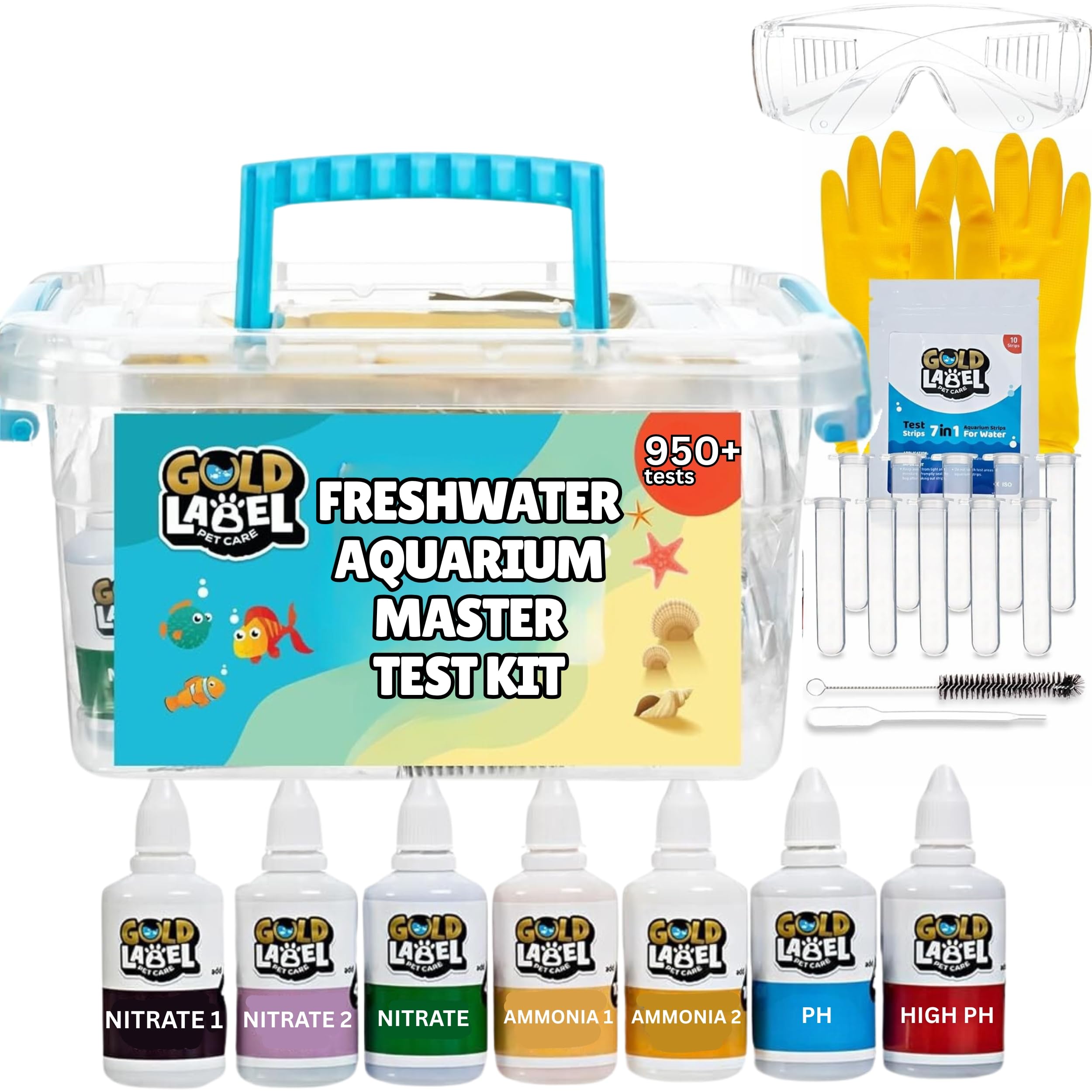
Gold Label Pet Care enters the premium tier with a master kit that doses over 950 individual tests — the highest raw count in this list. The bundle includes 7 reagent bottles targeting pH, high pH, ammonia, nitrite, and nitrate, plus a 10‑pack of test strips, a dropper, 10 glass test tubes, a cleaning pipe brush, safety glasses, and gloves. It is designed as an all-in-one starter lab for new aquarists who want both reagent precision and the speed of strips.
The reagent chemistry follows the standard Nessler/indophenol method for ammonia and the diazotization pathway for nitrite, and the color chart is printed on water-resistant cardstock. Owners report that the readings match API cross-checks within one shade step for most parameters. The test strips are a convenience bonus for quick mid-week checks, though they lack the resolution of the reagent tests. The included gloves and brush add practical safety that most kits skip.
A recurring critique concerns the bottle cap design: the inner dropper tip frequently detaches and remains stuck inside the cap when you first open a bottle, causing drips. Also, at least one user reported a failed ammonia reading that didn’t match the chart — a defect that underscores the importance of verifying questionable results with a second test. For the quantity and accessories, though, this kit is hard to beat on a per-test cost basis.
Why we love it
- Highest test count at over 950 individual tests
- Safety glasses and gloves included for spill protection
- Bonus test strips enable quick mid-week checks
Good to know
- Dropper tips can detach inside the cap on first use
- Reported occasional defective reagent batch — verify results
- No dedicated phosphate test reagent included
3. Pawfly 5 in 1 Aquarium Water Master Test Kit
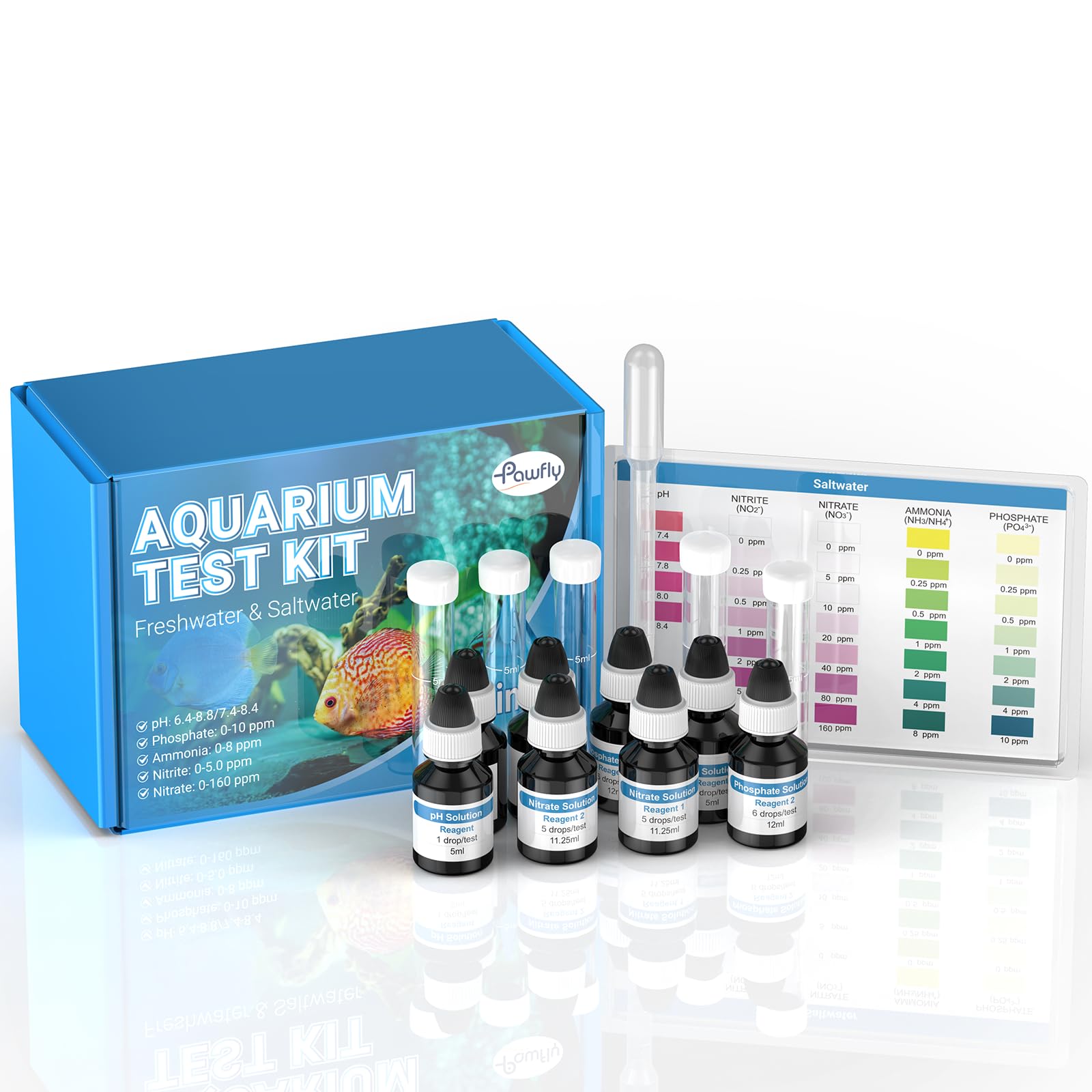
Pawfly’s 5‑in‑1 master kit breaks from the competition by bundling phosphate testing alongside the standard four-parameter core — pH, nitrite, nitrate, and ammonia — a feature usually reserved for separate specialty kits. The total capacity sits at 265 measurements (100 pH, 45 nitrite, 50 nitrate, 30 ammonia, 40 phosphate), which is lower than the API or Gold Label kits but acceptable for a single medium tank over six months. Both freshwater and saltwater color charts are printed on the instruction card, so reef keepers can use it immediately.
The reagent system uses glass vials with clear marking lines, and the foam carrying block holds all vials upright during testing — a simple but effective design that prevents tipping. The ammonia reagent uses the salicylate method rather than Nessler, which eliminates the hazardous mercury compound found in some older kits. Owners consistently note that readings match those of the established API kits within one shade gradation, with the phosphate test being particularly praised for catching early algae triggers that other master kits miss entirely.
The downsides are the fragile glass vials — at least two owners broke theirs within the first month — and the cardboard packaging that degrades quickly if exposed to moisture. There is no stand or hard case included, so you will need to provide your own storage solution. For aquarists who battle persistent algae and want phosphate tracking without buying a separate unit, this is the most efficient single-box option available.
Why we love it
- Phosphate testing integrated into the master kit — rare at this level
- Salicylate-based ammonia reagent is safer than Nessler formulas
- Foam block keeps multiple glass vials stable during simultaneous tests
Good to know
- Glass vials are breakable — handle with care
- Cardboard box degrades with moisture exposure
- Only 30 ammonia tests compared to the 100 pH tests
4. API 5-IN-1 TEST STRIPS 100-Count
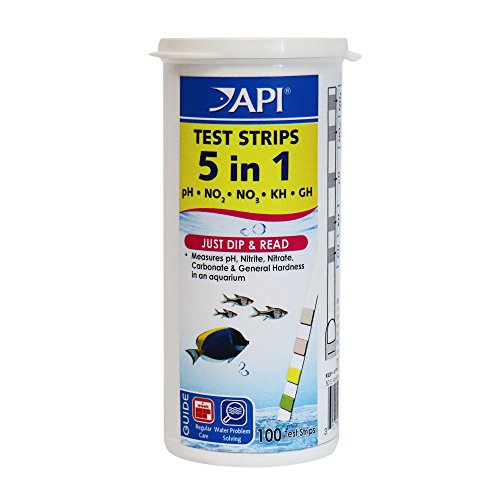
API 5‑IN‑1 Test Strips offer the fastest path to a basic water snapshot: dip, wait 60 seconds, and compare five color pads for pH, nitrite, nitrate, carbonate hardness (KH), and general hardness (GH). The 100‑count box provides about six months of weekly testing for a single tank, and the strips work in both freshwater and saltwater. For experienced aquarists who already know their tank’s baseline, these strips serve as a convenient quick-check between full liquid reagent panels.
The critical limitation is resolution. The nitrite pad jumps from 0 to 0.5 to 1.0 to 5.0 ppm — a gap wide enough that a reading of 0.3 ppm, which still requires intervention, will show as 0. A similar jump exists on the nitrate pad between 20 and 40 ppm. This coarse voltage makes the strips unsuitable for cycling a new tank or diagnosing subtle water quality drift. Several owner reviews note that the strip pads appeared to have a plastic film that prevented water absorption, though most agree that this seems to be a batch variation rather than a permanent design flaw.
KH and GH pads are unique to these strips and are genuinely useful for monitoring buffering capacity, especially in hard-water regions or African cichlid setups that require high mineral content. If your goal is a routine safety net for an established, stable tank, the 5‑IN‑1 strips are sufficient. If you are cycling a new aquarium or treating sick fish, you need a liquid reagent kit instead.
Why we love it
- KH and GH pads included — rare in strip format
- 60‑second read time is the fastest available
- 100 strips cover months of weekly checks
Good to know
- Coarse color increments miss intermediate dangerous values
- Some batches reported pad coating that blocks water absorption
- Not accurate enough for cycling or disease diagnostics
5. Seachem MultiTest Phosphate Test Kit

The Seachem MultiTest Phosphate Test Kit is a dedicated single-parameter reagent kit engineered for hobbyists who need to track phosphate levels below 0.05 mg/L — the threshold where nuisance algae begins to bloom in planted tanks and reef systems. The kit uses a multi-cavity plate that allows up to six simultaneous tests, which speeds up the process when you are dialing in phosphate dosing or evaluating a new source water supply. It works in both freshwater and marine environments, making it equally useful for nano reefs and high-tech planted aquascapes.
The chemistry employs a molybdenum blue reaction that produces a distinct blue color proportional to phosphate concentration. The included reference standard lets you validate the reagent before trusting your readings, a feature absent from most mass-market kits. Users consistently report that the Seachem kit detected phosphate in their tap water that the API master kit strips missed entirely, saving them from persistent algae battles. The test takes about 7 minutes from start to finish, including the 5‑minute development time.
The trade-off is volume: the kit provides roughly 50 tests before the reagent runs out, which is fine for targeted monitoring but expensive for weekly broad-spectrum screening. The plastic multi-cavity plate can also be finicky to clean between runs—residual dye from a previous test can skew the next reading if not rinsed thoroughly. For dedicated aquarists fighting hair algae or dosing phosphate-limiting media like PhosGuard, this kit provides the sensitivity needed to stay below the critical 0.10 mg/L mark.
Why we love it
- Sensitive down to 0.05 mg/L — catches traces other tests miss
- Includes a reference standard for reagent validation
- Multi-cavity plate runs up to 6 tests simultaneously
Good to know
- Only ~50 tests per kit — low volume for the price
- Multi-cavity plate must be thoroughly cleaned to avoid carryover
- No other parameters included — single-purpose purchase
FAQ
Why does my liquid reagent kit show different results than my test strips?
How often should I test my aquarium water with a master kit?
Can I use a freshwater master kit in my saltwater reef tank?
Final Thoughts: The Verdict
For most freshwater aquarists, the best aquarium water test kit winner is the API Freshwater Master Test Kit because it delivers proven reagent accuracy across 800+ tests, covering the full nitrogen cycle with a track record that is trusted in thousands of forums. If you want integrated phosphate monitoring to stay ahead of algae, grab the Pawfly 5 in 1 Water Master Test Kit. And for quick weekly sanity checks on an established stable tank, nothing beats the convenience of the API 5-IN-1 Test Strips.