
The sinking feeling of leaving your aquarium for a long weekend is universal — will the fish be overfed by a well-meaning neighbor, or worse, go hungry? Automatic aquarium feeders promise to solve that exact tension, but choosing the wrong one can dump an entire hopper of pellets into the water, turning your tank into a nitrate bomb. The difference between a stress-free vacation and a tank crash often comes down to one number: the dispenser’s portion-control resolution per cycle.
I’m Mo Mahin — the founder and writer behind Furric. I’ve spent my career deep in the data of aquarium equipment, cross-referencing dispenser motor torque, drum capacity, moisture-seal integrity, and thousands of owner-reported feeding failures to separate the reliable units from the clump-prone ones.
This guide breaks down five feeders that solve real-world problems — humidity jamming, over-portioning on tiny tanks, and draining batteries mid-trip — so you can find the best automatic aquarium feeder for your specific setup without wasting time on units that will fail after day three.
How To Choose The Best Automatic Aquarium Feeder
An aquarium feeder that works flawlessly for a 75-gallon community tank can poison a 10-gallon betta setup. The three specs that separate a successful purchase from a regret are portion resolution, moisture seal, and power redundancy.
Portion Control Resolution
Look for a unit that offers at least two adjustable windows or a sliding aperture. Fixed-opening drums often dump 2-3 grams per cycle — fine for large cichlids, lethal for nano tanks. The best feeders let you dial down to roughly 0.5g per rotation so you can layer multiple small feeds without flooding the water column.
Moisture Seal and Clog Prevention
Humidity inside a tank canopy can soften pellets within 48 hours, causing them to stick inside the rotor and stop dispensing entirely. A feeder with an auto-closing port or a rubber-sealed drum opening prevents this. Models that use a rubber gasket around the axle consistently survive week-long trips without jamming.
Power Redundancy
Battery-only units are fine for weekend trips, but the most reliable feeders allow simultaneous plug-in and battery operation. If the USB cable gets knocked loose while you are away, the battery keeps the schedule running. Rechargeable lithium models with 3-6 month endurance eliminate the worry of dead alkalines halfway through a two-week vacation.
Quick Comparison
On smaller screens, swipe sideways to see the full table.
| Model | Category | Best For | Key Spec | Amazon |
|---|---|---|---|---|
| Ycozy AF2020 | Mid-Range | Dual-power reliability | 200ml capacity, AA + USB power | Amazon |
| TOPBRY BP-001 | Mid-Range | Extended vacations with rechargeable battery | 3-6 month rechargeable Li-ion battery | Amazon |
| FISHNOSH ML | Budget | Simple no-screen operation for beginners | 200ml capacity, 3 feedings/day max | Amazon |
| FISHNOSH KL-004 | Premium | Temperature monitoring and portion precision | Built-in digital thermometer + dual sliding windows | Amazon |
| Papettly AFF0301 | Premium | Precision micro-feeding per chamber | 15-chamber rotating drum, 2g per cup | Amazon |
In‑Depth Reviews
4. FISHNOSH KL-004 (Digital Thermometer Model)

This is the only feeder in this lineup that adds an environmental safeguard — a built-in digital thermometer with an audible temperature alert. If your tank creeps outside the safe range while you are away, the unit beeps, giving you a chance to intervene before your fish suffer. The dual feeding windows let you swap between a large and small dispensing port depending on whether you are using crumble pellets or larger floating sticks.
Owners report that the clamp is optimized for rimless tanks; if your aquarium has a thick plastic lip, you may need to shim the bracket. The thermometer sensor reads within a few degrees of calibrated references, though some users note a consistent 9°F offset that requires manual compensation. Portion control is precise enough for tanks up to 65 gallons without overfeeding, and the motor runs silently enough that you won’t hear it cycle during the night.
For aquarists who keep sensitive species like discus or crystal shrimp, the combination of temperature monitoring and adjustable portion windows makes this the most thoughtful feeder available. It supports up to 9 feedings per day in three time slots, so you can micro-dose multiple small meals — exactly what high-metabolism fish need to stay healthy.
Why we love it
- Digital thermometer with alert warns of dangerous water temps
- Dual sliding windows provide fine-grained portion control
- Holds up to 200ml and runs silently
Good to know
- Thermometer may read ±9°F off — verify before relying on alert
- Clamp is designed for rimless tanks; rimmed tanks need a DIY fix
5. Papettly AFF0301

The Papettly breaks from the traditional auger-style dispenser by using a 15-chamber rotating drum that pre-portions each meal into individual cups. Each chamber holds roughly 2 grams, which gives you deterministic feeding — every rotation drops exactly what you loaded, with no variance from pellet size. This is a huge advantage for owners of small tanks or picky eaters where a 0.5g variance could mean the difference between a clean tank and a cloudy one.
The noise floor is genuinely low — owners measure operation well under 30 dB, so it won’t disturb a bedroom aquarium. The auto-closing ports seal each chamber after dispensing, which prevents humidity from softening the next meal. The trade-off is capacity: the drum holds only about 30 grams total, which for a heavily stocked tank or multiple feedings per day may last only 2-3 days. It is also not designed for flake or shrimp food, which can jam the rotating mechanism.
This feeder is ideal for the precision-focused aquarist who values portion certainty over raw capacity. For short weekend trips or daily automation in a nano tank, the chamber system eliminates the stress of wondering whether the auger clogged or dumped too much.
Why we love it
- 15 individually portioned chambers guarantee exact feeding every cycle
- Auto-closing ports keep food dry and prevent moisture clumping
- Whisper-quiet operation below 30 dB
Good to know
- Small 30-gram capacity — not suited for long vacations with heavy feeding
- Cannot handle flake or shrimp food — pellets and granules only
1. Ycozy AF2020
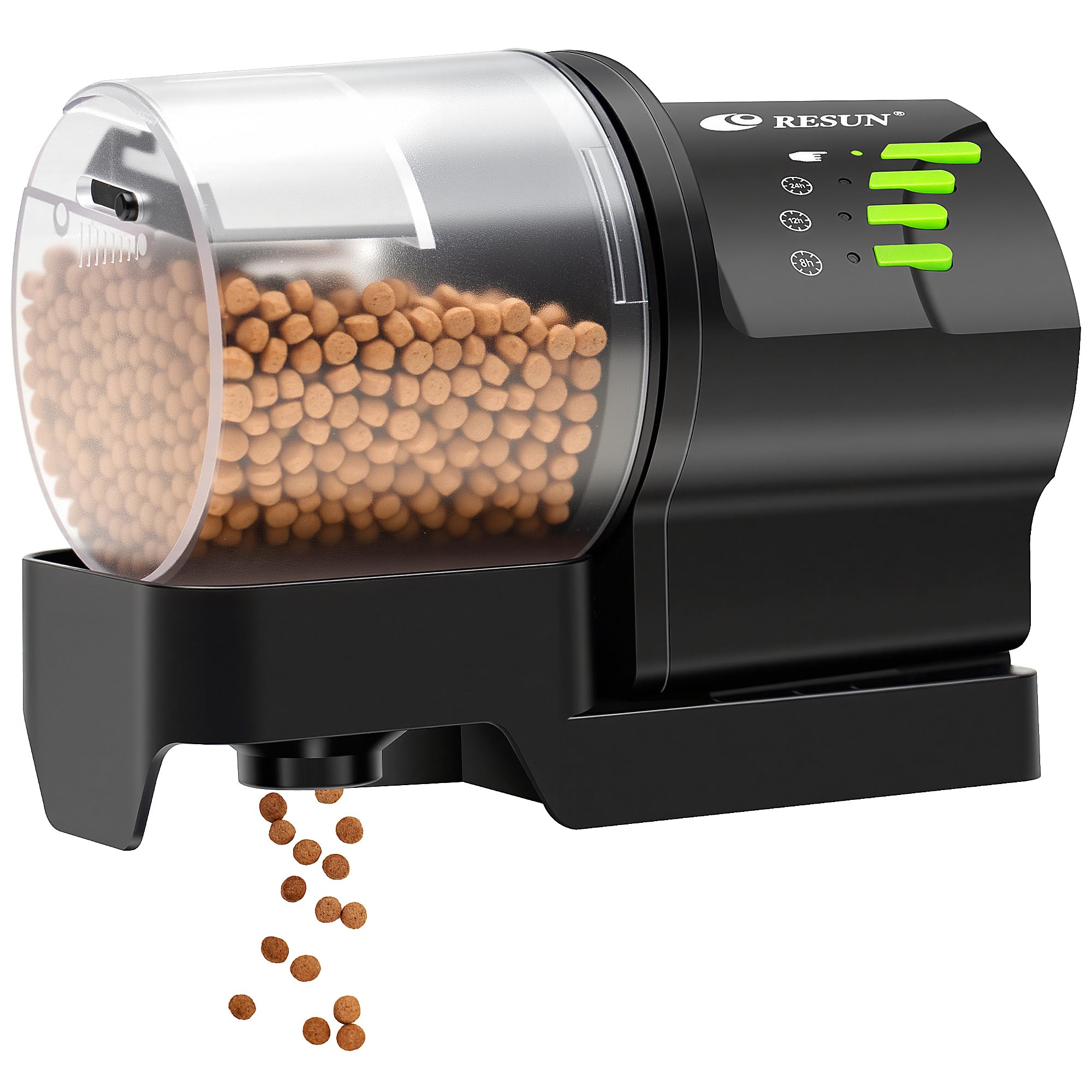
The Ycozy AF2020 earns the top spot because it solves the single most common feeder failure — power loss — with true redundancy. It runs on two AA batteries but also accepts USB power simultaneously, meaning if the USB cord gets bumped loose during your trip, the battery keeps the schedule alive. The adjustable outlet slider lets you match the opening width to pellet diameter, so you can feed micro pellets to small tetras without dumping half the hopper.
At 200ml capacity, it holds enough food for 15-30 days depending on your feeding frequency. The bracket system includes both a standard edge clip for open tanks and a funnel bracket that clips onto lids with a narrow opening — a thoughtful inclusion for rimmed aquariums. Owners consistently rate the ease of setup highly, and the manual feed button lets you test portion sizes over a paper plate before leaving.
For the vast majority of aquarium owners — community tanks, goldfish, and even small turtles — the Ycozy delivers the best balance of capacity, power backup, and portion flexibility. It is not the flashiest model, but it is the one least likely to fail when it matters.
Why we love it
- Dual power (USB + battery) ensures no missed feedings during outages
- Adjustable outlet slider fits everything from powder to large pellets
- 200ml capacity supports up to 30 days of vacation feeding
Good to know
- Edge clip can feel loose on very thick tank rims
- Requires initial testing to dial in the exact slider position for your food
2. TOPBRY BP-001

The TOPBRY BP-001 stands out for its built-in lithium battery, which owners confirm can last 3-6 months on a single USB charge. For anyone who travels frequently for work or has an irregular schedule, the ability to recharge via USB rather than hunting for AA alkaline replacements is a genuine convenience. The feeder allows up to four programmable feeding times per day with 1-3 rotations per session, giving you fine control over the total daily portion.
The top-fill design lets you pour in fresh food without removing the entire hopper, reducing the chance of accidentally dropping the unit into the tank. The 360-degree rotating pedestal means you can orient the feeder wherever the tank lid cutout allows, though some users report that the unit requires roughly 3 inches of clearance from the tank rim — not ideal for tight hoods. For flake food, owners found that spacing two single rotations three minutes apart worked better than a single double rotation, which could dump unevenly.
This is a strong choice for anyone who prioritizes rechargeability and scheduling flexibility over raw capacity. The 200ml hopper is standard, but the battery endurance means you can leave it running for months without touching the power cord.
Why we love it
- Rechargeable lithium battery lasts 3-6 months between charges
- Up to 4 separate feeding times per day with multi-rotation options
- Top-fill port allows easy refills without removing the unit
Good to know
- Needs ~3 inches of clearance from tank rim — check your setup
- Flake food requires creative timing to avoid clumping
3. FISHNOSH ML

The FISHNOSH ML is the budget leader that still gets the fundamentals right. It lacks a digital screen, which simplifies operation — you set feed timing to one of three intervals (8, 12, or 24 hours) using physical buttons. There is no display to confuse, no menu to navigate, and no programming errors. For a beginner or someone who just wants a basic vacation feeder without learning a new UI, this is the most straightforward option.
The 200ml hopper is identical in size to the premium models, and the easy-refill window lets you peek at the remaining food level without opening the lid. However, the lack of a moisture seal around the drum means that in high-humidity tank canopies, pellets can begin to soften after 3-4 days. Some owners report that after day four, the feed rate changes as the food swells and sticks. The solution is to test the output over a paper plate before each trip and adjust the slider to compensate.
For weekend getaways or daily use in a low-humidity open-top tank, the FISHNOSH ML is perfectly functional and undeniably affordable. It is not the unit to trust for a two-week tropical vacation in a covered tank, but for its price point, the reliability is solid for shorter durations.
Why we love it
- Dead-simple button interface — no screen, no confusion
- Large 200ml capacity for its price tier
- Refill window lets you check food level at a glance
Good to know
- No moisture seal — humid canopies can cause pellet clumping after 3-4 days
- Dispenses a relatively fixed portion; difficult to fine-tune for nano tanks
FAQ
Can an automatic feeder handle flake food without jamming?
How do I prevent moisture from ruining the food inside the hopper?
What is the minimum portion size I should expect from a standard feeder?
Final Thoughts: The Verdict
For most aquarium owners, the best automatic aquarium feeder winner is the Ycozy AF2020 because it combines dual-power redundancy, an adjustable outlet slider that fits any food type, and a generous 200ml capacity without a premium price tag. If you want rechargeable convenience and flexible scheduling, grab the TOPBRY BP-001. And for precision micro-feeding with temperature monitoring, nothing beats the FISHNOSH KL-004.