
Dragging a traditional string mop around the kitchen and mopping up the same puddle three times just to leave streaks is a chore most homeowners are ready to retire. The modern alternative marries vacuuming with wet scrubbing using onboard tanks, spinning rollers, and automated scheduling — delivering floors that feel dry, clean, and residue-free without you lifting a finger.
I’m Mo Mahin — the founder and writer behind Furric. Over the past five years I’ve mapped the specs, broken down cleaning path algorithms, studied battery discharge curves, and cross-referenced thousands of owner experiences to separate the smart buys from the gimmicks.
Whether you prefer a stick-style unit for spot cleaning or a robot that scrubs while you sleep, this guide details every configuration worth your time. These thorough evaluations will help you order the right automatic mop for your real-world floor plan and daily mess level.
How To Choose The Best Automatic Mop
Before you click “buy,” you’ll want to lock in the cleaning format that matches your home: a robot that vacuums and mops on its own schedule or a cordless stick-style wet/dry machine you steer. Each form factor changes the specs that matter most, from water tank size to self-cleaning frequency.
Robot vs. Stick-Style: Floor Plan and Frequency
Robotic units like the Dreame L10s Pro or eufy C20 handle daily light maintenance on open floor plans — they navigate under furniture and return to a base station that empties dust, washes pads, and refills water. Stick-style models such as the Tineco i5 Stretch or Ultenic AC1 Elite deliver higher suction (20kPa+) on the first pass and tackle wet spills immediately, but require your physical presence to cover every room.
Self-Cleaning and Drying Systems
A machine that washes its own brush roller or mop pad removes the worst part of mopping — handling a grimy rag. Look for 136°F+ hot-water washing combined with hot-air drying, which prevents bacterial odors between uses. The Dreame L10s Pro Ultra and Ecovacs T80 Omni both use heated washing cycles, while the eufy C20 relies on room-temperature air drying to keep energy consumption low.
Edge Cleaning and Obstacle Avoidance
Real home corners and baseboard gaps reveal which units actually clean edges. The iRobot Roomba 505 uses extendable spinning mop pads (PerfectEdge) and a LiDAR-guided navigation that recognizes cords and pet waste. The Tineco i5 Stretch relies on a dual-sided edge design and a 180° lay-flat body to reach under low-clearance furniture. If your space has lots of legs and thresholds, favor units with structured-light or AI obstacle detection over bumper-only models.
Quick Comparison
On smaller screens, swipe sideways to see the full table.
| Model | Category | Best For | Key Spec | Amazon |
|---|---|---|---|---|
| Dreame L10s Pro Ultra | Robot | Heated self-cleaning + long runtime | 7000Pa suction / 136°F wash cycle | Amazon |
| Ecovacs Deebot T80 Omni | Robot | Max suction for embedded dirt | 18,000Pa suction / real-time roller washing | Amazon |
| iRobot Roomba 505 Combo | Robot | Pet waste detection + superior mapping | LiDAR + extendable spinning pads | Amazon |
| Tineco Floor ONE i5 Stretch | Stick | Full 180° lay-flat under furniture | 20kPa / 30m runtime / anti-tangle roller | Amazon |
| Tineco Floor ONE Stretch S6 | Stick | FlashDry self-cleaning + lower clearance | 158°F FlashDry / 40m runtime | Amazon |
| eufy Robot Vacuum Omni C20 | Robot | Ultra-slim height for low furniture | 7000Pa / 85mm height / auto mop wash | Amazon |
| Ultenic AC1 Elite | Stick | Lightweight carry + smart mess detection | 9.5 lbs / 50m runtime / self-propelled roller | Amazon |
| Tikom L8000 Plus | Robot | Budget-friendly self-emptying | 6000Pa / 90-day dust bag / 150m runtime | Amazon |
| ILIFE A30 Pro | Robot | Entry-level self-empty station | 5000Pa / LiDAR / 150m battery | Amazon |
In‑Depth Reviews
1. Dreame L10s Pro Ultra

The Dreame L10s Pro Ultra delivers the trifecta of robot-mopping desirables: 7,000Pa of adjustable suction, a 136°F hot-water mop-wash cycle, and a 220-minute runtime that covers an entire level on a single charge. Its MopExtend mechanism physically pushes the pad past the robot’s edge to scrub baseboard-adjacent corners — an uncommon engineering touch at this level. The dock handles dust-bag collection (4.5L capacity), detergent dispensing, and hot-air pad drying, cutting your hands-on maintenance to a weekly rinse of the dirty-water tray.
Owners upgrading from earlier Shark and Roomba models consistently report faster mapping runs (under ten minutes for a 1,200 sq ft apartment) and a notable reduction in floor residue compared to cold-water pad washing. The 3D structured-light obstacle avoidance correctly identifies shoes, dog bowls, and power cords, though one reviewer noted the robot can’t tell a rug tassel from a floor-level toy — keep loose items off the floor before a scheduled cleaning. The base station is compact enough to tuck into a kitchen cabinet base, and the integrated camera doubles as a pet monitor when you’re away from home.
The L10s Pro Ultra shines brightest on tile and sealed hardwood where its high-speed spinning pad lifts dried coffee and juice rings without requiring you to re-mop the same spot. The runtime advantage over the eufy C20 (220 vs. 132 minutes) matters most for open-concept homes above 2,000 sq ft. On thick-pile carpet the robot throttles suction and retracts the mop pad automatically, though the vacuum-only pass won’t replace a dedicated upright for deep-pile.
Why we love it
- 136°F hot water self-clean keeps mop pads fresh for days
- 220-minute battery covers large homes without recharging
- MopExtend design edges closer to baseboards than most rivals
Good to know
- Dock dust-removal bin is not removable; must wipe interior
- Battery can struggle to clean a medium second floor on one charge
- Wi-Fi 2.4GHz only — check your router band compatibility
2. Ecovacs Deebot T80 Omni

Ecovacs raises the bar with the T80 Omni’s OZMO Roller Mop — a cylindrical brush that washes itself in real time at 220 RPM, skimming dirty water away as it scrubs rather than dragging a soiled cloth across the floor. Backed by 18,000Pa of suction, the T80 pulls embedded dust and pet hair from medium-pile carpet in a single pass, then intelligently retracts the roller when it transitions to area rugs so nothing stays wet. The 10-in-1 Omni station handles dust collection (up to 90 days), hot-water roller washing, hot-air drying, and clean-water refill — one of the most automated experiences at this price point.
Buyers moving from an iRobot J7+ report a stark reduction in hair wrap thanks to the ZeroTangle 3.0 comb, which hooks off hair before it can spiral around the roller. The AI navigation with VLM model correctly identifies floor-level cables and pet bowls and maps a 3,000 sq ft home without losing its position. A few owners noted that the maximum water-flow setting was needed to prevent the roller from skipping on large ceramic tiles, and the 2.4 GHz Wi-Fi requirement plus a simple password (no special characters) was the only way to get the app connected on the first try.
On high-contrast dark tiles, the robot occasionally misread a reflection as an obstacle and ran a hesitant path, but firmware updates have steadily improved edge hugging. The retractable roller mop means the T80 can vacuum carpet and then mop hard flooring in the same run without you needing to change any attachments — a time saver for mixed-floor households. If you want the highest suction figure in this review and a self-washing roller that doubles as a deep scrubber, the T80 Omni justifies its premium positioning.
Why we love it
- 18,000Pa suction is the highest in this line-up for embedded dirt
- Real-time roller self-washing prevents dirt cross-contamination
- ZeroTangle 3.0 combs out hair before it wraps the brush
Good to know
- App zoning can be fiddly; sometimes misidentifies floor pattern as obstacle
- Some units require a firmware update to complete mapping on large homes
- Only 2.4GHz Wi-Fi with simple SSID/password supported
3. iRobot Roomba 505 Combo
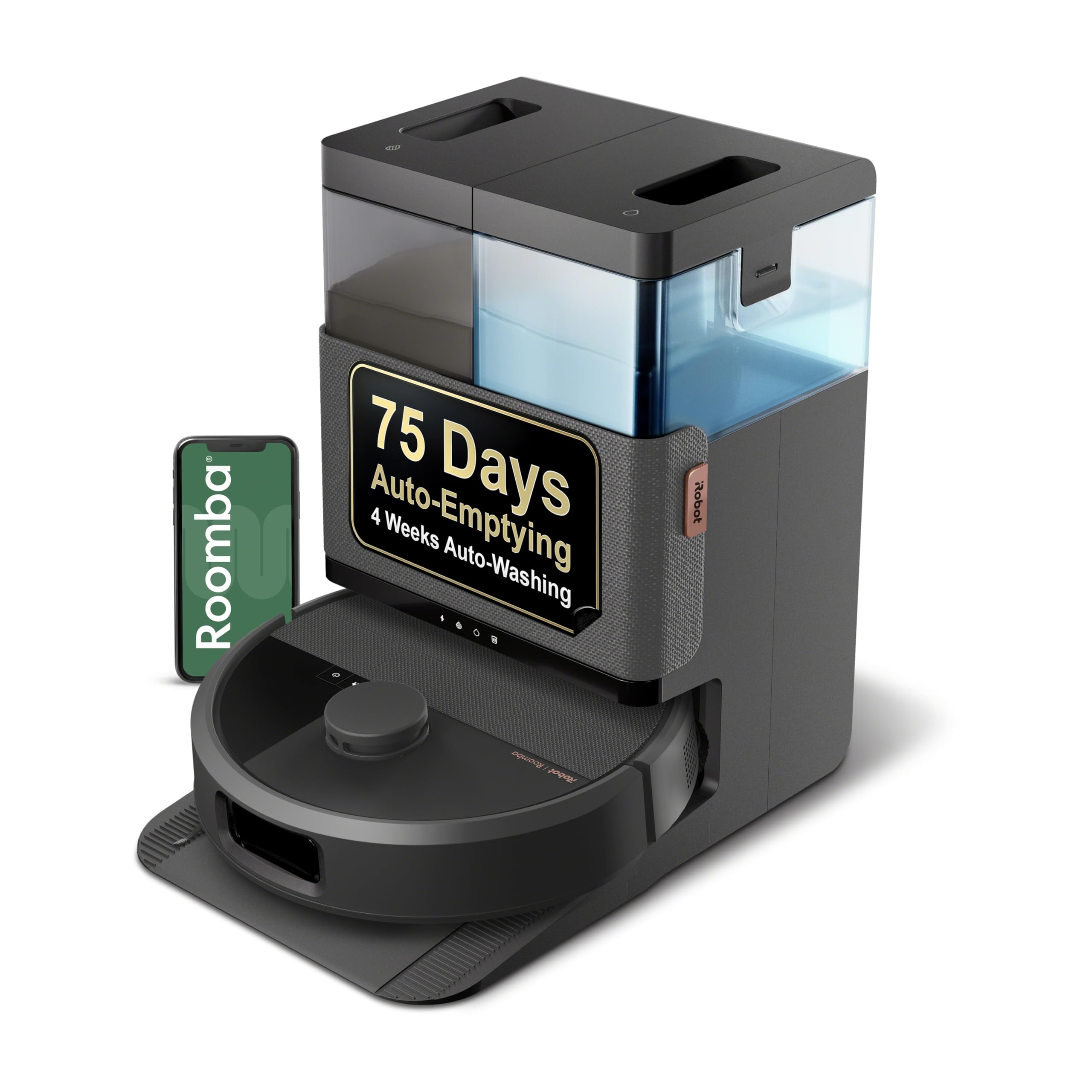
iRobot’s Roomba 505 Combo combines ClearView Pro LiDAR with PrecisionVision AI, making it one of the most obstacle-aware robots on the market. Its DualClean Mop Pads with PerfectEdge extend outward to increase floor-mopping coverage by 18% and apply Smart Scrub extra back-and-forth pressure for dried-on stains. The AutoWash Dock delivers auto-emptying (75 days of debris), pad washing (4 weeks between refills), and heated drying, so the only monthly task is topping up the clean-water tank and replacing the dirty bag.
Owners with large tile-open layouts report that the 505 maps the entire home in under 20 minutes and distinguishes between wet and dry messes on the floor — it will repeat a pass over a dirty section until the pads come away clean. The app allows you to pick vacuum-only, mop-only, vacuum-and-mop in one run, or vacuum-first-then-mop for carpet-heavy homes. A few customers flagged that the rotating beater brush is difficult to de-tangle when long hair wraps around the ends, though the rubber tread handles pet fur better than bristle alternatives.
The biggest practical advantage over cheaper robots is the combination of pad extension and AI waste detection: the 505 will steer around a pet accident and later mop the area at higher intensity, a safety feature families with puppies appreciate. The dock is bulkier because of its integrated water tanks, so you’ll need 18 inches of clearance in front. Run time sits at 120 minutes on standard mode, which is enough for a 2,000 sq ft home if you schedule mid-charge resume.
Why we love it
- PrecisionVision identifies pet waste, cords, and socks before contact
- PerfectEdge extending pads reach corners other robots miss
- AutoWash dock handles mop washing, drying, and auto-empty
Good to know
- Beater brush is difficult to unravel when hair wraps around ends
- Dock water tanks are small; may need refilling mid-week for large homes
- App UI has no list view for rooms, making zone selection clunky
4. Tineco Floor ONE i5 Stretch

The Tineco i5 Stretch is a stick-style wet/dry vacuum that folds to a full 180° flat position, compressing to just 5.1 inches in height so it slides entirely under couches, beds, and media consoles. With 20kPa of suction, it’s noticeably more aggressive than most robotic mops on glue-down messes like dried yogurt spills. The Constant Clean Brush system sprays fresh water onto the roller while scraping off grime in real time — so every pass pushes clean water, not the previous room’s dirt.
Dog and cat owners specifically mention that the anti-tangle design significantly reduces hair wrap around the roller brush, and the dual-sided edge cleaning fits flush against both left and right baseboards without leaving a gap. The 0.8L clean-water tank covers roughly 600 sq ft per fill, and a full charge lasts 30 minutes — enough time for a 1,000 sq ft kitchen/living/dining area if you work quickly. The self-cleaning cycle runs after you dock the machine, flushing the roller and internal tubing; you’ll still need to pull the HEPA filter monthly for rinsing.
Because this unit is cordless and weighs under 10 pounds, multi-story homes find it easier to carry the i5 Stretch between levels than to haul a base station and robot system upstairs. The lack of a mapping requirement means you can start cleaning the moment you unfold the handle, making it ideal for quick spot jobs between deeper robotic schedules. The trade-off is physical effort — you control the wand, and the battery doesn’t support whole-house cleaning in a single session for spaces over 1,200 sq ft.
Why we love it
- 180° lay-flat body reaches under low furniture no robot can
- 20kPa suction tackles stuck-on spills on the first pass
- Anti-tangle roller stays hair-free through multiple uses
Good to know
- 30-minute battery requires a recharge for homes over 1,200 sq ft
- Requires monthly HEPA filter cleaning to maintain suction
- Wand trigger must be held during use; no continuous-lock trigger option
5. Tineco Floor ONE Stretch S6

Tineco’s Stretch S6 refines the wet/dry stick concept with FlashDry self-cleaning — after you dock it, the base pumps 158°F water through the roller and internal pipes, then seals and dries the brush with heated air, eliminating the sour-rag smell that plagues lesser machines. It also compresses to the same 5.1-inch lay-flat profile as the i5 but adds a larger battery (40 minutes) and a 45° swivel head that flexes laterally even when fully reclined under furniture. The iLoop sensor reads the floor surface and adjusts suction and water flow in real time, conserving battery on hard floors and ramping power on spills.
Owners who switched from earlier Tineco S5 models praise the upgraded pouch battery that maintains its runtime after repeated charge cycles, and the 0.8L clean-water tank strikes a practical balance between weight and coverage. The 3-chamber dirty-water separation prevents liquid from reaching the motor during full-recline cleaning, a common failure point on cheaper stick vacs. A small but meaningful detail: the mini assistive wheels make back-and-forth movement under a sofa feel effortless, reducing wrist fatigue during a full-cleaning circuit.
On low-pile tile, the S6 dries floors in seconds rather than minutes, leaving no visible water film. The upgraded brush roller is thicker than the i5’s and handles larger debris — pennies, kibble, and the occasional Lego — without clogging the inlet. For homeowners who find robotic scheduling too automated but dislike traditional mops, the Stretch S6 offers the tactile control of a manual tool with the self-maintenance of a modern appliance.
Why we love it
- 158°F FlashDry self-clean prevents odors and mold inside roller
- 40-minute runtime covers more ground than the i5 on one charge
- 45° swivel head maintains maneuverability when fully flat
Good to know
- Self-clean cycle uses battery charge; dock when battery is above 30%
- Dirty-water separator makes emptying slightly more complex than basic tanks
- Daily use requires weekly disassembly of roller housing to prevent clogs
6. eufy Robot Vacuum Omni C20
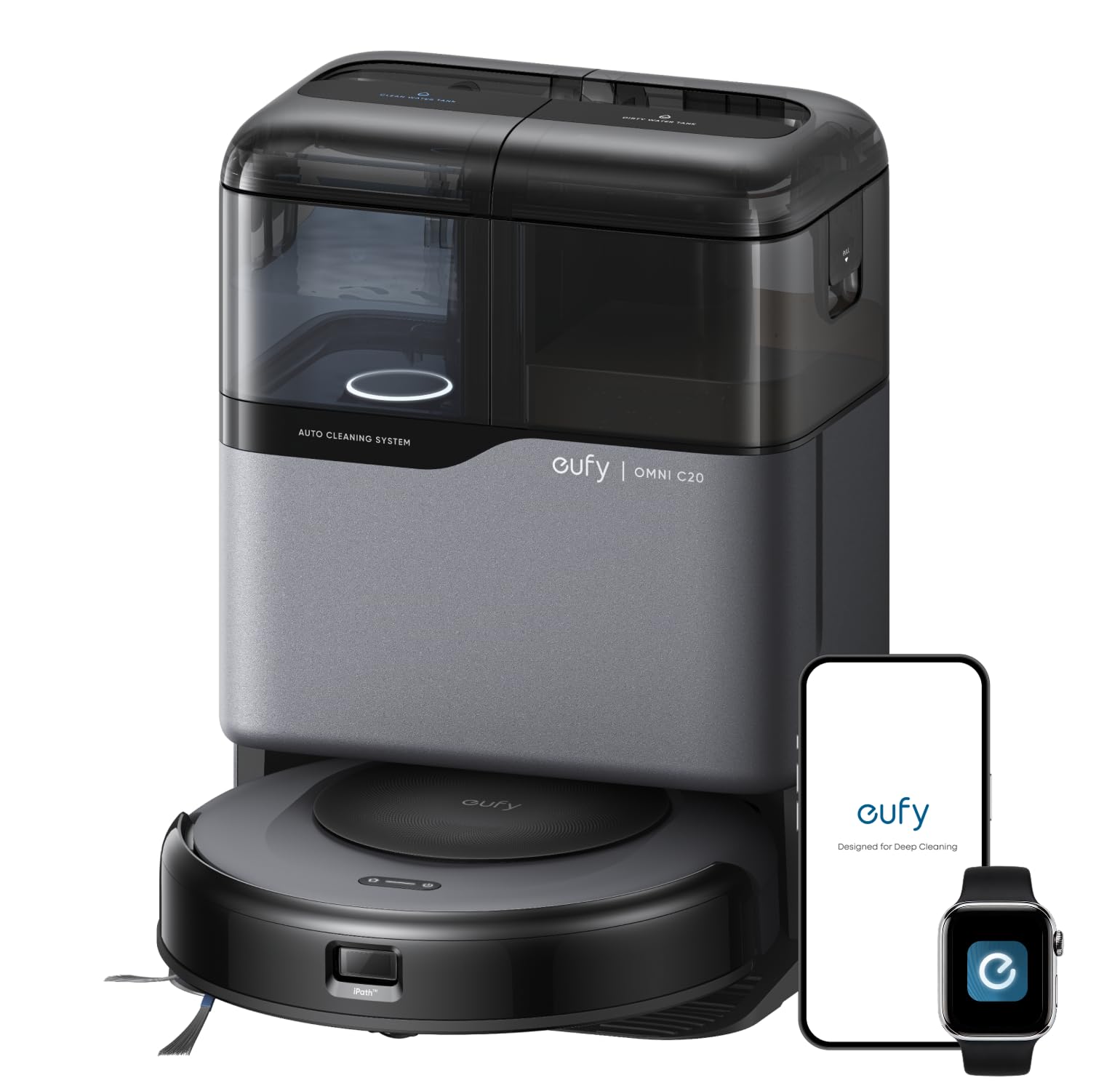
The eufy C20 boasts the slimmest profile in this comparison at 3.35 inches (85mm) tall, giving it access to sofa bottoms and platform bed frames that block robots over 4.5 inches. Despite the compact height, it still packs 7,000Pa of boost suction and a rotating mop pad that applies 6N of downward pressure at 180 RPM to scrub dried sauce rings. The Omni station auto-empties dust into a 3.1L bag, washes mop pads with room-temperature air, and then blow-dries them overnight — consuming just 1.56W per hour during the drying cycle.
Mapping is handled by iPath Laser Navigation, which stored up to three floor plans in our testing and completed a full map of a 1,500 sq ft single-story home in under six minutes. The Pro-Detangle Comb flips down during a mid-clean check to loosen hair wrapped around the roller, reducing the frequency of manual clean-outs versus older eufy models. Owners of pet-heavy homes found that the self-empty bag collected about 60 days of mixed dust and fur, and the transparent water tanks let you see at a glance when the dirty tank needs emptying or the clean tank needs refilling — no app check needed.
The C20 is quiet enough to run during video calls at low suction, but it struggles on black rug surfaces that confuse its cliff sensors; a simple boundary strip or no-go zone in the app fixes this. Mop Master mode provides zone cleaning for stubborn spots, automatically re-mopping the same 20 sq ft area twice if you mark it as high-traffic. The trade-off for the slim build is a smaller battery (132 minutes) and a standard air-dry cycle instead of heated drying — wet pads take 4-5 hours to fully dry in humid climates.
Why we love it
- 85mm height slides under most couches and bed frames
- 7,000Pa suction with boost IQ for embedded carpet dirt
- Transparent water tanks show fill levels without opening the app
Good to know
- Room-temperature air drying takes 4-5 hours in high humidity
- Battery at 132 minutes is shorter than Dreame’s 220 minutes
- Struggles on black/dark surfaces that confuse downward-facing sensors
7. Ultenic AC1 Elite
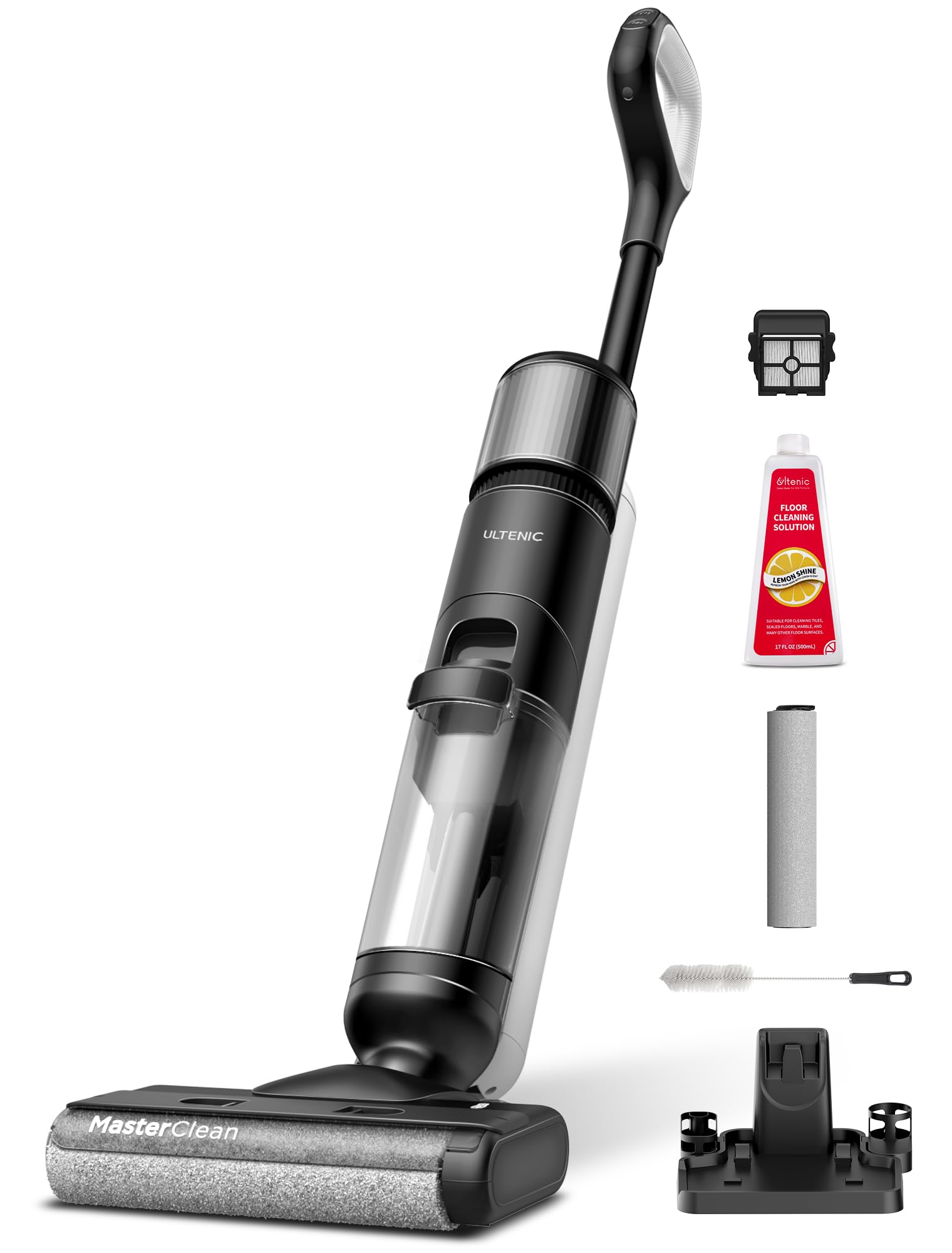
The Ultenic AC1 Elite weighs just 9.5 pounds — significantly lighter than the Tineco 5-series — and still delivers integrated vacuuming and mopping with a self-cleaning cycle. Its smart mess detection system automatically increases suction power when the roller passes over pool of liquid or scattered dry debris, switching to vacuum-only mode to dry the floor without leaving streaks. The dual-tank design (650mL clean, 450mL dirty) keeps dirty water isolated from fresh, and the self-propelled brush roller pushes the machine forward so you don’t have to exert any pulling force.
Battery life reaches 50 minutes, the longest of any stick-style unit in this review, covering a 2,000 sq ft home on a single charge in our tests. The digital display shows remaining battery, active cleaning mode, and alerts for water refill or dirty tank emptying — all while a voice prompt chimes the same information for easier interaction. Owners with kids and pets specifically mention the streak-free drying on tile floors, though one reviewer noted that the suction, while good, isn’t powerful enough to replace a dedicated upright vacuum for deep carpet cleaning.
The self-cleaning cycle runs for 90 seconds after docking and includes a brush roller rinse and a tube flush — enough to keep the machine fresh between weekly deep cleans. Ultenic advises against using third-party cleaning solutions to prevent foaming, and a few owners found that skipping the included foam-reducing solution led to occasional water leakage from the dirty tank overflow valve. For the price, the AC1 Elite offers the lightest form factor and longest runtime in the stick category, making it ideal for renters or single-level dwellers who want an automatic mopping experience without the base station footprint.
Why we love it
- 9.5 lbs is the lightest stick mop in this review
- 50-minute runtime covers the most sq ft on one charge
- Self-propelled roller reduces wrist effort during long sessions
Good to know
- Suction is adequate but won’t replace a dedicated carpet vacuum
- Only Ultenic-branded cleaning solution recommended to avoid foam
- Occasional overflow from dirty tank if “vacuum only” mode not used first
8. Tikom L8000 Plus
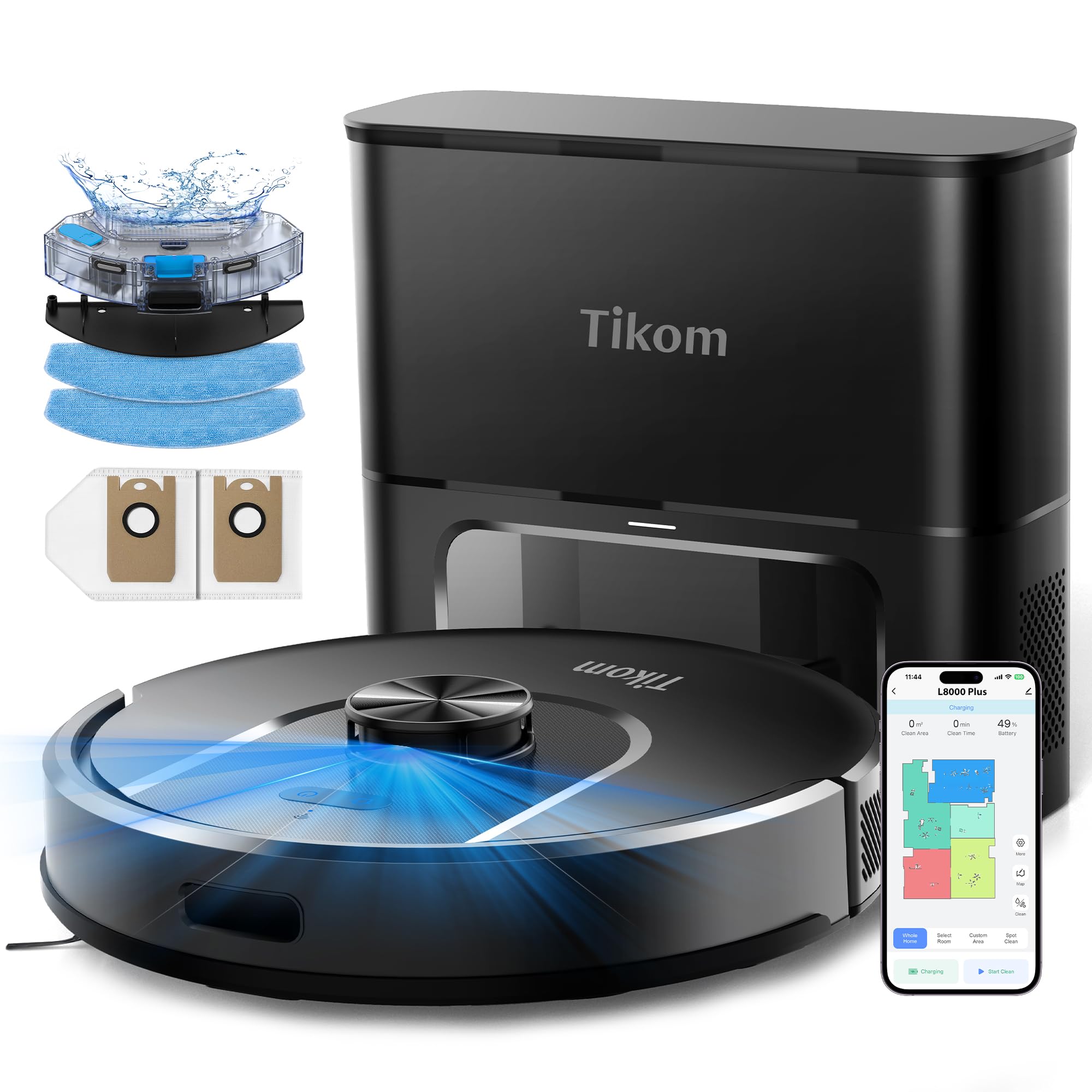
The Tikom L8000 Plus delivers a self-emptying robot vacuum and mop with a 3L dust bag that collects up to 90 days of debris — an endurance feature normally reserved for higher-priced options. Its 6,000Pa max suction pulls pet hair and fine dust from low-pile carpet and bare floors, and the 360° LiDAR navigation builds multi-floor maps (up to five) with no-go and no-mop zones. At 150 minutes in quiet mode, the battery runs long enough to clean a 2,000 sq ft home on a single charge, then auto-returns and resumes if the job isn’t finished.
Buyers on a tighter budget consistently highlight how the L8000 Plus maps faster and more accurately than other sub- robots, reliably avoiding stairs and obstacles without bumping into furniture. The mopping function uses a clip-on water tank and microfiber cloth that the robot drags behind — it works for maintenance damp-wiping, but the cloth doesn’t scrub like a spinning pad and won’t lift set-in spills. The app supports 2.4 GHz and 5 GHz Wi-Fi, a flexibility advantage over the Dreame and Ecovacs units, and scheduling can be set by room with specific suction speeds and water levels for each zone.
The L8000’s self-empty base is significantly louder than the Dreame’s — expect a five-second burst comparable to a full-size upright vacuum. Some owners noted that the mop holder must be removed entirely when mopping carpets to avoid saturating them, and the cloth stays damp after mopping and needs manual rinsing. For the price, this is the most affordable robot with a self-empty station and capable LiDAR, but the mopping subsystem is basic — treat it as a convenience floor-dampener rather than a deep scrubber.
Why we love it
- Self-empty base with 90-day dust bag at an accessible price point
- 6000Pa suction lifts fine ash, pet hair, and dust in one pass
- Supports both 2.4GHz and 5GHz Wi-Fi networks
Good to know
- Mop is a passive damp cloth — no scrubbing or rotating action
- Self-empty station is loud for 5 seconds after robot docks
- Mop holder must be manually removed to prevent carpet saturation
9. ILIFE A30 Pro

ILIFE’s A30 Pro enters the list as the most affordable self-emptying robot mop, pairing a 5,000Pa suction motor with a LiDAR navigation system and a dock that holds up to five 2.5L dust bags (280 days of capacity between swaps). The mapping precision is driven by reliable LDS laser scanning and a SLAM algorithm that builds accurate layouts within minutes, including no-go zones and virtual walls set through the ILIFEClean app. The 200ml integrated water tank and dustbin allow simultaneous vacuuming and mopping without swapping modules — just fill the tank, attach the pad, and the robot handles the rest.
Owners with pets report that the A30 Pro handles daily hair and litter pickup effectively on hard floors and medium-pile carpet, and the self-empty dock cycles quietly enough to run overnight without waking sleepers. The 150-minute battery covers about 1,500 sq ft in quiet mode before recharging, and the robot auto-resumes from its saved position after reaching a sufficient charge. A few reviewers noted that the mop pad does not lift when transitioning to carpet, so you must set a no-go zone in the app for every rug or manually remove the mop bracket — otherwise the robot drags a damp pad across fabric.
The A30 Pro’s suction is adequate for daily dust and hair but lacks the grunt of 6,000-7,000Pa competitors for deep-pile dirt. The app’s wording can be confusing (a toggle labeled “Close” instead of “Off”), but the core functionality — scheduling, zoning, and suction control — works without issues. For a straightforward entry-level automatic mop that keeps floors acceptably clean and empties itself for months at a time, the A30 Pro delivers where it counts without asking for a premium investment.
Why we love it
- Self-empty dock holds 280 days of dust — longest interval here
- LiDAR mapping with no-go zones works reliably after initial setup
- 5000Pa suction clears pet hair and daily dust on tile and carpet
Good to know
- Mop pad does not lift; must set carpet no-go zones to avoid damp rugs
- 5000Pa suction is lower than Tikom’s and eufy’s flagship numbers
- App UI uses unclear terminology (e.g., “Close” instead of “Off”)
FAQ
Can an automatic mop replace a traditional string mop entirely?
How many rooms can a single-charge robot mop cover?
What does self-cleaning really mean on a mop robot?
Will a self-emptying dock work with any wall outlet?
Final Thoughts: The Verdict
For most households, the automatic mop winner is the Dreame L10s Pro Ultra because it combines hot-water self-cleaning, a long 220-minute runtime, and effective MopExtend edge scrubbing at a price point that undercuts similarly equipped competitors. If your priority is the highest suction for embedded carpet dirt and a self-washing roller that avoids cross-contamination, grab the Ecovacs Deebot T80 Omni. And for homes with mostly tile and low-clearance furniture where you want total control over the cleaning path, nothing beats the Tineco Floor ONE Stretch S6 and its 158°F heated drying cycle.