
Axolotls are delicate, entirely aquatic amphibians that swallow their food whole, making the texture, size, and sinking speed of their diet a matter of health, not preference. A pellet that disintegrates or floats can lead to water quality crashes or refusal to eat, turning a simple feeding routine into a constant battle with tank parameters.
I’m Mo Mahin — the founder and writer behind Furric. I’ve spent years analyzing the nutritional profiles, sinking behaviors, and owner-reported palatability data across dozens of axolotl-specific diets to separate the formulations that support healthy gill development from those that merely cloud the water.
After sifting through thousands of verified buyer reports and dissecting every spec from pellet diameter to protein source, I’ve narrowed the field to the five formulations that deserve a spot in your feeding rotation if you are searching for the best axolotl food.
How To Choose The Best Axolotl Food
Selecting a prepared diet for an axolotl involves more than grabbing the first sinking pellet off the shelf. These amphibians have a short digestive tract and a strong preference for soft, motion-based food. Matching the pellet’s physical properties to the axolotl’s feeding anatomy is the difference between a thriving pet and a tank full of waste.
Pellet Size and Texture
Axolotls do not chew — they suction food in and swallow it whole. A pellet that is too hard can cause impaction, while one that is too large may be spit out repeatedly. Look for soft, moist pellets between 2.4 mm and 4 mm for juveniles and adults. The pellet should yield slightly under gentle pressure from your fingers before it enters the water.
Sinking Speed and Water Quality
Floating or slow-sinking pellets encourage axolotls to look upward, which is an unnatural feeding posture and can lead to gulping air. Fast-sinking pellets that reach the bottom within seconds allow the axolotl to feed in its natural horizontal hunting stance. Pellets that disintegrate rapidly release fines that spike ammonia and nitrate levels — a tightly bound, soft-moist formulation stays intact until eaten.
Protein Source and Digestibility
Axolotls require a high-protein diet derived primarily from animal sources such as krill, salmon meal, shrimp meal, or squid meal. Soy-based proteins are poorly digested by amphibians and often pass through without being absorbed, contributing to waste. A protein content above 40% is ideal, but the digestibility of that protein matters more than the raw percentage printed on the label.
Quick Comparison
On smaller screens, swipe sideways to see the full table.
| Model | Category | Best For | Key Spec | Amazon |
|---|---|---|---|---|
| Invert Aquatics Soft Pellets | Premium | Daily staple for all life stages | Soft pellet, 9 oz bag | Amazon |
| Invert Aquatics Axolotl Big Bites | Premium | Large adult axolotls | Fast-sinking, 4 mm+ pellet | Amazon |
| Aquatic Foods Inc. 1/8″ Pellets | Mid-Range | Juveniles and small adults | 1/8 inch sinking pellet | Amazon |
| Zoo Med Axolotl & Aquatic Newt | Mid-Range | Soft-moist 4 mm staple | 4 mm soft stick with no soy | Amazon |
| Brine Shrimp Direct Soft Moist Pellet | Value | Color enhancement on a budget | 2.4 mm sinking pellet, 16 oz | Amazon |
In‑Depth Reviews
1. Invert Aquatics Soft Pellets for Axolotls

The Invert Aquatics Soft Pellets are formulated specifically for axolotls and other small aquatic amphibians, using a shrimp and seafood protein base that mirrors the high-protein, low-fiber diet these animals evolved on. The soft-moist texture ensures the pellet compresses easily when swallowed, reducing the risk of intestinal blockages that can occur with harder, dry kibble-style foods.
These pellets sink rapidly upon entering the water, which is critical for axolotls that naturally hunt along the substrate. The 9-ounce bag provides enough volume for a single adult axolotl for several months, and the resealable packaging helps maintain moisture content between feedings. Owners consistently report that even finicky axolotls accept this formula on the first try, which reduces the stress of food transition.
Water quality remains stable because the pellets hold their shape for several minutes before softening, giving the axolotl time to find and consume them without releasing excessive fines. The formulation includes marine-based carotenoids that support natural color expression in the gills and skin over several weeks of consistent feeding.
Why we love it
- Soft-moist texture reduces impaction risk
- Fast-sinking design mimics natural bottom-feeding
- High marine protein content supports gill color
Good to know
- Bag packaging can be difficult to reseal airtight
- Larger pellets may need breaking for very young juveniles
2. Invert Aquatics Axolotl Big Bites
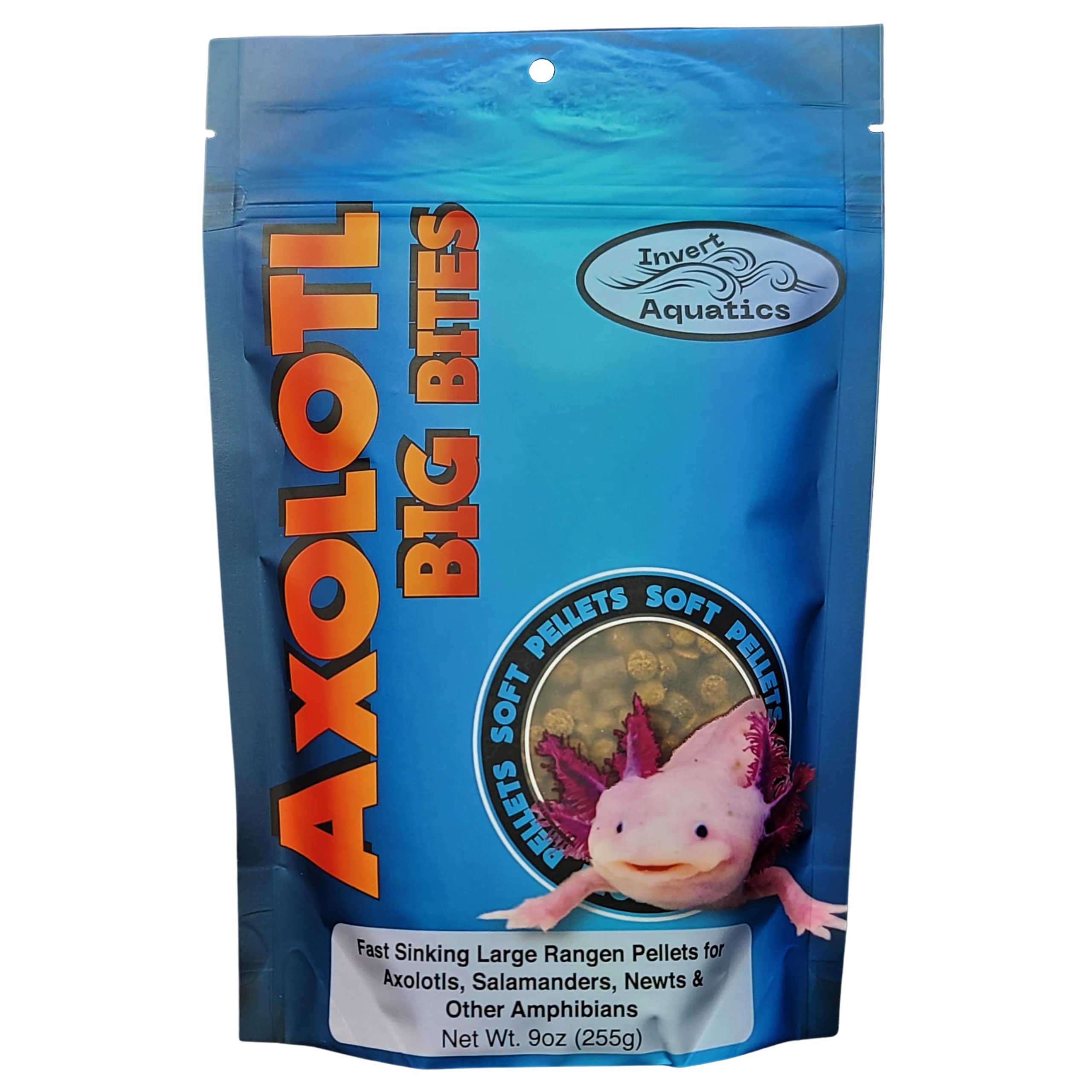
The Axolotl Big Bites from Invert Aquatics share the same soft-moist, fast-sinking philosophy as the standard pellets but scale up the pellet size for larger adult axolotls and amphibians that need a more substantial meal per bite. The inclusion of spirulina alongside shrimp and seafood meal adds a plant-based component that supports digestive regularity without diluting the protein density.
One standout feature is the aromatic profile — these pellets release a stronger scent plume as they sink, which helps trigger a feeding response in axolotls with reduced appetite due to stress, temperature changes, or minor illness. Owners of axolotls recovering from red foot disease or fungal infections report that the smell alone is enough to initiate feeding when other pellets are ignored.
The larger size makes them unsuitable for juveniles under four inches, but for fully grown axolotls, each pellet delivers a concentrated nutritional punch. Using a feeding dish on sand substrate is recommended to prevent the pellets from being buried during the frantic eating motion, especially since these sink so quickly.
Why we love it
- Aromatic formula stimulates picky eaters and recovering axolotls
- Fast-sinking design prevents gulping air at the surface
- Spirulina inclusion aids digestion
Good to know
- Too large for juveniles under four inches
- Strong smell may be noticeable during storage
3. Aquatic Foods Inc. 1/8″ Soft Moist Sinking Pellets

Aquatic Foods Inc. uses Rangen’s salmon meal as the primary protein source in these 1/8-inch pellets, supplemented with squid meal and shrimp meal to create a diverse amino acid profile. The small pellet diameter makes this an excellent option for juvenile axolotls or adults that prefer smaller, more frequent meals throughout the day rather than a few large pellets.
This brand pre-sifts its batches to remove dust and fines before packaging, which translates to noticeably cleaner water during the first minute after feeding. The soft-moist formulation keeps the pellet pliable enough for an axolotl to swallow whole, yet firm enough to hold its shape if the axolotl misses on the first suction attempt. Owners report that the pellets remain intact on the substrate for up to ten minutes before beginning to soften.
The jar packaging is a practical advantage over bagged options — it allows for easy portioning and keeps the pellets from drying out between feedings. The wild-caught ingredient claim adds transparency, and the family-owned business history suggests consistency in sourcing that larger conglomerates sometimes lack.
Why we love it
- Pre-sifted to minimize dust and water fouling
- Small 1/8-inch size perfect for juveniles
- Jar packaging maintains pellet moisture
Good to know
- May require training for axolotls accustomed to worms
- Limited customer reviews due to new product listing
4. Zoo Med Axolotl & Aquatic Newt Food

Zoo Med is one of the few major aquarium brands to formulate a dedicated axolotl and aquatic newt food that explicitly excludes soy protein. This matters because soy is poorly digestible for amphibians and often results in undigested waste that accelerates nitrate buildup. The protein in this formula comes exclusively from fish meal, which aligns closely with the nutritional profile of wild aquatic invertebrates.
The 4 mm stick format is designed for larger juveniles and adult axolotls. The sticks are soft-moist and sink readily, though they are slightly denser than the Invert Aquatics options, meaning they take a few extra seconds to reach the bottom. Once there, they hold their shape longer than many competing pellets, giving slower feeders ample time to find them. Owners report that a single 11-ounce container lasts several months even with daily feeding, thanks to the axolotl’s low metabolic rate and the dense caloric content of each stick.
One trade-off is that the stick shape can occasionally cause the axolotl to miss on the first suction attempt, as the longer profile is harder to align with the mouth compared to a round pellet. Owners who break the sticks into smaller segments before feeding report higher acceptance rates, especially for younger axolotls still developing their suction coordination.
Why we love it
- No soy protein reduces digestive waste
- Dense caloric content extends container life
- Holds shape on substrate for slower feeders
Good to know
- Stick shape may require breaking into smaller pieces
- Sinks slightly slower than round pellet alternatives
5. Brine Shrimp Direct Soft Moist Color-Enhancing Pellet

The Brine Shrimp Direct 2.4 mm pellet is the most affordable option in this lineup and the only one positioned primarily as a color-enhancing formula. The high astaxanthin content from krill and spirulina is intended to intensify the red and pink hues in fish, but axolotl owners report that it also supports deeper, richer gill coloration over time. The 16-ounce jar provides significantly more volume than any other product on this list, making the per-feeding cost the lowest available.
These pellets are extruded rather than cold-pressed, which gives them a uniform shape that holds together well in water. The soft-moist texture is comparable to the premium options, though the pellets are slightly firmer than the Invert Aquatics range. Axolotls accustomed to very soft food may spit these out initially, but most adapt within a few feedings. The smaller 2.4 mm diameter makes this an excellent option for juveniles, though adult axolotls may need multiple pellets per feeding to feel satiated.
The main drawback is that this formula is not designed exclusively for axolotls — it is marketed toward cichlids, catfish, and omnivorous pond fish. The protein source is reliable, but the mineral and vitamin ratios are tuned for fish rather than amphibians. Axolotl owners using this as a primary diet should supplement with earthworms or blackworms to ensure calcium and phosphorus levels remain balanced for bone and gill health.
Why we love it
- Largest volume at the lowest per-feeding cost
- Astaxanthin content supports gill color
- 2.4 mm size works well for juvenile axolotls
Good to know
- Formulated for fish, not specifically for axolotls
- Firmer texture may require adaptation period
FAQ
Can axolotls eat floating pellets?
How do I transition my axolotl from worms to pellets?
Why does my axolotl spit out the pellet?
Is color-enhancing food safe for axolotls?
How long can I store opened axolotl pellet food?
Final Thoughts: The Verdict
For most axolotl owners, the best axolotl food winner is the Invert Aquatics Soft Pellets because it combines the ideal soft-moist texture with a fast-sinking, high-marine-protein formula that axolotls accept readily and digest efficiently. If you have a large adult axolotl that needs a bigger bite and appetite stimulation, grab the Invert Aquatics Axolotl Big Bites. And for budget-conscious keepers feeding multiple juveniles, nothing beats the value of the Brine Shrimp Direct Soft Moist Pellet.