
Finding a substrate that holds humidity without turning into a swamp is one of the biggest challenges ball python owners face. You want consistent moisture for healthy sheds, but you also need something that resists mold and keeps odors down — it’s a delicate balance that many products fail to strike.
I’m Mo Mahin — the founder and writer behind Furric. I’ve spent months analyzing customer feedback, cross-referencing veterinary safety guidelines, and comparing how different natural materials behave in real enclosures to separate marketing claims from what actually works.
After careful evaluation, I am confident you will find the best ball python substrate for humidity to be essential for perfect shedding and health.
How To Choose The Best Ball Python Substrate For Humidity
Choosing a humidity-friendly substrate goes beyond picking something that looks natural. You need to balance moisture retention with breathability, particle size with safety, and longevity with ease of cleaning.
Moisture Retention vs. Airflow
Materials like coconut husk and sphagnum moss excel at holding water, but they must also allow air to circulate around the eggs and your snake. A substrate that stays too wet can cause scale rot or respiratory infections. Look for products that absorb water quickly and release it slowly without becoming soggy.
Particle Size and Safety
Fine particles can be ingested accidentally during feeding, leading to impaction. Chunky chips or compressed bricks that expand into larger pieces are safer. Avoid sharp edges or dusty substrates that could irritate your ball python’s eyes and respiratory system.
Ease of Maintenance
Some substrates need to be misted daily, while others hold moisture for days with a single spray. Consider your schedule and whether you prefer spot-cleaning or full replacements. Compressed blocks are convenient to store but require hydration before use; loose chips are ready to go immediately.
Quick Comparison
On smaller screens, swipe sideways to see the full table.
| Model | Type | Best For | Key Feature | Amazon |
|---|---|---|---|---|
| ReptiChip (RediChip) Medium | Loose Coco Chip (Medium) | Overall humidity retention & ease of use | Dust-free, U.S.-sorted, ready to use | Amazon |
| BabiChip Small Coco Chip | Loose Coco Chip (Small) | Fine texture for burrowing species | Premium small chips, odor-absorbing | Amazon |
| Riare Sphagnum Moss | Sphagnum Moss | Boosting humidity spots for hatchlings | Excellent moisture absorption, biodegradable | Amazon |
| Riare Coco Husk 2-Pack | Compressed Coco Husk | Value-packed humidity solution | Expands with water, 2 bricks included | Amazon |
| Legigo Coco Chip 2-Pack | Compressed Coco Husk | Odor control and easy storage | 2-pack compressed, natural moisture retention | Amazon |
In-Depth Reviews
1. ReptiChip (RediChip) Medium Coconut Chip

If you want a substrate that works straight out of the bag without the hassle of soaking bricks, this loose medium coconut chip is a game‑changer. It holds humidity beautifully — just add water for tropical species or use dry for arid setups. Ball python owners consistently praise how long it stays moist without becoming waterlogged.
The chips are larger and far less dusty than many competitors. Because they’re sorted in the United States, you get a consistent particle size that’s safe for burrowing and won’t stick to your snake’s food. The natural coconut husk also locks in ammonia odors, keeping the enclosure fresh between cleanings.
For a premium product that balances performance, safety, and convenience, this is my top recommendation. It’s especially well‑suited for keepers who want a reliable, low‑dust substrate that makes humidity management simple.
Why we love it
- Zero dust thanks to rigorous sifting
- Maintains 60–80% humidity with regular misting
- Large chips reduce the risk of ingestion
Good to know
- Higher upfront cost per bag
- Not as compact as compressed bricks for storage
2. BabiChip Small Coconut Chip Substrate

When you need a finer particle size for smaller enclosures or hatchlings that love to burrow, BabiChip delivers. The small chips mimic natural soil while retaining the moisture‑holding power of coconut husk. Experienced ball python breeders often use this as a top layer or mix it with larger chips for a gradient of humidity.
Like its sibling brand, BabiChip is processed in the USA to remove dust and debris. The chips encapsulate waste effectively, so you can spot‑clean without disturbing the whole bed. Many owners note that the fine texture reduces the appearance of mold because airflow penetrates more evenly.
This is a premium option for those who prioritize a soft, natural feel and want excellent odor control. It’s slightly more expensive, but the results are consistent for both tropical and arid species.
Why we love it
- Very low dust, even after drying out
- Small chips are ideal for deep burrowing
- Odors are trapped and neutralized effectively
Good to know
- Can compact if over‑misted
- Not as widely available as compressed bricks
3. Riare Premium Sphagnum Moss 1.3 lb

Sphagnum moss is a humidity super‑charger. This compressed brick from Riare expands into a fluffy, absorbent layer that can raise local humidity spots inside the enclosure. It’s especially valuable during shedding cycles or for creating a moist hide that helps loosen stuck shed.
The moss is sun‑dried and hand‑picked, so it contains minimal dust or impurities. Unlike coco chips, sphagnum can be used alone or mixed into the main substrate to boost moisture without making the entire floor wet. Reptile enthusiasts appreciate that it also serves as a safe nesting material for eggs or a soft bedding for delicate amphibians.
For keepers who want a targeted humidity tool rather than a full‑bedding solution, this moss is a smart addition. It’s affordable, renewable, and easy to dispose of in the garden afterward.
Why we love it
- Instantly increases humidity when dampened
- Love that it doubles as a bioactive component
- Completely natural and safe if ingested in small amounts
Good to know
- Needs frequent re‑mist in dry climates
- Compressed brick requires soaking before use
4. Riare 2‑Pack Natural Coconut Chip Substrate

If you’re looking for an economical way to provide high humidity without breaking the bank, this double pack of compressed coconut chips is a solid choice. Each brick expands to roughly 30 liters of fluffy substrate, giving you plenty of coverage for a standard 40‑gallon tank. Many first‑time ball python keepers start here because the price is gentle on the wallet.
The chips are chunky and free of sharp edges, so your snake can safely burrow. They do a good job trapping odors and breaking down waste. The main trade‑off is that you need to plan ahead — soaking the bricks takes about 20 minutes, and you must fluff them to avoid dry pockets.
For a budget‑conscious owner who doesn’t mind a little prep work, this substrate performs surprisingly well. It holds humidity for 2–3 days between mistings, and the included two bricks mean you always have a spare ready.
Why we love it
- Very low cost per cubic inch of substrate
- Expands consistently without dust storms
- Can be rehydrated multiple times before replacing
Good to know
- Requires pre‑soaking and fluffing
- Some bricks may have uneven expansion
5. Legigo 2‑Pack Coconut Chip Substrate
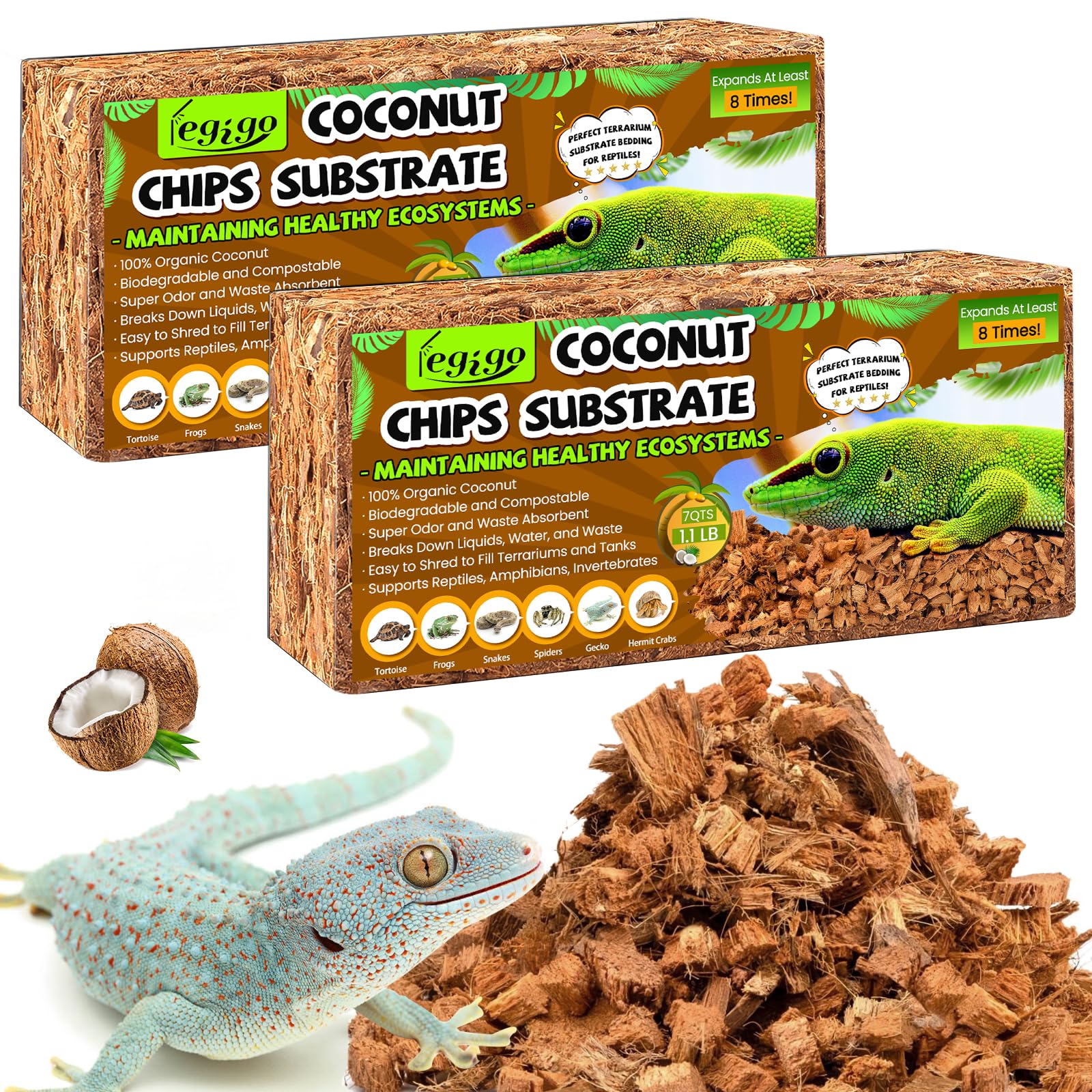
Another great budget option, the Legigo 2‑pack offers very similar performance to the Riare bricks at the same price point. It excels at absorbing odors and waste, keeping the terrarium smelling fresh even with messy feeders. The compressed bricks are slightly smaller than some competitors, but they still expand to a usable volume.
What sets Legigo apart is the emphasis on ease of use: the bricks break apart more easily when soaked, reducing the clumpy spots that sometimes happen with coconut husk. The natural texture encourages natural digging behavior, and because it’s 100% organic, it’s safe for both reptiles and future garden use.
If you’re comparing the two value packs, Legigo wins for convenience — it spreads out more evenly straight from the bag after expansion. For a straightforward, low‑cost humidity solution, this is a dependable pick.
Why we love it
- Breaks apart more uniformly than many bricks
- Odor absorption works for several days
- Compact packaging is great for small storage spaces
Good to know
- Volume per brick is slightly less than the Riare pack
- May need extra rinsing if sensitive to dust
Safety & Care Tips
Monitor Humidity Levels Daily
Ball pythons need 50–60% humidity normally and 70–80% during shed cycles. Invest in a reliable digital hygrometer and check readings morning and evening. If the substrate feels damp but the humidity reads low, add a small bowl of water or a hand‑spray of the enclosure walls rather than soaking the bedding again.
Spot Clean and Replace Regularly
Remove soiled substrate immediately to prevent bacterial growth. Every 4–6 weeks, do a full change — even if the bedding looks clean, organic materials break down over time. When replacing, take the opportunity to disinfect the enclosure with a reptile‑safe cleaner before adding fresh substrate.
FAQ
What is the best substrate for ball python humidity?
How often should I change the substrate in my ball python tank?
Final Thoughts: The Verdict
For most keepers, the best ball python substrate for humidity winner is the ReptiChip (RediChip) Medium Coconut Chip because it offers the ideal balance of moisture retention, safety, and convenience — ready to use right out of the bag. If you prefer a finer texture for burrowing or have a hatchling, grab the BabiChip Small Coco Chip. And for a budget‑friendly option that still delivers solid humidity, nothing beats the Riare 2‑Pack Coconut Chip Substrate.