
Waking up with a stuffy nose, itchy eyes, or a scratchy throat isn’t just uncomfortable — it’s your body reacting to airborne triggers that accumulated while you slept. For allergy sufferers, the bedroom should be a sanctuary, not a source of symptoms. A dedicated filtration unit changes that dynamic by continuously stripping dust mites, pollen, pet dander, and mold spores from the air you breathe for eight hours straight.
I’m Mo Mahin — the founder and writer behind Furric. My research process involves dissecting CADR ratings, filter stage configurations, decibel curves, and square-footage coverage claims across dozens of models, then cross-referencing those specs with verified owner experiences to identify which units actually deliver measurable relief in a real bedroom environment.
Whether you share your space with a shedding pet, live in a high-pollen zone, or simply want to minimize dust accumulation, finding the right bedroom air purifier for allergies means balancing filtration power with whisper-quiet operation so your sleep stays undisturbed.
How To Choose The Best Bedroom Air Purifier For Allergies
Picking the right unit for your bedroom requires filtering out marketing fluff and focusing on four measurable parameters that directly impact allergy symptom reduction. Here is what actually matters when the lights go out.
True HEPA vs. HEPA-Type vs. Washable Filters
True HEPA filtration captures 99.97% of particles at 0.3 microns — the standardized test size that correlates with common allergens like dust mite debris, pollen grains, and mold spores. Any label reading “HEPA-type,” “HEPA-style,” or “washable HEPA” fails to meet this standard and will allow smaller irritants to pass through. For allergy relief, insist on True HEPA as a non-negotiable spec.
Room Size Matching and Air Changes Per Hour
A unit rated for 500 square feet placed in a 150-square-foot bedroom will cycle the air roughly three times per hour, which is the minimum recommended for allergy sufferers. Always compare the unit’s CADR (Clean Air Delivery Rate) for smoke, dust, and pollen against your actual room volume. Higher CADR numbers mean faster particle removal — crucial for clearing airborne triggers before you settle in for the night.
Noise Levels and Sleep Mode Functionality
Decibel ratings below 30 dB are considered whisper-quiet and generally won’t disrupt sleep. Look for units with a dedicated sleep mode that drops fan speed to its lowest setting while dimming or disabling all indicator lights. Some premium models also offer a “display off” button — a small detail that makes a big difference in a completely dark bedroom.
Filter Replacement Cost and Frequency
A unit that costs less upfront may demand expensive filter swaps every three to six months, while a higher initial investment could include a filter lasting up to five years. Calculate the total cost of ownership over two years by multiplying filter price by expected replacements. Genuine replacement filters from the manufacturer maintain the stated CADR performance — third-party alternatives often reduce airflow and capture efficiency.
Quick Comparison
On smaller screens, swipe sideways to see the full table.
| Model | Category | Best For | Key Spec | Amazon |
|---|---|---|---|---|
| Levoit Core 200S-P | Mid-Range | Small bedrooms under 150 ft² | AHAM Verifide, 27dB sleep mode | Amazon |
| PuroAir 130i | Mid-Range | Pet owners & mold allergy sufferers | 600 ft² coverage, CarbonTech layer | Amazon |
| Honeywell HPA125V | Mid-Range | Auto-mode air quality tracking | 20.81dB sleep mode, 530 ft² | Amazon |
| GermGuardian AC4825E | Mid-Range | Large rooms & open floor plans | UV-C light, 743 ft² coverage | Amazon |
| Dyson Hushjet Compact | Premium | Silent operation & smart home integration | 24dB sleep mode, 5-year filter | Amazon |
| AirDoctor AD2000 | Premium | Hospital-grade filtration for severe allergies | UltraHEPA 0.003 micron, 1,220 ft² | Amazon |
| PuroAir 100i | Budget-Friendly | Compact portability & app control | 550 ft², 3-layer True HEPA | Amazon |
In‑Depth Reviews
1. Levoit Core 200S-P

The Levoit Core 200S-P strikes a near-perfect balance between whisper-quiet operation and verified filtration performance for small to medium bedrooms. Its AHAM Verifide certification means the 99.97% True HEPA capture rate and the 4.8 air changes per hour in a 140 ft² room have been independently validated — not just claimed. Owners consistently report measurable reductions in dust accumulation and noticeable relief from dust mite allergy symptoms within the first week of continuous use.
The 360-degree air intake draws pollutants from every direction, and the combination pre-filter and activated carbon layer handles pet odors and cooking fumes before they reach the main HEPA stage. At 27 dB on sleep mode, the unit is virtually inaudible, and the display-off button eliminates all light bleed — two critical features for uninterrupted sleep. Voice control compatibility with Alexa and Google Assistant adds convenience without requiring the app.
Filter replacements are straightforward and reasonably priced, though the compact footprint means the unit is best suited for rooms up to about 180 ft² where it can maintain the recommended four air changes per hour. For anyone with mild to moderate seasonal allergies who wants a set-it-and-forget-it solution, this is the most reliable entry point into the category.
Why we love it
- AHAM Verifide certification provides independent performance assurance
- Sleep mode at 27 dB is genuinely silent — no hum or whine
- Compact footprint fits on a nightstand without dominating the space
Good to know
- Best performance limited to rooms under 180 ft²
- Lacks real-time air quality sensor found on premium models
2. PuroAir 130i
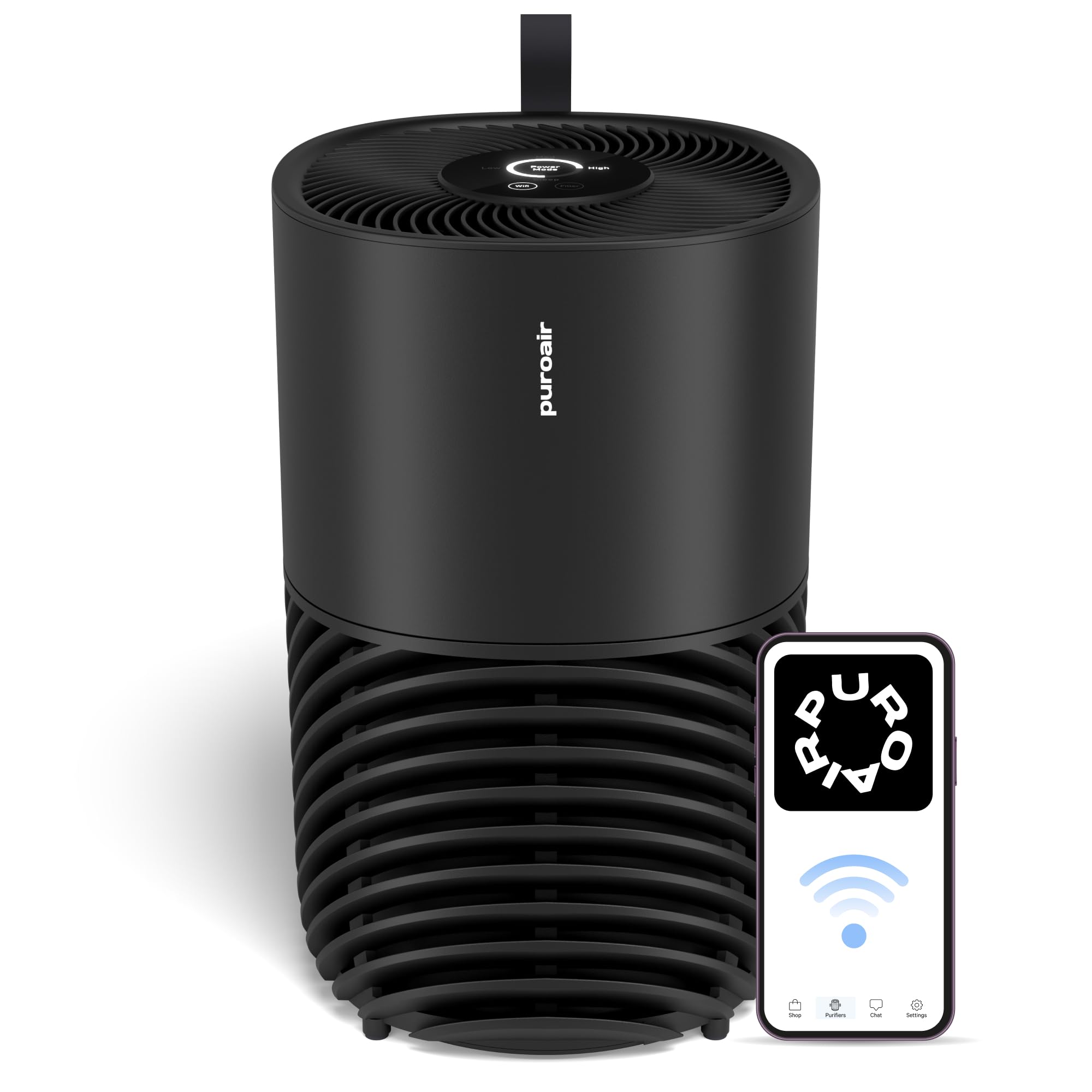
The PuroAir 130i brings a stronger carbon layer than most units in its price tier, making it especially effective against volatile organic compounds (VOCs), cooking odors, and wildfire smoke particles that trigger allergy-like symptoms. The three-stage system — pre-filter, True HEPA, and CarbonTech activated carbon — filters particles down to 99.9% of common pollutants, and independent lab testing backs the claim that it clears a 600 ft² room in one hour.
What stands out in real-world use is the almost silent low-speed operation that owners describe as undetectable during sleep, combined with Wi-Fi-enabled app control that shows remaining filter life percentages. Multiple verified reports note complete elimination of mold allergy symptoms — runny nose, itchy eyes, congestion — within three weeks of continuous bedroom operation. The compact cylindrical design fits into corners without blocking airflow.
The primary long-term consideration is filter replacement cost: genuine PuroAir filters maintain performance but carry a premium that makes the total two-year ownership notably higher than the Levoit. Aftermarket alternatives exist but owners report shortened lifespan of under three months. For allergy sufferers who prioritize VOC and odor removal alongside particle filtration, the 130i delivers category-leading performance.
Why we love it
- CarbonTech layer excels at trapping VOCs, smoke, and cooking odors
- Almost silent at low speed — ideal for light sleepers
- App provides filter life tracking and remote fan speed control
Good to know
- Genuine replacement filters are expensive relative to competitors
- Aftermarket filters degrade performance and lifespan significantly
3. Honeywell HPA125V
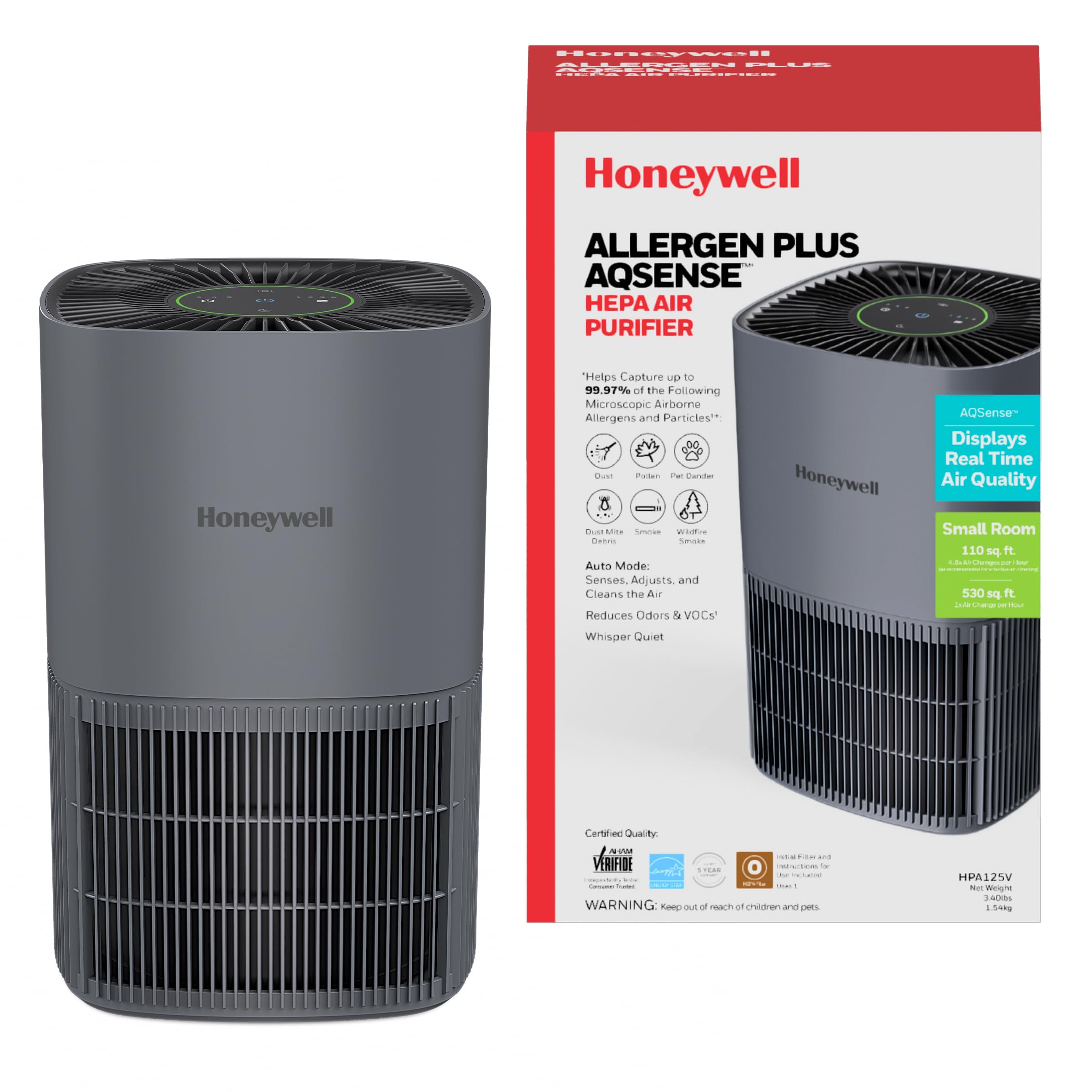
Honeywell’s HPA125V brings a room-monitoring intelligence that few competitors match at its price point. The AQSense Auto Mode uses an integrated particulate sensor to continuously sample air quality and adjust fan speed automatically, with a color-coded indicator — green, yellow, red — that gives immediate visual feedback. Owners report that the sensor reliably detects cooking odors and pet presence, ramping up filtration without manual intervention.
The 3-in-1 HEPA filtration system wraps a pre-filter and activated carbon layer around the True HEPA core, capturing 99.97% of dust, pollen, and pet dander. Sleep mode drops to 20.81 dB — among the quietest measured in this roundup — with dimmable lights that won’t disturb rest. The compact 7x7x11-inch footprint and 2.1-pound weight make it the easiest unit to reposition between rooms throughout the day.
The trade-off is coverage: while Honeywell rates it up to 530 ft², that figure represents one air change per hour. For effective allergy relief at four air changes per hour, it serves rooms up to roughly 110 ft². Owners also note the lack of a dedicated display-off option at higher fan speeds, meaning the indicator light remains on unless sleep mode is active. For small bedrooms where real-time air quality tracking matters, this is a uniquely capable option.
Why we love it
- Real-time air quality sensor with automatic fan speed adjustment
- Extremely quiet operation at 20.81 dB in sleep mode
- Lightweight and portable for easy room-to-room movement
Good to know
- Effective coverage limited to about 110 ft² at 4 ACH
- Indicator light stays on at higher fan speeds unless sleep mode is used
4. GermGuardian AC4825E

The GermGuardian AC4825E has been a staple recommendation for allergy households for years, and the 22-inch tower design remains one of the most effective layouts for covering larger bedroom and open-concept spaces. Its True HEPA filter captures 99.97% of particles at 0.1 microns — smaller than the standard 0.3-micron test — while the optional UV-C light targets airborne bacteria, germs, and mold spores that pass through the filter media.
Owners with asthma and severe allergies consistently report reduced reliance on medication and fewer nighttime symptoms after running the unit continuously for several weeks. The three-speed rotary dial is refreshingly simple — no app, no learning curve — and the washable pre-filter extends the life of the main HEPA cartridge. At 743 ft² of one-pass coverage, this unit can handle a master bedroom with an attached sitting area or a large loft-style bedroom.
The main caveat is noise: the high setting produces noticeable white noise that some owners find disruptive for sleep, though the low setting is quiet enough for overnight use. The UV-C light cannot be switched to a separate timer, so it either runs continuously or stays off. Filter replacements are widely available and reasonably priced, making long-term ownership costs predictable. For large bedrooms where powerful airflow matters more than whisper-quiet operation, the GermGuardian remains a proven workhorse.
Why we love it
- UV-C light adds germicidal protection beyond standard HEPA filtration
- Washable pre-filter reduces main filter replacement frequency
- 743 ft² coverage makes it suitable for large bedroom spaces
Good to know
- High-speed setting produces noticeable white noise
- UV-C light operates continuously — no separate timer control
5. Dyson Hushjet Compact
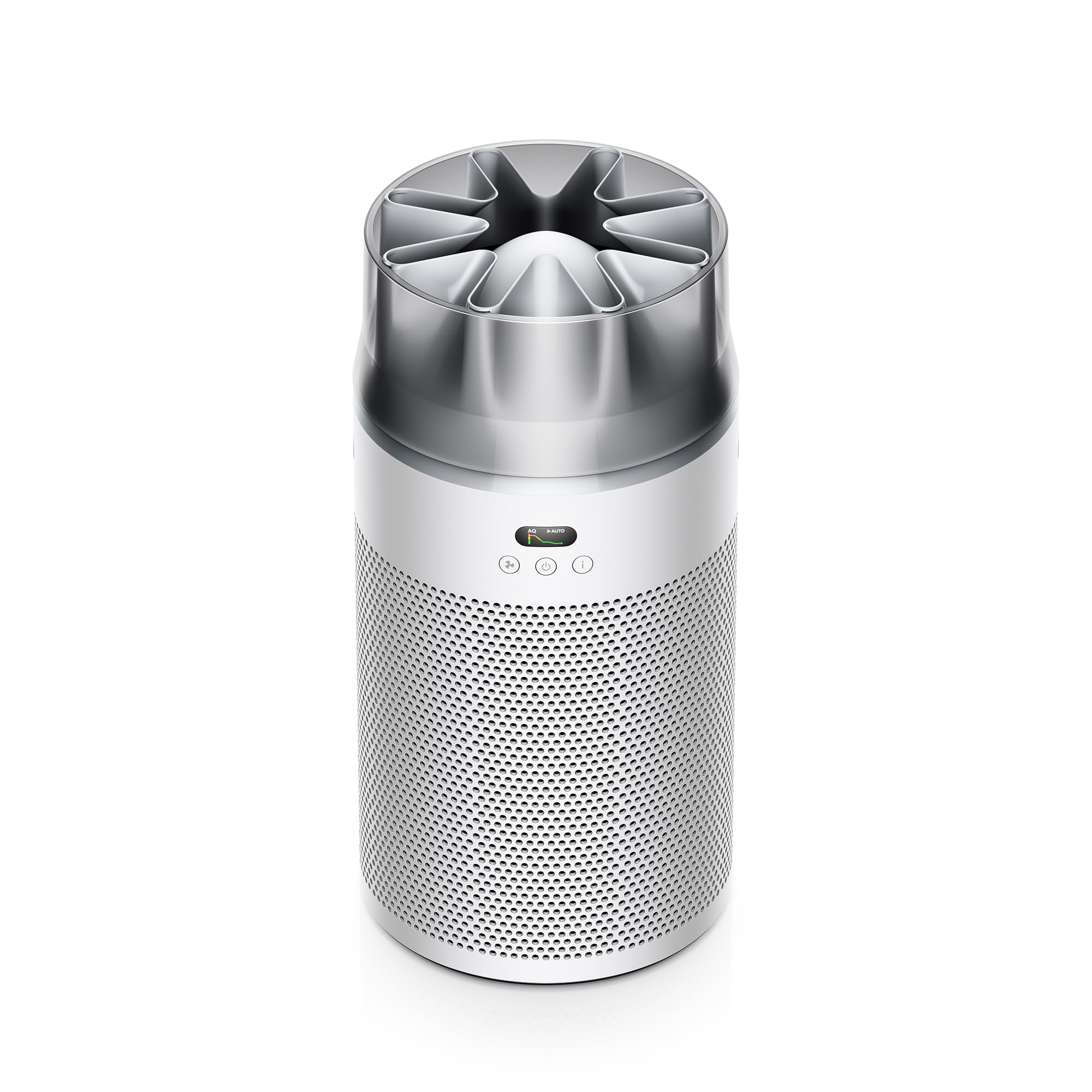
Dyson engineered the Hushjet Compact specifically to solve the noise problem that plagues most powerful air purifiers. The star-shaped nozzle design reduces turbulence, and the result is a unit that delivers whole-room purification at just 24 dB in sleep mode — quiet enough that you have to place your hand near the vent to confirm it is running. The fully sealed 360-degree electrostatic filter captures 99.97% of particles at 0.3 microns, and the activated carbon layer handles pet odors and cooking smells effectively.
The standout feature for allergy sufferers is the five-year filter lifespan — no replacement purchases, no installation hassles, no filter cost anxiety for half a decade. Real-time air quality monitoring through the MyDyson app gives detailed reports on particulate levels, and auto mode intelligently ramps fan speed only when a drop in air quality is detected, which Dyson reports saves energy and extends filter life. Owners moving from older Levoit or Honeywell units consistently describe the airflow as stronger and quieter simultaneously.
The premium price reflects engineering refinement rather than raw filtration capacity — the Hushjet covers 203 ft² at its rated ACH, which means it is purpose-built for bedrooms rather than whole-home applications. The lack of a physical remote control is a minor frustration noted by several owners, though app and voice assistant control covers most use cases. For those who prioritize absolute silence, smart home integration, and zero filter-maintenance hassle, the Dyson is the clear leader.
Why we love it
- Five-year filter eliminates recurring replacement costs and hassle
- 24 dB sleep mode is genuinely whisper-quiet — best-in-class
- Real-time air quality monitoring with automatic fan adjustment
Good to know
- Coverage limited to about 200 ft² — best for smaller bedrooms
- No physical remote control included; app and voice control required
6. AirDoctor AD2000
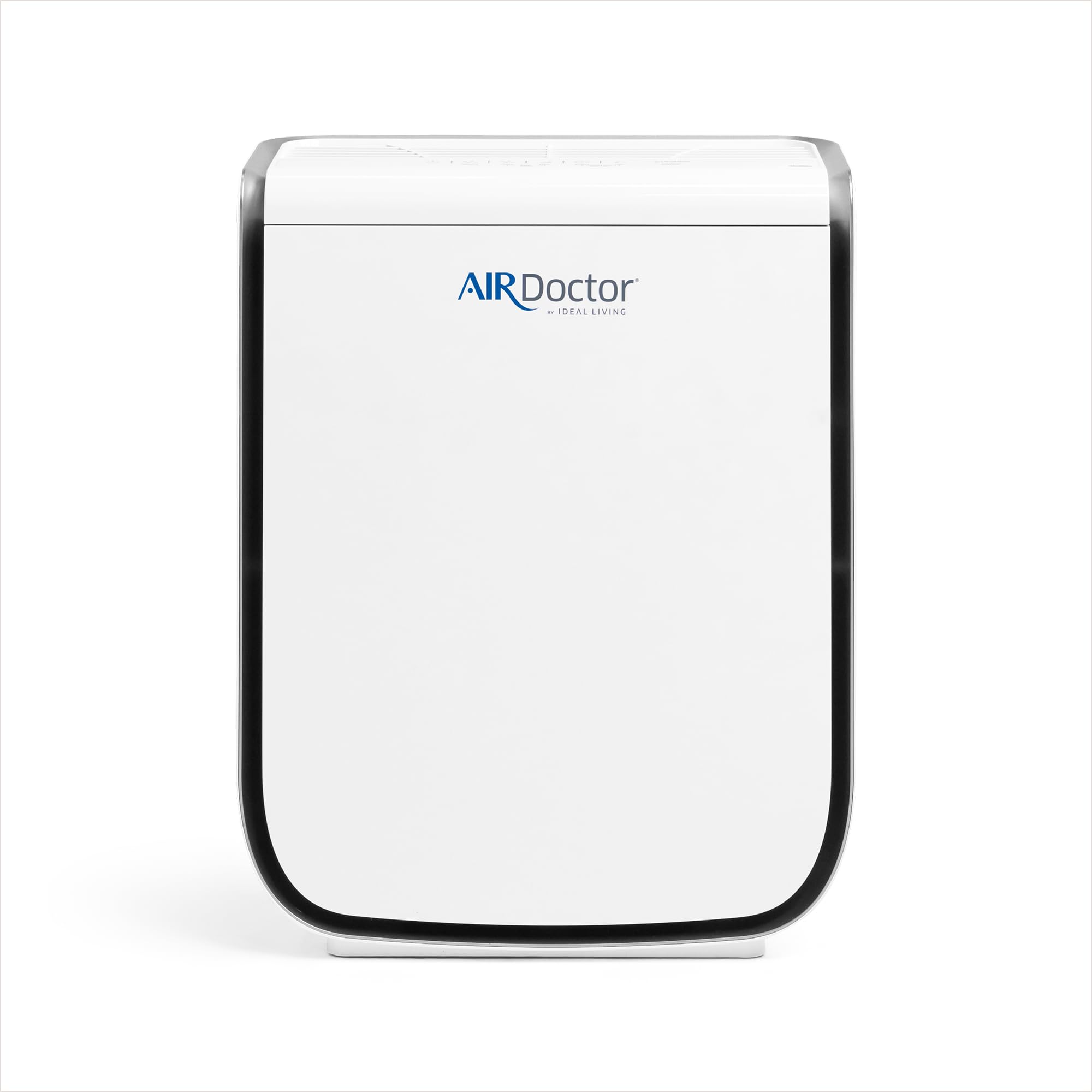
The AirDoctor AD2000 takes filtration to a level that standard True HEPA units cannot match. Its UltraHEPA media captures 99.99% of particles at 0.003 microns — 100 times smaller than the HEPA standard — which means it traps ultrafine particles like bacteria, virus fragments, and combustion byproducts that slip through conventional filters. The three-stage system adds a premium activated carbon and potassium permanganate layer specifically designed to adsorb VOCs, cooking fumes, and wildfire smoke gases.
Owners with severe environmental allergies or chemical sensitivities report dramatic improvements: one verified account describes complete elimination of a new-couch VOC smell within 24 hours of operation, and multiple reviews note that auto mode with the Halo PM2.5 sensor responds instantly to smoke or cooking odors by boosting fan speed. The 1,220 ft² one-pass coverage means it can serve a large master bedroom and still have headroom for an adjoining nursery or home office area.
The unit is physically large at 16.3 inches wide and 20.7 inches tall, and its 12.9-pound weight makes it semi-permanent once placed. Noise levels sit at 30 dB on low, which is quiet but not as whisper-silent as the Dyson or Levoit. Replacement filters are a significant ongoing cost: the carbon filter needs swapping every six months and the UltraHEPA every 12 months. For allergy sufferers who need the absolute highest particle capture efficiency and have the budget to maintain it, the AirDoctor is the undisputed champion.
Why we love it
- UltraHEPA captures 99.99% of particles down to 0.003 microns
- Premium carbon filter with potassium permanganate neutralizes VOCs and gases
- Halo PM2.5 sensor provides accurate real-time air quality feedback
Good to know
- Large footprint and heavy weight limit placement flexibility
- Filter replacement costs are substantial — carbon every 6 months, HEPA yearly
7. PuroAir 100i
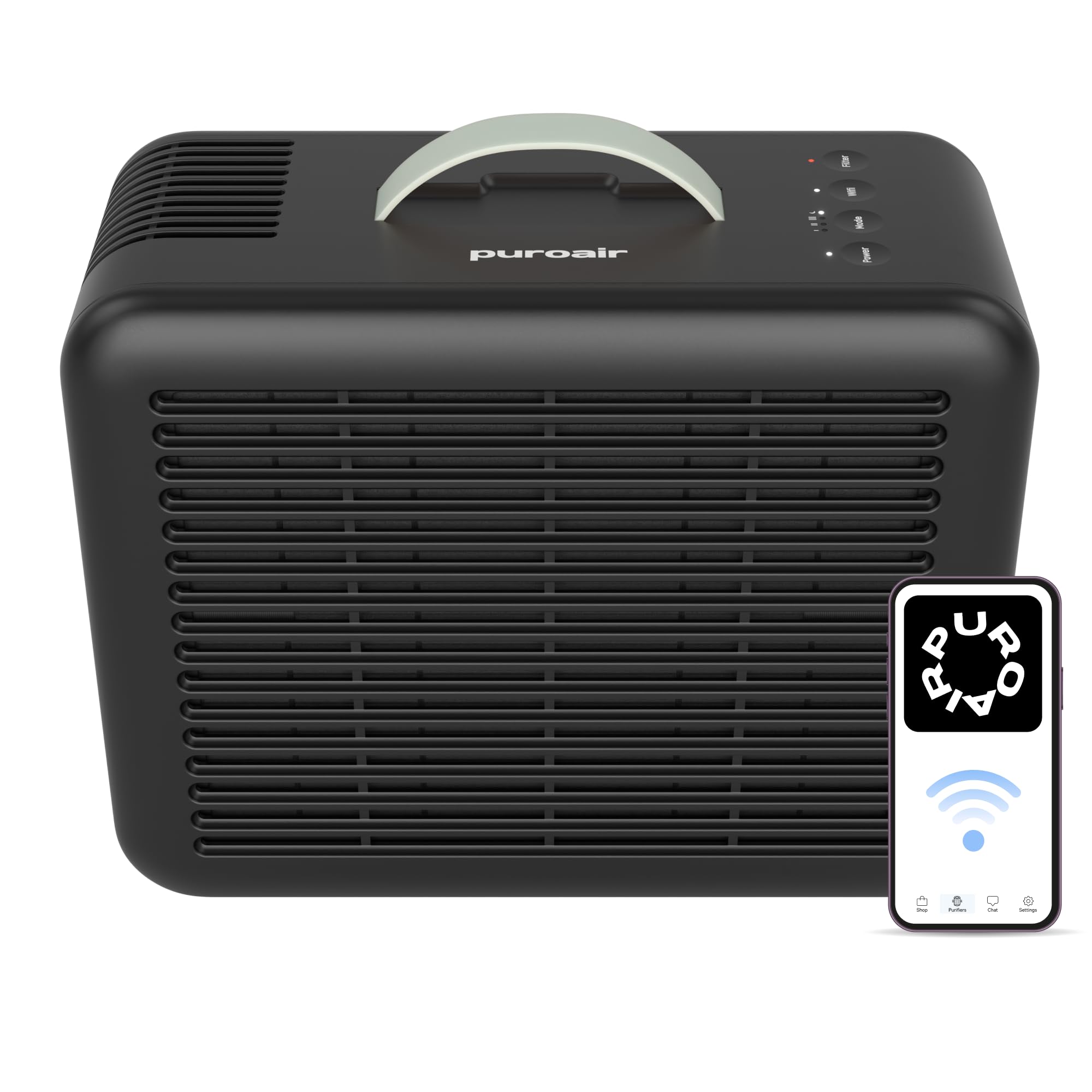
The PuroAir 100i delivers a surprisingly comprehensive feature set at a price that undercuts most competitors by a wide margin. The three-layer True HEPA and activated carbon system matches the filtration architecture of units costing twice as much, and independent testing confirms it cleans a 550 ft² room in one hour — making it effective for average-sized bedrooms with room to spare. The 4.63-pound weight and compact 12.2×5.1×8.7-inch dimensions make it the most portable unit in this lineup.
Owner feedback consistently highlights the immediate impact on air quality: cigarette and pet smells disappear within the first day of use, dust accumulation visibly slows over two weeks, and asthma symptoms ease noticeably in the same timeframe. The Wi-Fi-enabled app controls fan speed, sleep mode, and schedule settings, and the setup process takes roughly seven minutes. Owners also praise the whisper-quiet operation even on higher settings — a rare combination at this price tier.
The two-year warranty and partnership with the American Lung Association add confidence, but the unit lacks the refined build quality and sensor intelligence of premium models. The app, while functional, is more basic than the Dyson or Levoit interfaces. For allergy sufferers on a budget who need reliable True HEPA filtration with smart controls, the PuroAir 100i provides the best price-to-performance ratio in the market.
Why we love it
- Outstanding value — True HEPA and smart controls at an entry-level price
- Lightweight and portable enough to move between rooms easily
- Owners report noticeable allergy symptom relief within two weeks
Good to know
- App interface is functional but less polished than premium competitors
- Lacks real-time air quality sensor found on mid-range and premium units
FAQ
How many air changes per hour do I need for allergy relief?
Can a bedroom air purifier help with dust mite allergies?
Should I leave my air purifier on all night?
What size air purifier do I need for a standard 12×12 bedroom?
Do air purifiers produce ozone that could worsen allergies?
Final Thoughts: The Verdict
For most allergy sufferers, the bedroom air purifier for allergies winner is the Levoit Core 200S-P because it combines independent AHAM Verifide certification, whisper-quiet 27 dB sleep mode, and a compact footprint that fits any nightstand — at a price that makes replacement filters affordable over the long term. If your allergies are triggered primarily by VOCs, cooking odors, or smoke, grab the PuroAir 130i for its CarbonTech layer and app-controlled convenience. And for severe allergies requiring hospital-grade particle capture down to 0.003 microns, nothing beats the AirDoctor AD2000.