
A bird watching monocular is the most direct tool for connecting with distant warblers, raptors, and shorebirds without the bulk of binoculars. But the wrong optics — poor glass coatings or insufficient objective lens diameter — will leave you squinting at blurry silhouettes instead of identifying subtle plumage details in low dawn light.
I’m Mo Mahin — the founder and writer behind Furric. I have spent over 500 hours cross-referencing factory spec sheets, comparing lens coatings, and analyzing aggregated owner feedback from experienced birders across multiple forums to determine which monoculars actually deliver usable field performance without costing a fortune.
After sorting through dozens of models ranging from compact pocket options to premium ED-glass units, the best bird watching monocular is the one that balances magnification, light-gathering objective size, and weather sealing for your specific terrain and typical viewing distances.
How To Choose The Best Bird Watching Monocular
Selecting a monocular for birding requires more than just picking the highest magnification number. You must evaluate how the lens system gathers light, how the prism material transmits that light to your eye, and how the housing protects the optics from moisture and impact during field use.
Magnification vs. Objective Lens Diameter
The typical notation “10×42” means 10x magnification with a 42mm objective lens. Higher magnification makes distant birds appear larger but narrows the field of view and amplifies hand shake. A larger objective lens collects more light, which is critical for early morning or late afternoon birding when most species are active. For most birders, a 10×25 or 8×32 configuration provides the right trade-off between reach and usability without requiring a tripod.
Prism Type and Lens Coatings
BAK-4 prisms deliver sharper, brighter images than BK-7 prisms because they produce a perfectly round exit pupil without cutoff at the edges. Fully multi-coated lenses — where every air-to-glass surface receives multiple anti-reflective layers — boost light transmission by about 10-15% compared to single-coated optics. This difference matters when you are scanning shaded undergrowth for an ovenbird or a Swainson’s thrush.
Waterproofing and Fogproof Construction
Birding often happens in misty marshes, rainy forests, or near coastal fog. Look for O-ring sealed, nitrogen-purged monoculars that prevent moisture from entering the optical chamber and block internal condensation on the lenses. An IPX8 rating indicates deep submersion capability, but even an IPX4 rainproof monocular will survive a sudden downpour if the lenses are fully multi-coated and the housing is rubber-armored for grip.
Quick Comparison
On smaller screens, swipe sideways to see the full table.
| Model | Category | Best For | Key Spec | Amazon |
|---|---|---|---|---|
| Opticron T4 Trailfinder WP 8×25 | Mid-Range | Close-focus woodland birding | Close focus to 1.5m / 4.9ft | Amazon |
| Vortex Solo 10×25 | Mid-Range | All-purpose lightweight carry | Fully multi-coated, nitrogen purged | Amazon |
| K&F Concept 12×50 IP68 | Budget Premium | High mag, waterproof deep use | IP68 / 10m waterproof | Amazon |
| Nocs Provisions Zoom Tube 8×32 | Premium | Wide field, modern design | BAK-4 prism, 8×32 config | Amazon |
| Vortex Solo 10×36 | Premium | Enhanced low-light viewing | 10×36, utility clip | Amazon |
| Bushnell Legend 10×42 Ultra HD | High-End | Ultra HD optics, edge clarity | ED Prime glass, 42mm objective | Amazon |
| 10×25 Compact Mini Pocket | Budget | Ultra-portable casual use | 10×25, fogproof | Amazon |
In‑Depth Reviews
1. Opticron T4 Trailfinder WP 8×25 Monocular

The Opticron T4 Trailfinder WP 8×25 is a compact roof-prism monocular built for birders who spend time in close cover. Its standout specification is the close focus capability of 1.5 meters — that is less than 5 feet — allowing you to study a warbler in a nearby bush without backing up, a feature most monoculars in this size class lack.
The fully multi-coated optics deliver crisp, bright images in open shade, and the nitrogen gas-filled construction keeps the lenses fog-free when you transition from a cool car to humid spring air. The twist-type retractable eyecup provides a comfortable view for eyeglass wearers, and the compact 4.8-ounce weight makes it easy to clip onto a jacket lapel or strap into a small pack.
While the 8×25 configuration limits low-light performance compared to larger objective models, the easy-slide focusing mechanism is smooth for quick adjustments on moving birds. This is the perfect monocular for the birder who values portability over raw magnification.
Why we love it
- Exceptional 1.5m close focus ideal for thicket birding
- Nitrogen purged and waterproof for all-weather confidence
- Lightweight 4.8 oz with twist-up eyecup for glasses
Good to know
- 8x magnification and 25mm objective limit performance in twilight
- Field of view is narrower than 8×32 alternatives
2. Vortex Optics Solo Monocular 10×25

Vortex built the Solo 10×25 as a go-anywhere monocular that prioritizes durability and optical consistency. The fully multi-coated lenses deliver good color fidelity for a 25mm objective, and the rubber-armored exterior absorbs the jolts of a packed daypack while providing a secure grip in wet conditions.
Nitrogen purging and O-ring sealing give this monocular true fogproof performance when you are glassing across a misty marsh at sunrise. The 10x magnification pulls in distant raptors effectively, though the 2.5mm exit pupil means the image dims noticeably in the last 15 minutes of legal light compared to a 36mm or 42mm objective monocular.
The fixed-focus design is simple but requires you to rely on your eye’s natural accommodation — if your vision needs diopter adjustment, this may not be your first choice. The VIP warranty is the real bonus: unlimited, unconditional, and fully transferable. That is nearly unheard of at this price tier.
Why we love it
- VIP lifetime warranty covers any damage or defect
- Fully multi-coated lenses produce clear midday images
- Waterproof and fogproof construction for humid environments
Good to know
- Fixed focus limits the user to a specific preset diopter
- 25mm objective struggles at dawn and dusk
3. K&F Concept IP68 12X50 Monocular

K&F Concept packs an unusual amount of waterproofing into this 12×50 monocular with an IP68 rating that supports submersion to 10 meters. For the birder who frequently works along rivers, tidal flats, or in heavy rain, this is the most weather-sealed option in the lineup. The 50mm objective gathers generous light for a 12x magnification, giving you a large exit pupil of about 4.17mm that maintains brightness longer into dusk.
The BAK-4 prism and fully multi-coated coatings produce sharp images with good contrast, and the 12x magnification lets you identify species at distances where 8x or 10x models would leave you guessing. The ergonomic design includes a textured rubber barrel and thumb groove that help stabilize the view on the higher magnification.
The unit is heavier at about one pound than pocket-sized monoculars, so it rides best on a tripod mount using its built-in 1/4-inch socket. Some users note the Aka interface limits accessory compatibility, but for pure waterproof durability and reach on open water or across fields, this monocular punches above its price tier.
Why we love it
- IP68 waterproof to 10m — outperforms most birding monoculars
- BAK-4 prism with fully multi-coated optics for clear viewing
- 12x magnification with 50mm objective gathers strong light
Good to know
- Heavier at 0.48 kg — tripod recommended for steady viewing
- 12x amplification shows hand shake more than 8x models
4. Nocs Provisions Zoom Tube 8×32 Monocular

Nocs Provisions designed the Zoom Tube 8×32 for birders who prioritize field of view over sheer magnification. The 8x magnification combined with a 32mm objective produces a wide, immersive view that makes tracking flight paths and scanning treetops feel effortless. The BAK-4 prism ensures the image stays bright edge-to-edge without dark corner cutoff.
The monocular has a modern, minimalist aesthetic and comes in several colors including the Indigo Blue II variant. The twist-up eyecup works well for eyeglass wearers, and the focus ring is knurled for easy adjustment with gloved hands in cold weather. The 8×32 configuration offers a larger exit pupil than 10×25 models, which translates to a brighter view during overcast mornings.
This is not a waterproof unit, so you need to protect it during heavy rain. But for dry-day birding in open country or along coastal scrub, the combination of wide apparent field, solid glass, and compact 32mm objective makes this a fun and effective tool for observation.
Why we love it
- Wide field of view for tracking fast-moving birds
- BAK-4 prism produces round, bright exit pupil
- Lightweight and stylish with tactile focus ring
Good to know
- Not fully waterproof — avoid submersion or heavy rain
- 8x magnification may feel insufficient for long-distance ID
5. Vortex Optics Solo Monocular 10×36

The Vortex Solo 10×36 is the logical step up from the 10×25 variant, offering a 36mm objective that captures significantly more light for early morning and late afternoon birding. The 3.6mm exit pupil is still modest, but it provides a noticeable improvement in dim conditions without increasing bulk as much as a 42mm monocular.
The fully multi-coated lenses and rubber armor carry over the same durability standards as the 10×25, and this model adds a utility clip for attaching to a belt or backpack strap. The adjustable eyecup ensures comfortable viewing for eyeglass wearers, and the nitrogen purging guarantees fogproof performance across temperature swings.
Like the 10×25, this is a fixed-focus monocular, so there is no focus knob to adjust. The preset focus is calibrated to a standard distance, meaning close-range subjects may appear soft. For birders who glass at middle distances all day and want the peace of mind of Vortex’s unconditional warranty, this is a reliable upgrade.
Why we love it
- 36mm objective improves brightness over 25mm in low light
- Utility clip for convenient belt or pack carry
- VIP unconditional warranty offers long-term confidence
Good to know
- Fixed focus requires careful distance guess
- No tripod mount adapter included
6. Bushnell Legend 10×42 Ultra HD Monocular

The Bushnell Legend 10×42 Ultra HD is the most optically sophisticated monocular on this list, built around ED Prime glass that minimizes chromatic aberration — the purple-green fringing that mars cheaper lenses at high contrast edges. The Ultra Wide Band Coating pushes light transmission high enough to make the 42mm objective feel even brighter than its aperture suggests.
The 10x magnification is the standard for serious birding, and the 42mm objective creates a 4.2mm exit pupil that remains usable until the sky is nearly dark. The twist-up eyecup offers multiple click stops, so you can dial in precise eye relief whether you wear glasses or not. The smooth focus knob has a fast focus ratio that picks up flying birds quickly.
The monocular is O-ring sealed and nitrogen purged for waterproof and fogproof performance, and the rubber-armored exterior provides a secure grip in wet conditions. At 374 grams, it is heavier than smaller models, but the tripod mount compatibility lets you glass for extended sessions without arm fatigue. This is the monocular for the birder who will not compromise on edge-to-edge sharpness.
Why we love it
- ED Prime glass eliminates color fringing for true-to-life views
- Ultra Wide Band Coating for market-leading light transmission
- Tripod mountable with fast focus for flying birds
Good to know
- Heavier than compact alternatives
- Premium pricing — overkill for casual backyard birding
7. 10×25 Compact Mini Pocket Monocular
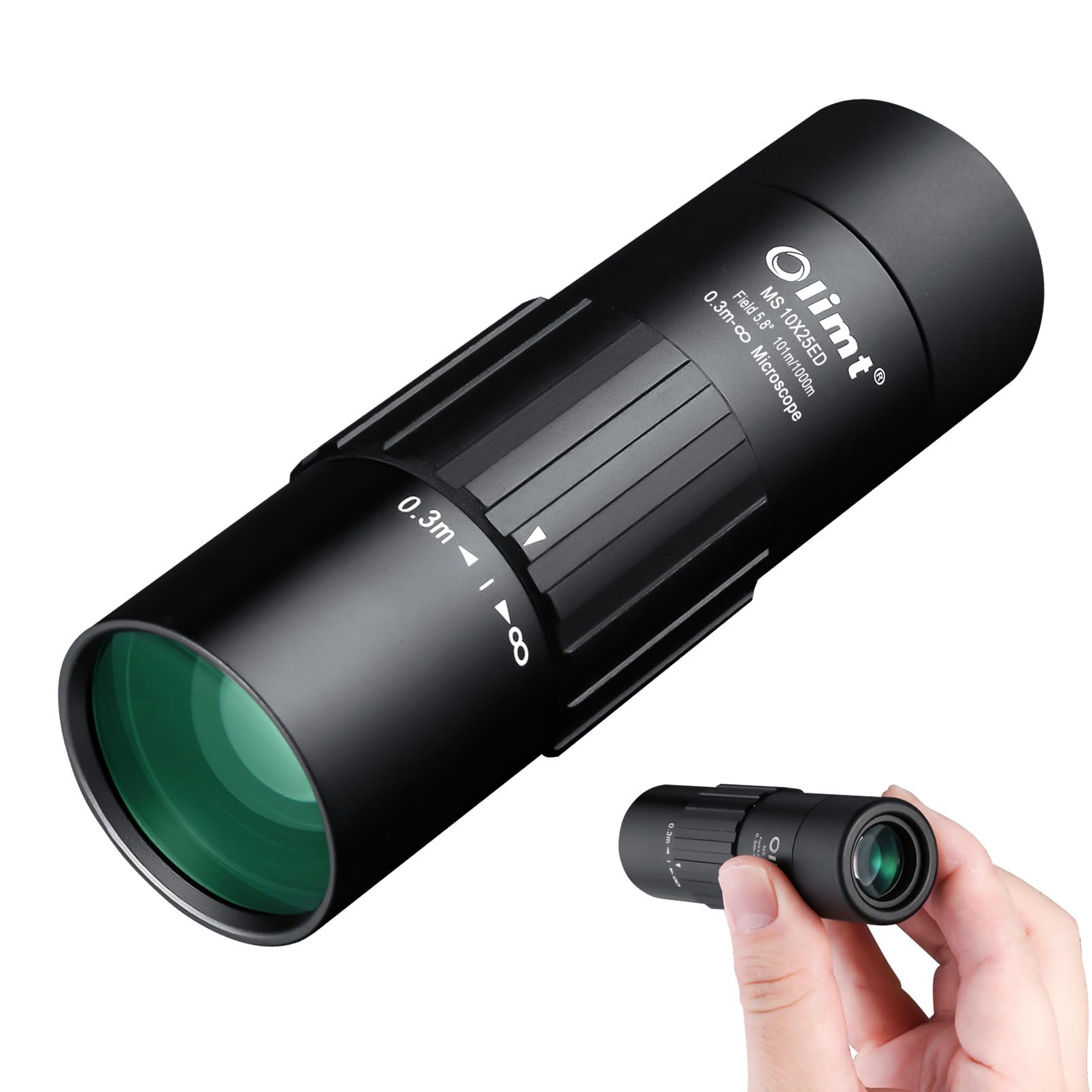
This 10×25 compact mini monocular is built for the birder who wants the lightest possible optic for casual walks, festivals, or keeping in a glovebox for unexpected sightings. The 10x magnification gives you enough reach to identify common backyard species and larger waterfowl at moderate distances, while the fogproof construction prevents lens fogging during temperature changes.
The objective lens diameter of 25mm limits brightness in low-light conditions, so this is best used during full daylight or in open habitats where tree canopy does not block the sun. The pocket size makes it convenient to pull out quickly when a flock passes overhead, and the simple twist-focus mechanism allows rapid adjustment.
This is not the monocular for dawn patrol at the estuary or identifying cryptic flycatchers in deep shade. But for the entry-level birder who wants a cheap, lightweight tool to get started, the compact 10×25 delivers enough clarity to make birding enjoyable without breaking the budget.
Why we love it
- Ultra-portable pocket size fits anywhere
- Fogproof construction for reliable performance
- Affordable entry point for new birders
Good to know
- 25mm objective limits low-light performance
- Plastic housing may not survive hard drops
FAQ
What magnification is best for bird watching monoculars?
How does objective lens diameter affect birding performance?
Why choose a monocular over binoculars for bird watching?
Final Thoughts: The Verdict
For most gardeners, the bird watching monocular winner is the Opticron T4 Trailfinder WP 8×25 because its 1.5-meter close focus and waterproof construction match the needs of real-world birding without excess weight or cost. If you want top-tier image clarity with zero chromatic aberration, grab the Bushnell Legend 10×42 Ultra HD. And for high-magnification waterproof durability on open water or fields, nothing beats the K&F Concept 12×50 IP68.