
Attracting blue jays—often the boldest and most striking visitors to a back garden—requires more than just tossing seed out the back door. Their size and preference for larger perches and sturdier structures mean the typical finch feeder simply won’t cut it. Choosing the right unit is the difference between occasional glimpses and a daily spectacle of brilliant blue feathers.
I’m Mo Mahin — the founder and writer behind Furric. My process for evaluating these feeders involves scrutinizing material resilience against weathering, hopper capacity for larger seed volumes, and owner feedback regarding actual blue jay visitation patterns over sustained periods.
To simplify this search, I’ve reviewed seven of the most promising models on the market to find the best blue jay feeder that balances robust construction, capacity, and value for your backyard birding setup.
How To Choose The Best Blue Jay Feeder
Blue jays are larger, assertive birds that favor sturdy platforms and a clear sightline while feeding. Selecting the right feeder means prioritizing their size requirements and typical behavior over general-purpose bird feeding logic.
Capacity and Seed Port Access
Blue jays consume whole sunflower seeds, peanuts, and suet pellets in volume. A feeder with a hopper capacity of at least 3 to 4 pounds reduces the frequency of refills. Look for models with wide feeding ports or open trays—blue jays avoid cramped perches that force them into uncomfortable positions.
Material Durability Against Weather and Pests
Recycled plastic and powder-coated metal are the two dominant materials for this category. Recycled plastic is lightweight, colorfast, and will not splinter from freeze-thaw cycles. Powder-coated metal offers superior chew resistance against squirrels and can survive high-wind conditions without cracking. Glass and thin acrylic components are more prone to breakage.
Pest Exclusion Design
Cages with grid spacing around 1.5 inches allow smaller songbirds to enter while excluding grackles and squirrels. However, the cage must still be wide enough to admit a blue jay’s body. A weight-sensitive perch or a baffle placed above the feeder adds an extra layer of protection without turning away the intended species.
Quick Comparison
On smaller screens, swipe sideways to see the full table.
| Model | Category | Best For | Key Spec | Amazon |
|---|---|---|---|---|
| Nature’s Rhythm Two Chamber Feeder | Hopper | High-volume seed dispensing | 10 lbs dual compartments, 10 feeding ports | Amazon |
| Mosloly 7 lbs Caged Bird Feeder | Caged | Excluding large birds while feeding jays | 7 lbs capacity, 1.3″ x 1.8″ grid | Amazon |
| Mosloly Caged Tube Feeder | Caged Tube | Squirrel-proofing with clear visibility | 3 lbs capacity, 4 adjustable ports | Amazon |
| Kingsyard Platform Gazebo Feeder | Gazebo Platform | Open fly-through feeding for multiple birds | Metal mesh tray, 6 entryways, 8″ x 7″ base | Amazon |
| Kingsyard 4 lbs Hopper Feeder | Hopper | Storing 4 lbs of mixed seed in WPC composite | 4 lbs capacity, recycled plastic build | Amazon |
| Kingsyard Dual-Use Metal Mesh Feeder | Mesh Dual | Separating thistle and sunflower seeds | 3 lbs capacity, two mesh compartments | Amazon |
| Kingsyard Bluebird Mealworm Feeder | Tray | Holding mealworms in glass dishes | 7.8″ tall, two 5 oz glass dishes | Amazon |
In‑Depth Reviews
1. Nature’s Rhythm Metal Hopper Bird Feeder

The Nature’s Rhythm feeder dominates the category with a 10-pound dual-compartment hopper and ten feeding ports—enough capacity to keep a flock of blue jays satisfied for days without a refill. The powder-coated copper finish resists weather corrosion, and the all-metal construction handles heavy winds and occasional raccoon encounters without damage. When fully loaded, the unit weighs over ten pounds, so it requires a sturdy hanging point or a shepherd’s hook rated for the load.
Two separate chambers allow you to fill one side with whole peanuts and the other with sunflower seeds, catering to different species at the same time. The wrap-around tray at the base serves as the primary feeding zone for blue jays, who prefer the open perching area over the side ports. The screw-top lid provides a secure seal against rain and makes refilling straightforward even when the hopper is full.
Owner reviews consistently highlight that the feeder has survived for several years with only minor wear to the coating. The large capacity makes it particularly appealing for regions with heavy winter migration where birds deplete seed rapidly. Note that the side perches are best suited for smaller birds like chickadees, but blue jays feed comfortably from the lower tray.
Why we love it
- Massive 10 lbs dual-compartment hopper minimizes refill trips.
- Durable all-metal construction with weather-resistant powder coating.
- Wrap-around feeding tray is ideal for blue jays.
Good to know
- Very heavy when full, requires a robust hanging structure.
- Side perches are too short for blue jays to use effectively.
- Not truly squirrel-proof, but the weight deters them from raiding.
2. Mosloly 7 lbs Large Heavy Metal Caged Bird Feeder
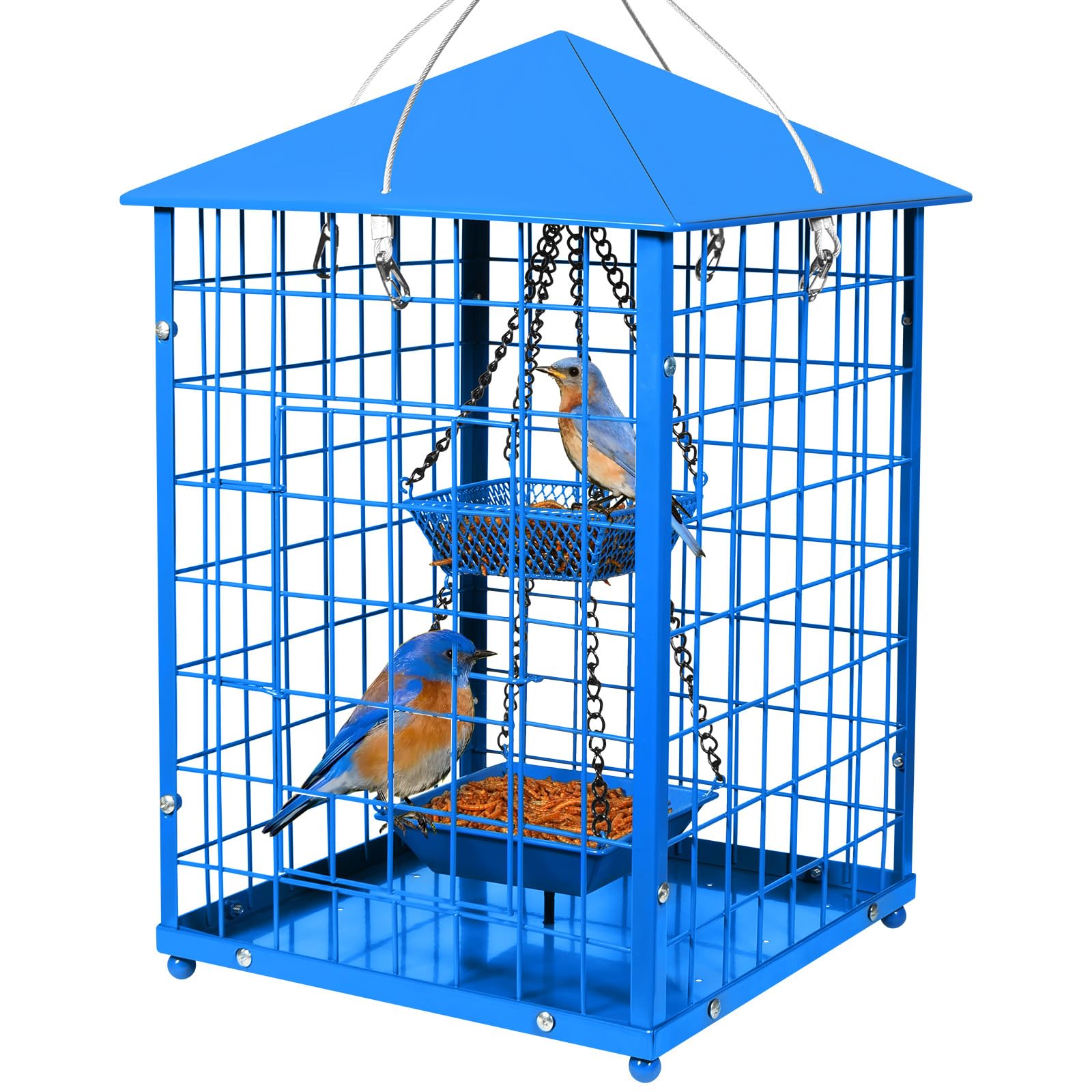
This caged feeder from Mosloly is designed specifically to give smaller songbirds—including bluebirds and chickadees—a safe feeding environment while keeping European starlings, grackles, and squirrels at bay. The 1.3-by-1.8-inch grid spacing is wide enough for blue jays to enter the cage without hesitation, though some larger jays may prefer to cling to the outside and feed from the tray. The 7-pound seed capacity means you won’t be refilling daily, and the enamel coating has held up well over multiple seasons with minimal rust.
Assembly is straightforward with a video guide provided, and the removable roof allows easy access for cleaning. The bottom tray catches fallen seed and shells, reducing ground waste. A door on the side is secured with a clip, though some owners have reinforced it with a paper clip to prevent determined squirrels from prying it open. The unit weighs around ten pounds empty, so a strong branch or post is necessary.
User feedback indicates that birds adapt to the new feeder within a few days. The design successfully excludes larger aggressive birds while allowing targeted feeding for blue jays, finches, and wrens. The only recurring critique is that the roof gap at the top hook can let rain seep in, but the drain holes in the tray manage moisture effectively.
Why we love it
- Excellent large-bird exclusion while accommodating blue jays.
- 7 lb capacity and enamel finish hold up for years.
- Catch tray reduces wasted seed underneath.
Good to know
- Heavy build requires a strong hanging point.
- Grid spacing may need hardware cloth modification to stop cowbirds.
- Rain can enter through the top hook gap.
3. Mosloly Caged Bird Feeders Metal – 3 Lbs

The smaller Mosloly caged feeder uses a clear polycarbonate tube surrounded by a heavy-duty stainless steel and iron cage. The tube holds up to 3 pounds of seed, and four feeding ports with perches allow multiple birds to feed simultaneously. An adjustable switch on the bottom lets you close off the lower three ports to control which birds access the bottom tray, giving you flexibility in managing seed flow.
Assembly requires following the manual closely, but the result is a robust unit that defeats most squirrel attempts. The dome lid effectively shields the seed from rain and snow. The 1.25-inch grid spacing is a point of contention—some owners report that smaller birds like titmice and nuthatches hesitate to enter, while blue jays and chickadees have no issue. If your local smaller birds avoid it, replacing the cage with a 1.5-inch grid solves the problem.
Owners praise the feeder for its sturdy build and the way it focuses feeding on smaller desired species. The plastic port covers and perches feel less premium than the metal cage, but they have held up through moderate weather exposure. The clear tube lets you monitor seed levels at a glance, and the detachable design makes cleaning straightforward.
Why we love it
- Strong metal cage effectively excludes squirrels.
- Adjustable bottom ports provide seed flow control.
- Clear tube allows easy viewing of seed levels.
Good to know
- 1.25″ grid spacing excludes some smaller birds.
- Plastic port covers and perches feel less durable than the cage.
- Not fully rat-proof despite being squirrel-proof.
4. Kingsyard Platform Bird Feeder – Gazebo Style
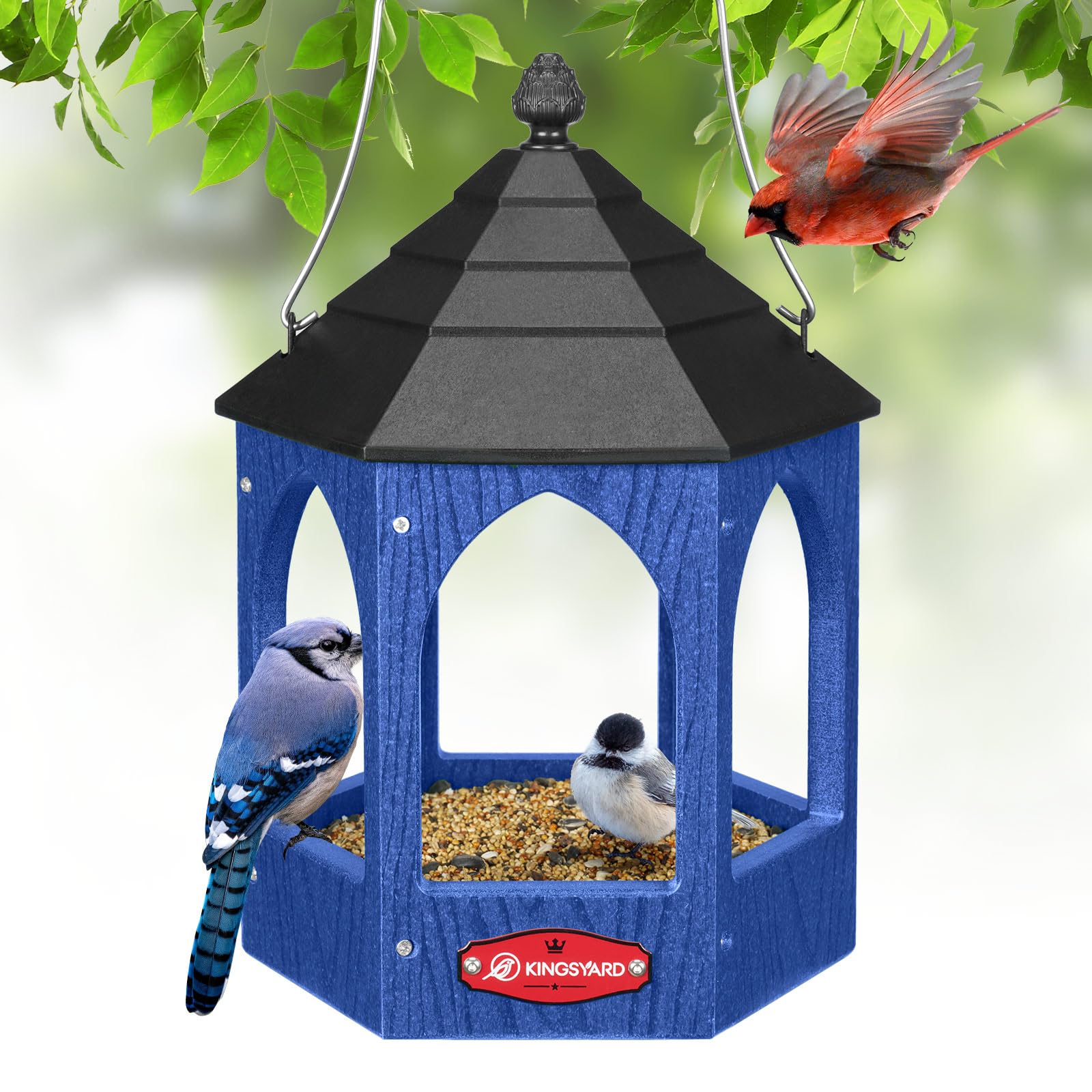
This gazebo-style platform feeder uses recycled plastic for the structure and a metal mesh bottom for drainage—an ideal combination for blue jays who prefer open, unobstructed feeding areas. The six open entryways allow birds to fly through from any direction, and the elevated roof protects seed from rain and snow. The mesh tray ensures moisture drains quickly, keeping seed fresh even after a downpour.
Assembly requires no tools, and the detachable metal handle makes hanging simple. The removable top provides full access for refilling and cleaning. At 8 inches by 7 inches, the platform comfortably accommodates two to three blue jays simultaneously, plus smaller species like finches and sparrows around the edges. The bright blue color adds visual appeal to any garden setting.
Owner reviews highlight how quickly birds adapt to the open design. The narrow entryways effectively prevent pigeons from entering, which is a major advantage for those struggling with larger nuisance birds. The recycled plastic material maintains its color across seasons without fading or cracking, and the feeder remains sturdy even after multiple freeze-thaw cycles.
Why we love it
- Open platform design is ideal for blue jay feeding behavior.
- Metal mesh bottom keeps seed dry through rain.
- Narrow entryways exclude pigeons effectively.
Good to know
- Open design is not squirrel-proof.
- No perch perches—birds feed directly from the tray.
- Smaller seed can fall through the mesh.
5. Kingsyard 4 lbs Large Bird Feeder House – WPC Composite
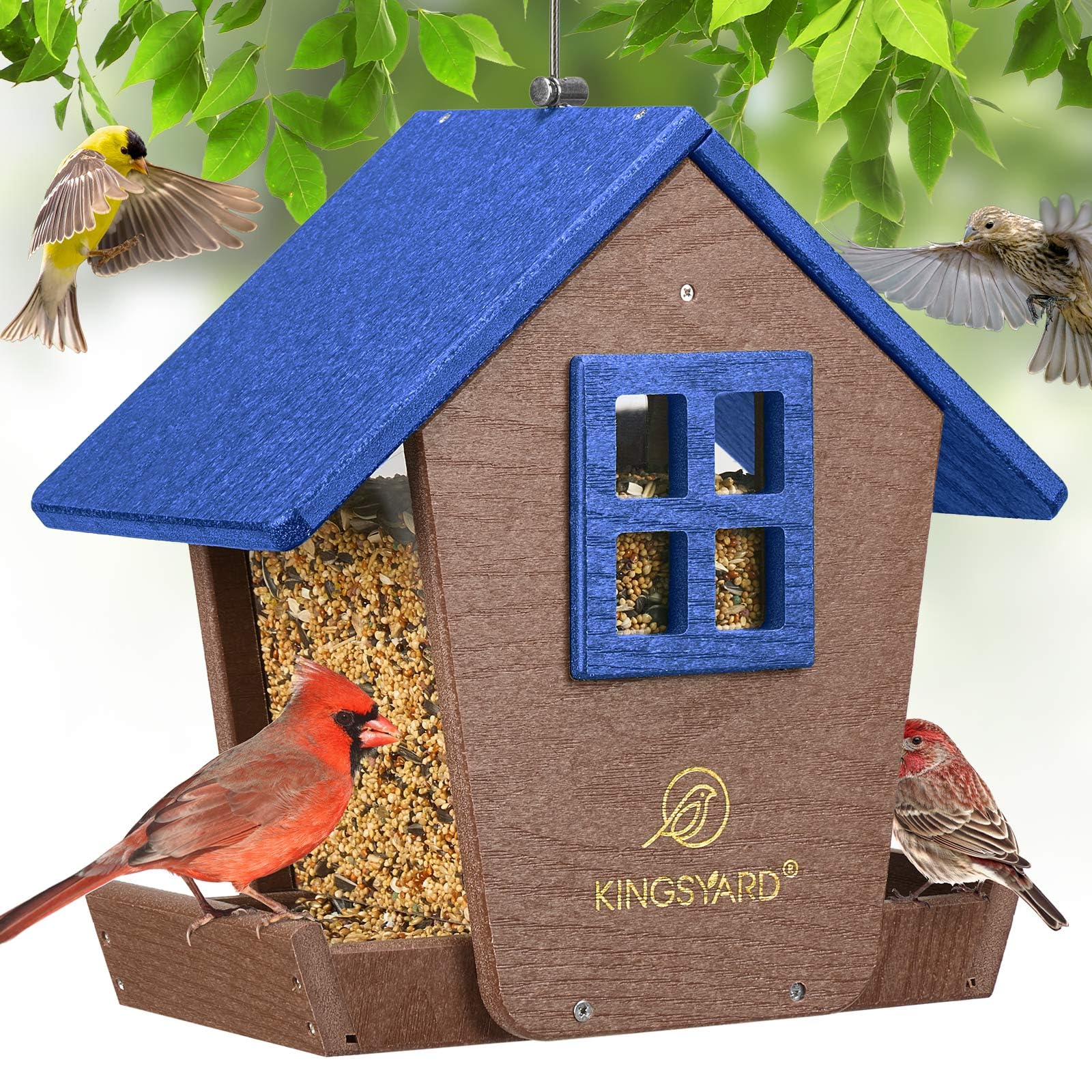
This hopper-style feeder from Kingsyard is constructed from WPC (wood plastic composite) recycled material, offering the look of a classic wooden feeder without the rot and splintering risks. The 4-pound hopper capacity is well-suited for a small to mid-sized bird population, and the clear plexiglass side panels let you monitor seed levels without opening the lid. The drawcord lock roof makes refilling simple and quick.
Openings along the bottom of the hopper automatically gravity-feed seed into the trays, and built-in drainage holes prevent moisture buildup inside the hopper. The blue color with white trim gives it a farmhouse aesthetic that blends into garden settings. The feeder attracts a wide range of species including blue jays, cardinals, finches, and chickadees.
Customer feedback notes that the perches are relatively small—only large enough for one cardinal or two goldfinches at a time. Blue jays may need to perch on the edge of the tray rather than the dedicated perches. Some owners have mentioned that squirrels can access the seed easily, but using safflower seed as a deterrent mitigates the issue. The feeder maintains its color well through UV exposure and holds up through winter weather without cracking.
Why we love it
- Durable WPC composite resists rot and cracking.
- Clear side panels allow easy seed-level checking.
- Attractive farmhouse design and easy roof removal.
Good to know
- Perches are small, limiting blue jay perching space.
- Open tray design allows squirrel access without a baffle.
- Seed can spill easily if the feeder is bumped.
6. Kingsyard Dual-Use Metal Mesh Wild Bird Feeder
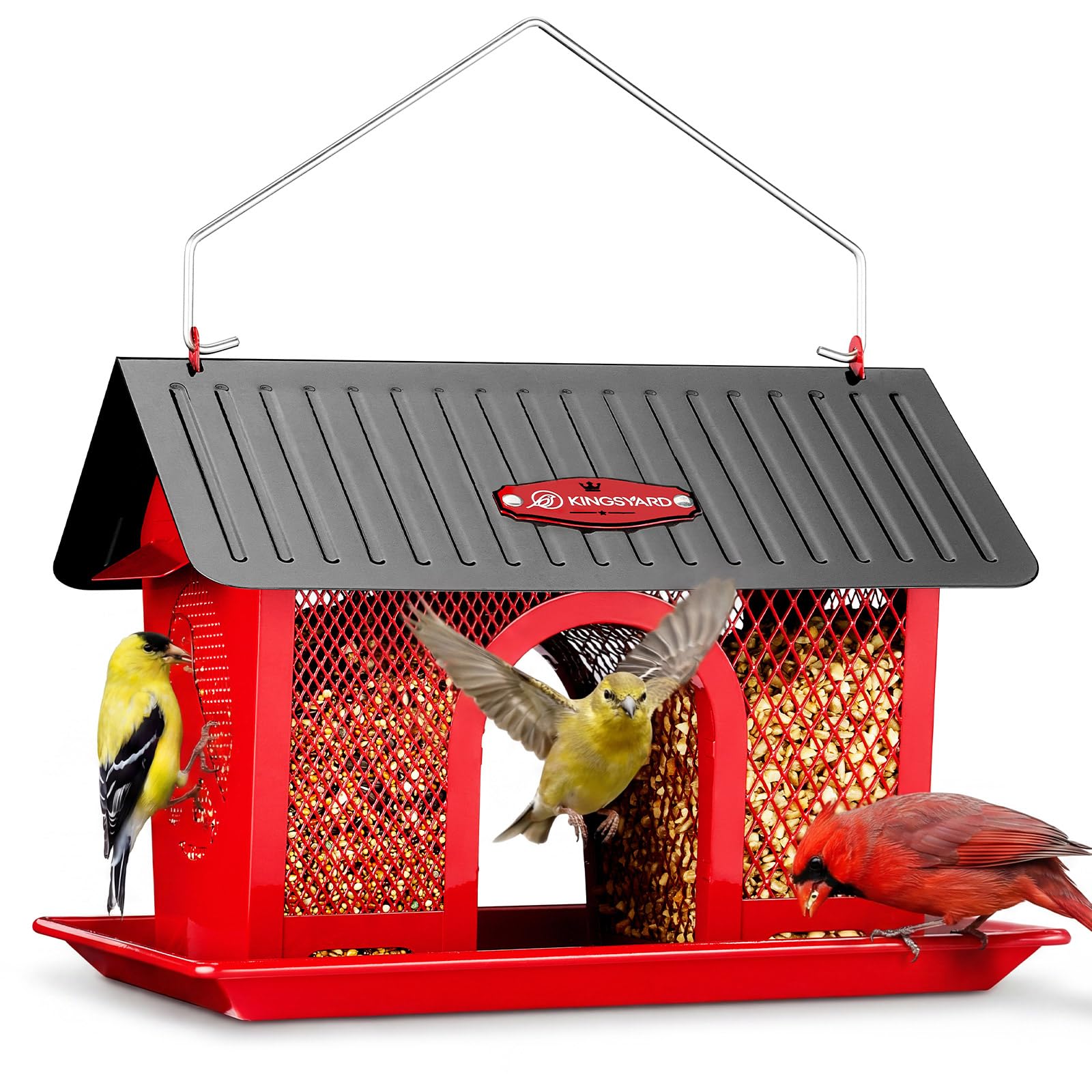
Kingsyard’s dual-compartment mesh feeder is built for versatility—one side uses fine mesh for thistle or nyjer seed, while the other uses wider openings for sunflower seed blends. This dual design reduces competition at feeding time, as finches and chickadees can feed from one side while blue jays and cardinals use the tray area on the other. The 360-degree feeding mesh allows clinging birds to feed from any angle.
The powder-coated metal construction is rust-resistant and chew-proof, surviving both squirrel gnawing and outdoor weather without denting. The removable roof and hook provide tool-free access for refilling, and the wide opening makes deep cleaning straightforward. The 3-pound capacity is moderate, but the dual seed design means you’re filling two smaller chambers rather than one large hopper.
Reviews consistently praise the feeder’s durability and how quickly birds adapted to it. The green/bronze color blends naturally into foliage, and the house-style silhouette adds charm. Some owners noted minor dents on the roof from shipping, but the functionality was unaffected. The feeder works well for a range of species and is particularly effective at separating seed types to attract a diverse bird population.
Why we love it
- Dual mesh compartments handle different seed types effectively.
- Powder-coated metal resists rust and squirrel damage.
- 360-degree feeding access for clinging birds.
Good to know
- 3 lb capacity split across two chambers reduces per-side volume.
- Some units arrive with minor shipping dents.
- Wider mesh openings may allow larger seeds to fall through.
7. Kingsyard Bird Feeder for Outdoor Hanging – Bluebird Mealworm Feeder

This purpose-built mealworm feeder from Kingsyard targets bluebirds and, by extension, blue jays who are fond of the same protein-rich treats. The two removable glass dishes each hold 5 ounces of mealworms or other small seeds, and the scalloped-edge tray provides ample landing space for one or two birds at a time. The recycled plastic construction is weatherproof and won’t absorb moisture, making it a low-maintenance option for seasonal use.
The overhanging roof protects the dishes from rain, though standing moisture in the glass cups can become an issue—some owners have noted that drainage holes in the dishes would be a welcome improvement. The cable hanger makes installation simple on any branch or hook. The feeder measures 10.5 inches in height, making it compact enough for smaller garden spaces.
Owner feedback emphasizes that the bright blue color effectively attracts bluebirds and blue jays, and the solid construction justifies the price point. A few reports of breakage during transit have been resolved promptly by the manufacturer’s customer service. Replacement glass dishes are easy to source as standard votive candle cups. While the capacity is modest, it’s more than sufficient for supplementing a primary feeder with high-energy mealworms.
Why we love it
- Color and dish design specifically target bluebirds and blue jays.
- Recycled plastic withstands weather without cracking.
- Removable glass dishes simplify cleaning.
Good to know
- Glass dishes lack drainage holes, can collect rainwater.
- Modest 5 oz per dish capacity requires frequent refills.
- Glass dishes can break during handling or shipping.
FAQ
Do blue jays prefer a platform or a hopper feeder?
What seed blend works best for drawing blue jays to a feeder?
How do I stop squirrels from overrunning my blue jay feeder?
Final Thoughts: The Verdict
For most gardeners, the best blue jay feeder winner is the Mosloly 7 lbs Caged Bird Feeder because it combines a generous 7-pound capacity with effective pest exclusion while still accommodating blue jays through its 1.3 x 1.8-inch grid. If you want the ultimate high-volume solution that reduces refill trips to once a week, grab the Nature’s Rhythm Two Chamber Feeder. And for those with smaller gardens or a preference for open feeding, the Kingsyard Platform Gazebo Feeder offers an attractive, functional entry point.