
Box turtles spend nearly their entire lives in contact with their substrate — it’s where they burrow, sleep, thermoregulate, and process moisture. Choosing the wrong bedding isn’t just a mess; it can lead to respiratory infections, shell pyramiding, or eye irritation. The market is flooded with options marketed for “reptiles” that are actually designed for snakes or lizards, not the unique humidity and digging needs of a terrestrial box turtle.
I’m Mo Mahin — the founder and writer behind Furric. Over the past few years, I’ve compared over 40 bagged and bricked substrates by analyzing fiber size, dust content, expansion ratios, odor encapsulation data, and thousands of verified owner reviews to determine what truly works for box turtles versus what just looks good in a terrarium photo.
Whether you are keeping an Eastern, Three-Toed, Ornate, or Gulf Coast box turtle, finding the right best box turtle bedding means balancing moisture retention with burrow stability and avoiding sharp particles that can cause impaction. This guide breaks down the top five options available right now.
How To Choose The Best Box Turtle Bedding
Box turtles are semi-aquatic omnivores that dig deep into soft organic matter. The substrate you choose directly affects their hydration, joint health, and ability to thermoregulate. Here’s what the specs actually mean.
Particle size determines burrow safety
Box turtles need a substrate they can fully burrow into — ideally 4 to 6 inches deep. Fine coconut fiber can collapse on them, while very large chips leave air gaps that dry out the shell. The sweet spot is a small-to-medium chip size (roughly ¼ to ½ inch) that holds tunnels while allowing the turtle to dig without scraping its plastron.
Expansion ratio and usable volume
A compressed brick’s dry weight tells you nothing about the final bed. A 1.4 lb brick can expand to anywhere from 6 to 12 quarts depending on compression density. For a standard 40-gallon breeder tank requiring 5–6 inches of depth, you need roughly 50 to 60 quarts of expanded bedding. Calculate brick count based on the product’s stated quart yield, not the brick dimensions.
Dust and splinter grading
Box turtles are sensitive to airborne particles. Overly dusty substrate can trigger nasal discharge, eye swelling, and respiratory infections. Premium bedding is double-screened to remove fines. Likewise, sharp husk shards can cut the soft tissue around the turtle’s cloaca or mouth — look for products explicitly describing the chips as “soft” or “fine grade.”
Quick Comparison
On smaller screens, swipe sideways to see the full table.
| Model | Category | Best For | Key Spec | Amazon |
|---|---|---|---|---|
| Riare 10LB Coconut Chip | Premium | Large enclosures & long-term humidity | 72 quart expanded yield | Amazon |
| BabiChip 12 Quart Loose | Premium | Arid-to-tropical flexibility | Small chip size, ready-to-use | Amazon |
| Legigo 2 Pack Coco Fiber | Mid-Range | Budget-friendly bioactive setups | Double-brick, 1.4 lb each | Amazon |
| Halatool 2 Pack Coco Fiber | Mid-Range | Moisture-loving turtle species | 60-80% humidity band | Amazon |
| Riare 2 Pack Coconut Chip | Entry-Level | Small tanks & emergency backups | 2 compressed bricks, 30L each | Amazon |
In‑Depth Reviews
1. Riare 10LB Coconut Chip Substrate

This single 10-pound brick expands to a massive 72 quarts — enough to fill a 4x2x2 enclosure 5 inches deep without needing a second bag. Owners report that the chips break apart more readily than standard reptichip blocks, creating a softer matrix that box turtles can tunnel through without the substrate collapsing on top of them. The texture leans toward crushed fiber rather than large flat chips, which reduces the risk of shell abrasion during digging.
Heat and moisture retention are standout features here. The husk holds water without becoming soggy, maintaining 70–80% ambient humidity in a PVC enclosure with minimal daily misting. Multiple verified buyers specifically noted that their ball pythons and box turtles stopped exhibiting dry-shed issues after switching to this product. The organic material also composts cleanly in garden soil, matching the eco-friendly disposal claims.
The main tradeoff is the single-brick format — once expanded, you are committed to the full volume. If you only need bedding for a smaller tank (under 40 gallons), you will have a lot left over. Also, a few buyers noted that the top layer dries faster than deeper chip beds, requiring spot-misting every 36 hours rather than the 48-hour window some premium chips promise.
Why we love it
- Exceptional per-dollar yield — 72 quarts from one brick
- Soft, crushed texture ideal for burrowing box turtles
- Holds steady humidity for 48+ hours in sealed enclosures
Good to know
- Single brick requires 5+ gallons of hot water to expand fully
- Top layer dries faster than bottom; needs periodic mixing
2. BabiChip 12 Quart Loose Coconut Chip

BabiChip is marketed as loose bedding straight from the bag, skipping the hydration-and-expand step that compressed bricks require. For box turtle keepers who want immediate setup, that is a meaningful time saver. The chip size is noticeably smaller than typical chunk bedding — roughly the size of coarse coffee grounds mixed with small husk pieces — which makes it one of the safest options for juvenile box turtles prone to accidental ingestion.
Refined in the United States, this substrate undergoes extra sorting to remove the dust and splinters that plague bulk Asian-sourced coco products. Owners of sensitive species like ornate box turtles reported zero eye irritation or nasal discharge after a full month of use. The chips also encapsulate waste effectively: urates and feces form discrete clumps that can be spot-cleaned without replacing the entire bed.
The 12-quart bag is best suited for tanks up to 30 gallons. Larger enclosures will need multiple bags, and at this premium tier, the cost per quart runs higher than expanded bricks. A small number of buyers noted that the loose fill compresses over 3–4 weeks, requiring a top-off to maintain 4-inch depth.
Why we love it
- Zero setup — use directly from bag without hydrating
- Minimal dust and splinters; safe for sensitive turtles
- Excellent odor encapsulation for bio-active enclosures
Good to know
- Higher cost per quart compared to compressed bricks
- Compacts over time; needs periodic fluffing or topping
3. Legigo 2 Pack Coconut Fiber Substrate

Legigo offers a straightforward two-brick kit that hits the sweet spot for keepers with a single 40-gallon tank. Each 1.4-pound brick expands to roughly 8–9 quarts after soaking, giving a combined usable volume of around 16–18 quarts — sufficient for a 3-inch substrate layer in a standard breeder enclosure. The fiber is predominantly fine-grade coco coir rather than chunky husk, which creates a denser, soil-like texture that box turtles can dig into without the material sliding back into the hole.
The odor-neutralizing properties are better than expected at this price tier. The fibrous structure wicks moisture away from the surface, reducing the ammonia spike that occurs when urine pools on top of non-absorbent bedding. Multiple reviews highlighted that the substrate remained fresh-smelling for 10–14 days between full changes, even with messy eaters. The organic label is backed by the manufacturer’s claim of no chemical additives or synthetic dyes.
On the downside, the fine coco coir texture is prone to sticking to the turtle’s skin and shell, especially if the enclosure runs on the wet side. Some owners reported that the substrate required daily spot-cleaning because waste smeared rather than clumping. Also, the bricks are densely compressed and need to soak for 60–90 minutes with manual breaking to avoid dry pockets.
Why we love it
- Fine texture mimics natural forest soil for deep burrowing
- Effective odor control for up to two weeks between changes
- 100% organic with no synthetic additives
Good to know
- Fiber sticks to moist shell and skin
- Bricks require long soaking and manual breaking
4. Halatool Coconut Fiber Substrate 2 Pack
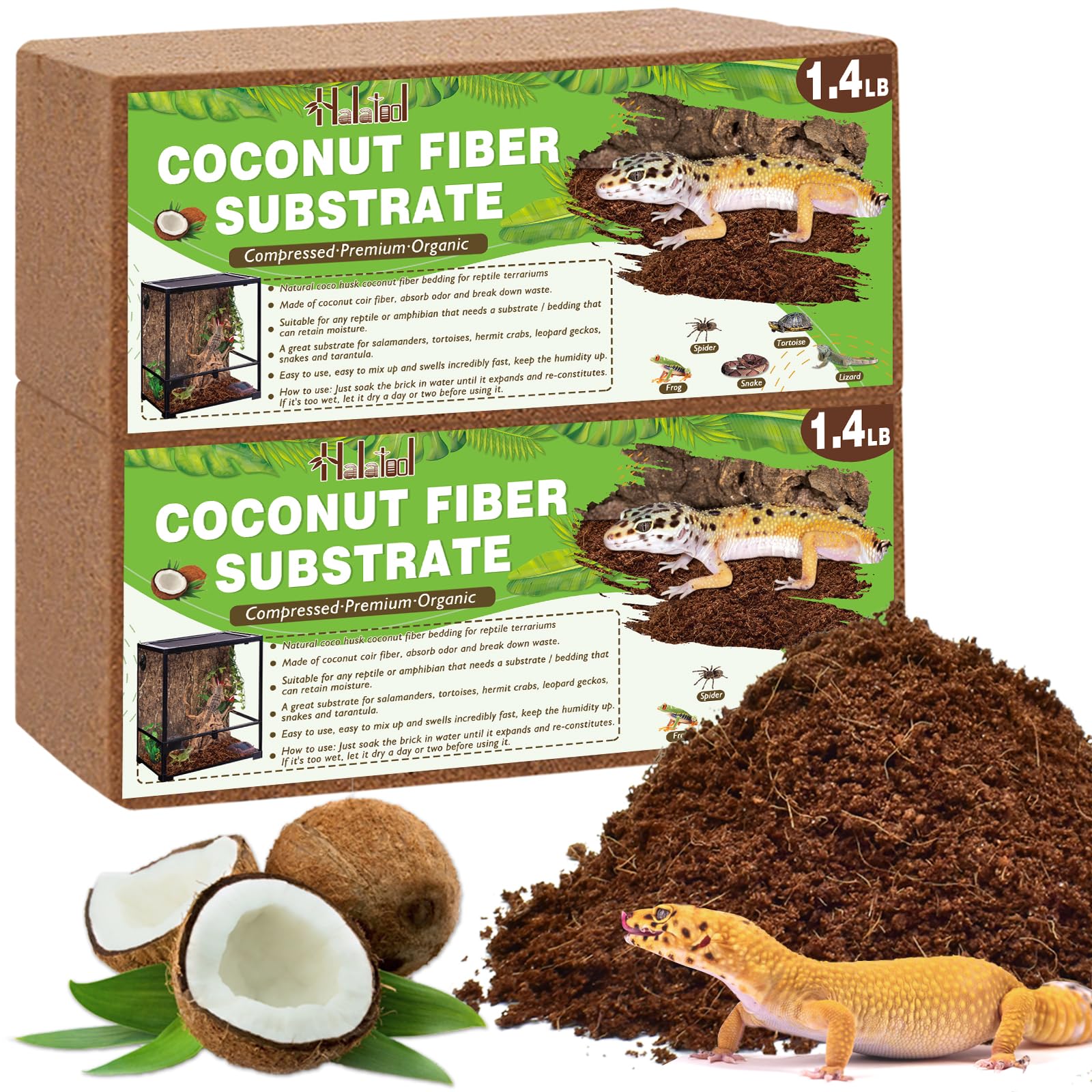
Halatool differentiates itself by engineering its fiber blend for a specific humidity window of 60–80% — exactly the band that most box turtle species need for proper shell growth and respiratory health. The two bricks produce roughly 18–20 quarts when fully expanded, making this a solid match for a 36-inch-long enclosure. Owners of Gulf Coast and Three-Toed box turtles, which require higher ambient moisture, reported that this substrate cut their misting frequency by nearly a third compared to standard coco coir.
The fibrous matrix is noticeably airy. Rather than packing into a muddy sludge when wet, the substrate retains a loose, crumbly structure that allows the turtle to dig without the tunnel sides caving in. The advanced odor control claim holds up: the fibers encapsulate urate solids quickly, and the aeration prevents the anaerobic breakdown that causes sour smells. Several reviewers specifically mentioned switching to Halatool after battling mold issues with cheaper substrates.
The main limitation is the expansion ratio — a few buyers found that the bricks did not triple in size as advertised, instead reaching about double the original volume. This means the actual usable bedding may fall short for keepers aiming for a deep 6-inch layer in a large enclosure. Additionally, the loose fibers can be messy during the initial hydration phase if not rinsed in a bag or bucket.
Why we love it
- Engineered for 60–80% humidity — ideal for box turtles
- Airy structure prevents anaerobic odor and mold
- Reduces misting frequency by up to 30%
Good to know
- Expansion slightly less than advertised
- Messy to hydrate without a dedicated bucket
5. Riare 2 Pack Natural Coconut Chip Substrate

Riare’s entry-level two-pack delivers 60 liters of total expanded volume (roughly 30 liters per brick) from compact bricks measuring just 8.2×4.1×2.2 inches each. For a keeper setting up a 20-gallon long quarantine tank or a hatchling box, this provides exactly the right amount without massive leftover storage. The chips are chunky rather than powdery, which reduces the dust cloud that often accompanies first hydration of fine coco fiber.
Moisture management is the strong suit here. The chips absorb water quickly and release it slowly, maintaining consistent humidity in the 65–75% range for 48 hours without re-misting. The chunky texture also makes spot-cleaning straightforward — waste pellets sit on top of the chips rather than sinking into a paste. A significant number of owners use this product as a top dressing over a deeper soil layer, effectively creating a dual-texture substrate that mimics the leaf-litter zone of a forest floor.
Because the chips are larger and less processed than fine coco fiber, they do not pack as densely. This means the substrate can shift when the turtle burrows, potentially leaving gaps in coverage. A few reviewers also noted that the bricks can leave dry, hard centers if not soaked in hot water for the full recommended time. For bioactive setups, the large chip size may slow the breakdown of waste by isopods and springtails.
Why we love it
- Compact bricks store easily and expand to 60 liters
- Chunky texture minimizes dust and simplifies spot-cleaning
- Consistent 48-hour humidity retention
Good to know
- Large chips can shift during burrowing
- Brittle dry centers possible without hot-water soak
FAQ
Can I use potting soil or garden soil as box turtle bedding?
How often should I fully replace coconut bedding for a box turtle?
Is coconut husk bedding safe for juvenile box turtles that eat everything?
Final Thoughts: The Verdict
For most keepers, the best box turtle bedding winner is the Riare 10LB Coconut Chip Substrate because it delivers 72 quarts of soft, crush-proof bedding from a single brick at a cost that undercuts premium bagged products. If you want immediate setup without the hydration step, grab the BabiChip 12 Quart Loose Chip. And for smaller quarantine tanks or hatchling enclosures where low volume is ideal, nothing beats the Riare 2 Pack Natural Coconut Chip.