
A dog that spends an hour nudging a treat-dispensing toy across the floor is a dog that is not redecorating your couch cushions, chewing the baseboard, or pacing the window while you are gone. Mental stimulation is the missing piece for countless restless pups, and the right puzzle can turn frantic energy into focused play. But between flimsy plastic that cracks on day two and puzzles your dog solves in under a minute, the market is full of duds that leave you and your pup frustrated.
I’m Mo Mahin — the founder and writer behind Furric. I spend my days comparing the tensile strength of natural rubber against synthetic blends, analyzing treat-dispensing flow rates, and studying how different puzzle mechanics (sequential slide, wobble-and-drop, hide-and-seek) impact engagement times across various breed sizes and prey drives.
This guide cuts through the noise, evaluating the five best contenders that actually deliver lasting enrichment and durability. I have broken down every moving part, material spec, and design flaw to bring you the definitive lineup of brain toys for dogs that keep your pup thinking, sniffing, and satisfied.
How To Choose The Best Brain Toys For Dogs
Not all brain toys challenge the same cognitive pathways. A toy that works wonders for a Border Collie may leave a Bulldog indifferent or frustrated. Focus on three pillars: the dog’s natural problem-solving style, the material’s resistance to puncture, and the toy’s ability to vary difficulty over time.
Match The Puzzle Mechanism To Your Dog’s Drive
Wobbling dispensers reward persistence — the dog must nudge or bat the toy repeatedly to release kibble. Spinning sliders require paw and nose coordination to rotate layers. Hide-and-seek plush puzzles engage prey drive through scent and tugging. Choose a mechanism that aligns with how your dog naturally interacts with toys. A persistent bat-and-chase dog thrives with a wobbler; a sniffer who loves rooting into blankets needs a hide-and-seek puzzle.
Material Durability And Toxicity Standards
Hardness is measured on the Shore A durometer scale. Soft rubber (30-40 Shore A) is gentle on teeth but yields quickly to aggressive chewers. Harder compounds (60-70 Shore A) resist punctures but can feel too stiff for small breeds. Look for materials explicitly labeled BPA-free and phthalate-free, and check whether the manufacturer tests to Proposition 65 standards if you live in California. Always confirm the material is food-safe if the toy touches treats you consume around the house.
Adjustable Difficulty Prevents Boredom Regression
The best brain toys offer a way to escalate the challenge — removable pins, adjustable treat portals, or fill-and-freeze options. A static puzzle your dog solves in two minutes on day one loses all enrichment value by day three. Seek toys with documentation explaining how to progress from beginner to expert, or toys that allow you to partially block exit holes to slow dispensing.
Quick Comparison
On smaller screens, swipe sideways to see the full table.
| Model | Category | Best For | Key Spec | Amazon |
|---|---|---|---|---|
| KONG Wobbler | Wobble Dispenser | Medium/Small active dogs needing slow feeding | 0.45 kg weight for sturdy wobble action | Amazon |
| Outward Hound Dog Tornado | Spinning Puzzle | Intermediate dogs who enjoy paw-and-nose coordination | 3 spinning layers with rotating bone compartments | Amazon |
| Outward Hound Hide-A-Squirrel | Hide-and-Seek Plush | Prey-drive dogs who love to tug and root | 12.6″ trunk holds 6 squeaky squirrels | Amazon |
| SodaPup Honey Pot | Freezable Dispenser | Dogs 30-65 lbs needing calm-down enrichment | 3.25″ diameter PUP-X synthetic rubber | Amazon |
| Forfon 9-Pack Set | Variety Puzzle Set | Small/medium dogs needing rotation variety | 3 difficulty tiers across 9 components | Amazon |
In‑Depth Reviews
1. KONG Wobbler
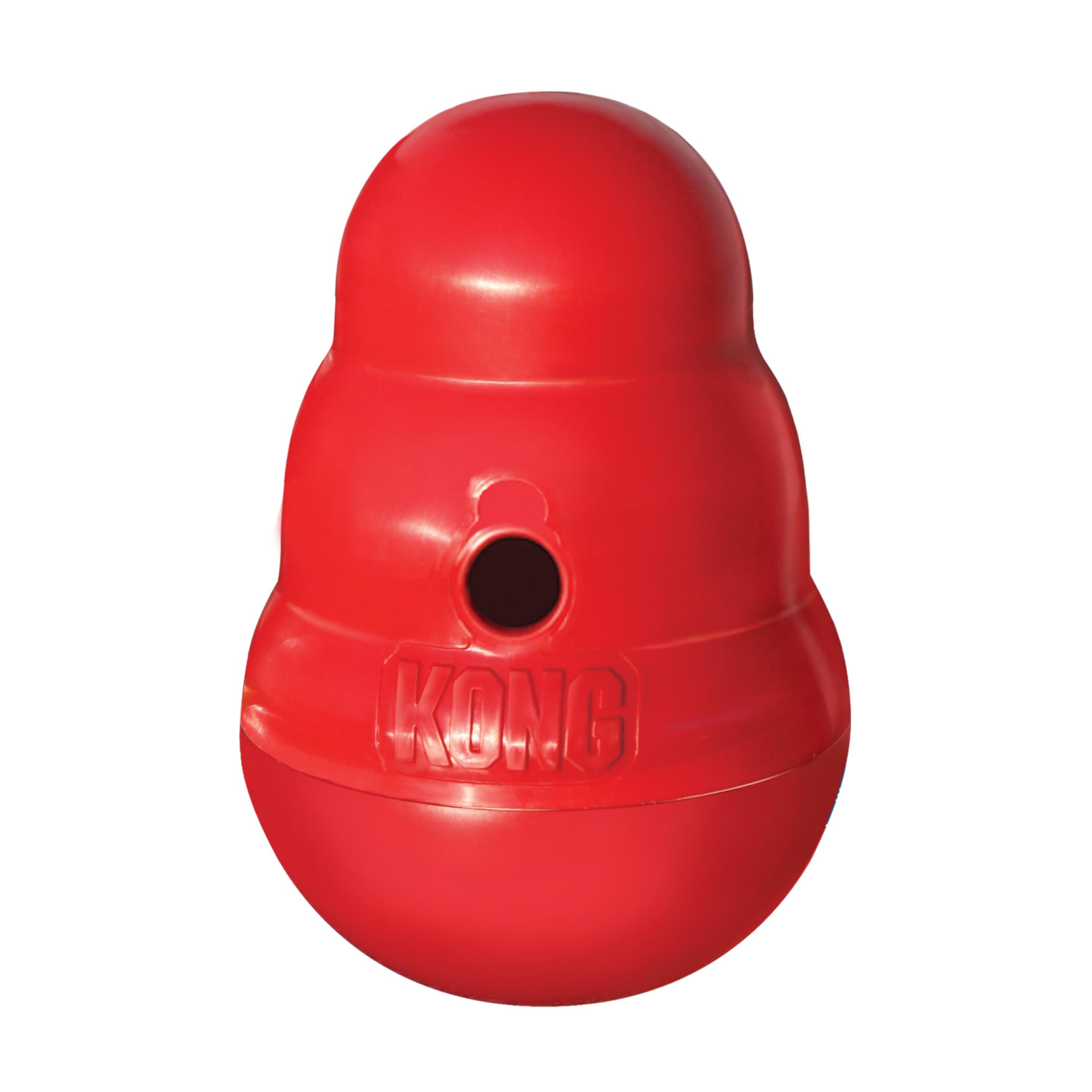
The KONG Wobbler is a half-kilogram weighted base that rocks unpredictably when your dog nudges it, dispensing kibble through a single adjustable hole. The teardrop geometry means it never stays upright for long, forcing the dog to chase, bat, and reposition continuously. This toy has been a go-to slow-feeder alternative since its introduction because the wobble itself becomes the reward mechanism — the dog works for every piece.
Designed for medium and smaller breeds, the 4.33-inch height and 9.25-inch length keep it low-profile enough for hard floors without tipping completely sideways under average paw force. The red thermoplastic shell survives moderate chewing, though the real durability comes from the thick walls around the screw-lid. Wash it on the top rack of the dishwasher after emptying any leftover crumbs.
Where the Wobbler shines is extending mealtime from thirty seconds to eight to twelve minutes for most medium dogs. That extended engagement window burns mental energy more efficiently than a bowl ever could. The main limitation is the lack of difficulty progression — you are stuck with the one exit hole, so once your dog masters the wobble rhythm, engagement time drops by half.
Why we love it
- Weighted base creates unpredictable wobble path that dogs must chase
- Dishwasher-safe construction simplifies daily cleaning
- KONG satisfaction guarantee backs the build quality
Good to know
- Single difficulty level — no way to increase challenge beyond the stock hole
- Small size limits capacity to about half a cup of kibble
2. Outward Hound Dog Tornado

The Dog Tornado works through a layered mechanism — three tiers that spin independently around a central axis, each with bone-shaped compartments the dog must rotate into alignment to release treats. It is rated Level 2 Intermediate on the Nina Ottosson scale, meaning it expects the dog to understand a cause-and-effect relationship between paw rotation and food reward. The 9.75-inch base gives enough surface area for dogs with broader paws to grip.
Each layer spins in a different direction, so the dog cannot simply repeat one motion. The middle layer holds the deepest wells, rewarding persistence rather than brute force. Outward Hound includes a tips-and-tricks card explaining how to start with all compartments unblocked and gradually add resistance by rotating layers to partial alignment. This adjustable-difficulty feature makes the Tornado one of the few mid-range puzzles that grows with the dog’s skill.
The plastic construction is lightweight at 1.2 pounds, which means determined dogs can slide the whole puzzle across a slippery floor. Place it on a grippy silicone mat or carpet to anchor it during play. Also, the small bone tokens can be a choking hazard for extra-small breeds — supervise the first few sessions to ensure your dog nudges the layers rather than trying to bite the moving parts.
Why we love it
- Three independently rotating layers prevent rote memorization of one motion
- Adjustable difficulty through partial alignment of compartments
- Holds up to half a cup of kibble or small treats
Good to know
- Lightweight base slides on hardwood — needs a grippy surface
- Small bone tokens may require supervision for toy breeds
3. Outward Hound Hide-A-Squirrel

The Hide-A-Squirrel is less of a traditional puzzle and more of a multi-sensory hunt game. The X-Large tree trunk measures 12.6 inches tall and 7 inches square, with six openings that each hold a squeaky squirrel plush. The dog must use scent, sight, and paw coordination to locate each squirrel, pull it out by the tail, and then optionally find the squeaker embedded in the belly. This toy engages the sequestering phase of the prey sequence — search, grab, and retrieve.
Each squirrel is individually stuffed with crinkle material inside the body plus a separate squeaker, providing two auditory feedback cues that reinforce the digging motion. The plush trunk material is softer than the rubber puzzles above, so it is best suited for dogs who enjoy tugging and carrying rather than destructive shredding. Outward Hound sells extra squirrel packs separately, allowing you to refresh the set when one goes missing under the sofa.
Durability is the main concession here — the trunk fabric and squirrel seams are only as strong as typical plush construction. Aggressive chewers who dissect toys will empty the stuffing from the squirrels within the first few sessions. Supervise play and remove any squirrel that shows ripped seams to prevent ingestion of squeaker parts. For non-destructive dogs, the Hide-A-Squirrel delivers the richest sensory engagement of any toy on this list.
Why we love it
- Six hidden squeaky targets create a realistic hide-and-seek experience
- Replaceable squirrel packs extend the toy’s lifespan
- Crinkle material and dual squeakers provide layered audio feedback
Good to know
- Plush construction is not suitable for heavy shredding dogs
- Squirrel seams can rip under aggressive tugging — supervise play
4. SodaPup Honey Pot
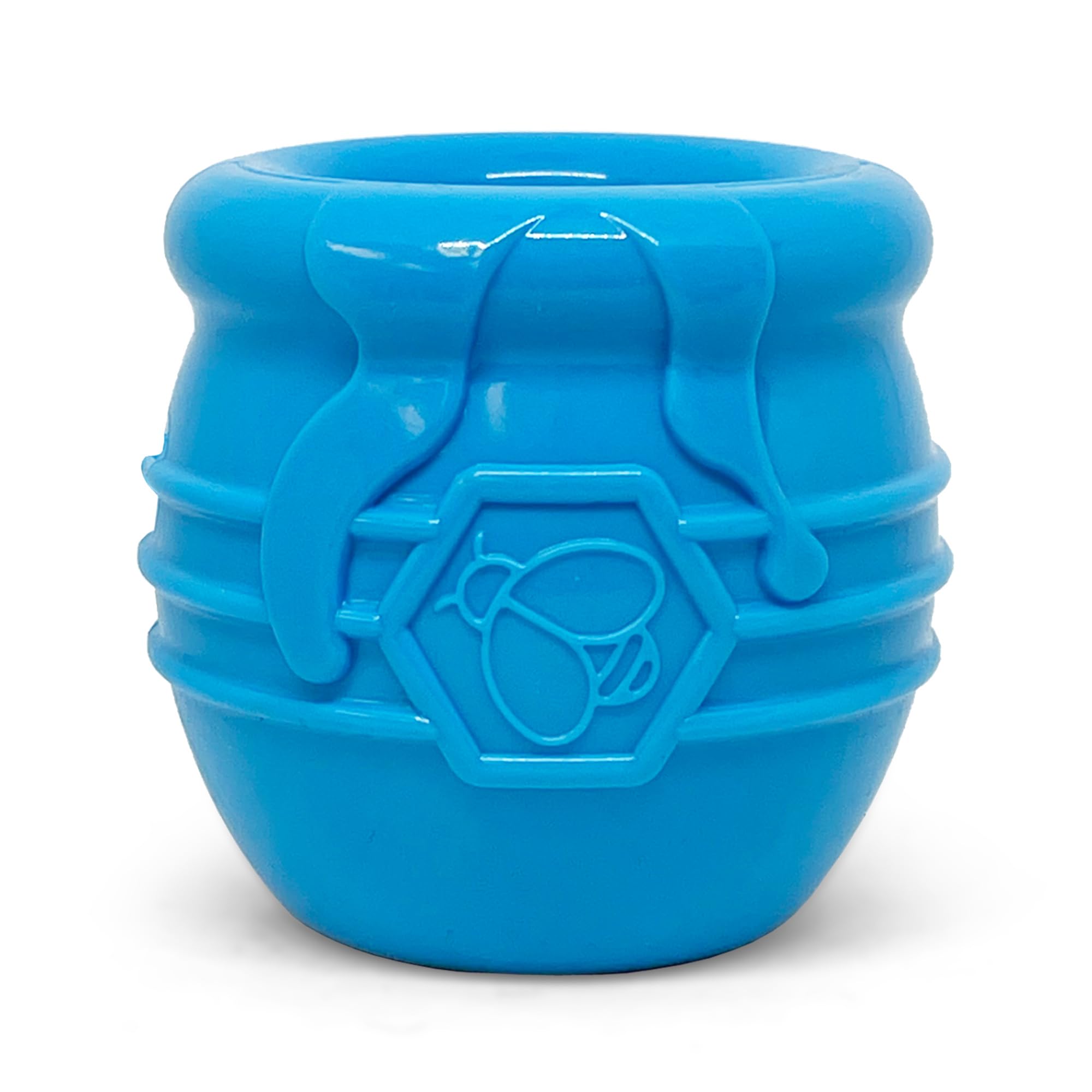
The Honey Pot is a compact 3.25-inch rubber cylinder designed specifically for dogs in the 30 to 65 pound range. The PUP-X synthetic rubber compound floats in water and has a durometer hardness comparable to natural rubber, meaning it withstands regular chewing without splitting. The design is simple — fill the inner cavity with peanut butter, yogurt, or wet food, then freeze it to create a long-duration lick challenge that soothes anxious dogs.
SodaPup manufactures this toy in the USA and tests to Proposition 65 standards for heavy metals and phthalates. The rubber is opaque with a matte texture that resists tooth puncture better than transparent silicone dispensers. The wide opening makes filling straightforward with a spatula, and the top-rack dishwasher safety means you can sterilize it between uses without hand-washing crevices. The honey-pot shape has a flat base that stays upright during freezing, preventing leaks in your freezer.
The Honey Pot is not a toss-and-chase toy — it is a stationary licking challenge. That makes it ideal for crate-training, post-walk cooldown, or pre-vet-visit calming. The main drawback is the single cavity size; you cannot adjust the dispensing rate because the dog must lick through the entire frozen block. For dogs under 30 pounds, the 3.25-inch diameter may be too large for comfortable mouth positioning.
Why we love it
- PUP-X synthetic rubber resists splitting and floats for water play
- Freezable filling extends engagement time to 20-30 minutes
- Proposition 65 tested and top-rack dishwasher safe
Good to know
- Recommended weight range 30-65 lbs limits use for smaller or extra-large breeds
- No adjustable dispensing rate — duration depends entirely on frozen contents
5. Forfon 9-Pack All-Around Dog Puzzle Toy Set
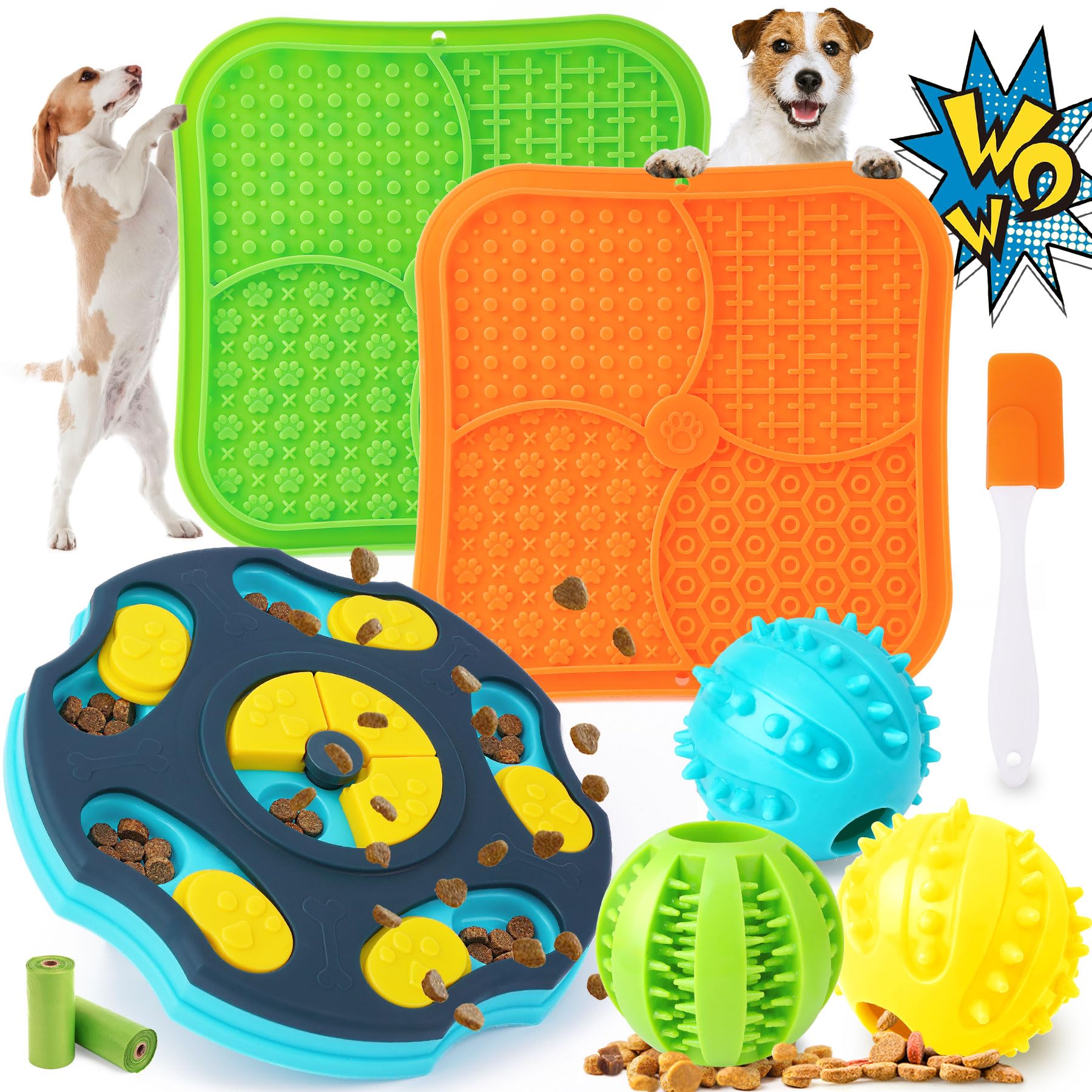
The Forfon 9-Pack is a complete mixed-kit that bundles two lick mats with suction cups, one puzzle slider, three treat balls, a silicone spatula, a brush, and two waste bags. This is not a single puzzle but a rotating library designed to prevent habituation — you can swap between a lick mat for calm feeding, treat balls for active chase, and the slider puzzle for paw coordination. The variety keeps novelty fresh without requiring multiple separate purchases.
The puzzle slider uses a sliding-tile mechanism where the dog shifts rubber covers to reveal treat wells underneath, rated as an intermediate challenge similar to the Outward Hound Tornado but with a flat-profile design that stays put on floors. The lick mats measure roughly 8 inches by 6 inches and feature raised suction cups on the back that grip tile and hardwood effectively. The treat balls are hollow with small dispensing holes, rolling unpredictably to encourage chasing.
Construction uses a mix of natural rubber and silicone, both labeled food-safe. The two bags included for outdoor cleanup are a practical bonus, though they are thin single-use sacks rather than heavy-duty pet waste bags. The set is best for small to medium dogs — the treat balls have smaller holes that larger kibble may not fall through, and the lick mats are sized for shorter tongues. For owners who want to test multiple enrichment styles before committing to a premium single puzzle, this set offers the most variety per purchase.
Why we love it
- Nine-piece rotating set prevents your dog from memorizing a single puzzle
- Lick mat suction cups grip smooth floors firmly during use
- Food-safe natural rubber and silicone construction
Good to know
- Treat ball dispensing holes sized for smaller kibble — large treats may jam
- Included waste bags are thin; consider replacing with heavier bags
FAQ
How long should my dog spend on a single brain toy session?
Can brain toys replace physical exercise for my dog?
How do I transition my dog from a bowl to a puzzle feeder?
What treats work best in slider and spinning-layer puzzles?
Final Thoughts: The Verdict
For most dog owners, the brain toys for dogs winner is the KONG Wobbler because its weighted wobble mechanism is the most reliable way to extend mealtime into a mentally engaging chase without needing treat prep or frozen components. If you want a complex rotational puzzle that grows with your dog’s problem-solving skills, grab the Outward Hound Dog Tornado. And for a dog that lives to dig, tug, and retrieve, nothing beats the multi-sensory hunt of the Outward Hound Hide-A-Squirrel.