
A cage for a mouse isn’t just a box — it’s a fortress. Mice are escape artists that can squeeze through gaps smaller than a pinky nail, chew through thin plastics overnight, and climb vertical surfaces that seem impossible. The wrong cage means a lost pet, a shredded baseboard, or a stressful 2 AM hunt behind the fridge.
I’m Mo Mahin — the founder and writer behind Furric. I’ve spent years analyzing small-pet housing specifications, comparing bar spacing measurements down to the millimeter, studying customer owner feedback on escape rates, and evaluating how different materials hold up against rodent gnawing behavior.
Whether you are housing a pair of fancy girls, a solo male, or a small colony, this guide breaks down the best structural options. My goal is to help you find the ideal cages for mice that balance security with easy daily maintenance.
How To Choose The Best Cages For Mice
Mice are not hamsters, and they are not rats. Their unique body shape (able to compress their ribcage) and their tireless chewing drive demand specific housing criteria. Overlooking bar spacing, material, or base depth is the most common reason a cage fails.
Bar Spacing: The Hard Limit
For adult mice, horizontal bar spacing must not exceed 0.4 inches (roughly 10 mm). Any wider and a determined mouse can squeeze through. For juvenile mice or smaller females, 0.3 inches (7.5 mm) is safer. Always measure the gap — visual estimates are unreliable. A cage with 0.5-inch spacing is a jailbreak waiting to happen.
Base Depth and Material
Mice are enthusiastic burrowers. A base depth of at least 4-6 inches allows for thick, diggable bedding that supports natural behavior. Shallow bases lead to bedding spills and stressed animals. Avoid all-plastic bases on cages marketed as “starter kits” — mice will gnaw through corners in weeks. Glass or thick acrylic bases are much safer long-term investments.
Ventilation vs. Drafts
Wire toppers or mesh tops provide essential airflow and reduce ammonia buildup from urine. However, fully wire-sided cages in a drafty room can chill mice. A hybrid cage — solid lower walls with a wire or mesh upper section — is the ideal balance. Acrylic or glass walls are fine indoors as long as the top provides adequate ventilation.
Multi-Level Design
Mice are agile climbers, but they are also prone to falls. Solid platforms with short ladder ramps are safer than wide-open wire levels. A fall from a 20-inch height onto a hard plastic shelf can injure a mouse. Choose a cage with platforms spaced no more than 8-10 inches apart, or fill gaps with hammocks and netting.
Quick Comparison
On smaller screens, swipe sideways to see the full table.
| Model | Category | Best For | Key Spec | Amazon |
|---|---|---|---|---|
| Homey Pet 3-Tier | Multi-Level | Colony housing & climbing enrichment | 0.7 in bar spacing; 38 in height | Amazon |
| Mcage 2-Tier Acrylic | Acrylic | Burrow observation & easy cleaning | 19 x 12 x 11 in acrylic base | Amazon |
| PIDINUK Foldable Acrylic | Tall Acrylic | Deep bedding for burrowing mice | 27.5 x 17 x 16 in; foldable | Amazon |
| Mcage 4-Tier Double Unit | Wrought Iron | Large colony vertical space | 0.5 in bar spacing; 53.5 in tall | Amazon |
| OIIBO 3-Tier Glass | Glass Hybrid | Chew-proof long-term housing | 0.4 in bar spacing; 10 in glass base | Amazon |
| Kaytee CritterTrail | Starter Kit | Single mouse or temporary housing | 0.29 in bar spacing; 16 x 10.5 in | Amazon |
| Penn-Plax S.A.M. | Travel Cage | Temporary or travel enclosure | 25 x 17 x 14.5 in wire body | Amazon |
In‑Depth Reviews
1. Homey Pet 3-Level Multi-Tier Cage

This three-tier design hits the sweet spot for small colonies of mice who love to climb. The 25 x 17 inch footprint provides ample floor space, while the 38-inch height with solid platforms and non-slip stairs reduces fall risk compared to wide-open wire levels. The 0.7-inch bar spacing is safe for adult mice but requires checking that no juvenile is small enough to squeeze through.
The pull-out bottom tray and included urine guard make cleaning a breeze — you can scrape out waste without dismantling the entire structure. Owners of rats and ferrets confirm the cage’s durability, with the ABS plastic and metal frame holding up well over months of use. The lockable casters allow you to roll the cage out for deep floor cleaning, a feature most fixed-bottom cages lack entirely.
Assembly is the main friction point — the instruction sheet is vague, and the plastic clips can feel brittle. Several owners relied on listing photos to finish the build. Once assembled, the cage is sturdy and secure, but you should expect to spend 30-45 minutes on setup. For a colony of 3-4 female mice, this cage offers the best vertical real estate per dollar in the mid-range space.
Why we love it
- Deep removable tray simplifies weekly cleaning
- Lockable casters for easy relocation
- Solid platforms reduce fall injuries
Good to know
- Assembly instructions are poor; use listing photos as reference
- 0.7-inch bar spacing may not be secure for very young mice
2. Mcage 2-Tier Acrylic Deluxe Palace

The fully transparent acrylic walls give you a 360-degree view of burrows, tunneling, and nesting behavior that opaque cages hide. The 19 x 12 x 11 inch dimensions are compact but work well for a pair of female mice or a single male. The deep base allows for several inches of bedding, satisfying the natural digging drive without spills over the edge.
Setup requires no tools — the top snaps into the bottom base with clips. Owners report that acrylic can be brittle; some units arrived with hairline cracks or a missing clip. The included accessories (wheel, water bottle, bowl, hide house) are sized for dwarf hamsters, so the wheel is too small for active adult mice and may need replacement. The tubing expansion outlet lets you connect additional modules later.
Cleaning is straightforward since the top lifts off completely, giving you full access to the base. The 9.5 mm gap on the wire top panel is secure for most mice, but a determined chewer might gnaw at the acrylic corners over time. This is a strong choice if visual observation is your top priority and you keep the population small.
Why we love it
- Clear walls allow burrow watching from any angle
- Tool-free assembly in under 5 minutes
- Deep acrylic base prevents bedding escapes
Good to know
- Acrylic can crack during shipping or if dropped
- Included wheel is too small for adult mice
3. PIDINUK Extra Tall Foldable Acrylic Cage
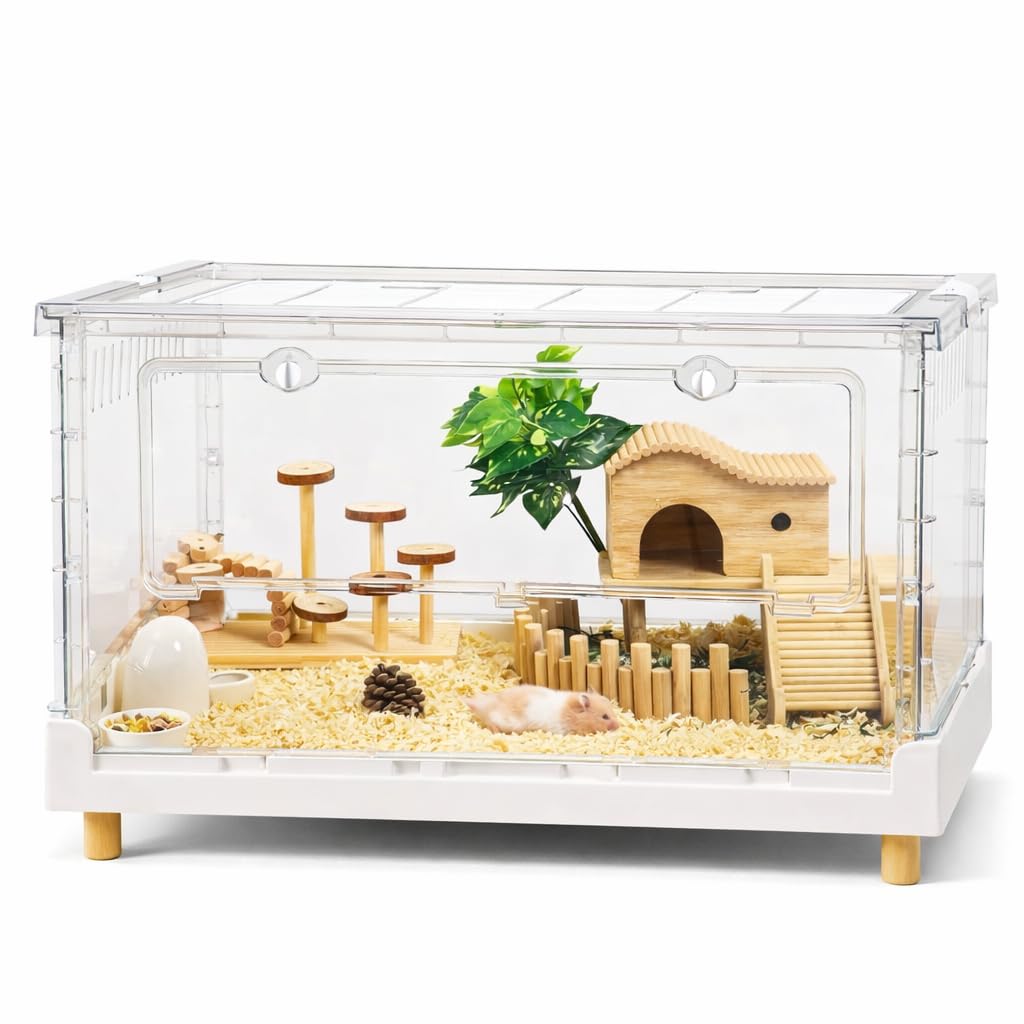
At 27.5 x 17 inches of floor space and 16 inches of height, this cage offers a generous footprint that fits on standard shelving or desktops. The extra vertical space is specifically designed to accommodate thick layers of bedding — you can add 6-8 inches of aspen or paper substrate, allowing mice to dig deep tunnel networks that a shallow tray simply cannot support.
The foldable structure is a rare feature in this category. When not in use, the cage collapses flat for storage, making it ideal for backup housing, travel, or apartment dwellers with limited space. The front door provides easy access for feeding and spot-cleaning, and the wire mesh top ensures adequate airflow without creating a draft at bedding level.
The main complaint involves the top wire spacing. Several owners note the bars are approximately 0.5 inches apart — wide enough that a determined juvenile or very small mouse could potentially squeeze through. Reinforcing the top with finer mesh or hardware cloth is recommended if housing young mice. Assembly requires patience with the snap-fit corners, which may not align perfectly on every unit.
Why we love it
- Collapsible design for easy off-season storage
- Tall structure allows deep burrowing substrate
- Front door simplifies daily interaction
Good to know
- Top bar spacing may need reinforcement for small mice
- Snap-fit assembly can be finicky
4. Mcage 4-Tier Double Unit Cage

This towering 53.5-inch cage is essentially a vertical mansion for a large mouse colony. The 24 x 17.5 inch footprint combines with four levels, two solid platforms, and anti-slip ramps to create a complex environment that keeps mice active and entertained. The 0.5-inch horizontal wire spacing is the critical spec here — tight enough for adult mice but not for tiny weanlings.
The double front doors (15 x 18 inches) and top hook door give you multiple access points, making it easy to reach every level for cleaning or handling. The bottom pull-out tray and removable platform grates simplify waste removal, though owners note the stock trays are not solid — many add DIY cardboard or plastic bins to prevent mess from falling between levels. The rolling casters include two locking wheels for stability.
Assembly is the steepest hurdle. The instructions are notoriously difficult to follow, and some units arrive with poorly punched holes that require deburring with a file. Once assembled, the cage is sturdy and visually impressive. Customers with rats and squirrels love the spaciousness, but the lack of solid flooring means you will need to customize to prevent waste accumulation on lower levels.
Why we love it
- Massive vertical space for active colonies
- Multiple large doors for easy access
- Rolling casters with lockable wheels
Good to know
- Assembly instructions are poor; expect trial-and-error
- Lacks solid bottom trays on platforms
5. OIIBO 3-Tier Glass Hamster Cage

If your mouse has destroyed an acrylic corner or chewed a hole through a plastic base, this glass hybrid cage is the permanent solution. The 10-inch deep glass base is completely chew-proof and waterproof, eliminating the most common escape route in rodent housing. The dimensions (20 x 12 x 20 inches) are more compact than multi-tier alternatives but offer three levels of climbing space.
The heightened wire topper features 0.4-inch bar spacing — a safe measurement for all but the tiniest juvenile mice. The PVC tray at the bottom slides out for cleaning, though the glass base is heavy (around 18 pounds empty) and requires two hands to lift. Owners of gerbils and rats report that the cage holds up well over years of use, with the glass showing no scratches or clouding.
The major drawbacks are assembly difficulty and cleaning complexity. The glass panels can arrive broken if packaging is insufficient, and the wire topper may not fit flush with the glass base, creating gaps that can trap a tail. Cleaning requires full disassembly since there is no easy side access. Top-door-only access means you will be reaching down into the cage for daily tasks, which is awkward with tall cages.
Why we love it
- Glass base is 100% gnaw-proof
- 10-inch depth supports heavy burrowing
- 0.4-inch bar spacing is secure for most mice
Good to know
- Glass is fragile during shipping and heavy to move
- Top-door-only access complicates daily cleaning
6. Kaytee CritterTrail Quick Clean Habitat

The CritterTrail is a classic entry-level cage that works well for a single mouse or as a temporary quarantine unit. The 16 x 10.5 x 10.5 inch size is small, but the 0.29-inch bar spacing (7.4 mm) is exceptionally secure — no mouse, no matter how young, can squeeze through. The included side-mount water bottle, exercise wheel, and food dish mean you can get started immediately without extra purchases.
The standout feature is the expandability. The cage connects to other CritterTrail habitats via Fun-nel tube accessories, letting you build a modular network over time. This is ideal if you want to start small and grow the setup as your mouse’s curiosity demands. The front wire door provides decent access, but the latch is notoriously flimsy — several owners report that the plastic hook breaks after a few months, creating an escape route.
The cage is made of lightweight plastic, and the base is too shallow for thick bedding (max 1-2 inches). The wheel is also small and may not accommodate an adult mouse’s full stride. This is a perfectly functional starter cage but will feel cramped for any mouse living in it long-term. Use it as a travel cage or a component in a larger CritterTrail system.
Why we love it
- Very tight bar spacing is escape-proof for all mice
- Modular expandability via tube connections
- Comes with all basic accessories included
Good to know
- Small footprint is not suitable as a permanent home
- Front door latch is fragile and prone to breaking
7. Penn-Plax S.A.M. Small Animal Cage

The Penn-Plax S.A.M. is designed for mobility, not permanent occupation. Weighing just 8.75 pounds with ergonomic handles, this wire-and-plastic cage is easy to lift onto a car seat or carry to a different room. The 25 x 17 x 14.5 inch dimensions are spacious enough for short-term use, and the waterproof green base is easy to wipe down after a road trip.
The wire body attaches to the base with simple clips, allowing full removal for deep cleaning. The top wire door opens for feeding, but the cage lacks a front-access door — you must reach over the top to handle your mouse. The bar spacing is not listed in the specs, but visual inspection suggests gaps of approximately 0.5-0.6 inches, which is too wide for any mouse. Owners primarily use this for guinea pigs and hamsters, which are larger-bodied pets.
This cage is not recommended as a primary home for mice due to the wide wire spacing and lack of deep base. It works as a vet-visit carrier or temporary housing during cage upgrades, but a mouse could easily squeeze through the bars. The plastic base is also thin and may be chewed through over time. Buy this only if you need a lightweight, portable option for supervised short stays.
Why we love it
- Lightweight at under 9 lbs with carry handles
- Waterproof base is quick to wipe clean
- Wire body detaches completely for thorough washing
Good to know
- Bar spacing is too wide for mice — not escape-proof
- Shallow base does not support burrowing behavior
FAQ
How often should I deep clean a mouse cage?
Is a wire-bottom cage safe for mice?
Can two male mice live together safely?
What is the best bedding depth for burrowing mice?
How do I prevent ammonia smell in a mouse cage?
Final Thoughts: The Verdict
For most mouse owners, the best cages for mice winner is the Homey Pet 3-Tier because it balances vertical climbing enrichment with a deep removable tray that simplifies weekly cleaning. If you want a chew-proof solution that will last for years, grab the OIIBO Glass Cage. And for travel or temporary housing on a tight budget, nothing beats the Kaytee CritterTrail for its secure narrow bar spacing.