
A camera for a reptile enclosure has to solve three problems that a standard home security cam can’t touch: a glass or acrylic barrier that causes reflections and hotspots, close-focus capability so a lizard basking six inches away isn’t a blurry blob, and a lens that delivers usable color night vision without blasting your pet with blinding IR light that disturbs its day/night cycle. Most indoor cams are designed for rooms, not terrariums, and they fail on all three counts.
I’m Mo Mahin — the founder and writer behind Furric. My research into this category focuses on comparing the specific close-focus distances, aperture sizes, anti-glare coatings, and dual-band WiFi reliability that make a camera actually functional against glass, not just technically spec’d.
Whether you keep a bearded dragon, a ball python, a crested gecko, or a colony of dart frogs, the best camera for reptile enclosure will give you a distortion-free view of your animal’s behavior, temperature zone use, and feeding responses from anywhere.
How To Choose The Best Camera For Reptile Enclosure
Reptile enclosures create a unique set of optical and environmental challenges. Glass surfaces produce glare. Short distances require a close-focus lens. Heat and humidity inside a vivarium can fog a standard lens. The following specs separate a usable reptile cam from a frustrating one.
Close-Focus Distance and Aperture
A typical security camera has a minimum focus distance of around two feet. Inside a reptile enclosure, the animal is often six to eighteen inches from the glass. If the camera cannot focus at that distance, the image will be soft or completely blurry. Look for cameras that explicitly state a close-focus lens designed for tanks or terrariums. Aperture also matters — an F1.0 or F1.6 lens captures more light at close range, giving you a clear image without needing to crank up gain and introduce noise.
Night Vision Type — No-Glow vs IR Blast
Reptiles, especially nocturnal species like leopard geckos and many snakes, are sensitive to light cycles. A camera that uses visible red or white IR LEDs can disrupt their circadian rhythm. The best option for a reptile enclosure is a camera with no-glow 940nm infrared or full-color night vision that uses a large aperture sensor rather than IR LEDs. Some cameras labeled as having night vision lack IR LEDs entirely and instead rely on the F1.0 aperture and ambient light — this is superior for the animal but worthless in total darkness. Match the camera type to your enclosure’s lighting schedule.
Anti-Glare and Mounting
A camera placed against a glass terrarium wall will inevitably deal with reflections from room lights, the camera’s own IR ring, and the enclosure’s internal lighting. Look for cameras that specifically mention anti-glare or anti-reflection technology. A magnetic mount is the most practical option for glass enclosures — it allows you to reposition the camera without drilling or adhesive residue. Peel-and-stick mounts are a close second but can weaken over time under heat and humidity.
WiFi Band and App Reliability
Dual-band WiFi (2.4GHz and 5GHz) gives you flexibility. 2.4GHz offers better range through walls and enclosure glass, while 5GHz offers faster streaming with less interference. Some cameras are 2.4GHz only, which is generally fine for this application. The app is where most budget cameras fail — a great camera with a buggy app is frustrating. Read reviews specifically about the app experience, not just the hardware.
Quick Comparison
On smaller screens, swipe sideways to see the full table.
| Model | Category | Best For | Key Spec | Amazon |
|---|---|---|---|---|
| litokam Reptile & Aquarium Camera | Premium | Best Overall for glass enclosures | F1.0 aperture, 147° wide view | Amazon |
| HOMIQ LIFE 3MP Camera | Mid-Range | Budget-friendly close-focus clarity | 3MP close-focus lens, 25fps | Amazon |
| Noonkey 3MP Pet Camera | Mid-Range | Dual-band & starlight color night vision | Starlight color night vision, 30fps | Amazon |
| VIVOSUN GrowCam C4 | Mid-Range | Timelapse plant/growth monitoring | 2K 4MP QHD, timelapse function | Amazon |
| GardePro E8 WiFi Trail Camera | Premium | Outdoor/off-grid enclosure monitoring | 1296p video, 940nm no-glow IR | Amazon |
In‑Depth Reviews
1. litokam Reptile & Aquarium Camera
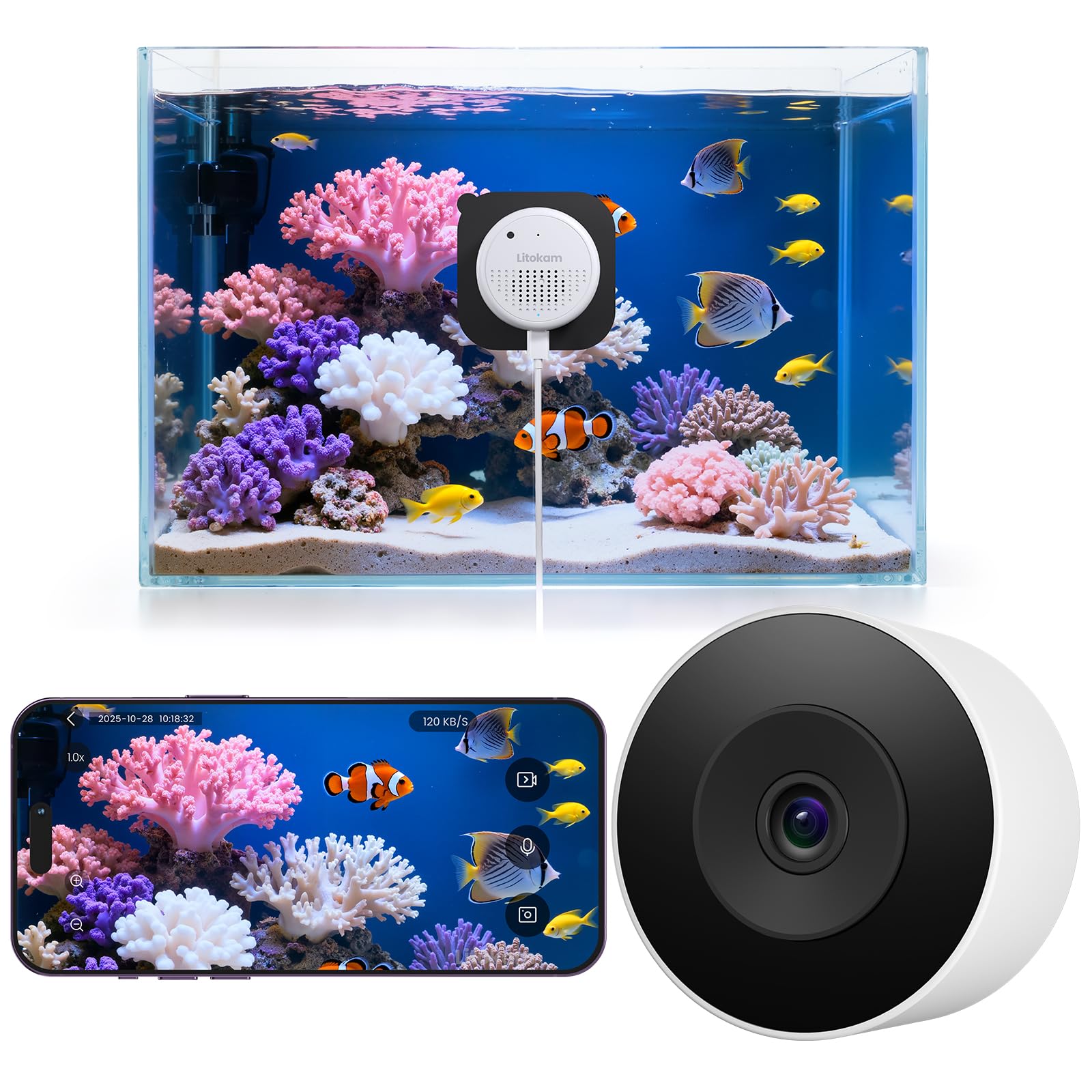
The litokam was engineered specifically for glass enclosures, and it shows in every design choice. The F1.0 super-large aperture lets in maximum light at close range, giving you full-color footage even in low-light vivarium conditions without needing a disruptive IR glow that can disturb a reptile’s day/night rhythm. It is explicitly designed to be placed against the glass, not mounted two feet away.
Its 147° ultra-wide-angle lens covers nearly the full width of a standard 40-gallon breeder tank, and the 3X digital zoom lets you inspect a crested gecko’s eye or a snake’s scale condition without physically opening the enclosure. The anti-glare tech is real — it minimizes the hot spots and reflections that plague standard cams against glass. Dual-band WiFi (2.4GHz and 5GHz) ensures a stable stream, and it works with Alexa and Google Assistant.
A few owners noted that night vision is better described as “low-light” vision — in pitch-black darkness with zero ambient light, the image becomes unusable because there are no IR LEDs. This is actually a feature, not a bug, for nocturnal species sensitive to light. If your enclosure has any ambient light from a space heater, moonlight, or a night bulb, you’ll get excellent detail. The magnetic mount is strong and makes repositioning effortless.
Why we love it
- F1.0 aperture delivers rich color detail in low light without IR disruption to pets
- Anti-glare and anti-reflection coating eliminates hotspots on glass terrariums
- Magnetic mount allows instant repositioning without tools or adhesive residue
Good to know
- Requires some ambient light for night vision; unusable in total pitch-black darkness
- Cloud storage requires a paid subscription beyond the free tier
2. HOMIQ LIFE 3MP Camera
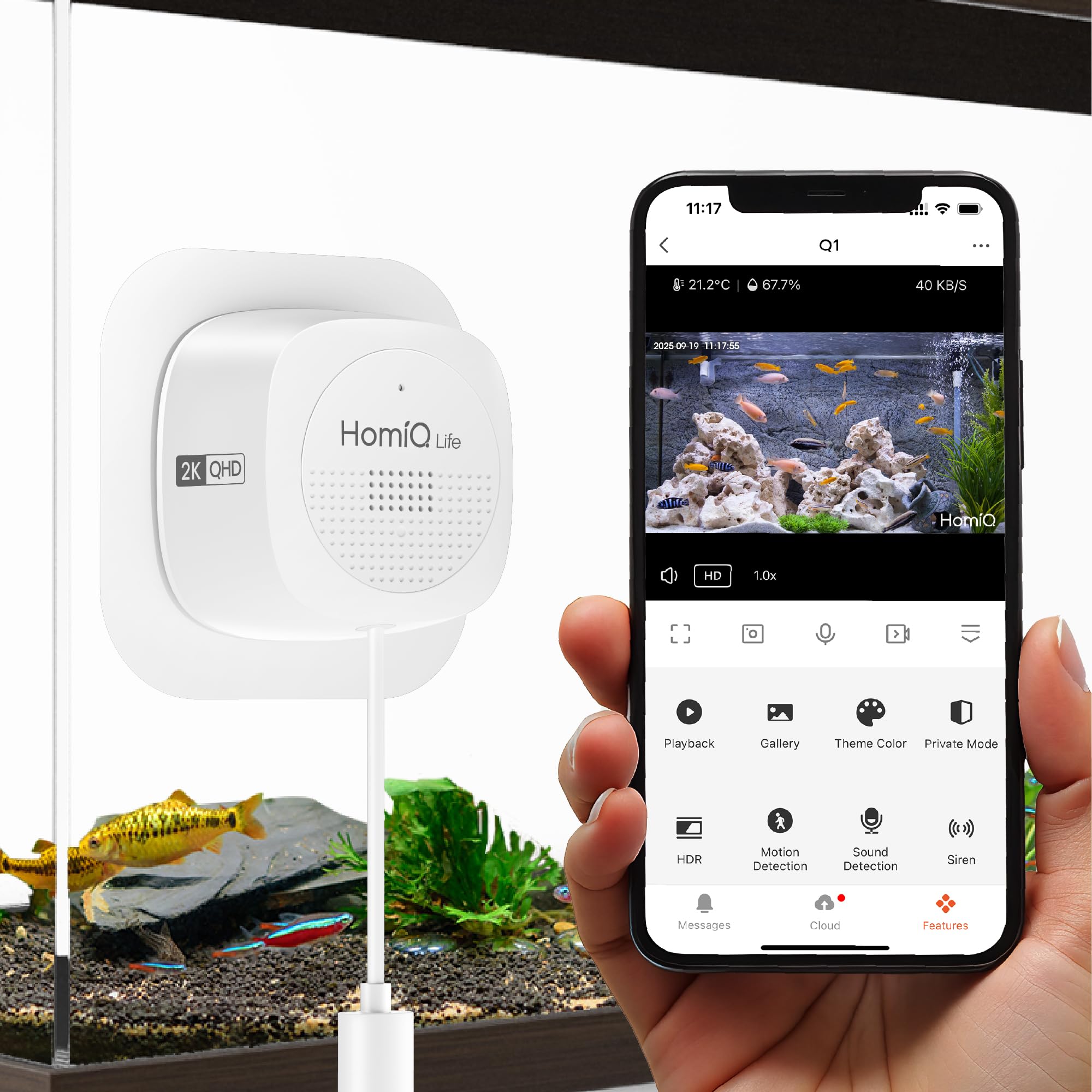
The HOMIQ LIFE 3MP camera punches well above its price tier for a very specific reason: it uses a true 3MP close-focus lens that locks onto subjects at terrarium distance. At roughly six to twelve inches from the glass, a bearded dragon’s scales or a snake’s pattern is razor-sharp, while most sub- cameras produce a soft, smeared image at that range. The peel-and-stick mount and Bluetooth pairing mean zero tools and zero frustration during setup.
The 3MP sensor captures enough detail to read thermostat displays through the glass or spot a mite infestation early. The magnetic mount is a secondary option, but the adhesive mount holds securely on clean glass. It supports up to 256GB microSD for 24/7 recording, plus cloud storage. Owners report that the motion detection is responsive enough to catch feeding events and that the two-way audio is clear enough to call your reptile (though they won’t respond).
The critical weak point is the night vision. Several buyers note that the camera has no IR LEDs, meaning it is essentially a daytime-only camera once the enclosure lights go off. If you have a nocturnal species or want to monitor nighttime basking behavior, this is not the camera for that. It also generates a small amount of heat during prolonged use, so avoid placing it directly against a glass surface in a hot enclosure where condensation could form.
Why we love it
- True close-focus lens delivers sharp detail at 6-12 inches from the glass
- Tool-free peel-and-stick installation and Bluetooth pairing
- 3MP resolution allows zooming in on scale condition and enclosure details
Good to know
- Night vision is absent — useless for nocturnal monitoring after lights out
- Camera body gets warm during extended use; avoid condensation-prone glass placement
3. Noonkey 3MP Pet Camera
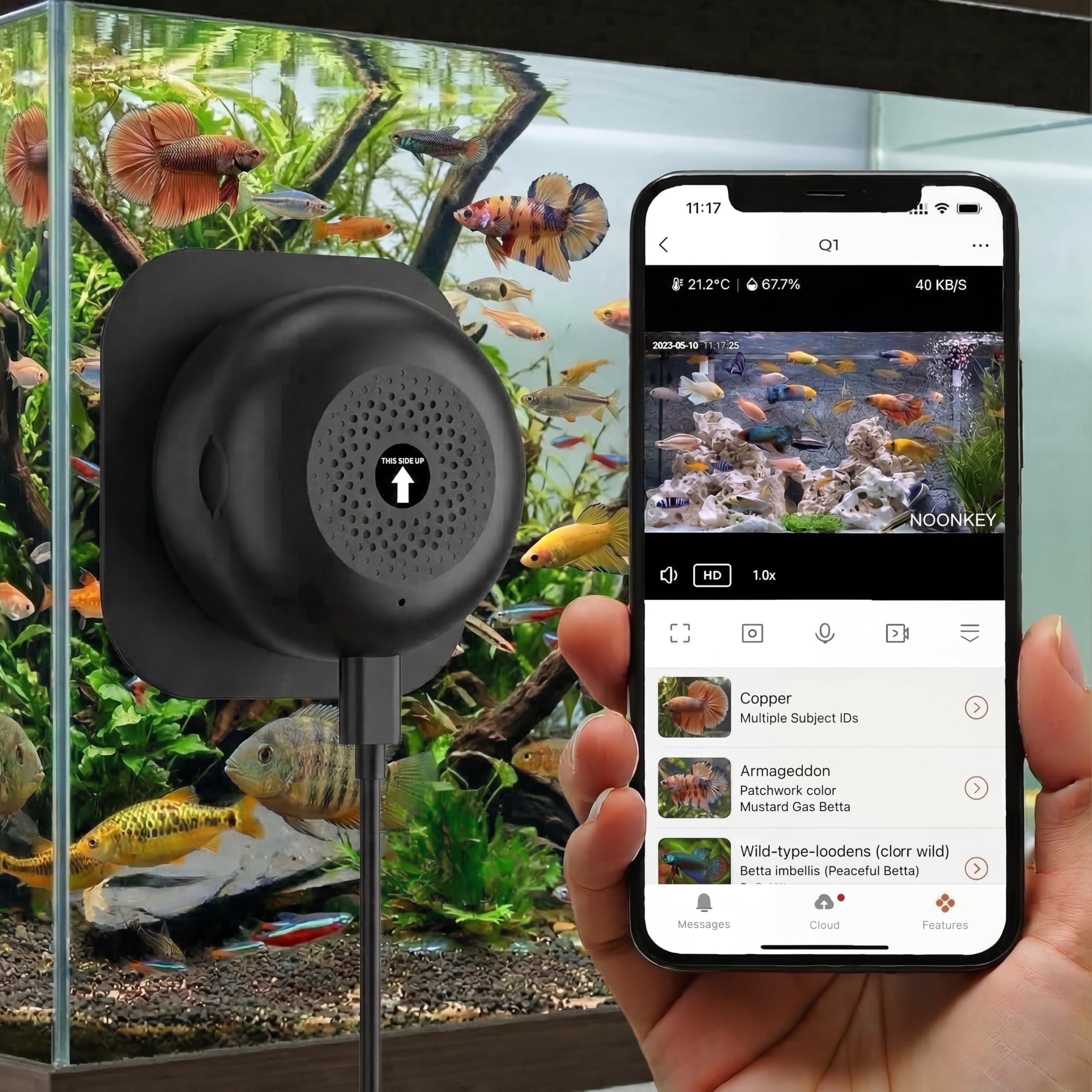
The Noonkey camera brings starlight color night vision into the mid-range price bracket — a feature typically reserved for cameras that cost nearly twice as much. Instead of using bright infrared LEDs that can bother nocturnal reptiles, the starlight sensor amplifies available ambient light to produce full-color video even in very low-light conditions. For a ball python enclosure with a ceramic heat emitter that emits a faint orange glow, this camera will deliver watchable color footage all night long.
The 3MP 2K sensor produces crisp daytime detail, and the dual-band WiFi (2.4GHz and 5GHz) gives you flexibility depending on your home network. The window-mounted design with adhesive stickers is simple, though the angle is fixed — there is no pan or tilt capability. The 30fps frame rate is noticeably smoother than the 25fps on some competitors, which makes a difference when monitoring fast-moving arboreal lizards like green anoles.
The biggest gap is that a small minority of units have inconsistent WiFi connectivity on the 5GHz band after firmware updates. If you hit this issue, switching to 2.4GHz typically solves it. Also, the field of view is narrower than the 147° offered by the litokam — you’ll cover a 20-gallon long tank adequately, but a 4-foot enclosure will have corner blind spots. The app stability is solid on both iOS and Android according to owner reports.
Why we love it
- Starlight color night vision works without disruptive IR LEDs
- 30fps frame rate provides smooth video for active species
- Dual-band WiFi (2.4GHz and 5GHz) offers connection flexibility
Good to know
- Fixed angle with no pan/tilt limits coverage in larger enclosures
- Occasional 5GHz band connectivity issues that require switching to 2.4GHz
4. VIVOSUN GrowCam C4

The VIVOSUN GrowCam C4 is built for a slightly different primary use case — monitoring plant growth — but its close-focus 2K 4MP QHD lens, magnetic mount, and pole clamp compatibility make it a surprisingly good option for a bioactive reptile enclosure where you want to track changes in your clean-up crew population, plant growth, or shed cycles over days and weeks. The timelapse function is the standout feature here: set it to capture a frame every minute and watch a month of enclosure activity compressed into a 60-second video.
The camera clips onto the metal frame of a grow tent or the rim of an enclosure using the included clamp mount, keeping it secure and hands-free. Day/night mode provides 24/7 recording to a microSD card (up to 512GB). The 2K resolution is sharp enough to count isopods in a bioactive substrate. The VIVOSUN app is well-designed and integrates with other Vivosun grow equipment if you use their controllers or timers.
There are real limitations for reptile-specific use. The camera records in a proprietary H264 format that is only viewable through the app — you cannot plug the SD card into a PC and watch the files directly. The SD card is also partitioned by the firmware: one-third is reserved for timelapse footage and two-thirds for continuous recording, and you cannot change this ratio. Some users experienced WiFi disconnects in grow tents with reflective Mylar walls, though this is less of a problem with standard glass terrariums. If you want to offload media for editing, you must download through the app as MP4.
Why we love it
- Timelapse function is unmatched for tracking enclosure changes over weeks
- Pole clamp and magnetic mounts offer versatile installation on rims and frames
- 2K 4MP resolution captures fine detail in bioactive substrate and small critters
Good to know
- Proprietary video format; media cannot be read directly from the SD card
- SD card partition is fixed at 1/3 timelapse and 2/3 continuous recording
- WiFi can disconnect in enclosures with reflective interior surfaces
5. GardePro E8 WiFi Trail Camera
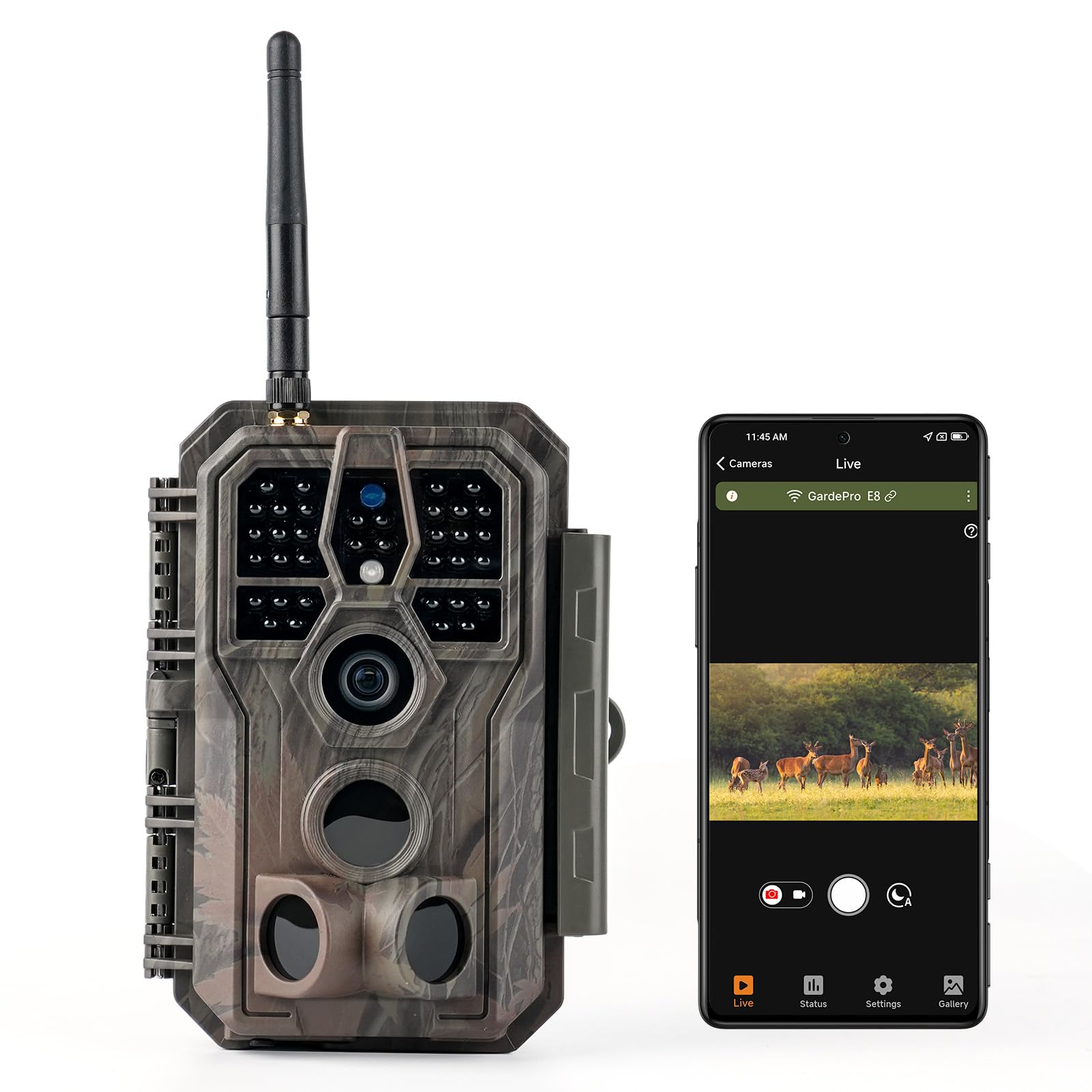
The GardePro E8 is not a typical reptile enclosure camera — it is a trail camera with direct-to-phone WiFi and 940nm no-glow infrared, making it the best choice if your reptile lives in an outdoor enclosure, a greenhouse, or a location where you cannot run power or a home WiFi network. The 940nm no-glow IR is completely invisible to both human and reptile eyes, so it will not disturb even the most light-sensitive snake or gecko. It captures 1296p video with synchronized audio and a 0.1-second trigger speed.
The camera is powered by 8x AA batteries (not included), and it supports the GardePro SP350 solar panel for continuous off-grid power. The WiFi is direct-to-phone — it does not connect to your home router, which means the range is limited to about 45 feet in open air. This works perfectly for a large outdoor custom enclosure or a greenhouse where you walk within range to check footage. The 120° PIR detection angle and 5-shot burst mode ensure you capture fast-moving reptiles like monitors or water dragons.
This camera is overkill and slightly impractical for a standard indoor glass terrarium. The focus distance is optimized for wildlife at 5-50 feet, not for a close-up of a lizard six inches away. The lack of home WiFi connectivity means you cannot check the feed from work — you have to be physically within 45 feet. Some units develop an audible beep during nighttime photo capture, which is distracting if the camera is mounted near a quiet enclosure. Battery life is also a consideration: 8x AAs will drain faster with frequent WiFi downloads.
Why we love it
- 940nm no-glow IR is completely invisible to reptiles — zero circadian disruption
- 0.1-second trigger speed captures fast-moving species in outdoor enclosures
- Solar panel support enables continuous off-grid operation
Good to know
- Optimized for mid-range focus (5-50 ft), not close-up terrarium views
- Direct-phone WiFi only — no remote viewing from outside the 45 ft range
- Some units emit a beep during nighttime photo capture
FAQ
Will a standard security camera work on my glass terrarium?
Can I use a camera with IR LEDs on a nocturnal reptile?
What microSD card speed do I need for 2K recording?
How do I prevent the camera from overheating near a basking lamp?
Final Thoughts: The Verdict
For most reptile keepers, the best camera for reptile enclosure is the litokam Reptile & Aquarium Camera because its F1.0 aperture, anti-glare glass coating, and wide 147° field of view solve the three critical problems of terrarium monitoring without disturbing your animal. If you need starlight color night vision on a tighter budget, the Noonkey 3MP Pet Camera delivers excellent low-light performance with dual-band WiFi. And for keepers with outdoor enclosures or off-grid setups, the GardePro E8 Trail Camera with no-glow 940nm IR is the right choice.