
A canister vacuum that triggers your allergies is a cleaning tool that works against you. Every sweep across a carpet or hardwood floor should trap dust mites, pet dander, and pollen inside the machine, not blast them back into the breathing zone. The right sealed filtration system makes the difference between air that feels fresh and a room that leaves you congested.
I’m Mo Mahin — the founder and writer behind Furric. I’ve spent years analyzing sealed HEPA and ULPA filtration specs, bagged versus bagless containment designs, and real owner feedback on how well different canister vacuums retain microscopic irritants.
After comparing dozens of models on suction power, filter efficiency, and sealed-system integrity, I’ve narrowed the field to the nine best options that genuinely help you breathe easier. This guide covers the key specs and real-world trade-offs every buyer needs to know when choosing the right canister vacuum for allergies.
How To Choose The Best Canister Vacuum For Allergies
Not every vacuum labeled “HEPA” actually traps allergens effectively. The difference lies in whether the entire airflow path is sealed, whether the filter media meets a certified standard, and whether the bag or bin seals particles away during disposal. Here is what to check before you buy.
Sealed Filtration vs. Open Exhaust
A canister vacuum with a HEPA filter that sits in an unsealed body will still leak microscopic particles out through the motor casing. Look for models that advertise a sealed system or “S-Class” filtration, meaning every joint, gasket, and seam is airtight. The filter grade matters — true HEPA catches 99.97% of particles at 0.3 microns, while ULPA filters like the U15 grade capture 99.999% of particles down to 0.12 microns.
Bagged vs. Bagless Containment
Bagged vacuums compress dust inside a disposable bag that you throw away without touching the contents. Bagless models require you to empty a plastic bin, which typically sends a burst of fine dust back into the air. For severe allergy sufferers, bagged is generally the safer choice, especially when the bag includes a self-sealing collar that traps material during removal.
Motor Wattage and Suction Control
A higher wattage motor does not guarantee better allergen pickup if the airflow path is restricted. Look for adjustable suction that lets you tune the power for different surfaces. On delicate drapes or area rugs, lower suction prevents the vacuum from pulling up embedded dander that then bypasses the filter. On carpets, higher suction lifts deeply lodged particles.
Floor Tool and Brush Design
The floor head itself can scatter dust if it lacks a proper seal around the bristles. For allergy use, choose a vacuum that includes a dedicated hard-floor tool with a soft brush that does not scratch, and a turbo or electric brush for low-pile carpets. The brush roll should be easy to access for cleaning hair wraps that otherwise block airflow and reduce filtration efficiency.
Quick Comparison
On smaller screens, swipe sideways to see the full table.
| Model | Category | Best For | Key Spec | Amazon |
|---|---|---|---|---|
| SEBO Airbelt K3 | Premium Bagged | Deep carpet & pet hair allergy relief | S-Class filtration 99.97% at 0.3µm | Amazon |
| Miele Complete C3 Calima | Premium Bagged | Long-term allergy control & quiet operation | HEPA Lifetime Filter 99.999% | Amazon |
| Soniclean WhisperJet C2 | Premium Bagged | Ultra-quiet cleaning with lab-grade filtration | U15 ULPA 99.999% at 0.12µm | Amazon |
| Miele Blizzard CX1 PureSuction | Mid-Range Bagless | Hardwood floors with low waste | Hygiene Lifetime Filter 99.98% | Amazon |
| Prolux Tritan | Mid-Range Bagged | Pet dander on mixed floor types | Sealed HEPA + 140 CFM airflow | Amazon |
| Kenmore 81214 200 Series | Mid-Range Bagged | Budget-friendly allergy-friendly canister | Enhanced HEPA 99.97% capture | Amazon |
| EyeVac Air 2-in-1 | Specialty Combo | Touchless dustpan + air purification | True HEPA H-13 + carbon filter | Amazon |
| Eureka NEN186BL | Entry-Level Bagless | Lightweight bagless for hard floors | 3-stage sealed HEPA 99.9% at 0.3µm | Amazon |
| Simplicity Jill | Entry-Level Bagged | Compact bagged for small spaces | 1200W motor + certified HEPA filter | Amazon |
In‑Depth Reviews
1. SEBO Airbelt K3

The SEBO Airbelt K3 is a German-engineered bagged canister that pairs a 1250-watt motor with S-Class filtration, capturing more than 99.97% of airborne particles as small as 0.3 microns. The included ET-1 electric powerhead is designed specifically for deep carpet cleaning and pet hair removal, while the parquet brush handles hardwood floors without scratches. The 37-foot operating radius with a 25-foot cord and 7-foot crush-proof hose means you clean large rooms without switching outlets.
Owners consistently praise the quiet operation and the dual-control handle that lets you adjust suction or turn off the brush roller without bending down. The tool-free removable brush roller is a standout for allergy sufferers — you can clean hair wraps off the bristles in seconds without reaching for scissors. The 0.8-gallon Aerapure bag uses a self-sealing collar that traps dust during disposal, which prevents the burst of irritants you get with bagless bins.
Multiple long-term reviews compare the K3 directly to Miele models and report that the SEBO offers a longer warranty, cheaper replacement bags, and a more durable hose construction. The 7-year motor warranty and 5-year parts warranty reflect the build quality. A few users note that the wand friction fit can slip loose occasionally, but that is a minor inconvenience against the filtration performance and build longevity.
Why we love it
- Tool-free brush roller removal for easy hair cleanout
- Quiet 1250W motor with fingertip suction control on handle
- Longest warranty in this comparison (7-year motor)
Good to know
- Floor attachment fell off holder for some users
- Wand friction fit can occasionally slip during use
2. Miele Complete C3 Calima

The Miele Complete C3 Calima represents the top end of sealed bagged canister design for allergy control. Its HEPA Lifetime Filter retains up to 99.999% of fine dust and allergens, and the entire airflow path is sealed so no particle escapes through the motor exhaust. The included TurboBrush floorhead works on low- to medium-pile carpet, while the Parquet Twister floorhead handles smooth flooring with a soft brush that does not scatter dust.
Reviews highlight the vacuum’s lightweight feel at around 16 pounds, the smooth casters that glide across floors, and the foot switches that let you control suction power without bending over. The bag capacity is 4.5 liters, which means fewer bag changes compared to compact models. The one-touch cord rewind is fast — some owners actually consider it too fast because it snaps back aggressively, so you need to guide the plug.
Several long-term owners report that the C3 Calima lasts well over a decade with proper maintenance. One user stated their previous Miele ran for 18 years before needing repair and bought the same model again. The downside for carpet-heavy homes is that the Calima does not come with a power brush, only a turbo brush that relies on airflow to spin. Thick carpets will need the separate electric powerhead, which adds to the investment.
Why we love it
- HEPA Lifetime Filter captures 99.999% of allergens
- Lightweight 16-pound body with smooth gliding casters
- Proven durability — many units last 15+ years
Good to know
- No electric powerhead for thick carpet
- Replacement bags and filters are expensive
3. Soniclean WhisperJet C2

The Soniclean WhisperJet C2 brings medical-lab-grade U15 ULPA filtration to residential use, capturing 99.999% of particles down to 0.12 microns — that is nearly three times smaller than what a standard HEPA filter traps. Designed in Germany, the vacuum uses a venturi-effect airflow design that delivers strong suction while keeping noise levels remarkably low. Owners consistently describe it as the quietest canister they have ever owned.
The digital motor control dial lets you dial in exact suction levels for different tasks, from cleaning sheer curtains to deep-cleaning low-pile carpets. The 37-foot cleaning radius with an automatic cord rewind gives you solid range. The included Technik floor tool works well on both hard floors and low-pile carpet, though some owners note that the floor tool bracket on the wand can break under repeated pressure.
The three-stage filtration system uses a dust bag, a motor filter, and an exhaust ULPA filter. The bags are small and proprietary, and some chemically sensitive users have reported a scent from the replacement bags that bothered them. The build quality and ultra-quiet operation, however, earn strong marks from owners who need a low-noise vacuum that still traps fine particles at the best residential-grade level available.
Why we love it
- U15 ULPA captures particles down to 0.12 microns
- Exceptionally quiet operation for allergy-sensitive homes
- German-engineered venturi airflow for efficient suction
Good to know
- Replacement bags are small and proprietary
- Scented bags may bother chemically sensitive users
4. Miele Blizzard CX1 PureSuction

The Miele Blizzard CX1 PureSuction breaks from the brand’s bagged tradition by using Vortex technology to separate coarse debris and fine dust into a transparent canister. The maintenance-free Hygiene Lifetime Filter retains 99.98% of fine particles, making it a solid option for allergy sufferers who prefer bagless convenience. The 1200-watt PowerLine motor provides strong adjustable suction across hard floors and low-pile carpets.
The vacuum comes with two floorheads: the AllTeQ universal floorhead with wide thread lifters for hair removal, and the Parquet Twister floorhead for delicate hard floors. The 32-foot operating radius with height-adjustable Comfort telescopic wand gives reasonable reach. Owners who live in homes with mostly hardwood or tile flooring report excellent performance, noting that the suction is strong enough to pull dust from grout lines.
Some owners point out that the canister is harder to maneuver than upright models due to the shape, and the dusting brush attachment does not stay firmly on the handle. The bagless bin does produce a brief dust cloud when emptying, which is worth considering if your allergy triggers are severe. Overall, the CX1 is a strong bagless option for those who want Miele reliability without buying bags.
Why we love it
- Bagless Vortex separation reduces waste and ongoing costs
- Maintenance-free Hygiene Lifetime Filter captures 99.98%
- Two dedicated floorheads for hardwood and carpet
Good to know
- Canister shape is less maneuverable than upright models
- Emptying the bin releases some dust back into the air
5. Prolux Tritan Bagged Canister

The Prolux Tritan delivers 140 CFM of airflow — higher than many traditional canisters — through a sealed HEPA filtration system designed for pet dander and household allergens. The 5-speed motor lets you adjust suction from a low setting that will not suck up small rugs to a high setting that pulls embedded hair and dust from carpets. The floor tool works on both hardwood and low-pile carpet, and the turbo carpet nozzle adds rotating brush agitation.
Owners consistently mention the lightweight feel and how easily the unit rolls across floors. The bag and filter system is straightforward to access and replace. Several users report that this vacuum outperformed similar Bissell and Kenmore models they previously owned, especially on pet hair pickup. The 13-inch cleaning path covers decent ground per pass.
A few negative reviews point to quality control issues: one owner found rust inside the metal wand after two months, and another reported the HEPA filter cover latch failing. The 1-year factory warranty covers defects, but the inconsistency in build tolerances is worth noting. For the price point, the Tritan offers strong suction and sealed HEPA filtration that competes with models costing significantly more.
Why we love it
- 140 CFM airflow outperforms many standard canisters
- 5-speed motor gives control for delicate surfaces
- Lightweight and easy to maneuver across mixed floors
Good to know
- Some reported rust on metal wand after a few months
- HEPA filter cover latch can be faulty on some units
6. Kenmore 81214 200 Series

The Kenmore 81214 200 Series uses a 2-motor system — one for suction and one for the power brush — paired with an enhanced HEPA filter that traps 99.97% of dander and dust allergens. The four height adjustments on the powerhead let you optimize airflow for different carpet pile heights and hard floors. The bagged design keeps allergens sealed inside the disposable bag during disposal.
Owners transitioning from upright vacuums report that this canister picks up dust bags worth of material that their previous machines left behind. The 24-foot retractable cord and 9-foot attachment reach give decent coverage. The lightweight design at under 20 pounds makes it manageable for carrying up stairs, and the included dusting brush, crevice tool, and bare floor tool cover most cleaning scenarios.
Several long-term reviews note that the power brush indicator light only activates red when the brush overloads, which is normal behavior but can be confusing. The on/off switch is located on the canister body rather than the handle, which some owners find inconvenient. A small number of units arrived with defective powerheads and required replacement. The strong suction and effective HEPA filtration, however, make this a reliable mid-range choice for allergy management.
Why we love it
- 2-motor system provides strong, consistent suction
- 4 height adjustments optimize airflow for different carpets
- Enhanced HEPA filter traps 99.97% of allergens
Good to know
- On/off switch is on the canister, not the handle
- Some units shipped with defective powerheads
7. EyeVac Air 2-in-1

The EyeVac Air 2-in-1 combines a touchless automatic vacuum dustpan with a standalone HEPA air purifier that covers 600 square feet. The infrared sensors activate the 1000-watt vacuum automatically when you sweep debris near the unit, so you never bend down to use a dustpan. The true HEPA H-13 filter captures 99.7% of airborne particles as small as 0.3 microns, and the activated carbon filter traps odors.
Owners with shedding dogs and cats report that the automatic vacuum is a game-changer for daily maintenance — just sweep hair and crumbs toward the unit and it disappears. The air purifier runs quietly on its own cycle (4-hour, 8-hour, or continuous), reducing airborne allergens between vacuuming sessions. The unit fits into a room without looking like an appliance.
The main limitation is that the bottom door does not seal completely airtight, which can reduce suction for very fine debris like craft glitter or fine sawdust. The vacuum function is loud while active. The EyeVac Air is not a replacement for a full canister vacuum that deep-cleans carpets and reaches under furniture, but it works well as a complement for quick daily debris pickup combined with continuous air purification.
Why we love it
- Combines touchless vacuum dustpan with air purifier in one unit
- True HEPA H-13 and activated carbon dual filtration
- Auto sensor activation eliminates bending to sweep
Good to know
- Bottom door does not seal completely airtight
- Vacuum function is loud during operation
8. Eureka NEN186BL

The Eureka NEN186BL provides 16kPa of suction power from a 1000-watt motor in a lightweight bagless canister that weighs under 17 pounds. The 3-stage sealed filtration system captures 99.9% of dust particles as small as 0.3 microns, making it a viable option for allergy households on a tighter budget. The 2-liter dustbin is easy to empty, and the washable HEPA filter eliminates replacement filter costs.
Owners transitioning from upright vacuums appreciate the lightweight design and how easy it is to carry between rooms. The stepless suction control knob lets you dial down power for delicate curtains or crank it up for deep carpet cleaning. The retractable 17-foot cord and included pet brush, crevice tool, and dusting brush cover most basic cleaning needs. Several pet owners report that it picks up dog and cat hair effectively on both carpets and hard floors.
The build quality reflects the budget price point — some owners report loss of suction after a few weeks if the filter is not maintained meticulously, and the connection wand can fail. Customer service experiences have been mixed. The bagless bin does release some dust during emptying, which is a consideration for severe allergy triggers. For the price, the NEN186BL offers respectable performance and sealed HEPA filtration.
Why we love it
- 16kPa suction at a very accessible price point
- Washable HEPA filter reduces long-term costs
- Stepless suction control for different surfaces
Good to know
- Bagless bin releases some dust during emptying
- Connection wand can fail under regular use
9. Simplicity Jill
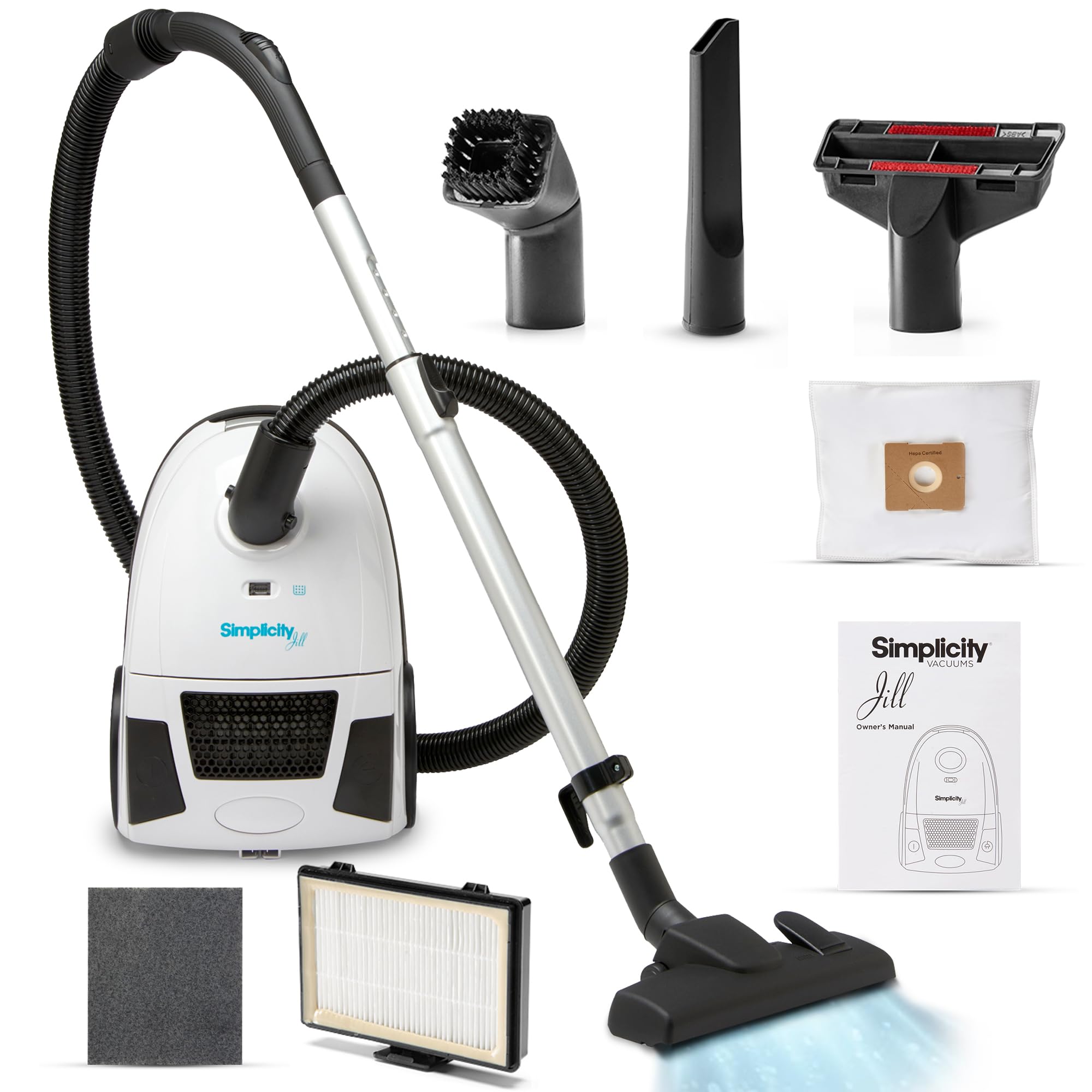
The Simplicity Jill is one of the lightest bagged canister vacuums available at just 9 pounds, making it easy to carry up stairs and store in small spaces. The certified HEPA filter provides solid allergen capture for a compact unit, and the 1200-watt motor delivers reliable suction for bare floors, corners, and hard-to-reach areas. The adjustable suction lets you reduce power for delicate surfaces like curtains and upholstery.
Owners in apartments and small homes praise the compact size and how well the Jill maneuvers around furniture. The bagged design keeps allergens sealed during disposal, and the 2.7-liter bag capacity is reasonable for a unit this small. The included crevice tool, upholstery tool, and dusting brush give you the basics for above-floor cleaning and detail work. Several users report that the suction is noticeably stronger than other compact models they have tried.
The cord recoil mechanism is the most common failure point — several owners report it breaking within the first few months. The vacuum is also relatively noisy compared to larger canisters. The small 5.6-foot hose limits your reach, and the floor tool is not ideal for larger rooms. For a compact bagged canister that fits a small apartment and budget, the Jill delivers effective HEPA filtration but comes with durability caveats.
Why we love it
- Extremely lightweight at 9 pounds for easy portability
- Certified HEPA filter in a compact bagged design
- Adjustable suction for delicate surfaces
Good to know
- Cord recoil mechanism prone to early failure
- Short 5.6-foot hose limits reach in larger rooms
FAQ
Does HEPA label mean every model traps the same amount of allergens?
Is a bagged canister always better than a bagless one for allergy control?
How often should I replace the exhaust filter on my allergy vacuums?
Can I use a vacuum without a powered brush head on carpets for allergy relief?
What does ULPA filtration give me that HEPA does not for allergies?
Final Thoughts: The Verdict
For most households managing allergies, the best canister vacuum for allergies is the SEBO Airbelt K3 because it combines S-Class filtration with a tool-free brush roller, a 7-year warranty, and a bagged self-sealing design that keeps allergens locked away during disposal. If you need near-silent operation and the highest grade of particle capture, grab the Soniclean WhisperJet C2 with its medical-lab-grade U15 ULPA filter. And for a budget-friendly entry into bagged HEPA canisters, the Kenmore 81214 200 Series delivers strong 2-motor suction and 99.97% allergen retention at a fraction of the premium-tier price.