
Feline urinary issues — from painful crystals to full blockages — demand a diet that controls mineral balance, promotes dilute urine, and avoids ingredients that trigger struvite or calcium oxalate formation. The wrong canned food can worsen a condition that already affects one in three cats.
I’m Mo Mahin — the founder and writer behind Furric. I’ve analyzed veterinary nutrition protocols, compared phosphorus and magnesium levels across dozens of wet food lines, and studied owner-reported outcomes for urinary-specific formulations to separate marketing claims from clinically meaningful features.
Whether your cat has a history of FLUTD, struvite crystals, or chronic dehydration, this guide reviews the top shelf-stable options for maintaining a healthy urinary tract, and it’s built around the best canned cat food for urinary health.
How To Choose The Best Canned Cat Food For Urinary Health
Not every wet food labeled “urinary care” is alike. Some reduce pH, others lower magnesium, and a few restrict phosphorus for cats with early kidney involvement. Understanding three core metrics separates a helpful diet from a dangerous one.
Phosphorus and Protein Density
Low phosphorus is critical for cats with compromised kidneys or a history of calcium oxalate stones — but slashing phosphorus often means adding cheap binders like powdered cellulose. Premium urinary formulas keep phosphorus well below AAFCO minimums (under 0.5% dry matter) without sacrificing high-quality animal protein sources.
Magnesium Content and Urine pH
Magnesium levels below 0.1% dry matter help prevent struvite crystal formation, but pH matters more. Urine should stay between 6.0 and 6.5. Prescription diets typically contain urine-acidifying agents (DL-methionine) to hit that range; many over-the-counter options rely solely on low dietary magnesium, which is less reliable for cats with recurrent blockages.
Moisture and Texture Acceptance
Cats with urinary issues need high water intake — a 3-ounce can delivering 78% moisture beats any dry kibble. But texture drives compliance: some cats refuse pâté and prefer chunks in gravy, while others reject shreds. A diet your cat won’t eat has zero therapeutic value, so palatability is as important as the mineral profile.
Quick Comparison
On smaller screens, swipe sideways to see the full table.
| Model | Category | Best For | Key Spec | Amazon |
|---|---|---|---|---|
| Weruva Wx Phos Focused Chicken Variety | Low Phosphorus | CKD cats needing ultra-low phosphorus | Up to 50% less phosphorus than AAFCO minimum | Amazon |
| Royal Canin Urinary Care Thin Slices | Vet Diet | Healthy adults needing regulated mineral balance | Precisely balanced mineral profile for urine pH | Amazon |
| Blue Buffalo True Solutions Urinary | Non-RX | Proactive support for neutered males | Chicken-first recipe with no wheat thickeners | Amazon |
| Purina Pro Plan Urinary Pate Variety | Value | Budget-friendly maintenance for FLUTD cats | Reduces urinary pH with low dietary magnesium | Amazon |
| Hill’s Science Diet Urinary & Hairball | Dual Purpose | Cats with urinary issues plus hairball trouble | Natural fiber plus urinary-safe mineral levels | Amazon |
| Hill’s Prescription Diet c/d Multicare | RX Therapeutic | Active struvite dissolution and prevention | 89% recurrence reduction; dissolves struvite in 7 days | Amazon |
| Purina Pro Plan Urinary Poultry & Beef 48pk | Multi-Flavor Bulk | Multi-cat households needing variety and volume | High protein, low magnesium, three flavor options | Amazon |
In‑Depth Reviews
1. Weruva Wx Phos Focused Chicken Formulas Variety Pack
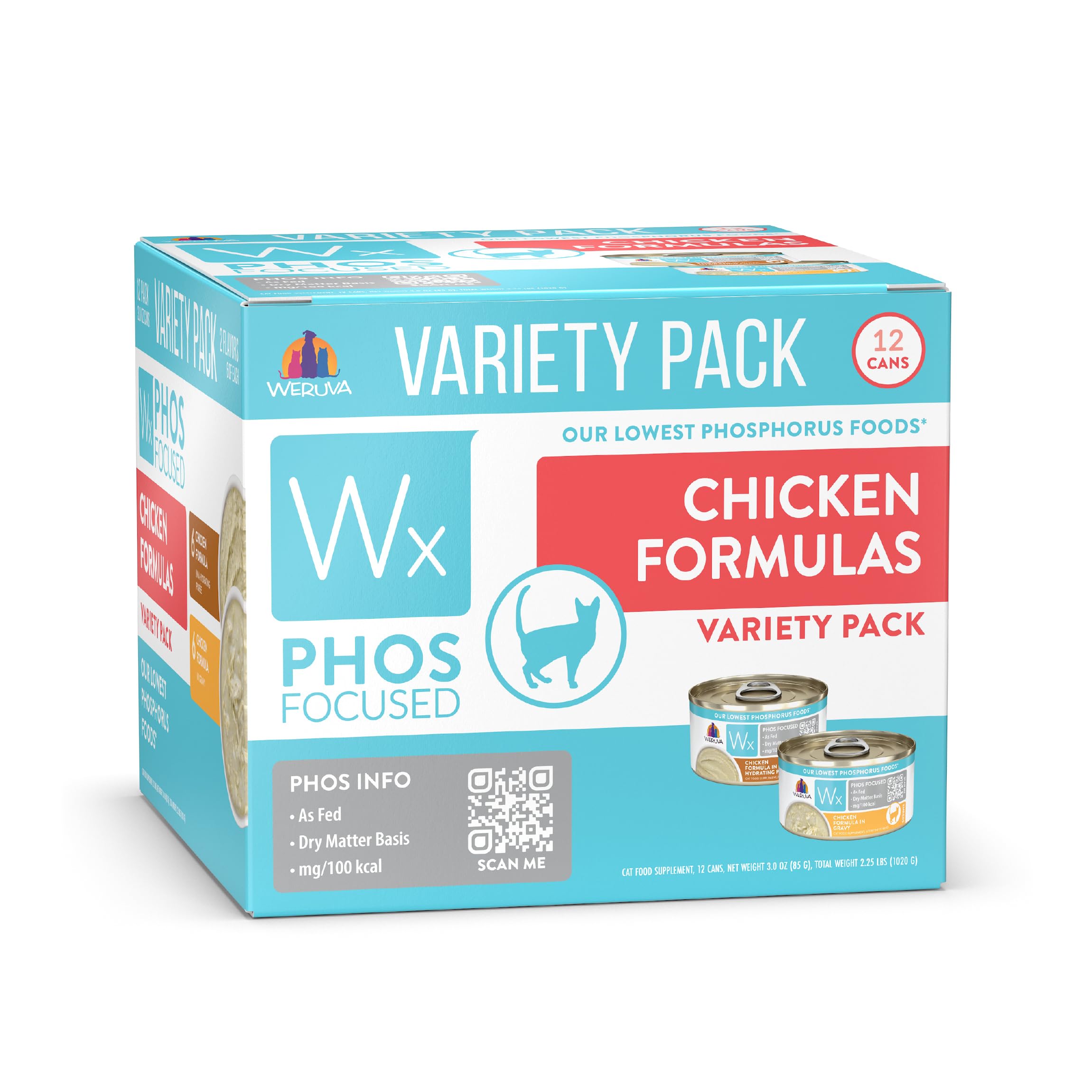
Weruva’s Wx Phos Focused line is built for cats who need aggressive phosphorus restriction without sacrificing digestible protein. Each 3-ounce can delivers up to 50 percent less phosphorus than the AAFCO minimum for adult maintenance, using high-bioavailability chicken muscle meat rather than low-quality organ meal or powdered cellulose to artificially lower the mineral percentage. That distinction is crucial for CKD cats who still need strong amino acid absorption to maintain lean body mass.
The texture variety — shredded chicken in gravy plus a smooth purée option — addresses the finickiness that often plagues cats with renal or urinary disease. Owner reports show that even 17-year-old cats who refused prescription renal diets and phosphate binders eagerly accepted these recipes, with measurable drops in kidney markers over several months. The bone-free protein formulation also reduces the risk of excessive calcium intake that could promote calcium oxalate formation.
No corn, wheat, soy, or artificial additives appear on the ingredient panel, and the gravy-based format encourages additional water intake. Some cats do reject the shredded texture and only lap the gravy, so the variety pack is a smart entry point to test acceptance before committing to a full case.
Why we love it
- Phosphorus level far below AAFCO minimum — best-in-class for CKD cats
- Bone-free, all muscle meat protein for bioavailability
- Two textures (shreds in gravy and purée) improve acceptance odds
- Free from corn, wheat, soy, and cellulose fillers
Good to know
- Small 3-oz cans may require two per meal for larger cats
- Not a therapeutic dissolution formula — best for maintenance, not active stone breakup
- Some cats reject the shredded texture and only drink the gravy
2. Hill’s Prescription Diet c/d Multicare Urinary Care Stew

When a cat has an active urinary blockage or confirmed struvite crystals, over-the-counter diets won’t cut it. Hill’s Prescription Diet c/d Multicare is the veterinary gold standard for dissolving struvite stones — clinical data shows it can break down existing stones in as little as seven days (average 27 days) while reducing the recurrence rate of common urinary signs by 89 percent. This is a therapeutic tool, not a maintenance food.
The Chicken & Vegetable Stew format delivers controlled levels of magnesium, calcium, and phosphorus while maintaining a urine pH below 6.5 through specific acidifying agents. Each 2.9-ounce can provides roughly 78 percent moisture, which supports the urinary dilution that helps flush crystal aggregates before they form stones. Owners report that even 15-year-old cats with lifelong urinary issues thrive on this formula for years without recurrence.
Prescription Diet c/d is designed for lifelong feeding under veterinary supervision, but the smaller can size means multi-cat households or larger breeds may need two cans per day. The soft pate stew texture mixes well with other foods for finicky cats, though the higher price point compared to non-RX alternatives is a real consideration for long-term use.
Why we love it
- 89 percent reduction in urinary sign recurrence — clinically tested
- Dissolves existing struvite stones in as little as 7 days
- Veterinarian-formulated urine acidification for precise pH control
- Lifelong feeding safety data for maintenance after crisis resolution
Good to know
- Requires veterinary prescription for purchase
- Higher per-ounce cost than non-RX urinary foods
- Small 2.9-oz cans may not satisfy larger or hungrier cats
3. Purina Pro Plan Urinary Tract Health Pate Variety Pack (24-Can)

Purina Pro Plan’s Urinary Tract Health pate is the most consistently cited over-the-counter option for managing FLUTD in multi-cat homes without requiring a prescription. The Ocean Whitefish & Salmon entrees deliver low dietary magnesium (well under 0.1 percent dry matter) and a reduced urinary pH target, supported by 25 essential vitamins and minerals plus taurine for cardiac and retinal health. Owners pairing this with a veterinary-prescribed dry food report excellent crystal control.
Palatability is this line’s standout strength — multiple verified reviews note that cats who rejected Science Diet and Royal Canin urinary formulations eagerly clean the bowl of Pro Plan. The pate texture holds up well in automatic feeders and mixes with additional water to boost hydration further. Each 3-ounce can is BPA-free and manufactured in Purina-owned U.S. facilities, a point of trust for owners who prioritize supply chain transparency.
The variety pack alternates Ocean Whitefish and Salmon entrees, which reduces flavor fatigue in cats that eat several cans per week. Some owners note the fish-based smell is stronger than chicken-based urinary foods, but the trade-off is a formula that encourages consistent consumption — a critical factor for maintaining dilute urine long-term.
Why we love it
- High palatability — cats routinely prefer it over competitor urinary diets
- Low magnesium content supports struvite prevention
- BPA-free cans, U.S. manufacturing, and no artificial colors or preservatives
- Flavor variety reduces mealtime boredom
Good to know
- Fish-based smell is stronger than chicken formulations
- Not suitable for calcium oxalate management without veterinary guidance
- Some cats on strict prescription diets may need the RX version instead
4. Hill’s Science Diet Adult Urinary & Hairball Control Chicken Minced

Hill’s Science Diet Adult Urinary & Hairball Control addresses two of the most common reasons cats regurgitate — hairballs and mineral-based urinary irritation — in one minced chicken recipe. The urinary component relies on controlled levels of magnesium and calcium to maintain a healthy urine pH, while a natural fiber blend (including psyllium husk) helps move ingested hair through the digestive tract before it forms obstructive balls.
This is a non-prescription maintenance formula, meaning it’s suitable for adult cats (1–6 years) without active urinary blockages but with a history of mild crystal formation or chronic hairball issues. Owners who pair it with the matching Science Diet Urinary & Hairball dry kibble report normalized litter box behavior, reduced vomiting frequency, and improved coat condition thanks to the omega-6 fatty acid and vitamin E profile. The minced texture is softer than shreds but firmer than pâté, a middle ground that appeals to cats who dislike both extremes.
While it shares the Hill’s brand trust and U.S.-sourced ingredient philosophy, it does not carry the same clinical dissolution capability as the Prescription Diet line. For cats with confirmed struvite stones or recurrent blockages, the Prescription Diet c/d Multicare is the appropriate step-up — this is a supportive maintenance diet, not a therapeutic intervention.
Why we love it
- Combines urinary pH support with hairball fiber — two issues, one can
- Non-prescription, suitable for maintenance between vet visits
- Natural fiber (psyllium) moves hair without harsh laxatives
- High-quality protein with omega-6s and vitamin E for skin and coat
Good to know
- Not effective for dissolving existing struvite or calcium oxalate stones
- Only labeled for adult cats 1–6 years, not seniors or kittens
- Some cats prefer the pâté texture over minced formats
5. Purina Pro Plan Urinary Poultry & Beef Variety Pack (48-Can)
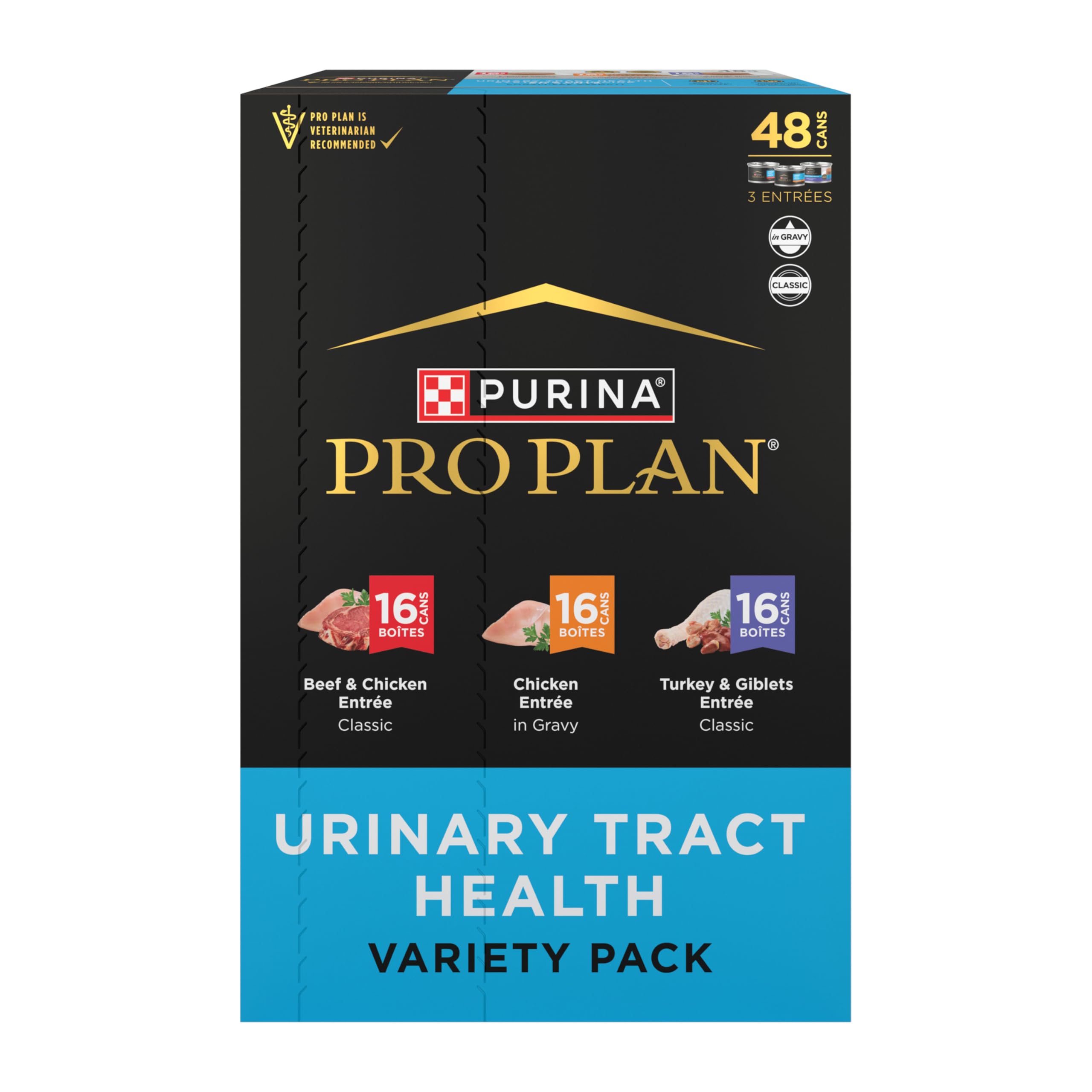
This 48-can variety pack from Purina Pro Plan is the highest-volume urinary health wet food option reviewed here, delivering chicken, beef with chicken, and turkey with giblets entrees in a single case. The formulation mirrors the standard Pro Plan Urinary line — reduced urinary pH, low dietary magnesium, and high-quality animal protein as the first ingredient — but the bulk format drives the per-can cost significantly lower than veterinary prescription diets. Owners of multiple cats or single-cat households feeding wet food exclusively will find this the most budget-sustainable option.
The protein content is notably higher than many grain-laden urinary diets, supporting muscle maintenance in active adult cats while the 78 percent moisture profile promotes the urine dilution necessary for crystal prevention. Several long-term users report zero urinary recurrence over multiple years of continuous feeding. The three-flavor rotation also solves the problem of flavor fatigue that sometimes emerges with mono-flavor 24-can cases.
It’s critical to note that this is a preventive maintenance formula rather than a treatment for active blockages. A verified reviewer cautions that cats with diagnosed crystal problems may need the prescription version from the vet — this food supports health but does not dissolve existing stones. For owners whose cats have clean urinalysis results but a history of mild sensitivity, this bulk pack is a smart, cost-effective strategy.
Why we love it
- 48-can bulk format provides the lowest per-can cost in this guide
- Three protein flavors reduce mealtime boredom and food refusal
- High protein content supports lean body mass
- Long-term owner reports show zero urinary recurrence over years
Good to know
- Not a therapeutic diet — cannot dissolve existing crystals or stones
- Storage space required for two 24-can packs
- Some cats prefer fish-based flavors over poultry/beef
6. Royal Canin Feline Care Nutrition Urinary Care Thin Slices in Gravy

Royal Canin’s Urinary Care Thin Slices in Gravy targets the healthy adult cat who needs a regulated mineral balance to prevent the first urinary crisis, rather than treating an existing one. The formulation is a veterinary diet — not requiring a prescription in most markets — that uses precisely controlled calcium, phosphorus, and magnesium levels to maintain a healthy urine concentration. The thin slices in gravy format is one of the most texture-flexible options in this category, appealing to cats who reject pâté but enjoy shred-adjacent pieces suspended in sauce.
Palatability is a consistent strong point: multiple verified reviews mention that picky cats who refuse other urinary diets eat Royal Canin readily, including cats recovering from cystitis who need calorie-dense nutrition. The gravy also allows owners to mix in extra water for added hydration without the food turning into a slurry. Owners on autoship note the packaging is stackable and easy to open, reducing daily friction for caregivers managing multiple cats.
The primary limitation is that this is a maintenance diet, not a dissolution or acute-treatment formula. It works well for the cat with no current blockage but a breed predisposition (like Persians or Himalayans) or a previous mild UTI that resolved. Pairing it with the Royal Canin Urinary Care dry food creates a consistent mineral profile across both meals, a strategy many veterinary nutritionists recommend.
Why we love it
- Exceptional palatability — picky cats routinely choose this over competitor options
- Thin slices in gravy format enables easy water mixing for extra hydration
- Precisely calibrated calcium, phosphorus, and magnesium ratios
- Compatible with Royal Canin urinary dry food for mixed feeding protocols
Good to know
- Not formulated to dissolve existing struvite or calcium oxalate stones
- Higher per-can cost compared to non-veterinary-brand alternatives
- Shipping damage risk — dented cans reported by some buyers
7. Blue Buffalo True Solutions Urinary Care Wet Cat Food Chicken
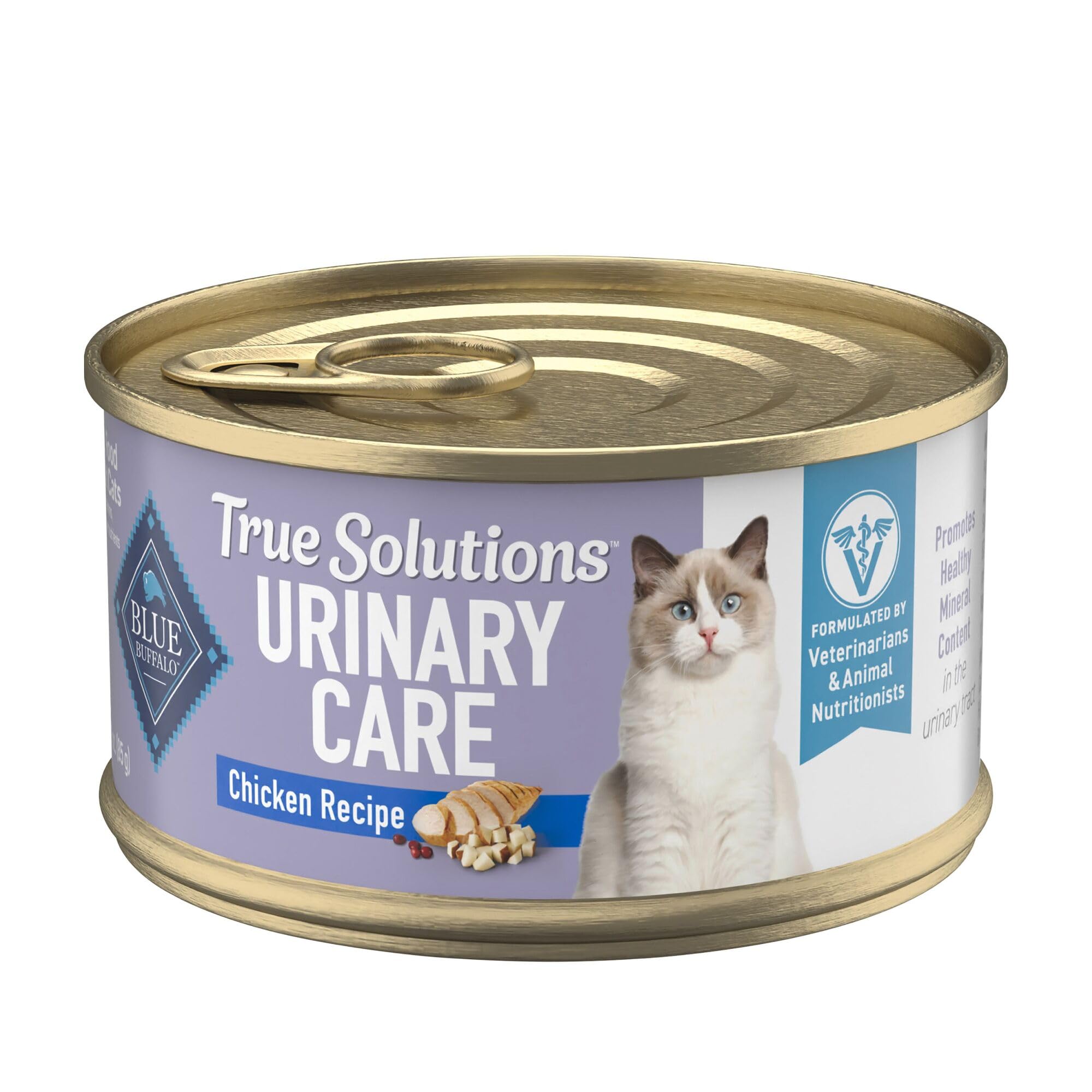
Blue Buffalo’s True Solutions Urinary Care is the only entry in this guide that combines a chicken-first ingredient deck with a guarantee against wheat-based thickeners — a meaningful distinction for cats with sensitive stomachs that react to the gluten or carb binders found in many budget urinary diets. Each 3-ounce can relies on real deboned chicken as the primary protein, with no chicken by-product meal, corn, wheat, or soy anywhere on the label. The pâté texture is soft and easy to chew, making it accessible for senior cats or those with dental discomfort.
Owner reports consistently highlight that this food resolved crystal formation in neutered males without requiring a switch to an expensive veterinary prescription diet. The formulation is designed by veterinarians and animal nutritionists, using clinically tested ingredients to promote healthy mineral content in the urinary tract. For proactive owners who want to support urinary health before a crisis develops, this represents a middle path — more controlled than generic grocery-store wet food, less restrictive than a prescription therapeutic diet.
The 24-can case provides good value per ounce compared to prescription alternatives, though some owners note the per-unit cost still feels elevated relative to standard maintenance wet foods. The pâté format is a plus for digestion but may not appeal to cats who prefer shreds or chunks in gravy. Adding warm water creates a soupy texture that some cats prefer, effectively increasing water intake while softening the food.
Why we love it
- Chicken-first recipe with no wheat thickeners, corn, or soy
- Clinically tested ingredients to support urinary tract health
- Soft pâté texture ideal for seniors or cats with dental issues
- Non-prescription but veterinarian-formulated — no RX needed
Good to know
- Not suitable for acute stone dissolution — preventive only
- Pâté-only format — no shreds or gravy options for texture-picky cats
- Some owners report the price is higher than comparable non-RX urinary foods
FAQ
What is the difference between prescription and over-the-counter urinary canned food?
How long should a cat stay on urinary health wet food?
Can I mix urinary wet food with dry food from a different brand?
Which texture is best for a cat with urinary issues — pâté, shreds, or gravy?
Is low phosphorus always better for urinary health in cats?
Final Thoughts: The Verdict
For most owners managing a cat with a history of urinary issues, the canned cat food for urinary health winner is the Weruva Wx Phos Focused Chicken Variety Pack because it delivers the lowest phosphorus profile without resorting to filler ingredients, making it equally suitable for cats with kidney involvement and those needing pure urinary tract support. If you need clinical stone dissolution after a confirmed blockage, grab the Hill’s Prescription Diet c/d Multicare Stew. And for the multi-cat household on a sustainable budget, nothing beats the per-can value and flavor rotation of the Purina Pro Plan Urinary Poultry & Beef Variety 48-Pack.