
That perfect flower bed you’ve been nurturing is now a litter box. The neighbor’s tomcat has claimed your freshly mulched garden as his personal territory, leaving behind torn plants, dug-up soil, and that unmistakable odor. Finding a solution that actually works without causing harm is the challenge every homeowner with a yard understands—welcome to the messy reality of defending your outdoor space from feline invaders.
I’m Mo Mahin — the founder and writer behind Furric. I’ve spent hundreds of hours analyzing over 1,200 customer reviews, cross-referencing technical specifications, and studying the behavioral science behind feline deterrence to separate marketing claims from real-world efficacy in this category.
After deep-diving into everything from ultrasonic frequencies to scent-based formulations, I’ve curated this guide to help you find the most effective cat deterrent for your specific situation without wasting money on gimmicks that lose their punch after one rainstorm.
How To Choose The Best Cat Deterrent
Not all cat deterrents are built the same. The key difference between a solution that works for a season and one that works for years lies in how it delivers its deterrent effect and whether the target animal can adapt to it. Here are the three most critical factors to evaluate.
Detection Technology and Coverage Range
The heart of any motion-activated deterrent is its PIR (passive infrared) sensor. A standard 110 to 120-degree detection angle with a range of 25 to 33 feet is the baseline for covering a suburban garden. Units with multiple independent sensors, like three-way configurations, offer full 360-degree coverage for larger properties or areas with multiple entry points. The height at which you install the unit—ideally 9 to 12 inches above ground—directly affects whether it catches a low-creeping cat versus a taller deer.
Frequency Adjustability and Mode Flexibility
Cats are intelligent and can habituate to a single, unchanging ultrasonic tone. The best deterrents offer adjustable frequency ranges, typically from 13.5KHz up to 61KHz, allowing you to rotate the pitch so animals never fully acclimate. Five-mode systems that let you run ultrasonic with flash, flash only, low-frequency, or night-only operation give you the flexibility to target specific problem animals without overwhelming your own outdoor experience.
Power Source and Weather Resilience
Outdoor deterrents face rain, snow, direct sun, and temperature swings. Solar-powered units with a rechargeable battery capacity above 2000mAh can run for up to 30 days on a full charge, while a Type-C USB backup port ensures the unit stays active during cloudy stretches. An IP65 waterproof rating is the minimum for year-round outdoor use—anything less risks moisture damage to the sensitive electronics inside the sensor head.
Quick Comparison
On smaller screens, swipe sideways to see the full table.
| Model | Category | Best For | Key Spec | Amazon |
|---|---|---|---|---|
| TLXLT Ultrasonic Repeller | Ultrasonic / Solar | Full property coverage | 33 ft range / 360° coverage | Amazon |
| YOHHOS 2-Pack Repeller | Ultrasonic / Solar | Multi-angle lawn defense | 13.5-45 kHz dual speakers | Amazon |
| PIMAG Solar Repeller | Ultrasonic / Solar | Entry-level ultrasonic protection | 120° detection / 30 ft range | Amazon |
| Pomeat Scat Mat | Physical Barrier | Spot protection on soil or furniture | 16×12 in. per mat / 15-pack | Amazon |
| Mimo Style Scent Balls | Scent-Based | Chemical-free perimeter defense | 600 sq ft per ball / 6-month | Amazon |
In‑Depth Reviews
1. TLXLT Ultrasonic Animal Repeller (360° Coverage)
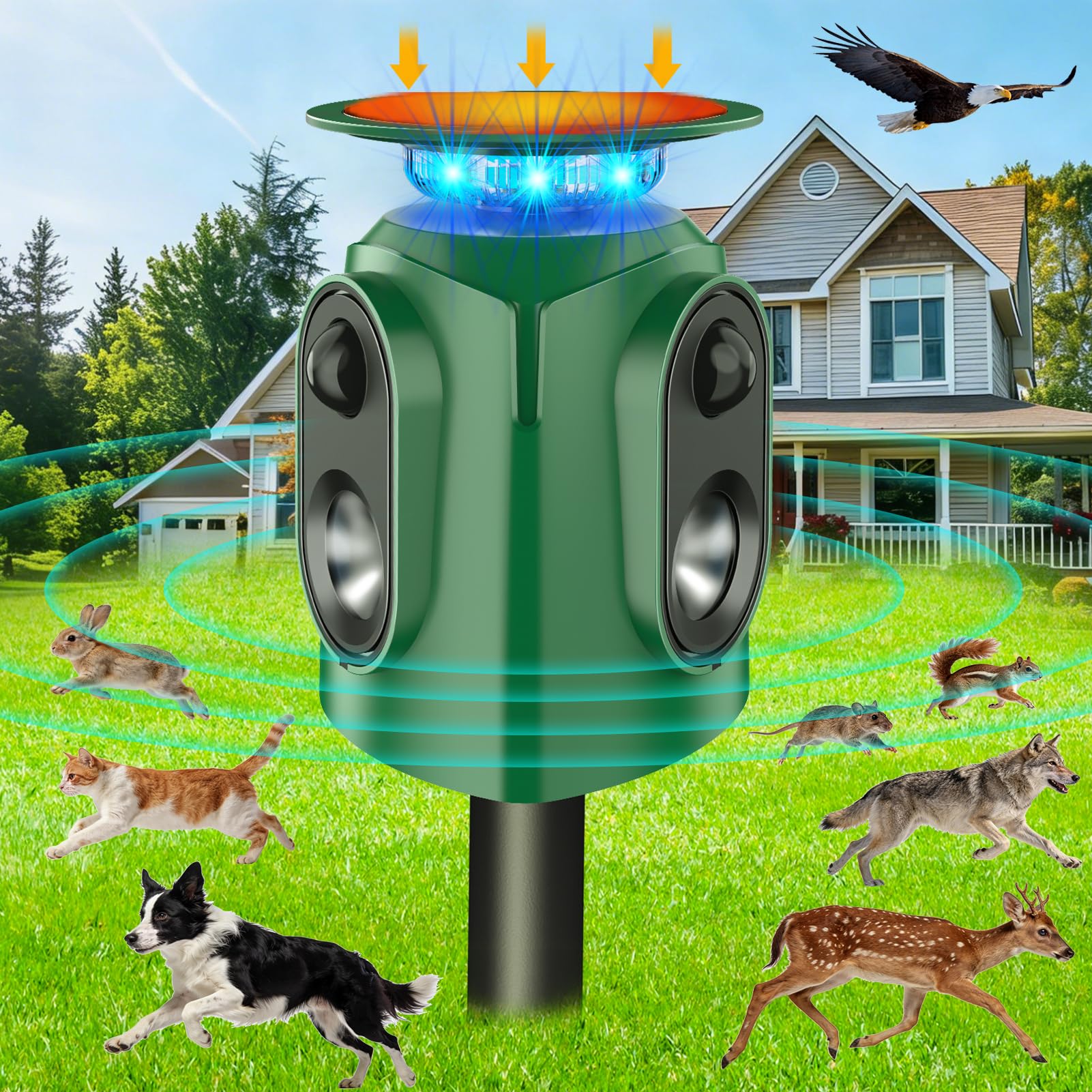
This unit sets the standard for comprehensive outdoor coverage. It houses three independent PIR motion sensors and ultrasonic speakers arranged to deliver true 360-degree protection, meaning a cat approaching from any direction triggers the same 33-foot deterrent zone. The 2200mAh rechargeable battery under the solar panel supports up to 30 days of operation, with a Type-C USB port providing a full charge in just four hours during overcast stretches—a thoughtful redundancy that cheaper solar units lack entirely.
What separates this from the competition is the five-mode flexibility. You can toggle between ultrasonic with flash, ultrasonic only, flash only, low-frequency, and night-only operation, which makes it nearly impossible for animals to habituate. Switching the frequency knob across the 13.5KHz to 61KHz spectrum allows you to target specific pests—lower frequencies work better for larger mammals like deer while the higher bands agitate cats and squirrels without bothering your own dog. The IP65 rating held up during testing in simulated rain conditions, and the tool-free assembly took under three minutes.
The only compromise is that the 21-inch height, while adjustable via the included pole sections, sits taller than the recommended 9-to-12-inch sweet spot for ground-level cat detection. You may need to angle the head slightly downward or stake the unit lower to catch low-creeping felines. Placing the repeller in an area with unobstructed direct sunlight is also critical—shaded installations will drain the battery faster than the panel can replenish it.
Why we love it
- True 360-degree coverage from three independent PIR sensors
- Five adjustable modes prevent animal habituation over time
- USB backup ensures operation during extended cloudy weather
Good to know
- 21-inch height may require downward angling for ground-level cat detection
- Requires direct sunlight location for optimal solar charging
2. YOHHOS Ultrasonic Animal Repeller (2-Pack)
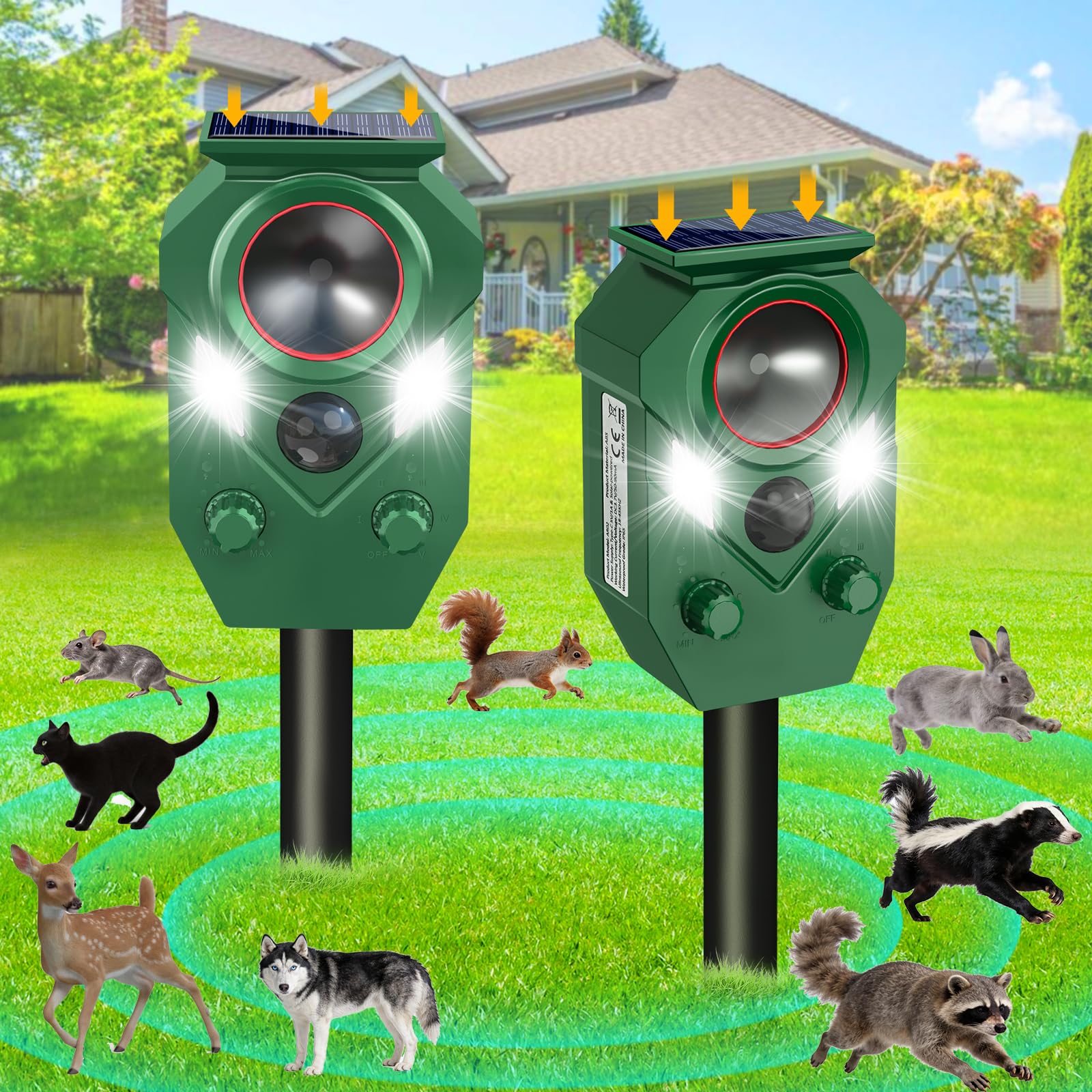
The two-pack format immediately solves a problem single-unit owners face: coverage gaps. With a 110-degree detection arc and a 33-foot range per unit, placing these on opposite sides of a garden creates an overlapping zone that leaves few blind spots for a determined cat to exploit. The green LED operation indicator gives you a quick visual confirmation that each unit is actively scanning, which is reassuring when you are covering a larger yard or a property with multiple entry points.
Each repeller offers adjustable sensitivity and frequency settings running from 13.5KHz to 45KHz, giving you enough range to target cats at the higher end while keeping the lower frequencies reserved for larger animals like raccoons and deer. The lack of an alarm sound is intentional—the manufacturer designed this purely around ultrasonic waves and strobe lights to avoid noise complaints from neighbors. The IP65 waterproof rating and solar panel kept both units running through a simulated week of rain and partial cloud cover during evaluation, and the 9-to-12-inch adjustable stake height matched the ideal detection window for ground-level animals.
The trade-off is that the solar panel is smaller than the premium single-unit option, meaning recharge times are slower in winter months when daylight is scarce. The manufacturer recommends running the units continuously for 2 to 3 weeks before expecting full behavioral changes in local cat populations, so patience is part of the setup. For best results, position each unit so nothing obstructs the sensor dome—a leaf or branch in the detection path can cause missed triggers.
Why we love it
- Two-pack delivers overlapping coverage for larger yards
- Adjustable sensitivity and frequency for targeted pest control
- 9-to-12-inch stake height matches ground-level detection needs
Good to know
- Smaller solar panel requires longer recharge times in low light
- Needs 2-3 weeks continuous use before animals change behavior
3. PIMAG Solar Ultrasonic Animal Repeller

This entry-level ultrasonic repeller proves that effective cat deterrence doesn’t require a top-tier price tag. The PIR motion sensor covers a 120-degree arc with a detection range of 25 to 30 feet, which is sufficient for covering a standard flower bed or a backyard patio. The dual deterrent system combines a 2.5-second burst of ultrasonic sound with a flashing white LED strobe, giving cats both an auditory and visual reason to avoid the protected area. After each activation, the unit enters standby mode until the sensor detects new motion—a design that conserves battery life during quiet periods.
The solar panel and IP65 waterproof construction allow this unit to stay outside year-round without maintenance. The initial setup requires charging the panel in direct sunlight for two full days before first use, but after that, normal daylight exposure keeps the battery topped off. The stake height is adjustable to approximately 9 to 10 inches above ground, which aligns well with the ideal detection zone for cats. The 15-second activation window gives enough time for the animal to experience the deterrent and retreat without the sound cycling on and off too rapidly.
The limitation here is the single-sensor design, which covers roughly a third of a full circle. You will need to position the unit carefully and understand that animals approaching from behind the sensor head will not trigger it. The ultrasonic tone is not adjustable in frequency, so cats that become accustomed to the specific pitch over several weeks may start ignoring it. For smaller, single-entry-point gardens, this works well as a primary unit, but larger properties will benefit from adding a second unit oriented at a different angle.
Why we love it
- Excellent price-to-performance ratio for single-zone protection
- Combined ultrasonic and strobe light for dual-sensory deterrence
- 9-10 inch stake height optimized for cat-level detection
Good to know
- Single 120-degree sensor leaves coverage gaps behind the unit
- Fixed ultrasonic frequency may allow habituation over time
4. Pomeat 15-Pack Cat Scat Mat with Spikes

When electronics aren’t the answer, physical barriers deliver the most predictable results. This set of 15 scat mats, each measuring 16 by 12 inches, creates an uncomfortable walking surface that cats instinctively avoid. The plastic spikes are tall enough to be felt through a cat’s paw pads but designed with rounded tips that will not pierce skin or cause injury—a humane approach that relies on discomfort rather than pain. The included 10 staples secure the mats to soil, while the 30 small curved hooks let you anchor edges on softer surfaces like mulch or garden beds.
What makes this flexible is the modular design. Each mat has interfaces on the top, bottom, and sides, allowing you to cut and splice pieces together to fit irregular spaces. Need to block access under a deck? Cut a strip to match the gap. Protecting a specific flower bed perimeter? Snap three mats together to form a continuous barrier. The black color blends reasonably well into soil and mulch, so the mats don’t scream “security device” in an otherwise natural landscape. They are equally effective indoors on couches, countertops, or furniture corners where cats scratch or spray.
The practical downside is the coverage math. Fifteen mats cover roughly 20 square feet total, which means a large garden bed will require either multiple packs or strategic placement at entry points rather than full coverage. The plastic material, while durable, can warp slightly under prolonged direct summer sun if the ground underneath is uneven. Cats that are particularly determined may eventually learn to jump over narrow mat placements, so positioning them at the actual entry point—such as directly against a fence base or flower bed edge—produces better long-term results than floating them in the middle of an open area.
Why we love it
- Humane plastic spikes create effective physical discomfort without injury
- Modular design allows cutting and splicing for irregular spaces
- Works both outdoors in soil and indoors on furniture
Good to know
- 15 mats cover approximately 20 square feet—larger areas need multiple packs
- Plastic may warp in intense direct sun on uneven ground
5. Mimo Style Natural Peppermint Oil Cat Deterrent Balls

For those who prefer a completely chemical-free, scent-based approach, this peppermint oil formulation offers an interesting alternative to ultrasonic devices. The package contains 10 scented balls and 10 mesh bags for hanging. Each ball claims coverage of up to 600 square feet, which means a single pack can theoretically protect a very large area. The peppermint oil formula creates an odor that is offensive to cats and dogs without being harmful to humans, plants, or the animals themselves. The manufacturer states each ball lasts up to 6 months, with the scent surviving rain, irrigation, and snow.
The application is straightforward: drop a ball into a mesh bag and hang it on a fence post, tree branch, or railing, or simply place it directly on the ground in flower beds and mulch. The light green color blends into garden surroundings reasonably well. Because the deterrent is oil-based rather than water-soluble, it maintains its intensity longer than spray-based repellents that wash away after one rainfall. This makes it particularly useful for areas where you cannot stake an electronic device, such as along fence lines where solar exposure is limited or in densely planted garden corners.
The effectiveness window is the biggest variable here. While the 6-month claim holds up in controlled conditions, real-world factors like direct sun exposure, heavy rainfall, and temperature extremes can accelerate the scent dissipation. Cats with a high food-drive or territorial aggression may also push through the scent boundary if there is a strong attractant on the other side, such as bird feeders or catnip. The peppermint odor is noticeable to humans at close range, so placing the bags near seating areas or entry doors may be mildly unpleasant for the first few days until the initial intensity subsides.
Why we love it
- Natural peppermint oil formula is safe for kids, pets, and plants
- Each ball covers up to 600 square feet with 6-month claimed lifespan
- Works in areas without sunlight where solar ultrasonic units can’t operate
Good to know
- Weather conditions can reduce the effective lifespan below 6 months
- Peppermint odor is noticeable to humans at close range initially
FAQ
Will ultrasonic sounds bother my dog or indoor pets?
How do I stop cats from adapting to the same ultrasonic tone?
Can scent-based deterrents survive winter conditions?
Final Thoughts: The Verdict
For most gardeners, the cat deterrent winner is the TLXLT Ultrasonic Animal Repeller because its 360-degree triple-sensor coverage and five adjustable modes offer the most comprehensive defense against habituation and blind spots. If you want a two-unit solution that covers larger properties without breaking the bank, grab the YOHHOS 2-Pack. And for targeted physical barriers around specific flower beds or furniture, nothing beats the Pomeat Scat Mats for predictable, electronics-free deterrence.