
When you share your home with two cats, mealtime can turn into a sprint rather than a relaxed meal. The wrong feeder design turns one bowl into a territory dispute, leaving one cat overfed and the other anxious. Getting a proper dual-feeding station ends the competition at the bowl and puts you back in control of portions.
I’m Mo Mahin — the founder and writer behind Furric. I’ve spent the last three years comparing smart pet feeder specifications on the market, analyzing thousands of verified owner reviews to identify which dual-bowl designs genuinely prevent resource guarding and which fall apart on portion accuracy.
The specific model that balances split-bowl geometry, reliable dispensing, and backup power defines the best cat feeder for two cats for your household, and this guide breaks down the seven most relevant options across different price and feature brackets.
How To Choose The Best Cat Feeder For Two Cats
Not every automatic feeder is built to handle the dynamics of a multi-cat home. The distinction between a single-cat dispenser and a proper dual-cat station comes down to bowl layout, portion control for multiple mouths, and fail-safe power that keeps both cats fed when you are away.
Bowl Separation and Design
The distance between the two bowls is the first spec to check. A feeder with side-by-side bowls that are less than six inches apart forces both cats to eat shoulder-to-shoulder, which can trigger blocking behavior. Look for opposing or widely spaced bowls — ideally 16 inches or more of separation — so each cat has a clear sight line and undisturbed eating zone. The material also matters: stainless steel resists chin acne better than plastic.
Portion Accuracy and Serving Size Granularity
For two cats with potentially different dietary needs, the feeder must allow you to program distinct portion sizes per meal, not just a single spout that drops the same amount into both bowls. Some models use a rotating wheel with adjustable chute openings; others rely on an auger system. The best units for multi-cat homes let you set portions in one-gram or one-portion increments of roughly ten grams each, giving you the control to feed a maintenance diet for one cat and a weight-loss schedule for the other.
Capacity that Matches Your Schedule
A feeder that holds four liters may last one cat ten days, but two cats will empty it in under a week. For weekend trips or longer getaways, a five-liter or six-liter hopper is the practical minimum. The shape of the hopper also matters — angular corners can trap kibble and cause false low-food alerts, while a smooth, sloping interior feeds more reliably to the bottom.
Power Backup Reliability
Two cats mean double the consequences if the feeder stops working. Battery backup is non-negotiable when you travel. Units that accept D-cell batteries alongside the wall adapter will keep dispensing during a power cut. Some feeders lose the internal clock during a power bounce, which delays or advances the next meal — a flaw that matters more for a multi-cat home because the disruption affects two feeding windows, not one.
Additional Features Worth the Upgrade
Camera and two-way audio help you monitor both cats and call them to the bowl, which is useful if you separate their feeding areas. Wet food cooling is a separate category entirely — semiconductor cooling trays keep refrigerated meals fresh for up to three days, but few dual-cat feeders integrate cooling because the power draw is higher. Decide whether you need remote monitoring or refrigeration, then look for those features as value-adds rather than distractions from the core feeding performance.
Quick Comparison
On smaller screens, swipe sideways to see the full table.
| Model | Category | Best For | Key Spec | Amazon |
|---|---|---|---|---|
| oneisall 5L Dual-Bowl | Mid-Range | Opposing 16-inch bowls | 5L / 20 cups capacity | Amazon |
| HoneyGuaridan S25D | Mid-Range | Slow-feed inserts included | 3.5L with anti-blocking motor | Amazon |
| WOPET HV10DP | Premium | Camera with 70° tilt | 6L, 1080P camera, 256GB SD | Amazon |
| PETKIT YumShare Dual-Hopper | Premium | Two independent hoppers | 5L total, AI motion capture | Amazon |
| PETLIBRO Wet Food Feeder | Premium | Wet food refrigeration | Semiconductor cooling, 3 compartments | Amazon |
| faroro TD20 Camera Feeder | Value | Budget camera monitoring | 4L, 3MP camera, 128GB SD | Amazon |
| Petory 4L WiFi Feeder | Value | Voice recording meal call | 4L, 10s voice, 10 meals/day | Amazon |
In‑Depth Reviews
1. oneisall 5L Dual-Bowl Automatic Cat Feeder
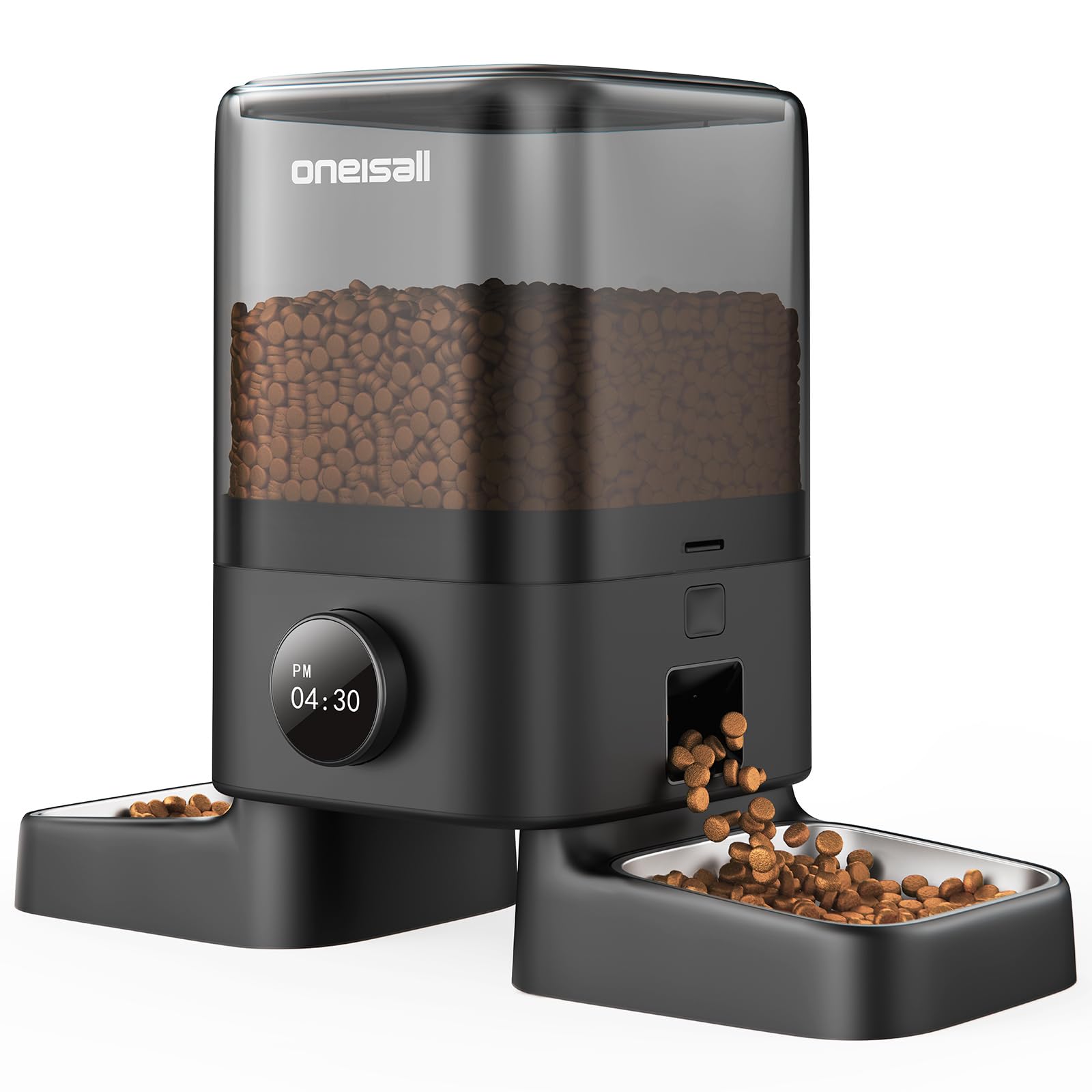
The oneisall 5L earns the top spot because it solves the fundamental dual-cat problem through pure geometry. The two stainless steel bowls sit on opposite ends of the base — 16 inches apart — giving each cat a distinct eating zone that prevents the queueing and blocking that plagues side-by-side designs. The 20-cup / 5-liter hopper handles a full 5.6-pound bag and feeds two adult cats for roughly fifteen days before a refill is needed, which aligns well with bi-weekly grocery runs.
Portioning uses a dial-based wheel system that drops equal quantities into both bowls simultaneously. The portion size adjusts in mechanical steps, and 44 percent of verified buyers note the dial is easier to program than a multi-button panel. The dual power supply accepts an AC adapter or three D-cell batteries, and the battery backup kicks in automatically during a power failure without losing the schedule. A rechargeable battery variant also shows remaining days on the display, so you can see exactly when the backup will die.
The downsides are minor but worth noting. The metal bowls are thin enough to rattle against the base when cats eat, so some owners place a silicone liner underneath. The low-food alert only triggers after the hopper is empty and two scheduled portions have been skipped, which means you cannot rely on it as an early warning. Still, for a dual-bowl feeder that actually stops food fights, the oneisall delivers the most functional layout at a fair mid-range price point.
Why we love it
- Opposing 16-inch bowl spacing eliminates mealtime competition
- Large 20-cup hopper feeds two cats for two weeks
- Reliable battery backup with days-remaining display
Good to know
- Thin metal bowls can be noisy without a liner
- Low-food warning activates only after hopper is fully empty
2. HoneyGuaridan S25D Automatic Cat Feeder
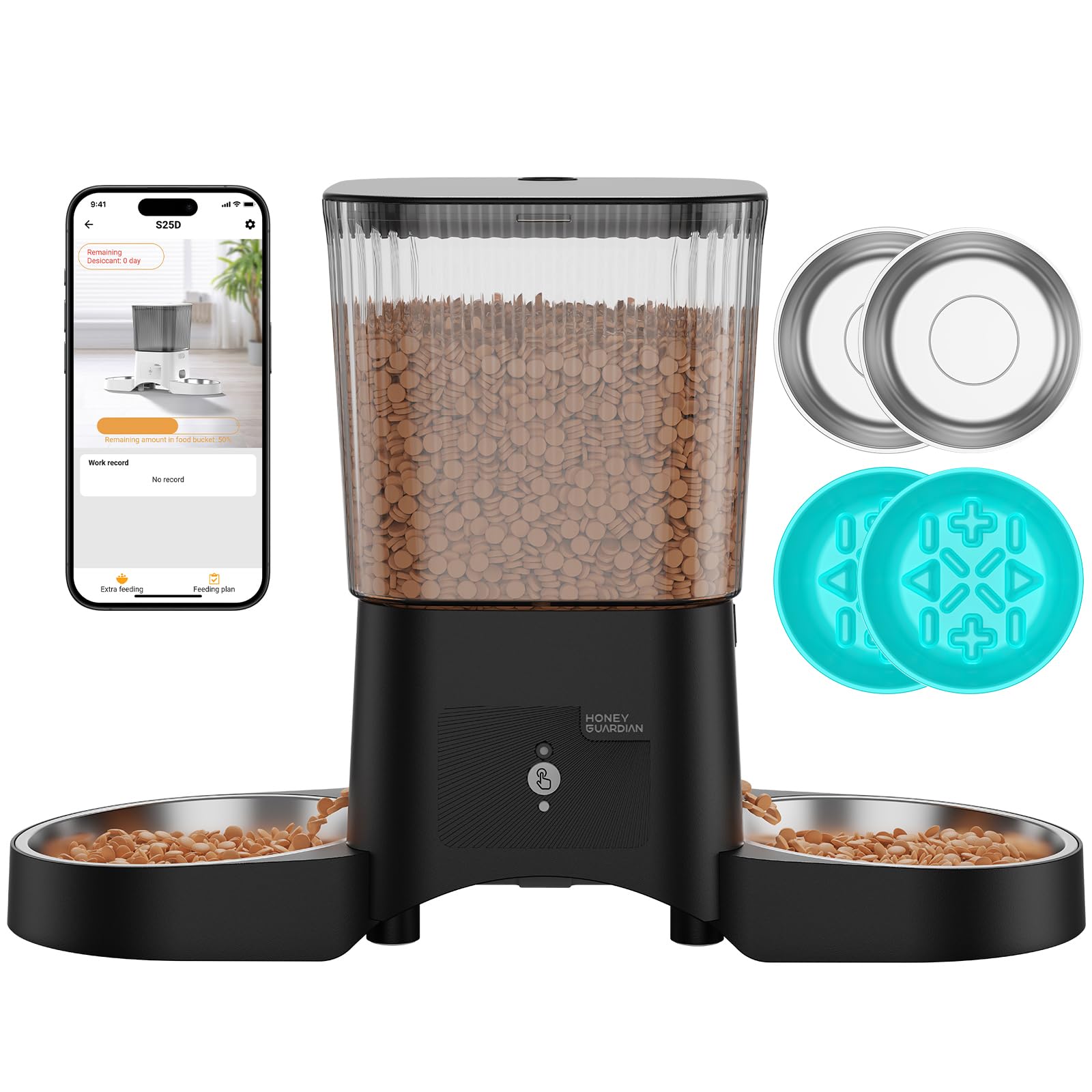
HoneyGuaridan’s S25D stands out because it bundles two sets of bowls — standard stainless steel and anti-choking slow-feed inserts — giving you a tool to address scarf-and-barf behavior in multi-cat homes. The 3.5-liter hopper is smaller than the oneisall’s 5-liter unit, but the triple-seal lid (rubber gasket, desiccant, and rotating chute cover) keeps kibble fresher for longer, which matters when you are trying to stretch a bag across two cats over several days.
The anti-blocking motor is a genuine differentiator: if a large kibble fragment jams the wheel, the motor reverses direction to clear the blockage and then resumes normal rotation. This feature prevents the skipped-meal scenario that cheaper feeders cause when a single piece of freeze-dried food gets stuck. The feeder also works with both 2.4 GHz and 5 GHz Wi-Fi, which avoids the compatibility headache that many smart feeders introduce with 5G-only routers.
The slow-feed inserts have a minor fit issue — they rest on top of the metal bowls rather than locking in, so a determined cat can occasionally dislodge them. The app also lacks a manual confirmation after dispensing, which makes it hard to verify portions remotely without watching the camera feed. Despite those quirks, the S25D offers the best value for owners whose primary concern is preventing rapid eating and the vomiting that follows.
Why we love it
- Includes both stainless steel and slow-feed bowl sets
- Motor automatically reverses to clear food jams
- Triple-seal lid keeps kibble fresh for days
Good to know
- Slow-feed inserts sit loosely over the metal bowls
- App does not confirm that food was dispensed
3. WOPET HV10DP Camera Feeder
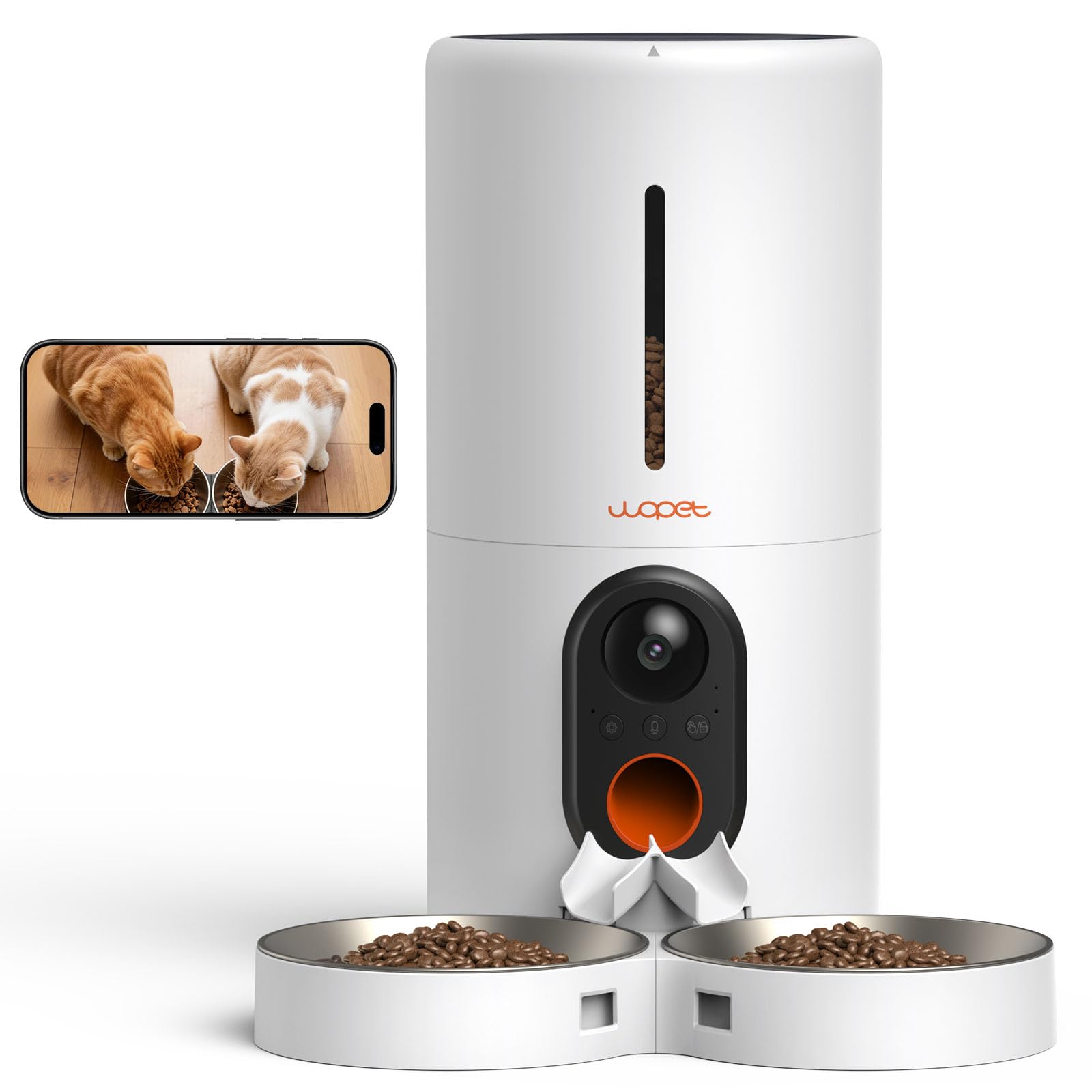
The WOPET HV10DP is the feeder to choose when remote monitoring is a priority. Its 1080P HD camera offers a 160-degree wide-angle view and a 70-degree vertical tilt, which is rare among pet cameras — most are fixed or only pan horizontally. The ability to tilt down lets you see a cat that is eating at floor level rather than just the top of the hopper. The camera supports a micro SD card up to 256 GB, and a 4 GB card ships in the box so you can start recording immediately.
The 6-liter hopper is the largest in this roundup, holding roughly three weeks of dry food for two cats. The feeder works on both 2.4 GHz and 5 GHz Wi-Fi, and the dual power supply (AC plus three D-cell batteries) keeps the schedule running even if the power cuts at 3 AM. Multiple users can connect simultaneously through the WOPET Life app, so everyone in the household can check in or dispense an extra portion without stepping on each other’s settings.
The camera assembly is mounted on top of the hopper rather than integrated into the body, which means it wobbles slightly when the dispensing wheel rotates, and the camera can shift out of its intended angle over time. Owners report needing to readjust the camera position every few days. The HV10DP also lacks the split-bowl or opposing-bowl design of the oneisall — both cats must share the single feeding tray, so this unit works best if your cats eat cooperatively or if you plan to use two separate feeders.
Why we love it
- Camera tilts 70° vertically to see floor-level eating
- 6-liter hopper is the largest capacity in this guide
- 4 GB SD card included out of the box
Good to know
- Camera shifts angle during dispensing cycles
- Single tray design not ideal for competitive eaters
4. PETKIT YumShare Dual-Hopper Feeder
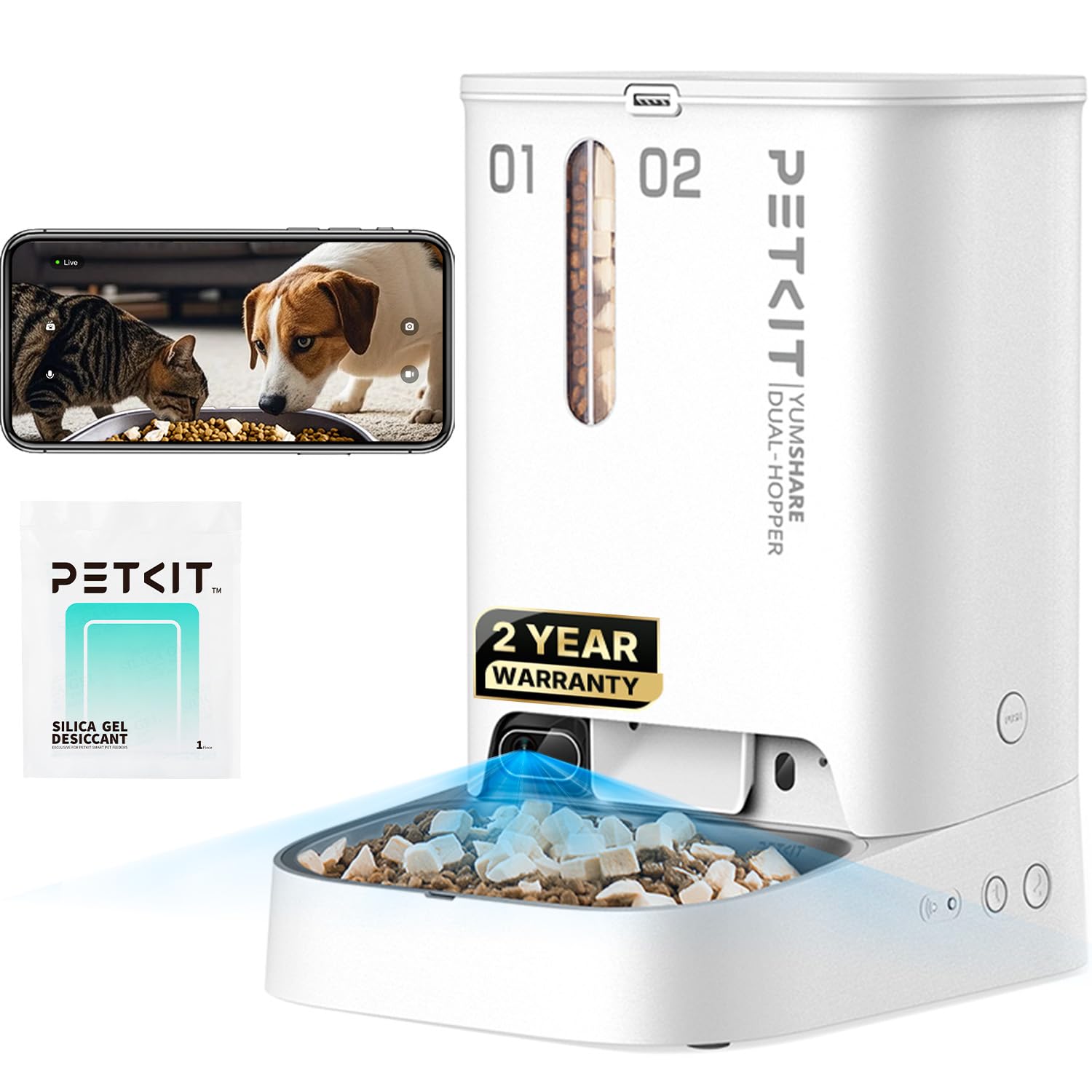
PETKIT’s YumShare takes a fundamentally different approach to the two-cat problem: instead of one hopper splitting into two bowls, it offers two completely independent hoppers that dispense into separate trays. Each hopper holds roughly 2.5 liters, giving you the ability to program unique schedules and portion sizes for each cat without any mechanical sharing. If one cat needs a prescription diet and the other eats maintenance kibble, this is the only feeder in the list that handles that split natively.
The 1080P camera with a 140-degree wide-angle lens sits between the two bowls and captures AI-powered motion events, automatically saving photos of each cat visiting the feeder. Those clips are stored in PETKIT’s cloud service (some features require a subscription) or viewable in the app. The feeder also includes a 20-second voice recording that plays when each hopper dispenses, so you can call each cat with a personalized message. The anti-stick coating on the hopper walls reduces kibble bridging, and the desiccant system keeps moisture out.
The biggest limitation is the total capacity: 5 liters split across two hoppers means each side holds roughly 10 cups. Two free-feeding cats will drain both hoppers in under a week. The app also requires 2.4 GHz Wi-Fi and Bluetooth for initial pairing, which adds a setup step that some users find finicky. The YumShare is also the heaviest feeder here at 3.4 kilograms, so moving it for cleaning feels substantial. But for prescriptive feeding where each cat gets a different food type, no other feeder offers this level of independence.
Why we love it
- Two separate hoppers allow different food types per cat
- AI motion capture saves photos of each feeding visit
- 20-second personalized meal call per hopper
Good to know
- Total 5-liter capacity split across two hoppers refills sooner
- Requires 2.4 GHz Wi-Fi and Bluetooth for setup
5. PETLIBRO Automatic Wet Food Cat Feeder

Every other feeder in this guide is designed for dry kibble only. The PETLIBRO wet food feeder is the single unit here that handles the two-cat dynamic for cats that need moist food. It uses a semiconductor cooling plate under the stainless steel tray to keep three chilled compartments at a safe temperature for up to 72 hours, then warms the served portion back to room temperature thirty minutes before mealtime. This prevents the digestive upset that cold wet food can cause.
The three numbered compartments correspond to scheduled meals, and the anti-pinch infrared sensors on both sides of the lid detect a cat’s head or paw during eating and delay the lid closing. This is a genuine safety feature that matters when two cats might crowd the feeder or when one cat tries to protect the opening. The stainless steel tray is dishwasher-safe and designed without hidden corners, which reduces bacterial buildup compared to plastic drip trays.
The trade-offs are significant for a two-cat household. The tray holds only three meals total, so if your two cats eat three meals a day, you are refilling every twenty-four hours. The device only supports 2.4 GHz Wi-Fi, and the cooling system requires constant AC power — there is no battery backup for the refrigeration element, so a power outage beyond a few hours will spoil the food. This feeder is ideal for owners who work long hours and want to serve fresh wet food while they are away, but it is not a set-and-forget vacation solution.
Why we love it
- Semiconductor cooling keeps wet food fresh for three days
- Infrared anti-pinch sensors protect paws and head
- Dishwasher-safe stainless steel tray with no hidden corners
Good to know
- Only three meals capacity — refills required daily for two cats
- No battery backup for the cooling system
6. faroro TD20 Smart Pet Feeder
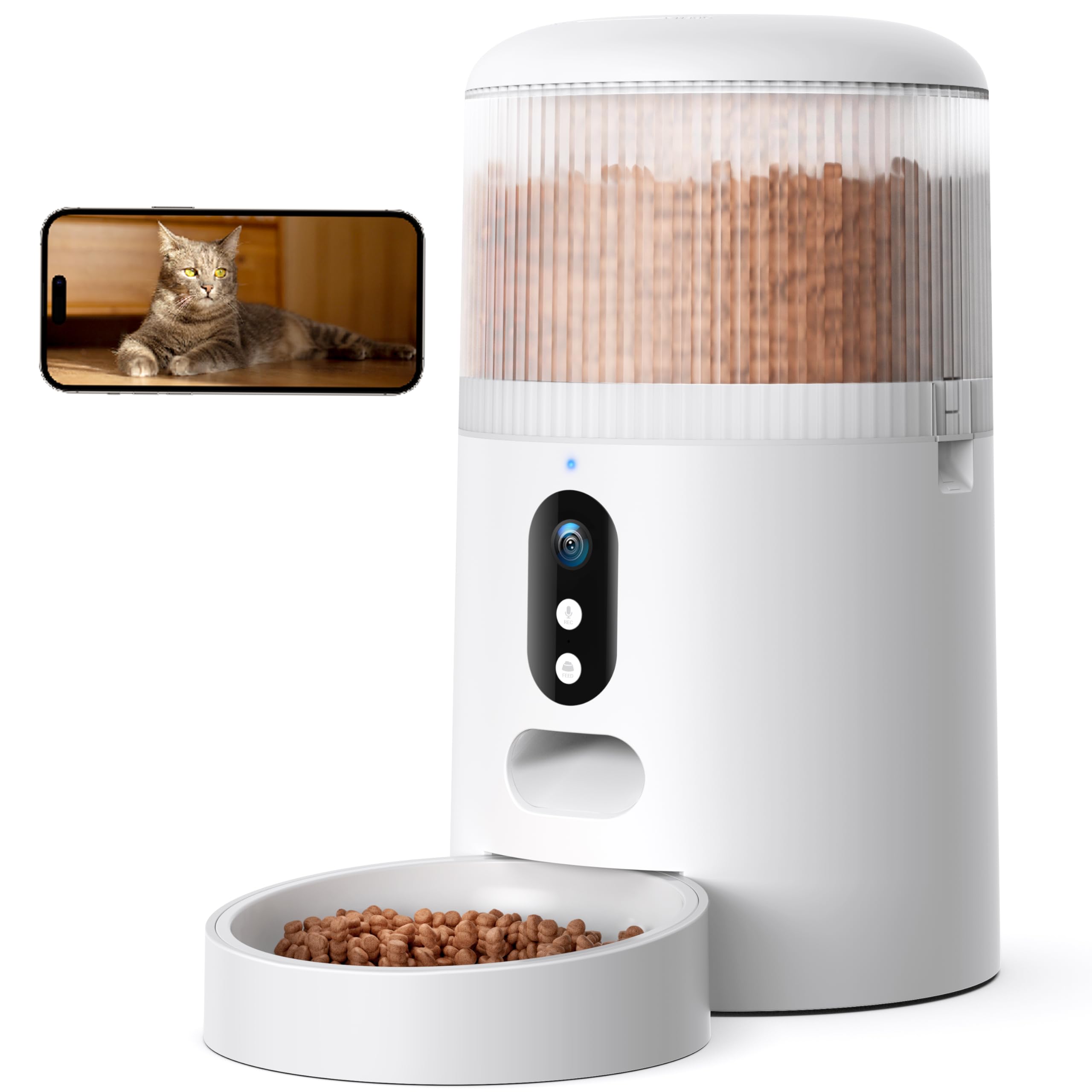
The faroro TD20 proves that a camera feeder does not have to cost triple digits. The 3MP HD camera with IR night vision and a 110-degree viewing angle gives you live video and motion-triggered clips, all stored on a separate 128GB micro SD card. The app delivers pop-up notifications when the motion sensor detects movement, when food is low, or when the device goes offline. For owners who primarily want a visual check-in without paying premium prices, the TD20 delivers that core function.
The 4-liter hopper stores roughly 16.9 cups of dry food and accepts kibble up to 10 millimeters in diameter, which covers most standard cat foods and small freeze-dried pieces. The feeder supports up to eight meals per day with 1 to 10 portions per meal, each portion calibrated at approximately 10 grams. The dual power system uses a USB cable (adapter included) or three D-cell batteries as backup, and the low-food sensor triggers a notification so you know when the hopper is running low before it hits empty.
The portion sizing is metric-only, which means you need to know that eight portions equal roughly one cup. That learning curve frustrates some users. The unit also lacks internal battery memory — if the power goes out, the clock resets and meals may be off by a minute. More importantly, some users found that certain 128GB SD cards caused playback to stop after five minutes; swapping to a different brand fixed the issue, but it adds a compatibility hunt on top of the purchase. The TD20 is a strong entry-level camera feeder but requires patience with its idiosyncrasies.
Why we love it
- 3MP camera with night vision at a budget-friendly price
- 4-liter hopper holds 16.9 cups of dry kibble
- Motion alerts and low-food notifications via app
Good to know
- Portion sizing is metric-only with no cup conversion label
- Some SD cards cause playback dropouts after five minutes
7. Petory 4L WiFi Automatic Feeder

The Petory 4L has earned a reputation for reliability over time — several verified owners report three years of daily use without a mechanical failure. The feeder connects via Bluetooth to your 2.4 GHz Wi-Fi network and allows up to ten meals per day with 1 to 50 portions per meal, each portion roughly one-tenth of a cup. That granularity is unusual in the budget tier and gives you fine control over two-cat portions even though the feeder uses a single dispensing chute.
The battery backup uses three D-cell batteries and can sustain a schedule of three meals at two portions each for roughly two weeks. The app sends notifications for food blockages, low food levels, and offline status, and the voice recording feature lets you record a ten-second call that plays when the food drops. The hopper and bowl are both dishwasher-safe, and the BPA-free plastic paired with a removable stainless steel bowl makes for straightforward cleaning. The desiccant bag inside the lid extends the freshness window without adding complexity.
The feeder has two known weaknesses. A daylight saving time bug — reported by multiple owners — causes the feeder to stop dispensing after the time change unless you manually reschedule every meal. The second issue is that some units emit a strong plastic-chemical smell out of the box that caused one owner’s cat to vomit; airing out the hopper for two to three days resolved it, but it is a gripe worth noting. The single-bowl design also means both cats share the same tray, so this unit works best in households where the cats already eat peacefully together.
Why we love it
- Proven three-year reliability from verified owners
- Up to 50 portions per meal for granular control
- Voice recording and blockage notifications
Good to know
- Daylight saving time can disrupt feeding schedules
- New units may require airing out to remove plastic smell
FAQ
What is the minimum bowl separation for two cats to eat without conflict?
Can I use a two-cat feeder for one prescription diet and one regular diet?
Why does my cat panic when the feeder dispenses food?
Should I get a feeder with a camera for two cats?
How long can I leave my two cats alone with an automatic feeder?
Final Thoughts: The Verdict
For most gardeners, the best cat feeder for two cats winner is the oneisall 5L Dual-Bowl Automatic Cat Feeder because its 16-inch opposing bowl layout directly prevents mealtime conflict while the 20-cup hopper keeps both cats fed for two weeks on a single refill. If you need to slow down a fast eater, grab the HoneyGuaridan S25D for its included slow-feed inserts and anti-jamming motor. And for remote monitoring with a tilting camera that lets you see both cats eat, nothing beats the WOPET HV10DP.