
A messy cat doesn’t just scatter litter — it turns your home into a dusty, tracked battlefield. Between clumps that dissolve on scooping, dust clouds that trigger respiratory issues, and odors that return hours after cleaning, the wrong litter makes every day a losing fight. The fix isn’t just “any clumping clay” — it’s a formula engineered for hard clumps that stay intact, dust levels near zero, and particle size that stays in the box instead of migrating to every corner of your house.
I’m Mo Mahin — the founder and writer behind Furric. I’ve spent years analyzing cat litter chemistry, comparing clumping tensile strength across brands, studying particle-size distribution for tracking control, and cross-referencing thousands of owner reports on dust levels and respiratory irritation in both cats and humans.
This guide cuts through the marketing fluff to identify the litter formulations that actually deliver on their core promises. Whether you need hard clumps that survive a mechanical sifter, dust control for an asthmatic cat, or a tracking-resistant texture that keeps your floors clean, the best cat litter for messy cats is about matching the right physical properties to your specific mess pattern.
How To Choose The Best Cat Litter For Messy Cats
Selecting a litter for a messy cat isn’t about brand loyalty or scent preference — it’s about understanding the physical properties that determine whether waste stays contained or spreads. Three factors dominate the decision: clump integrity, dust content, and particle geometry.
Clump Hardness and Tensile Strength
The defining failure of budget litters isn’t odor control — it’s clumps that disintegrate when you touch them with a scooper. For messy cats that dig deep and cover aggressively, you need a formula that binds urine into a cohesive mass that won’t shatter or leave wet crumbles behind. Look for medium-grain clays that form dense, rock-like clumps within 20–30 seconds of contact. Avoid lightweight crystals or soft-pellet plant blends unless they specifically advertise “hard clumping” — many natural litters sacrifice tensile strength for biodegradability.
Dust Content and Respiratory Impact
Dust isn’t just an annoyance for humans sweeping the floor — it’s a direct health risk for cats with asthma, allergies, or sensitive respiratory systems. The best formulations claim “99.9% dust-free” and use washed clay or plant materials that minimize airborne particulates. For multi-cat households, dust accumulation in the air accelerates as trays are disturbed more frequently. Prioritize litters that explicitly state “low dust” or “dust-free” in their technical specifications rather than relying on marketing language about “gentle” formulas.
Particle Size and Tracking Control
Tracking happens when particle diameter falls below a critical threshold relative to the surface area of a cat’s paw pads. Fine-particulate clay (typical of cheap “scoopable” litters) behaves like sand — it clings to every crevice and migrates several feet from the box. Medium-grain clay (around 1–2 mm diameter) has enough weight to fall off paws quickly while still forming tight clumps. Some litters use “anti-tracking” technology by blending two different particle sizes — the larger granules drop first while finer ones clump effectively.
Quick Comparison
On smaller screens, swipe sideways to see the full table.
| Model | Category | Best For | Key Spec | Amazon |
|---|---|---|---|---|
| Dr. Elsey’s R&R Stress-Reducing | Clay Clumping | Dust-sensitive & asthmatic cats | 99.9% dustless, medium-grain clay | Amazon |
| Purina Tidy Cats Performance Plus | Clay Clumping | Low tracking & multi-cat homes | 64% less tracking than leading litter | Amazon |
| Catit Go Natural Plant-Based | Plant/Clay Hybrid | Eco-conscious & lightweight use | 70% pea husk / 30% bentonite clay | Amazon |
| World’s Best Cat Litter Lavender | Natural Corn | Flushable & natural odor control | 99% dust-free, clumping corn formula | Amazon |
| Fresh Step Advanced Simply Unscented | Clay Clumping | Bulk value & automatic boxes | 37 lb. multi-pack, 15-day odor control | Amazon |
In‑Depth Reviews
1. Dr. Elsey’s R&R Stress-Reducing Clumping Clay Cat Litter
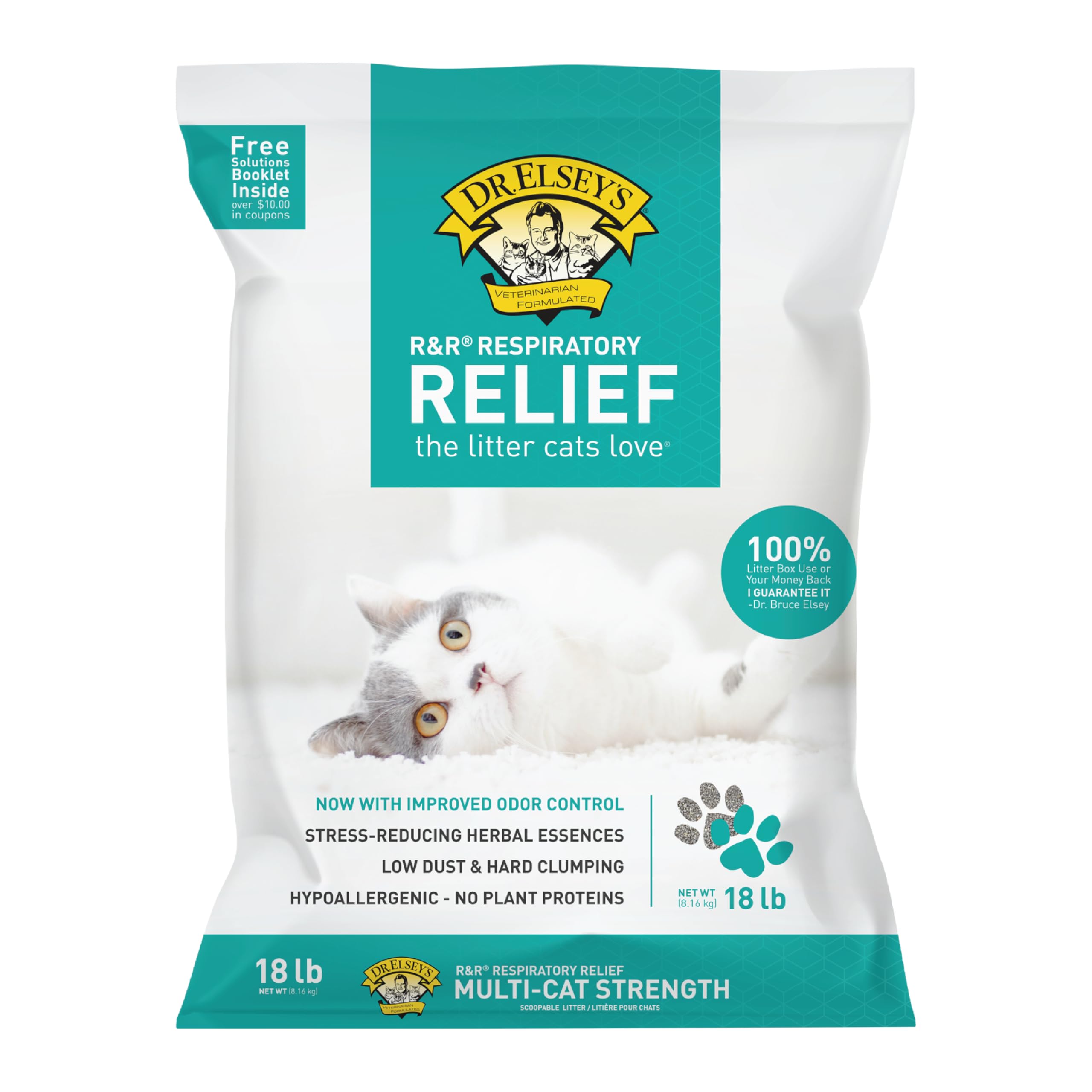
The 99.9% dustless claim on this Dr. Elsey’s formulation isn’t marketing exaggeration — owner reports confirm that cats with chronic coughing and diagnosed asthma stop coughing within days of switching to this litter. The medium-grain clay strikes the precise balance between clump hardness and particle weight: clumps form dense enough to survive mechanical litter box sifting, while the grain size prevents the fine-particulate dust that irritates lungs and the oversized granules that fail to bind urine.
Tracking is minimal compared to standard scoopable clays, though some owners note the 18-pound bag once weighed 20 pounds for the same price — a shrinkflation point worth noting if you’re accustomed to the old fill level. The unscented formulation contains natural essences rather than synthetic perfumes, which helps reduce stress in cats sensitive to artificial fragrances while still neutralizing ammonia odors through the clumping action itself rather than cover-up scents.
For multi-cat households where at least one cat has respiratory sensitivity, this is the safest starting point. The hard clumping prevents the wet-bottom syndrome that develops when urine seeps through loose clumps and bakes onto the tray, and the 18-pound bag provides roughly three weeks of coverage for two cats when scooped daily.
Why we love it
- Proven to stop coughing in asthmatic cats per owner reports
- Hard clumps that work with automatic litter boxes
- Medium-grain clay reduces both dust and tracking simultaneously
Good to know
- Bag weight was reduced from 20 to 18 pounds without price adjustment
- Heavier than plant-based alternatives at 18 lbs per bag
2. Purina Tidy Cats Performance Plus Feet Unscented
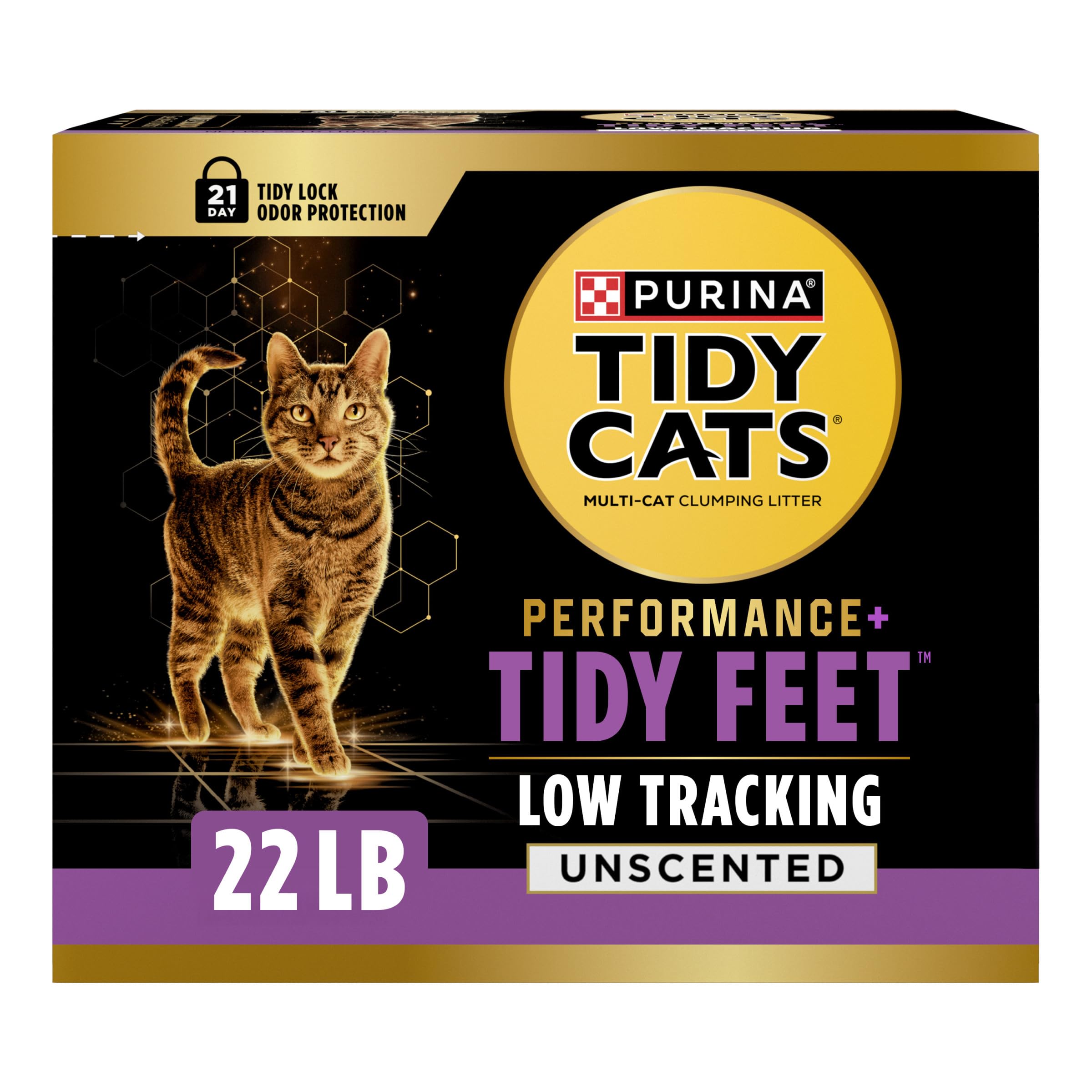
The “Tidy Feet” moniker on this Purina formulation directly addresses the tracking pain point with a measurable claim: 64 percent less tracking versus the leading clumping litter. This is achieved through a dual-particle blend where larger granules drop off paws immediately while finer particles handle clumping duty. Owner reports consistently describe it as the first litter their cat cannot scatter — a critical win for messy cats that dig explosively and then leap from the box.
Clumping performance matches the low-tracking promise. The formula forms tight clumps that don’t stick to the sides of the tray, and the 22-pound box provides excellent per-pound value for multi-cat homes. The unscented variant avoids the chemical headache that scented litters can cause for both cats and owners, while still delivering the 21-day odor control window advertised — though owners note that the “fresh linen” scent in the scented version is perceptible only in the bag and dissipates within hours of pouring.
The 22-pound box is heavy but translates to lower replacement frequency. For households with three or more cats where tracking is the primary complaint, the combination of low-dust formulation and anti-tracking particle geometry makes this the most targeted solution for floor cleanliness.
Why we love it
- 64% less tracking vs. leading clumping litter — measurable difference
- Tight clumps don’t stick to tray sides
- Excellent multi-cat odor control window
Good to know
- Heavy 22-pound box may be difficult to lift for some owners
- Scented version’s fresh linen smell fades quickly
3. Catit Go Natural Plant-Based Cat Litter
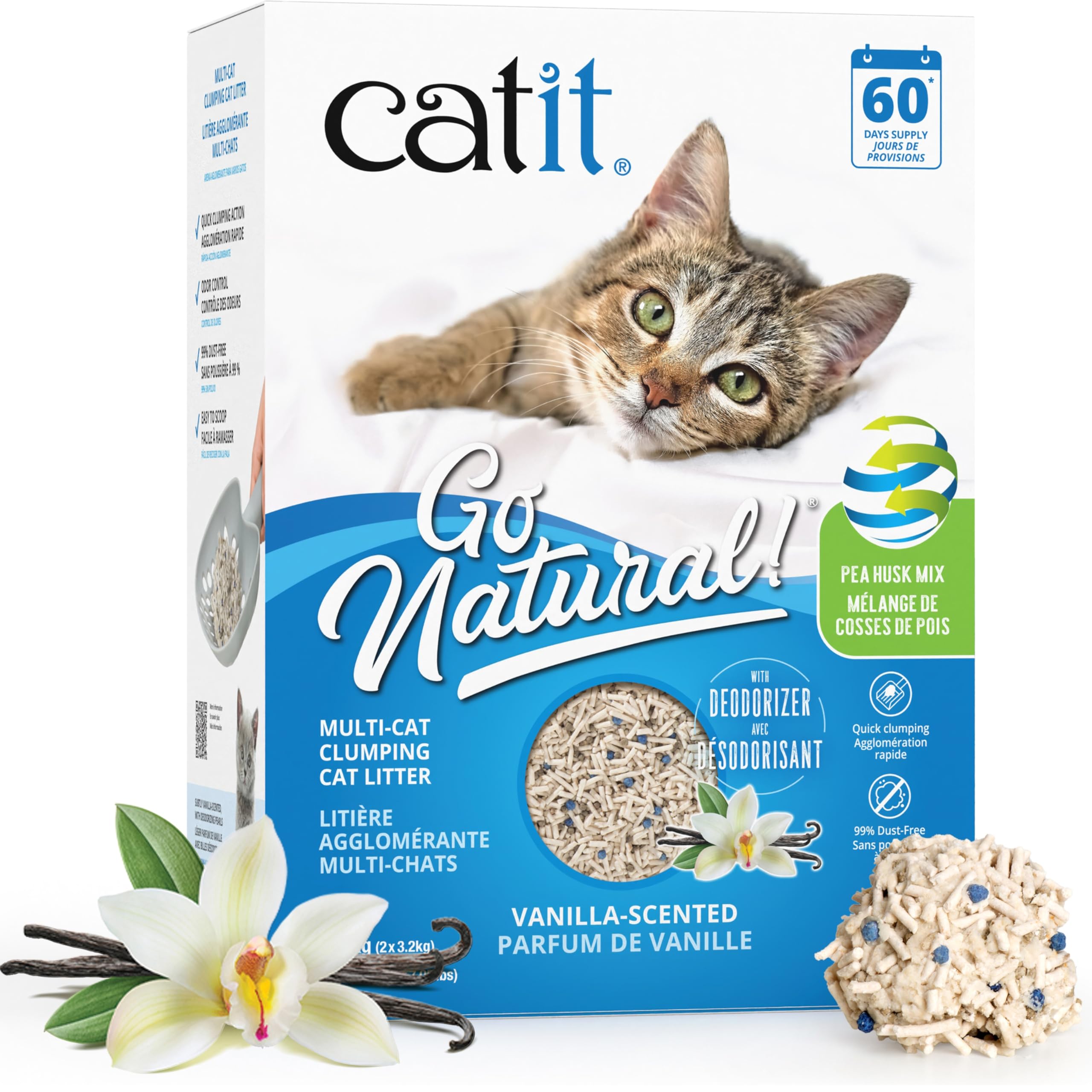
The 70/30 split — pea husk for sustainability, bentonite clay for clumping power — addresses the central compromise of natural litters: they often clump poorly. This hybrid formulation produces clumps that owners describe as “drier and harder” than pure plant-based alternatives, with the added benefit of being significantly lighter than full-clay options. At roughly half the weight of a comparable clay bag, the Catit formula reduces the physical strain of carrying and pouring while maintaining clump integrity.
Dust is rated at 99% dust-free, and owner reports confirm very low airborne particulates during pouring and scooping. The vanilla scent is the primary potential issue — some owners find it becomes off-putting after several days in the box, and the brand currently doesn’t offer an unscented variant. The deodorizing pearls mixed into the formula help neutralize ammonia between scoopings, and one bag reportedly lasts a full month for a single cat with daily maintenance.
For owners transitioning from clay to plant-based litters, the bentonite clay content ensures that cats accustomed to clay texture don’t reject the switch. The low tracking profile and biodegradable material make this a strong choice for environmentally conscious households where the cat’s mess pattern is moderate rather than extreme.
Why we love it
- Hybrid formula solves the clumping problem typical of natural litters
- Significantly lighter than clay — easier to carry and pour
- One bag lasts a month with daily scooping for single cats
Good to know
- Vanilla scent can become unappealing after prolonged use
- Pricier per pound than straight clay alternatives
4. World’s Best Cat Litter Lavender Scented Multiple Cat

World’s Best is one of the few corn-based litters that clumps tightly enough to compete with clay — owners consistently report clumps that hold together during scooping without the crumbling that plagues most plant-based options. The 99% dust-free rating is legitimate: corn litter naturally produces less airborne dust than clay because the kernel granules are heavier and less friable. For flushable use, this is the most convenient option — clumps break down in water without clogging plumbing, eliminating plastic bag waste entirely.
The lavender scent is stronger in the bag than in the box, dissipating quickly after pouring. Some owners note a faint “barnyard” corn smell during scooping when the lavender fades, but this is mild compared to the ammonia breakthrough typical of clays after three days. The 7-pound bag is smaller than clay competitors, which means more frequent purchases — though the lighter weight per bag is easier to handle for owners who struggle with 20+ pound clay boxes.
For messy cats that bury waste aggressively, the corn texture is less likely to stick to paws than fine clay, resulting in lower tracking overall. A gradual introduction over several days by mixing with the old litter is recommended for cats resistant to texture changes.
Why we love it
- Flushable clumps — zero plastic waste
- 99% dust-free — excellent for respiratory health
- Corn granules track less than fine clay
Good to know
- 7-pound bag means more frequent repurchasing
- Slight corn smell can emerge when lavender scent fades
5. Fresh Step Advanced Simply Unscented Multi Cat Clumping Cat Litter
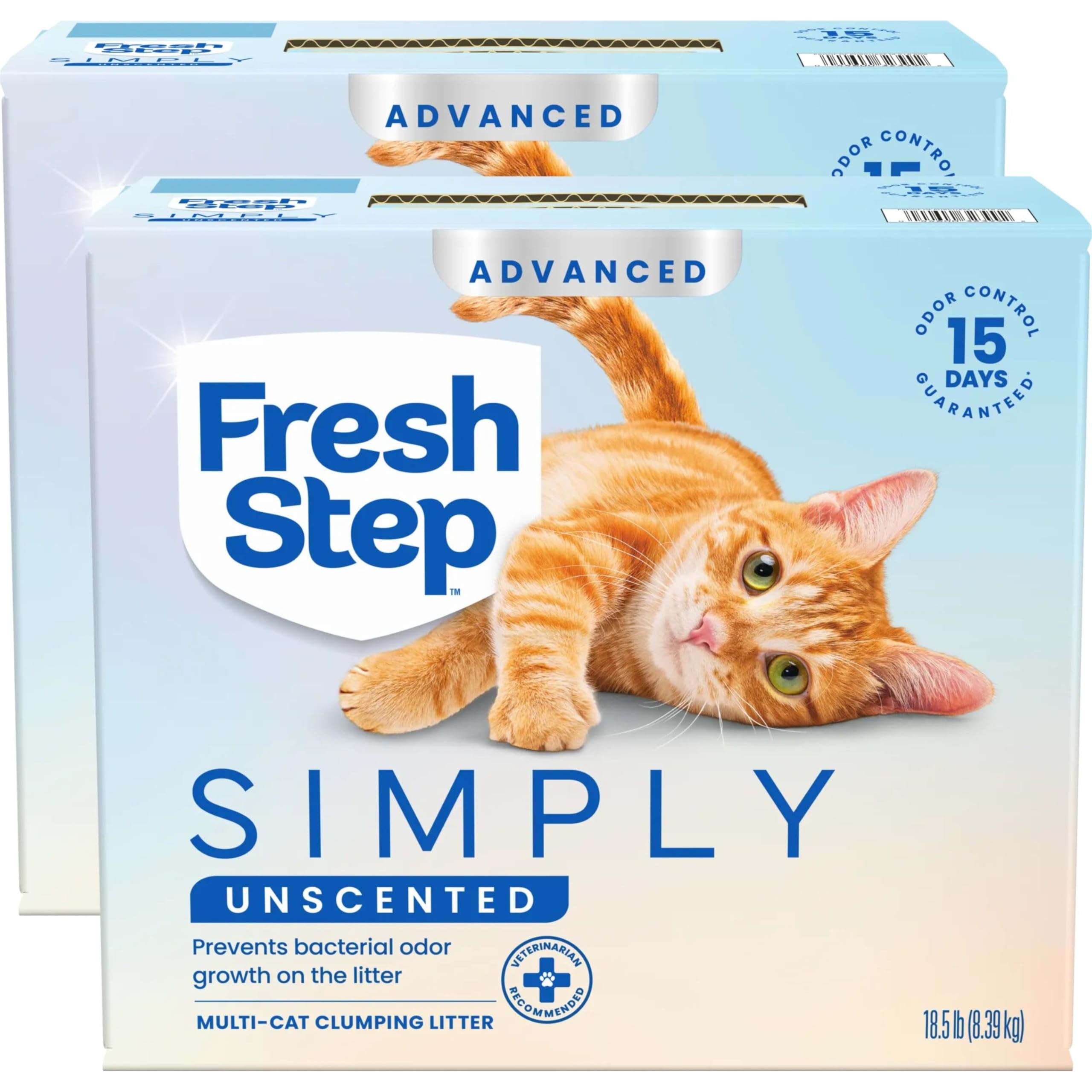
The 37-pound dual-box format of this Fresh Step variant targets the highest-volume buyers — multi-cat households where litter consumption is measured in bags per week, not per month. The activated charcoal and Ammonia Block Technology work together to neutralize urine odors chemically rather than masking them with fragrance, which is critical for unscented formulations. Owner reports confirm that a three-cat household using this litter experiences no ammonia breakthrough for 10–12 days between full box changes, exceeding the 15-day claim under real-world heavy use.
Clump quality is among the best in the clay category: tight, scoopable clumps that resist crumbling even when the scooping action is aggressive. Some owners initially report slight dust during the first pour from a fresh bag, but this settles after the first few scoops and doesn’t recur with subsequent use. The unscented formula is genuinely fragrance-free — no cover-up scents, no chemical lingering — making it ideal for households where owner or cat fragrance sensitivities are a concern.
The main trade-off is physical weight: two 18.5-pound boxes total 37 pounds, which can be challenging to transport and store. For owners with automatic litter boxes, the tight clumping ensures that mechanical sifting mechanisms don’t break clumps apart, reducing maintenance frequency.
Why we love it
- 37-pound bulk format — lowest per-scoop cost in this lineup
- Activated charcoal + Ammonia Block for genuine unscented odor control
- Compatible with automatic litter boxes
Good to know
- 37 pounds is heavy to carry and requires storage space
- Slight dust on first pour before granules settle
FAQ
Why do some clumping litters leave wet sludge at the bottom of the tray?
Is unscented litter always better for cats with sensitive respiratory systems?
How deep should I fill the litter box for a messy digger?
Can I mix different litter types to improve tracking or odor control?
Final Thoughts: The Verdict
For most cat owners dealing with a messy feline, the best cat litter for messy cats winner is the Dr. Elsey’s R&R Stress-Reducing Clumping Clay because it combines 99.9% dust-free certification with hard-clumping medium-grain clay that reduces both respiratory irritation and tracking simultaneously. If your primary pain point is litter scattered across the floor, grab the Purina Tidy Cats Performance Plus Tidy Feet for its 64% tracking reduction guarantee. And for eco-conscious owners who refuse to send clay to landfills, the Catit Go Natural Plant-Based hybrid delivers clump quality that pure plant litters can’t match while remaining lightweight and biodegradable.