
For backyard flock owners, ammonia fumes from accumulated manure are not just unpleasant — they damage birds’ respiratory systems, reduce egg production, and make tending the coop an ordeal you start dreading. A targeted deodorizer does more than mask smells; it chemically neutralizes the nitrogen compounds that create that sharp, burning odor while keeping bedding dry and composting rates healthy.
I’m Mo Mahin — the founder and writer behind Furric. I’ve studied the chemistry of zeolite absorption, probiotic bacterial competition, and activated carbon porosity to understand exactly how different litter additives perform against the specific volatile compounds found in poultry waste.
After analyzing owner feedback and ingredient specifications across the market, I’ve narrowed the field to the five formulas that actually tackle coop odor at its source. This guide covers the best chicken coop deodorizer options for every flock size and management style.
How To Choose The Best Chicken Coop Deodorizer
Not all deodorizers function the same way. Some absorb moisture to prevent ammonia formation. Others introduce beneficial bacteria that outcompete odor-causing microbes. A few rely on herbal scents to overlay unpleasant smells. Knowing which mode of action fits your cleaning routine determines whether the product works or just wastes your money.
Absorption vs. Biocontrol vs. Fragrance
Zeolite-based products physically trap ammonia molecules within their porous structure, keeping the gas locked in the granules rather than releasing into the air. Probiotic formulas add live bacteria that consume the nitrogenous waste before it can volatilize. Herbal blends rely on aromatic essential oils (lavender, oregano, rosemary) to provide a pleasant scent overlay — they mask rather than neutralize. For serious ammonia problems, absorption or biocontrol is essential. Herbal options work best as supplemental enrichment in well-managed coops where odor is already minimal.
Application Form and Dust Level
Powdered deodorizers distribute more evenly across deep litter but can be inhaled by birds and handler during application. Granular products settle faster and release less airborne dust, but may require more effort to work into bedding. Pay attention to reviews that mention dustiness — chickens have sensitive respiratory tracts, and a product that creates a visible cloud during sprinkling is not ideal for enclosed coops.
Safety for Egg-Laying Hens
Any additive placed in nesting boxes or scattered on litter will be pecked at by curious birds. Ingredients like food-grade diatomaceous earth, zeolite, and organic acids (citric, lactic) are generally recognized as safe. Products with synthetic fragrances, artificial dyes, or unknown fillers should be avoided. Always check that the deodorizer is labeled for use around laying hens — some cat-litter deodorizers contain chemicals that could taint eggs or harm the flock.
Quick Comparison
On smaller screens, swipe sideways to see the full table.
| Model | Category | Best For | Key Spec | Amazon |
|---|---|---|---|---|
| FLOCKLEADER Healthy Coop 12lbs | Probiotic + Acidifier | Deep litter systems with weekly application | 12 lb bag; probiotics + zeolite + organic acids | Amazon |
| MAQIHAN 30oz Nesting Herbs | Herbal Blend | Nesting box enrichment and scent overlay | 30 oz; 10-ingredient dried herb mix | Amazon |
| Coir Wonder Activated Charcoal 2.2lb | Activated Carbon | Ammonia absorption in enclosed coops | 2.2 lb; steam-activated coconut charcoal | Amazon |
| Sweet PDZ Pet Deodorizer 3.5lb | Mineral Absorber | Budget-friendly ammonia elimination | 3.5 lb; 100% natural zeolite mineral | Amazon |
| FLOCKLEADER Healthy Coop 6lbs | Probiotic Starter | Small flocks and trial use | 6 lb bag; probiotics + zeolite + organic acids | Amazon |
In‑Depth Reviews
1. FLOCKLEADER Healthy Coop 12lbs

The 12-pound bag of FLOCKLEADER Healthy Coop hits the sweet spot for most backyard flocks because it combines three complementary mechanisms in one granule: live Bacillus-based probiotics that colonize the litter and break down uric acid before it converts to ammonia, zeolite crystals that physically trap existing moisture and gas molecules, and organic acids (citric and lactic) that lower the pH of the bedding environment to inhibit microbial growth. This triple-action approach means the product continues working between cleanouts rather than exhausting itself after a single application.
Owners of flocks up to 20 birds report that a weekly sprinkle around roosting bars and nesting boxes keeps ammonia readings near zero for the full week, even in humid conditions. The granule form produces minimal airborne dust compared to powder alternatives, which matters when you are working inside an enclosed coop. Multiple verified reviews note that the product is effective even when used sparingly — the live bacteria multiply in the litter, so you do not need to reapply as heavily as you would with a purely mineral-based deodorizer.
The biggest practical consideration is bag size management: once opened, the live probiotic component has a finite shelf life, so the 12-pound bag is best suited for flocks of at least 10 to 12 birds who will cycle through it in two to three months. Smaller flocks may find the 6-pound version more appropriate to avoid wasting viable bacteria.
Why we love it
- Triple-action formula (probiotic, zeolite, acid) covers absorption and biocontrol simultaneously
- Granule form minimizes respiratory dust for birds and handler
- Live bacteria self-sustain in litter, reducing reapplication frequency
Good to know
- Opened bag must be used within a few months to keep probiotics viable
- 12lb size may be excessive for flocks under 8 birds
2. MAQIHAN 30oz Chicken Nesting Herbs
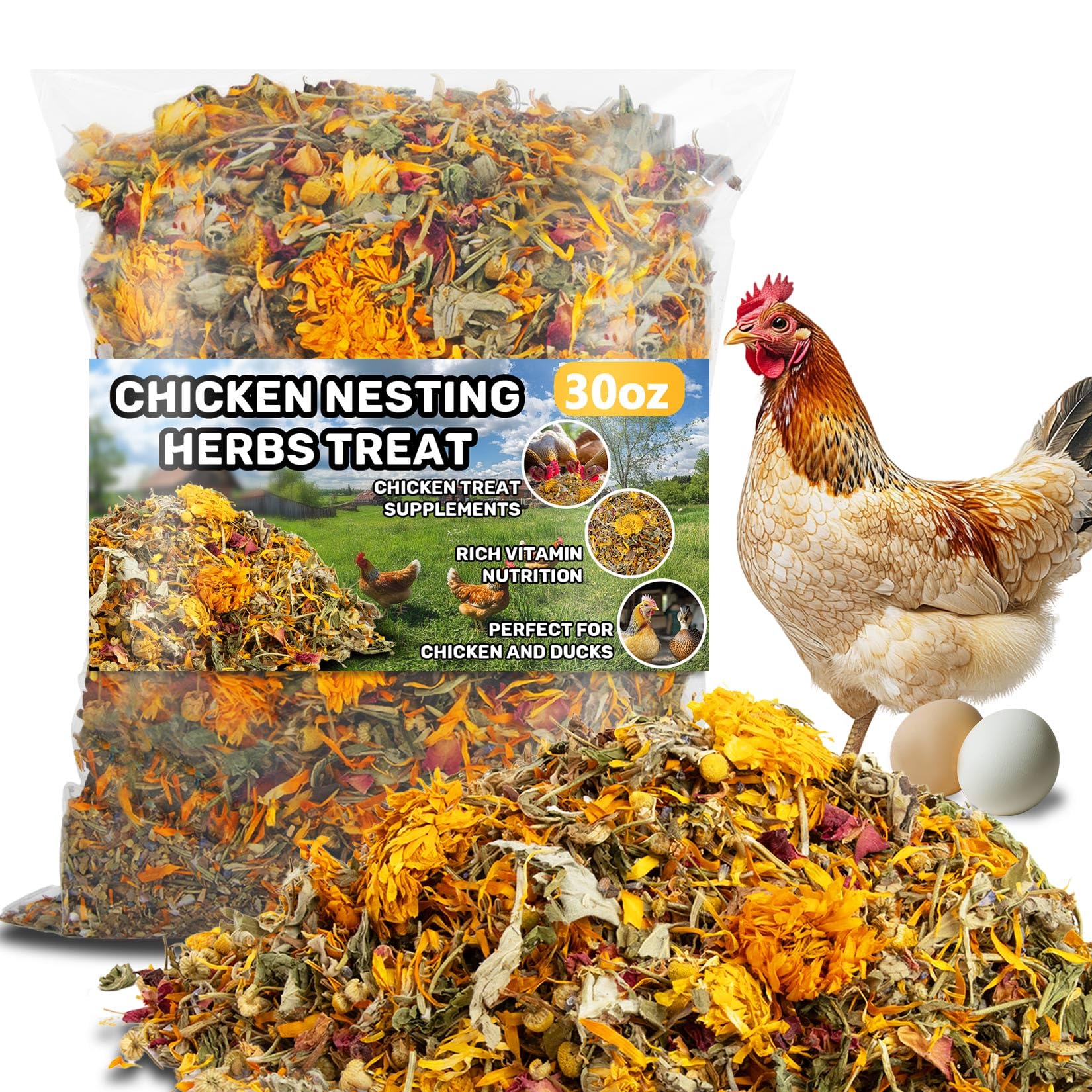
MAQIHAN’s 30-ounce blend is the only product on this list that treats odor management as a secondary benefit to flock enrichment. The 10-ingredient mix — basil, dandelion, calendula, chamomile, oregano, lavender, rosemary, and crushed oyster shells — is intended for sprinkling inside nesting boxes, into dust bath areas, or mixed lightly into feed. The herbal volatiles (linalool from lavender, carvacrol from oregano, 1,8-cineole from rosemary) produce a fresh, mildly spicy aroma that overlays the barnyard scent of the coop without attempting to chemically neutralize ammonia.
Owner feedback consistently highlights two unexpected outcomes: hens actively scratch and fluff the herbs into their nesting material, which appears to reduce egg breakage and keeps hens settled on the nest longer. The crushed oyster shells also provide a calcium boost for layers that peck at the bedding. Many reviewers note that the herbs arrive vacuum-packed flat, retaining essential oil content better than loose-filled bags. The herbal scent lasts roughly three to five days before fading, depending on ventilation and humidity.
This is not a standalone solution for a coop with high ammonia buildup — if your deep litter is already generating strong fumes, the herbs will mask them for only a short window. Use this after a full cleanout as a maintenance layer, or in coops where odor is already under control but you want a more pleasant environment for both birds and keeper.
Why we love it
- Dried flowers and herbs retain natural essential oils for a genuine botanical scent
- Crushed oyster shell adds dietary calcium for laying hens
- Encourages natural nesting behaviors and reduces egg breakage
Good to know
- Provides scent overlay rather than chemical ammonia neutralization
- Scent fades within 3–5 days; requires regular reapplication
3. Coir Wonder Activated Charcoal 2.2lb
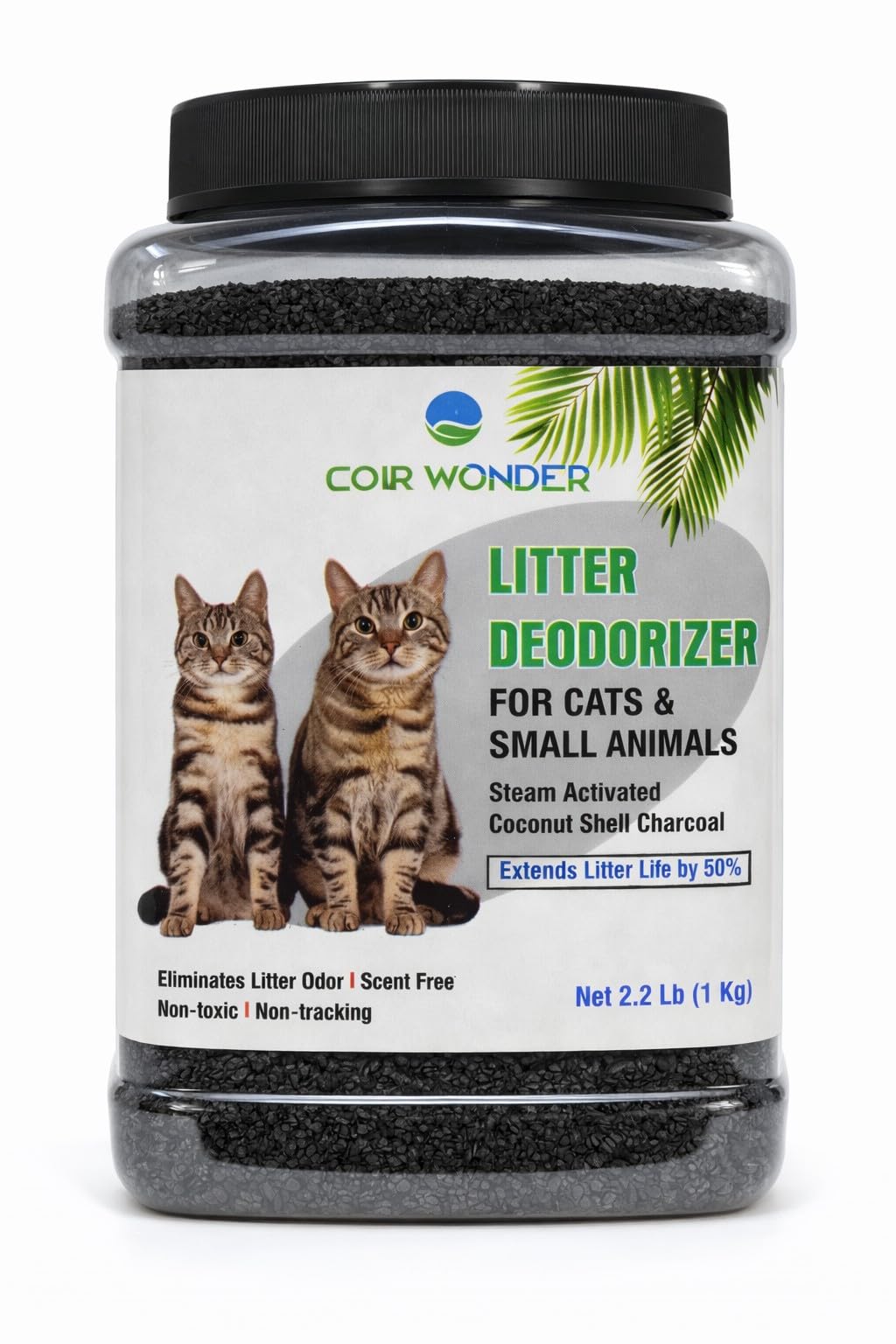
Coir Wonder takes a fundamentally different approach from the probiotic and herbal options: its activated charcoal is produced by steam-treating coconut shell at high temperature, creating an exceptionally porous carbon structure with a vast internal surface area — roughly 1,000 square meters per gram. This carbon lattice physically adsorbs ammonia, hydrogen sulfide, and other volatile organic compounds, trapping them inside the pore spaces rather than allowing them to off-gas into the coop air.
At 2.2 pounds, the jar is compact but the carbon is incredibly lightweight, so a little goes a long way. Owners report using roughly a quarter cup per fresh bedding change in a standard 4×6 coop and noticing immediate odor reduction that persists for two to three weeks. The black granules are unscented — there is no fragrance added — so what you smell is genuinely the absence of odor rather than a perfume overlay. A notable advantage for multi-pet households is that this same product works in cat litter boxes, small animal cages, and even garbage cans, making it a versatile single purchase.
The main drawback is that activated carbon is purely passive: it does not prevent the formation of ammonia in the first place the way probiotics do, nor does it lower litter pH. Once the pore spaces are saturated (typically after three to four weeks of heavy use), the granules stop working and must be replaced. This makes it best suited as a supplementary booster alongside a regular cleaning schedule rather than a substitute for litter management.
Why we love it
- Steam-activated coconut carbon traps ammonia molecules inside its pore structure
- Unscented and chemical-free — no risk of respiratory irritation
- Works across cat litter, small animal cages, and chicken coops
Good to know
- Passive absorption only; does not prevent ammonia generation
- Granules saturate after 3–4 weeks and require full replacement
4. Sweet PDZ Pet Deodorizer 3.5lb

Sweet PDZ is the most straightforward entry on this list — a single-ingredient natural mineral (clinoptilolite zeolite) that functions as a molecular sieve. The zeolite crystals carry a negative charge that attracts positively charged ammonium ions, pulling them out of the air and locking them within the mineral lattice. There are no probiotics, no organic acids, no essential oils — just the raw absorption power of volcanic rock that has been milled to a fine powder.
Owners who switch from scented chemical deodorizers to Sweet PDZ often remark that they finally understand what “odor elimination” actually means — the ammonia smell does not get covered up, it simply disappears. The powder form is effective for working into deep litter because it coats individual bedding particles, but several reviews mention noticeable airborne dust during application. A light misting of water over the bedding before sprinkling can mitigate this. The 3.5-pound bag lasts a surprisingly long time because zeolite does not degrade or expire — you only need to replace it when physical saturation occurs, which for a small flock can mean several months per bag.
The product is also marketed heavily toward horse stall and cat litter use, and the labeling cross-references those applications more prominently than poultry. It is fully safe for chickens, but new flock owners should confirm they are applying it to the litter rather than directly onto birds or into feed, as the fine powder can be drying to the respiratory tract if inhaled in large quantities.
Why we love it
- Single-ingredient zeolite — no fillers, fragrances, or unnecessary additives
- Extremely cost-effective per application; powder lasts months
- Converts ammonia-saturated material into nutrient-rich compost component
Good to know
- Powder form generates visible dust during application
- No biocontrol mechanism — requires regular litter management
5. FLOCKLEADER Healthy Coop 6lbs
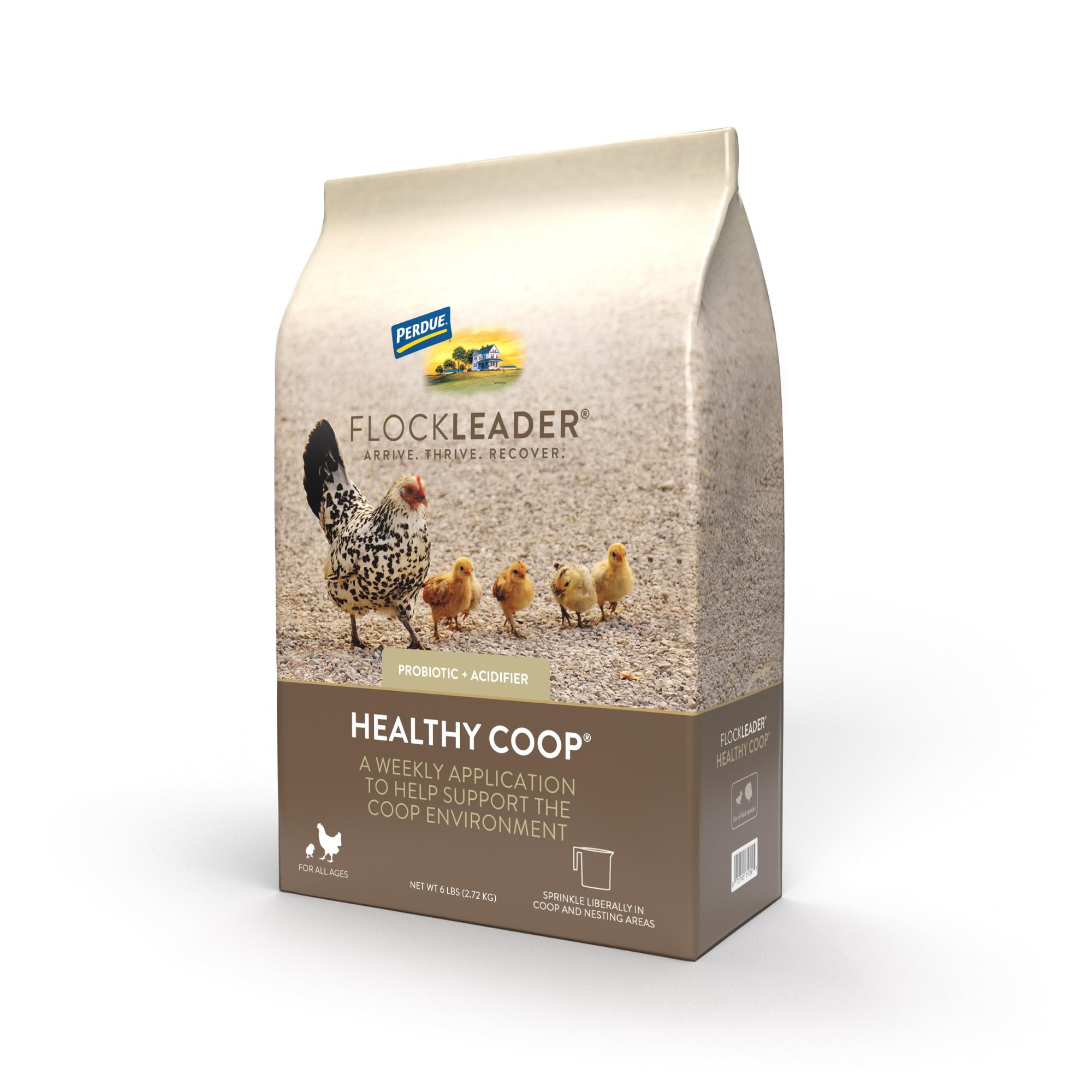
The 6-pound bag of FLOCKLEADER Healthy Coop contains the exact same probiotic-zeolite-acid blend as the 12-pound version reviewed above — live Bacillus bacteria, natural zeolite crystals, and food-grade organic acids — but in a smaller format that works better for flocks of under 10 birds or for keepers who want to test the product before committing to a larger investment. The ingredient proportions are identical, so the application rate remains a light sprinkle around roosting and nesting areas once per week.
Reviewers with small backyard flocks of 4 to 8 hens consistently report that the 6-pound bag lasts roughly 6 to 8 weeks with weekly application, which aligns well with the live probiotic’s optimal usage window. Multiple owners note that the product dries out damp bedding noticeably within 24 hours of application, which is the zeolite component at work rather than a fragrance effect. The unflavored, unscented composition means there is no perfumed smell to mask ammonia — the odor simply stops forming because the bacteria are consuming the nitrogen before it can volatilize.
The only real downside versus the larger bag is the higher per-ounce cost, which is typical for smaller packaging. If you have a flock of 12 or more birds that goes through product quickly, the 12-pound bag delivers better economy. For anyone with a half-dozen hens or a mixed flock of bantams, this size avoids the problem of losing probiotic viability before the bag is empty.
Why we love it
- Identical triple-action formula as the larger bag — no compromise on performance
- 6–8 week supply for small flocks matches probiotic shelf life
- Dries damp bedding within 24 hours via zeolite absorption
Good to know
- Higher per-ounce cost than the 12lb bag
- Flocks over 12 birds will burn through this too quickly
FAQ
Can I use cat litter deodorizer in my chicken coop?
How often should I apply coop deodorizer for best results?
Will deodorizer affect my chickens’ egg taste or smell?
Can I make my own chicken coop deodorizer at home?
Do deodorizers work in winter when coops are closed up tight?
Final Thoughts: The Verdict
For most backyard flock owners, the best chicken coop deodorizer winner is the FLOCKLEADER Healthy Coop 12lbs because its triple-action of live probiotics, zeolite absorption, and organic acid pH control delivers continuous odor reduction between weekly cleanouts without relying on fragrances. If you want a natural mineral-only solution that converts spent litter into compost, grab the Sweet PDZ 3.5lb. And for enriched nesting boxes that double as flock enrichment, nothing beats the MAQIHAN 30oz Herbal Blend.