
Thin eggshells and inconsistent laying are the two signs your flock isn’t getting what it needs from the bag you’re pouring. Layer feed isn’t just protein percentages — it’s the precise calcium-to-phosphorus balance, the digestibility of the grain matrix, and whether those omega-3s actually make it into the yolk. The wrong formula leaves you with broken eggs and a flock that stops earning its keep.
I’m Mo Mahin — the founder and writer behind Furric. I analyze feed formulations by comparing crude protein levels, calcium content, ingredient sourcing, and additive efficacy while cross-referencing hundreds of verified owner reports to separate marketing claims from measurable egg output.
After evaluating five distinct layer feeds across mid-range and premium price tiers, I’ve identified the one formula that consistently delivers thick shells, rich yolks, and steady production without unnecessary fillers. Here is my pick for the best chicken feed for layers you can order right now.
How To Choose The Best Chicken Feed For Layers
Selecting a layer feed is about matching the hen’s physiological demands to the bag’s guaranteed analysis. A 20-week-old pullet starting to lay needs a different mineral profile than a two-year-old production hen. Here are the three specs to check before you buy.
Crude Protein And Amino Acid Profile
Layer feeds should sit between 16% and 18% crude protein. Below 16%, egg production drops noticeably. Above 18%, you’re paying for excess that gets excreted. The amino acid methionine is the limiting factor for egg size — check that the feed lists added methionine or includes high-methionine ingredients like sunflower meal or flaxseed.
Calcium Content And The Oyster Shell Factor
A laying hen needs 3.5 to 4.5 grams of calcium daily to produce one egg with a strong shell. Most complete layer feeds contain around 3.5% to 4% calcium. If your feed includes oyster shell pieces, the calcium is more bioavailable than limestone powder alone. Feeds with an “Oyster Strong System” or similar calcium fortification reduce cracked eggs noticeably.
Form: Pellets vs Crumbles vs Mash
Pellets minimize selective eating — hens can’t pick out the corn and leave the soybean meal. Crumbles work well for younger layers transitioning from starter. Mash is the least processed but generates the most waste. For a backyard flock, pellets generally deliver the most complete nutrition per pound with the least spillage.
Quick Comparison
On smaller screens, swipe sideways to see the full table.
| Model | Category | Best For | Key Spec | Amazon |
|---|---|---|---|---|
| Prairie’s Choice Layer Formula | Crumble | Hens that prefer crumble texture | 16% Protein, Non-GMO, 25 lb | Amazon |
| Small Pet Select Layer Pellets | Pellet | Premium corn/soy-free nutrition | 18% Protein, No Corn, 20 lb | Amazon |
| Wholesome Harvest Layer Blend | Granule | Small flocks and ducks | 16% Protein, Herbs & Oyster Shells, 10 lb | Amazon |
| Purina Layena Pellets | Pellet | Thick shells on a budget | Oyster Strong System, 25 lb | Amazon |
| Purina Layena+ Omega 3 | Pellet | Omega-3 enriched eggs | 250 mg Omega-3 per egg, 40 lb | Amazon |
In‑Depth Reviews
1. Prairie’s Choice Non-GMO Backyard Chicken Feed – Layer Formula, 25 lbs

Prairie’s Choice delivers a 16% protein crumble that is non-GMO, antibiotic-free, non-medicated, and gluten-free — a clean label that resonates with keepers who want minimal processing in their flock’s diet. The crumble form is ideal for hens that are 16 to 18 weeks old or older who are transitioning into full lay, as the smaller particle size encourages intake without the sorting behavior pellets sometimes trigger.
Owner reports consistently highlight one outcome: egg size increases noticeably within days of switching to this feed. Multiple long-term users who have purchased the formula for several years report that their hens resumed laying after a slump when they moved from major-brand feed to Prairie’s Choice. The 25-pound bag size is practical for flocks of six to ten hens, lasting roughly three weeks depending on consumption rates.
The only real friction point involves acceptance speed — some hens initially pick around the corn pieces, leaving them behind while eating the rest. This selective eating usually resolves within a few days as the flock adjusts. For the combination of clean ingredient sourcing, reliable production response, and mid-range cost per pound, this crumble earns the top spot.
Why we love it
- Non-GMO and antibiotic-free formula that impresses owner health standards
- Multiple verified reports of hens resuming laying or increasing egg size
- Grown, milled, and packaged in the USA for supply chain traceability
Good to know
- Some hens initially pick out corn pieces before eating the rest
- Crumbles may generate slightly more dust than pellets in the feeder
2. Small Pet Select Chicken Layer Feed Pellets, 20 lb

Small Pet Select takes a fundamentally different approach by eliminating corn and soy entirely — two ingredients that dominate nearly every other layer feed on the market. The protein base comes from sunflower, pumpkin, and flax seeds, pushing crude protein to 18%. This composition is especially useful for keepers who want soy-free eggs for their own consumption or for neighbors with soy sensitivities, since feed ingredients directly carry over into the egg.
Verification of freshness is immediate when you open the bag: owners routinely describe the aroma as noticeably fresher and cleaner than commodity feeds, with minimal dust or fines at the bottom. The inclusion of botanicals and probiotics supports digestive health, which manifests in consistent droppings and fewer digestive upsets during seasonal transitions. One experienced keeper reported that the yolks turned a deep mango hue and developed a buttery flavor profile within a week of switching to this pellet.
The trade-off is packaging reliability. Multiple buyers reported that the bag arrived inside a cardboard box that was not fully sealed, resulting in feed spillage during transit. Storing the bag in a sealed metal or plastic container indoors is recommended to protect the freshness you’re paying for. At roughly double the cost per pound of basic layer feed, this is an investment in ingredient transparency.
Why we love it
- True corn-free and soy-free formula — rare among layer feeds
- 18% protein from premium seeds produces deeply colored yolks
- Probiotics and botanicals support flock digestion effectively
Good to know
- Cardboard box packaging sometimes arrives unsealed, spilling feed
- Premium price per pound; best for small to medium flocks
3. Wholesome Harvest Non-GMO Whole Grain Layer Blend, 10 lb
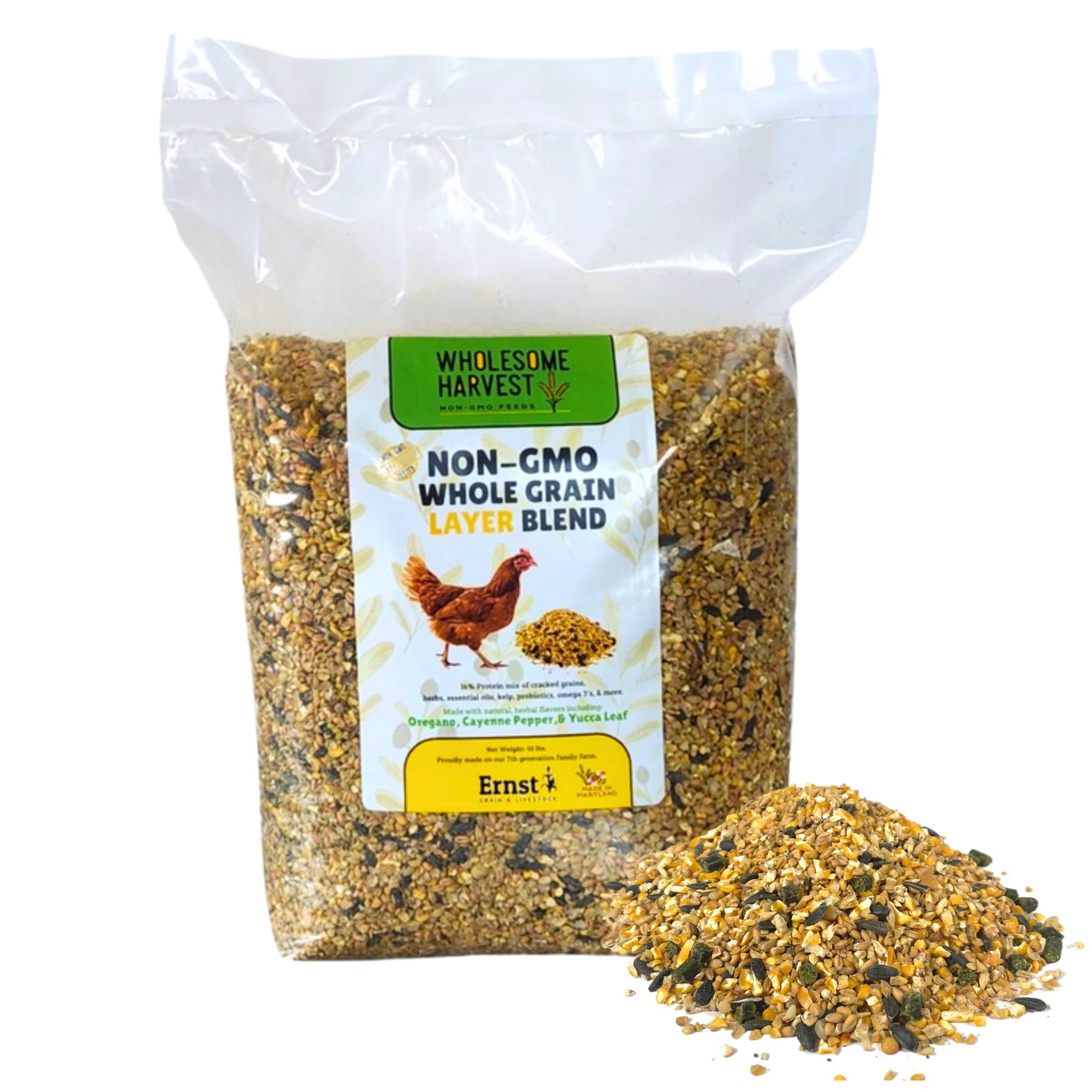
Wholesome Harvest packs a surprising amount of functional ingredients into a small 10-pound bag. The cracked grain blend includes corn, soybeans, wheat, and barley, but the differentiator is the addition of essential oils, herbs, and oyster shell pieces integrated directly into the mix. This means the calcium source is already in the feed, which simplifies things for keepers who don’t want to manage a separate oyster shell supplement bowl.
The omega-3 enrichment from linseed (flax) oil shows up in the yolk quality — owners report visible improvements in yolk color and shell thickness within the first few bags. The 16% protein level is appropriate for standard laying breeds, and the granule form lands between a mash and a crumble, which works well for both chickens and ducks. Verified purchasers noted that bantam breeds make the bag last noticeably longer due to lower daily intake.
The primary limitation is bag size. A 10-pound bag moves quickly with a flock of six or more standard-size layers, and the cost per pound is higher than the 25-pound options from Prairie’s Choice or Purina. This feed is best suited for small backyard flocks of two to four hens, or as a supplementary rotational feed to break up monotony. The consistent positive feedback across over thirty repeat purchases suggests the formula itself is extremely reliable.
Why we love it
- Oyster shell pieces already blended into the feed — no separate calcium needed
- Essential oils and herbs add variety that hens actively prefer
- Consistent quality across 31+ purchases with no mold or rancidity reported
Good to know
- 10-pound bag size requires frequent reordering for larger flocks
- Cost per pound is higher than commodity 25-pound layer feeds
4. Purina Layena+ Omega 3 Formula, 40 Pound Bag
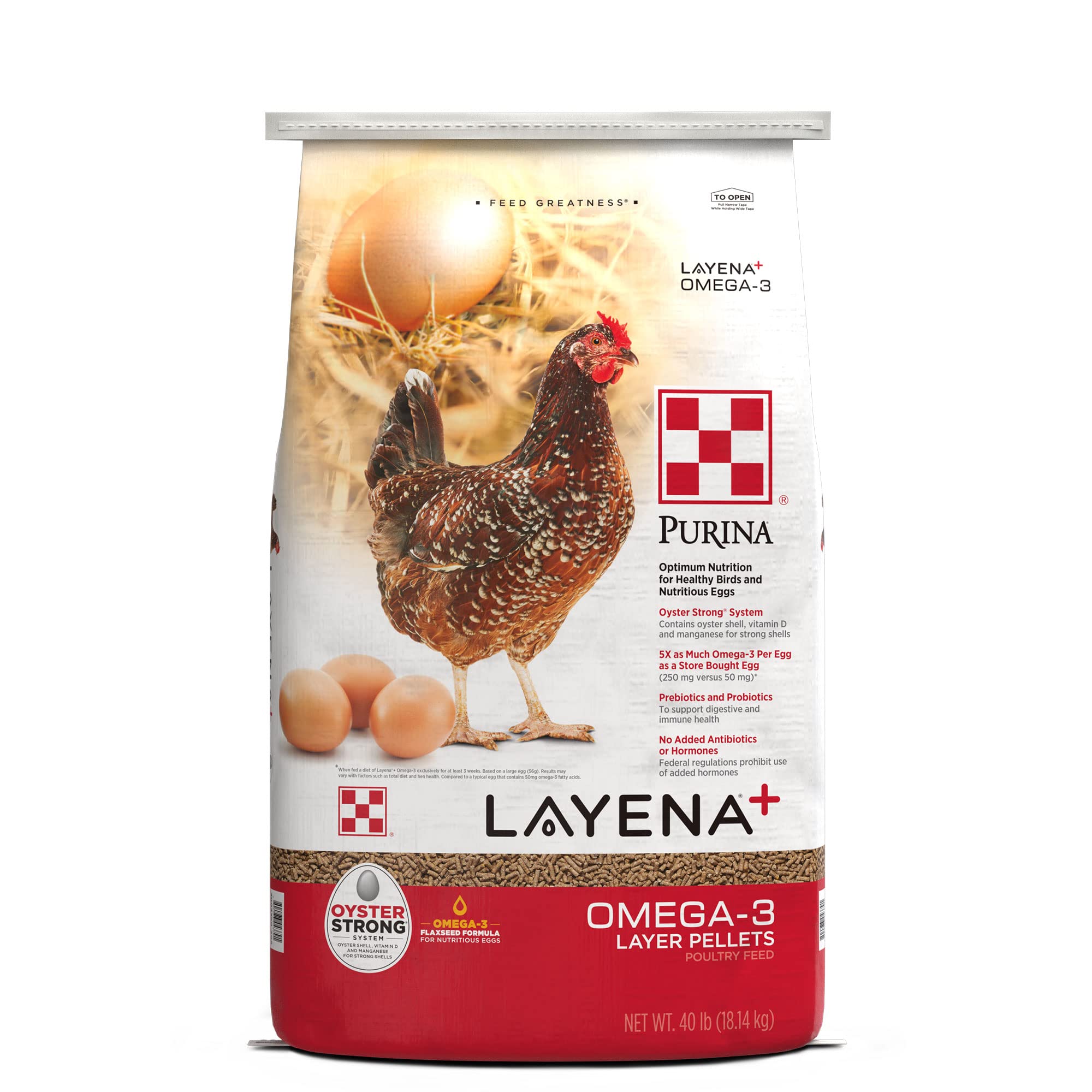
Purina Layena+ upgrades the standard Layena formula by adding omega-3 fatty acids at a level that actually transfers into the egg. The claim is 250 milligrams of omega-3 per large egg compared to roughly 50 milligrams in a standard store-bought egg. For keepers who eat their own eggs or sell to health-conscious customers, this measurable nutritional boost is a genuine differentiator that no other feed in this lineup matches.
The 40-pound bag size is the largest in this review, making it the most economical option for flocks of ten or more layers. The Oyster Strong System carries over from the standard Layena formula, so shell quality remains consistent. Owners consistently report thick shells and dark yellow yolks, with many setting up auto-reorder subscriptions because the product is a staple that maintains a reliable output profile.
Availability is the main drawback — the product goes out of stock frequently, which forces keepers to either stock up when available or maintain a backup feed. Packaging damage during delivery is also reported occasionally, though this seems tied to shipping carrier handling rather than bag construction. For keepers targeting omega-3 enriched eggs from a large flock, this pellet delivers a proven formulation at a competitive per-pound value.
Why we love it
- Proven omega-3 transfer to eggs (250 mg per egg claim)
- 40-pound bag offers the lowest cost per pound for large flocks
- Oyster Strong System maintains thick shells reliably
Good to know
- Frequently out of stock — plan ahead with a backup feed
- Packaging may arrive damaged during shipping
5. Purina Layena Pellets, 25 lbs

Purina Layena in the 25-pound pellet format is the benchmark entry-point layer feed — widely available, consistently formulated, and proven across millions of hens. The Oyster Strong System delivers a steady calcium supply that shows up in the shell thickness data owners report: hard, thick shells that resist cracking during collection and handling. Keepers with small backyard flocks routinely describe this feed as a reliable workhorse that produces predictable results.
The pellet form reduces waste significantly compared to crumbles or mash, which is a meaningful advantage for keepers who dislike sweeping up fines around the feeder. Owners specifically note that their chickens eat the pellets eagerly, and the uniformity of the pellet size prevents selective consumption. The five-star rating across hundreds of reviews reflects the consistency of the formula — it works the same way bag after bag, which is exactly what a keeper needs from a daily staple feed.
The limitation is the nutritional ceiling. There are no added probiotics, no omega-3 enrichment, and no herbal inclusions. It is a solid, complete layer feed that meets minimum nutritional requirements without extras. If your flock has specific needs — soy-free, corn-free, or boosted omega-3 — this feed won’t address them. But for straightforward, budget-conscious feeding of standard layers, this pellet gets the job done without surprises.
Why we love it
- Oyster Strong System produces consistently thick, crack-resistant shells
- Pellet form minimizes waste and selective eating
- Widely available and easy to set up on subscription auto-delivery
Good to know
- No added probiotics, omega-3, or herbal ingredients
- Not suitable for keepers seeking corn-free or soy-free options
FAQ
Can I feed layer feed to my pullets before they start laying?
Why are my hen’s eggshells thin even with a layer feed?
How much layer feed should I give per hen daily?
What is the difference between medicated and non-medicated layer feed?
Final Thoughts: The Verdict
For most backyard keepers, the chicken feed for layers winner is the Prairie’s Choice Layer Formula because it delivers non-GMO, antibiotic-free nutrition in a crumble that hens accept readily while producing measurably larger eggs. If you want corn-free and soy-free ingredients with deep yolk color, grab the Small Pet Select Layer Pellets. And for the largest flock at the lowest cost per pound, nothing beats the Purina Layena+ Omega 3 Formula.