
A cleaning robot for hardwood floors must deliver more than suction — it needs precision water control to avoid warping boards, soft bristles that won’t leave micro-scratches, and a smart map that respects your area rugs. The wrong choice leaves swirl marks, soggy corners, or a vacuum that refuses to climb a threshold.
I’m Mo Mahin — the founder and writer behind Furric. Over the years, I’ve analyzed dozens of robot vac-mop hybrids by comparing LiDAR mapping accuracy, suction curves, mop-pad materials, and real owner feedback across hardwood-focused households.
This guide breaks down the nine best models that balance scratch prevention with deep cleaning power, helping you find the ideal cleaning robot for hardwood floors in your home.
How To Choose The Best Cleaning Robot For Hardwood Floors
Bare hardwood is more vulnerable than tile or vinyl — moisture seeps into seams, grit grinds into the finish, and aggressive brushes can strip protective coatings. When you shop a cleaning robot for hardwood, four specs determine whether your floors stay protected or slowly degrade.
Water Flow & Mop Type
Stationary pad mops simply drag a damp cloth across the floor — they leave a thin, even film of water that evaporates quickly. Rotating mops (two spinning discs) use more water and mechanical scrubbing, which can push moisture into gaps if the robot lingers too long. Look for adjustable water levels or a self-drying base that prevents standing water on the planks.
Brushroll Material
Bristle brushrolls, common on traditional vacuums, trap sand and grit that act like sandpaper on hardwood finish. Soft rubber rollers or silicone flaps glide over bare floors without scratching while still flicking debris into the dustbin. If your home has solid or engineered hardwood, avoid any model with stiff bristle rows.
Obstacle & Threshold Climbing
Hardwood rooms often have transition strips (wood to tile or carpet) that sit 15–20 mm high. A robot that struggles to climb will strand itself on a rug or refuse to enter the kitchen. Models with larger wheels or active suspension handle transitions better, but check the stated climb height in millimeters before buying.
Navigation & No-Go Zones
Random-bounce robots clean hardwood less efficiently and are more likely to bump into baseboards repeatedly. LiDAR-based units map the room in minutes and let you draw virtual no-go zones, protecting pet bowls, charging cables, or delicate furniture legs. For multi-room hardwood layouts, a saved map eliminates re-scans every cycle.
Quick Comparison
On smaller screens, swipe sideways to see the full table.
| Model | Category | Best For | Key Spec | Amazon |
|---|---|---|---|---|
| DREAME L10s Ultra Gen 2 | Premium | Deep mopping & self-cleaning | 10,000 Pa suction, 240-min battery | Amazon |
| eufy E25 | Premium | Always-clean roller mop & edge cleaning | 20,000 Pa suction, 125-min runtime | Amazon |
| Shark Navigator RV2120AE | Premium | Bagless self-empty for pet owners | LiDAR row-by-row, 120-min battery | Amazon |
| Shark Navigator AV2110S | Mid-Range | Smart mapping & anti-hair wrap | LiDAR navigation, 120-min battery | Amazon |
| uninell UR3 | Mid-Range | High suction on carpet & hardwood | 7,000 Pa suction, 180-min battery | Amazon |
| SHELIKI D60S MAX | Mid-Range | Long runtime & quiet cleaning | 220-min battery, 6,000 Pa suction | Amazon |
| KILGONE G20 | Mid-Range | Ultra-slim under low furniture | 2.8 in height, 2-hr runtime | Amazon |
| Tikom L8000 Plus | Budget-Friendly | Best value with self-emptying base | 6,000 Pa suction, 150-min run time | Amazon |
| KILGONE SDL40 | Budget-Friendly | No-tangle brush for long hair homes | 6,000 Pa suction, 200-min battery | Amazon |
In‑Depth Reviews
1. DREAME L10s Ultra Gen 2

The DREAME L10s Ultra Gen 2 is the flagship hardware for homeowners who want a fully autonomous cleaning station — it empties its own dust, washes and dries its mop pads with warm air, and refills its own water tank from a 4.5-liter base reservoir. The DuoScrub rotary mops spin at high speed to loosen sticky spills on sealed hardwood while the adjustable mop extension reaches into corners and along skirting boards without bumping.
Suction power tops out at 10,000 Pa, which is overkill for bare hardwood but essential if the robot travels onto area rugs or low-pile carpets — the ultrasonic carpet sensor detects the transition and lifts the mops automatically so the pad doesn’t wet your wool or sisal. The 5,200 mAh battery delivers up to four hours of runtime in Standard mode, covering a full-floor run without needing a mid-session recharge.
On hardwood specifically, the ability to set custom suction and water levels per room via the app means you can apply a light mist on the living room planks and ramp up to full power in the tiled kitchen. Pet owners will appreciate the auto-boost on carpets and the pet-care mode that doubles passes around designated pet areas.
Why we love it
- Self-washing rotary mops prevent dirty water from smearing across hardwood
- Adjustable mop extension catches edges that most robots miss
- 4.5L clean-water tank allows weeks of hands-off mopping
Good to know
- Base station is large (nearly 26 in tall) and needs dedicated floor space
- Occasional sensor calibration issues reported after several months
- Dust bag replacements required every 75 days
2. eufy E25
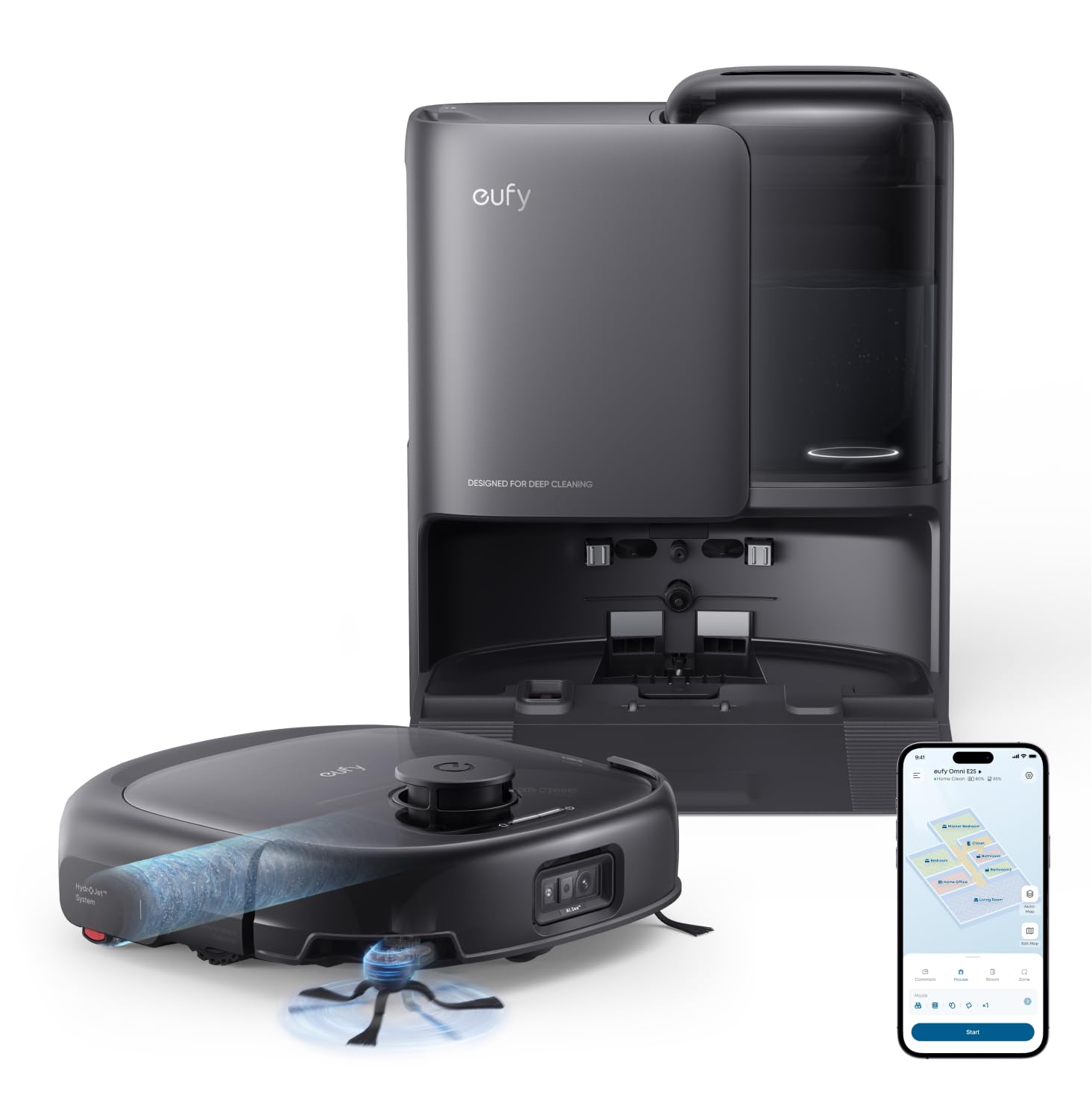
The eufy E25 stands out because it uses a clean-water roller mop that refreshes itself twice per second — instead of pushing a soiled pad across your floors, it continuously flushes dirt into a separate waste compartment. This HydroJet system eliminates the streaks and fine-grit residue that pad mops leave behind on glossy hardwood finishes.
Its 20,000 Pa suction is the highest on this list, lifting grit from grout lines and carpet edges while the CornerRover arm extends to scrub baseboards. The all-in-one station self-empties the 3-liter dust bag, hot-air dries the roller at 50°C, and refills water, so you can run daily cleaning cycles for two and a half months before touching the bag.
Hardwood owners will want to set the no-mop zones carefully — the E25’s mop lift clears carpet by only 10.8 mm, which is adequate but less margin than the DREAME’s full retraction. The zero-tangle DuoSpiral brush handles long hair without wrapping, and the 125-minute runtime covers most open-plan layouts in one session.
Why we love it
- Self-refreshing roller avoids spreading dirty water across hardwood
- CornerRover arm scrubs baseboards and furniture legs
- Hot-air drying prevents mold on the mop roller
Good to know
- Setup requires removing the top lid to avoid erratic navigation
- Roller brush can tangle if pets shed extremely long fur
- Some units struggle to return to the charging base reliably
3. Shark Navigator RV2120AE

The Shark Navigator RV2120AE shares the same LiDAR and brushroll platform as the AV2110S but upgrades the self-empty base to hold 60 days of debris in a bagless bin — no disposable dust bags to buy. The Spot LiDAR maps a 2,500-square-foot home in minutes, and the row-by-row cleaning pattern covers 1.5x more area than earlier Shark ION models.
On hardwood, the self-cleaning brushroll engages the floor surface directly without stiff bristles, reducing the chance of micro-scratches. Owners report strong suction on bare floors and reliable obstacle detection that avoids shoe cords, furniture legs, and pet bowls without bumping.
The key trade-off is the 120-minute battery — in a large home, the robot will need to recharge and resume, which can extend total cleaning time. The bagless bin is transparent (non-opaque), so you can see when it’s full, and the HEPA pre-motor filter captures airborne dust that might otherwise settle back onto your polished hardwood.
Why we love it
- Bagless base saves money on replacement dust bags
- 98-99% mapping accuracy with Spot LiDAR
- Self-cleaning brushroll is gentle on hardwood finish
Good to know
- Struggles on all carpet types (low to shag) according to some users
- Single rotating brush leaves more debris near edges
- Needs 3 hours to recharge fully after a deep-cleaning cycle
4. Shark Navigator AV2110S
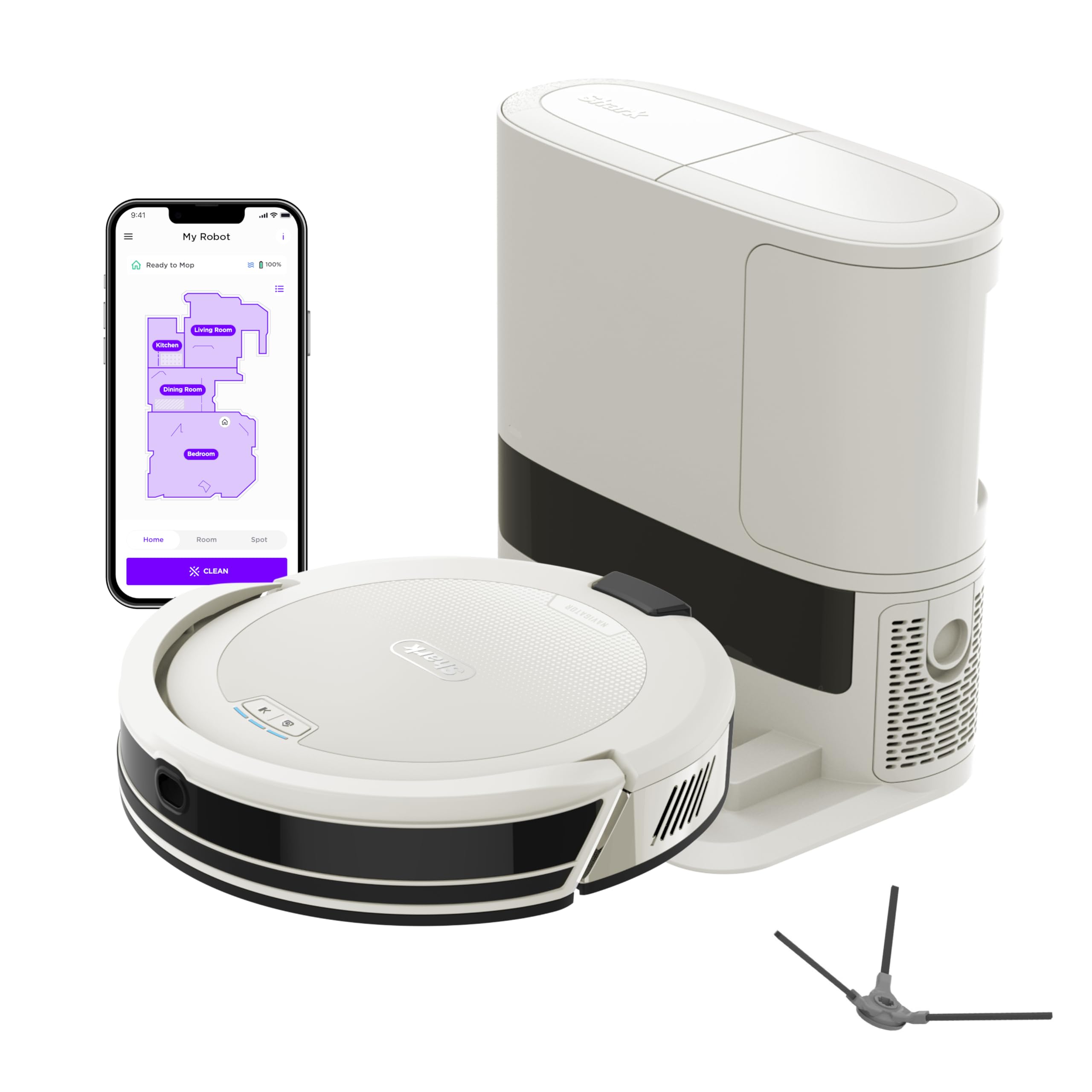
The Shark Navigator AV2110S is the mid-tier entry in the Navigator line, offering the same LiDAR navigation and anti-hair-wrap brushroll as the premium model but with a smaller bagless base that holds 30 days of debris. For a home with 800–1,200 square feet of hardwood, that capacity still means you empty it roughly once a month.
Customer feedback consistently highlights its superior obstacle avoidance — the robot detects objects and adapts its path without bumping into furniture, which matters for hardwood owners who keep delicate floor vases or slender chair legs. The self-cleaning brushroll digs into carpet fibers for owners who have area rugs, and the recharge-and-resume function picks up exactly where it stopped after a mid-job top-up.
On bare hardwood, the robot vacuum performance is strong: fine dust and debris are captured in the bin, and the pre-motor filter prevents particles from recirculating. The main downside reported is that the AV2110S is not effective on medium-to-high-pile carpets — if you have shag or thick rugs, the suction and brushroll struggle to pull embedded dirt.
Why we love it
- Accurate LiDAR mapping with 98-99% coverage
- Self-cleaning brushroll prevents hair wrap on hardwood
- Quiet operation compared to earlier Shark models
Good to know
- Does not perform well on medium or high-pile carpets
- Only one side brush limits edge pickup
- Replacement parts can be difficult to source
5. uninell UR3
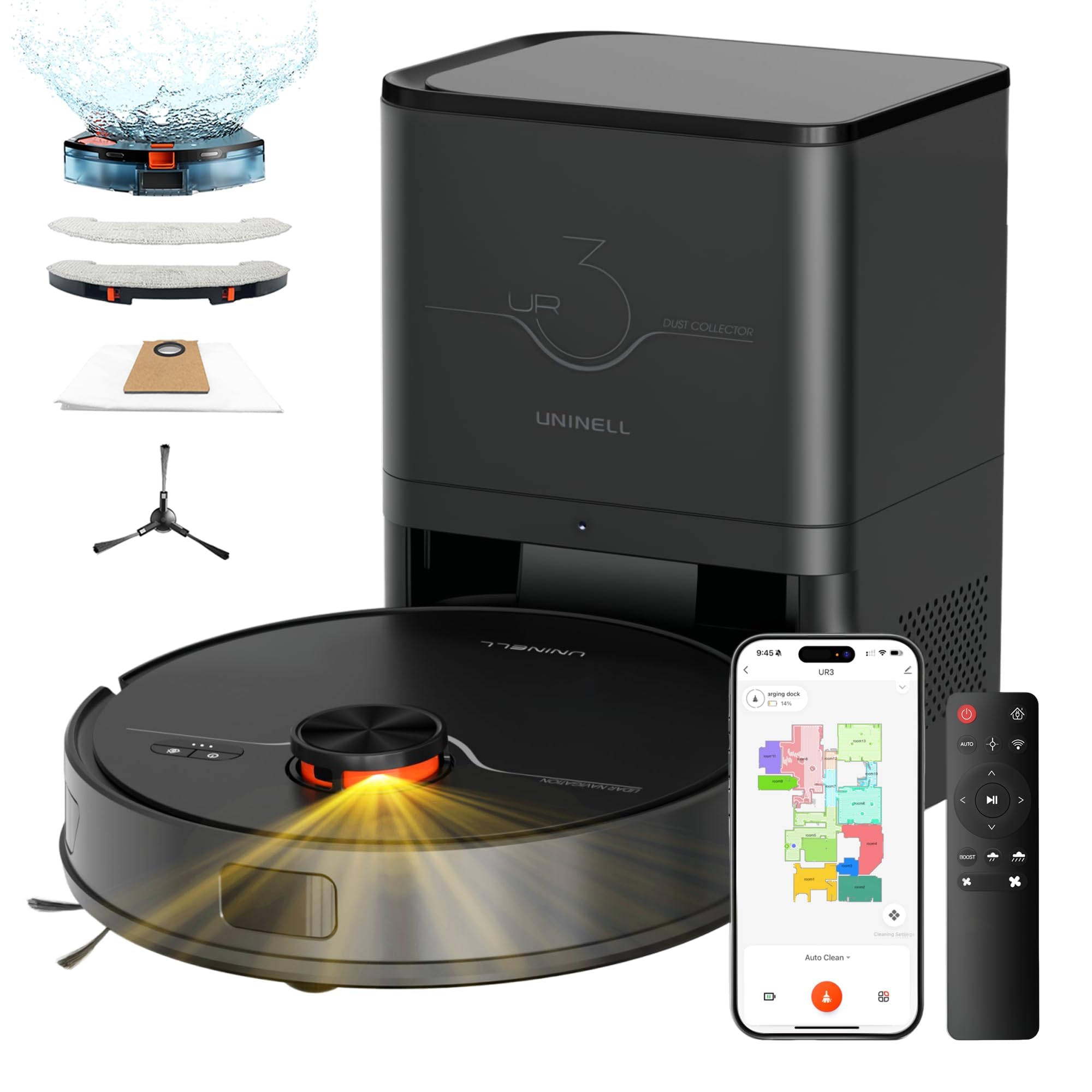
The uninell UR3 packs 7,000 Pa of suction into a self-emptying platform that holds 90 days of debris in a 3.5-liter bag — the largest dust capacity in this price tier. The LiDAR mapping system saves up to five floor plans, so it can switch between your hardwood living room and tiled kitchen without re-scanning.
What sets the UR3 apart for hardwood floors is the tangle-free brush design that actively prevents long hair and pet fur from wrapping around the roller. Homeowners with multiple dogs or long-haired family members report significantly less manual cleanup compared to earlier robots. The auto-carpet boost recognizes when the robot moves from wood to rug and ramps up suction instantly.
The mop function uses a stationary pad — it’s effective for light dust-mopping but won’t scrub stuck-on food or dried footprints. Owners who want a deeper scrub should pair the UR3 with a manual mop every few weeks. The 180-minute runtime covers up to 2,000 square feet on a single charge, and the 65 dB noise level is quiet enough for overnight scheduling.
Why we love it
- 3.5L self-empty bag lasts 90 days even in high-traffic homes
- Tangle-free brush handles long hair without wrapping
- Auto-carpet boost transitions seamlessly from hardwood to rugs
Good to know
- Stationary mop pad only provides a light wipe, not a scrub
- Tends to avoid corners and obstacles rather than clean close to them
- May get stuck on low-hanging cords or clothing on the floor
6. SHELIKI D60S MAX
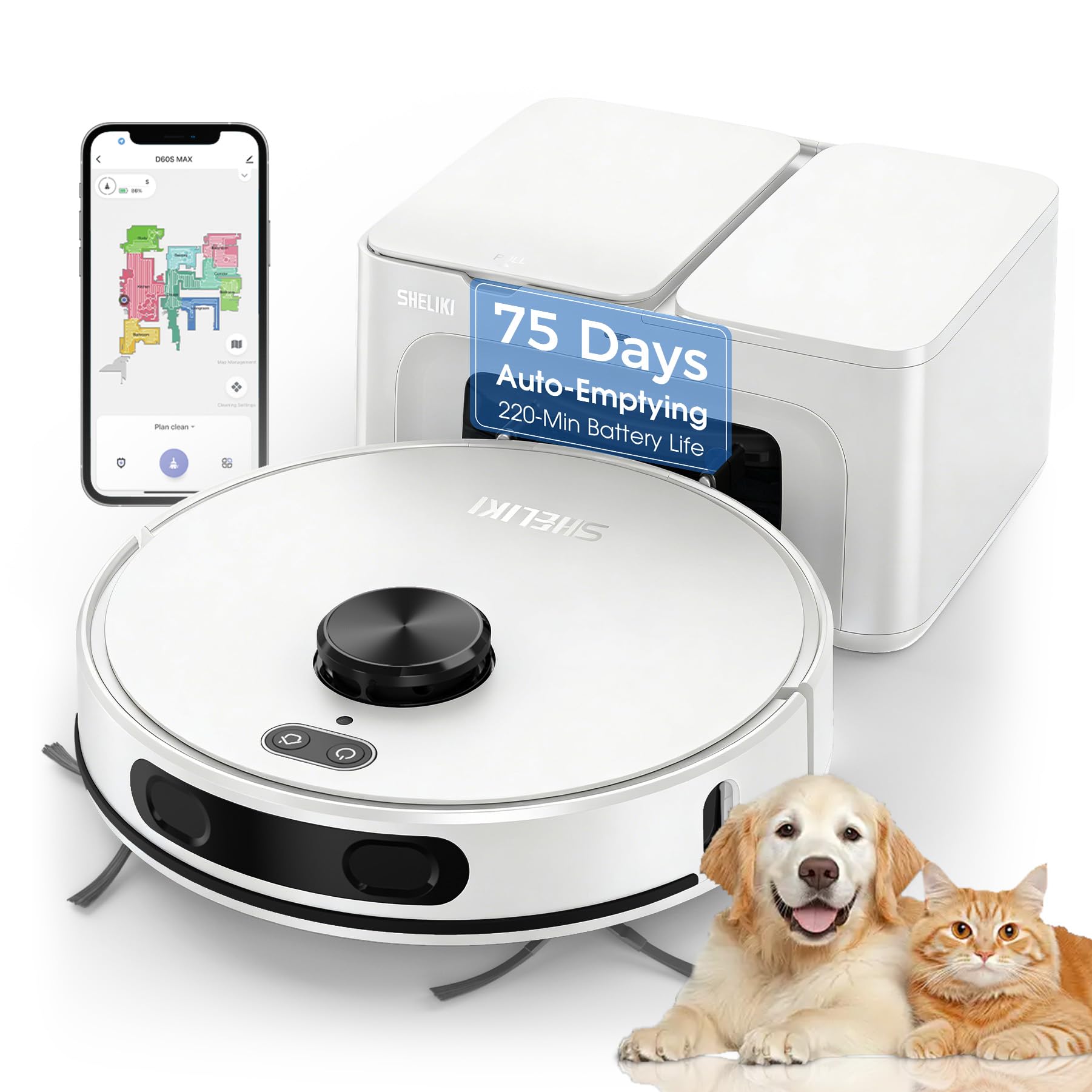
The SHELIKI D60S MAX prioritizes endurance: a 5,200 mAh battery delivers up to 220 minutes in Standard mode, covering roughly 2,200 square feet before needing a recharge. That makes it a top pick for large open-plan homes where hardwood spans the main living areas and the robot must clean in one uninterrupted pass.
LiDAR navigation maps the home in minutes and saves up to five floor plans. The app lets you set no-go zones, split rooms for targeted cleaning, and adjust suction across four levels — 800 Pa in Quiet mode for light daily maintenance, or 6,000 Pa in Max for deep carpet cleaning when the robot visits low-pile area rugs.
The self-emptying base holds debris for up to 75 days before the bag needs replacement. On hardwood, the quiet mode (below 64 dB) is barely noticeable during a workday, and the 3-in-1 sweep-vacuum-mop system picks up fine dust and pet hair without leaving visible residue. Some users note the mapping process takes a couple of runs to perfect, but once trained, the coverage is methodical.
Why we love it
- 220-minute battery cleans large homes without recharging
- Four suction levels let you dial down for daily hardwood maintenance
- Self-emptying base with 75-day capacity minimizes manual work
Good to know
- Mapping may require 2-3 initial runs to lock in an accurate layout
- App occasionally disconnects and requires a re-login
- Dust bags are consumables and must be replaced
7. KILGONE G20

At only 2.8 inches tall, the KILGONE G20 slides under low-clearance furniture that blocks standard robots — think platform beds, low-profile sofas, and mid-century credenzas. This ultra-slim footprint is a practical advantage in hardwood rooms where dust accumulates under furniture that a broom or mop can’t reach.
The 3D obstacle avoidance uses sensors to detect cables, pet bowls, and furniture legs in real time, then navigates a zig-zag path that covers 30% more floor than random-bounce cleaners. On hardwood, the 230 mL electronic mop applies a controlled amount of water, and owners report streak-free results on sealed wood floors.
The 2,600 mAh battery provides two hours of runtime (1,290 square feet per charge), and the companion app offers four modes: Auto, Zig-Zag, Edge, and Spot. For hardwood baseboards, Edge mode sends the robot along walls for targeted pickup. The lack of a self-emptying base means you’ll empty the dust cup after each full-home cleaning — a tradeoff for the compact profile.
Why we love it
- Slim 2.8-inch height cleans under almost any furniture
- 3D obstacle avoidance prevents bumps into delicate hardwood furniture
- Edge mode targets baseboards where dust accumulates
Good to know
- No self-emptying base — requires manual dust cup emptying after each run
- Small 230 mL water tank limits mopping coverage per fill
- Mop pad is stationary, not rotary — limited scrubbing power
8. Tikom L8000 Plus
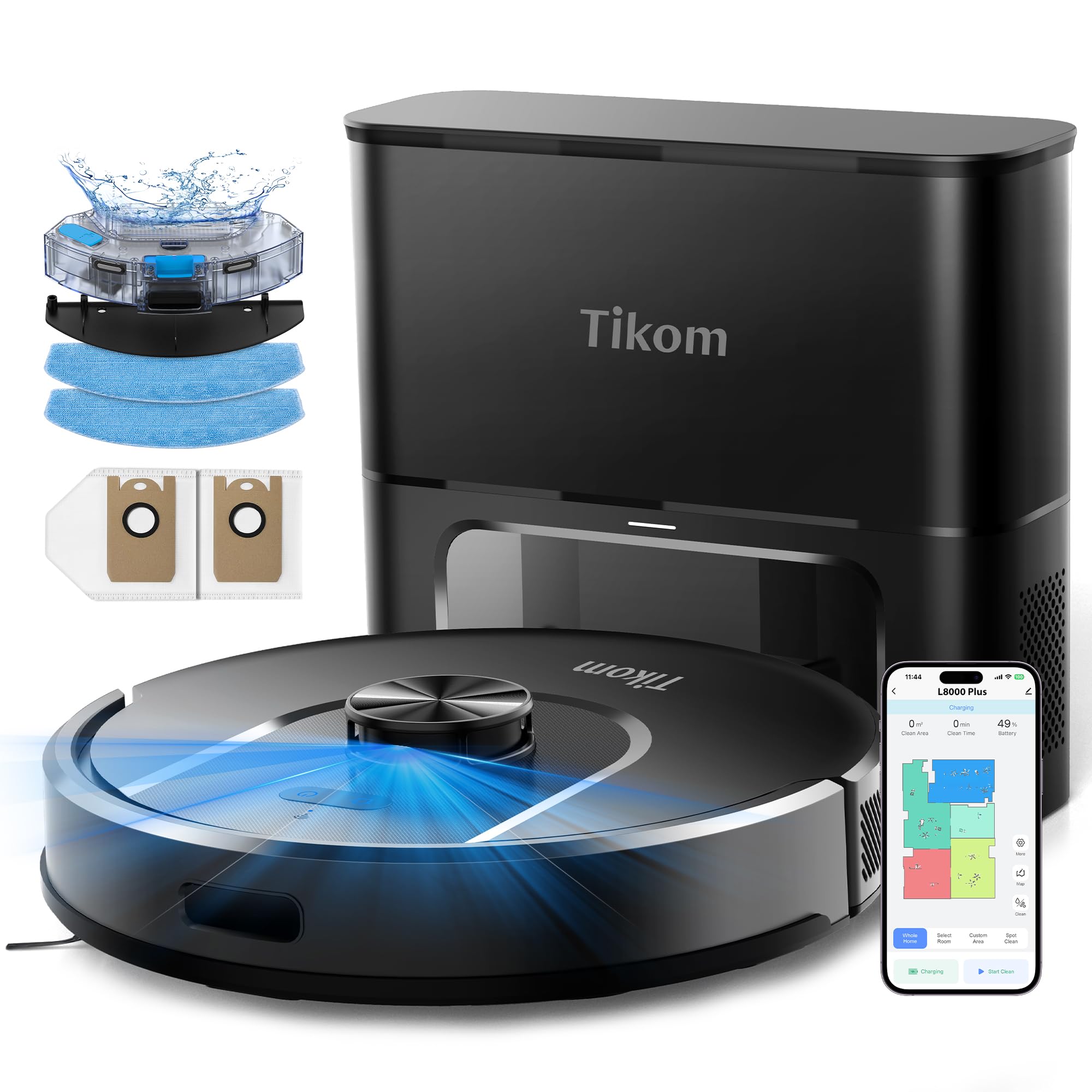
The Tikom L8000 Plus brings a self-emptying base, LiDAR navigation, and 6,000 Pa suction into a package that competes with models costing significantly more. The 3-liter dust bag holds up to 90 days of debris, meaning you interact with the robot roughly four times a year for emptying — ideal for hands-off owners.
On hardwood, the 2-in-1 sweeping and mopping function lets you adjust water flow across three levels to match your floor’s sensitivity. Owner reviews consistently mention strong suction that picks up fine dust and pet hair in one pass, with the LiDAR mapping creating organized cleaning lines rather than random bouncing. The 150-minute run time is sufficient for a mid-sized home.
The L8000 Plus supports no-go zones and no-mop zones via the app, so you can keep the mop pad away from area rugs and avoid wetting the carpet edges. It works with Alexa and Google Assistant, and the dual-band Wi-Fi (2.4 GHz and 5 GHz) gives flexibility for home networks that block older protocols.
Why we love it
- Self-emptying base with 90-day capacity at a budget-friendly price
- LiDAR navigation creates efficient row-by-row coverage
- Adjustable water flow protects hardwood from over-moisturizing
Good to know
- Mop holder must be removed or zoned out to avoid wetting carpet
- Dust bag is a consumable that needs periodic replacement
- Some users report occasional difficulty with the robot re-docking
9. KILGONE SDL40
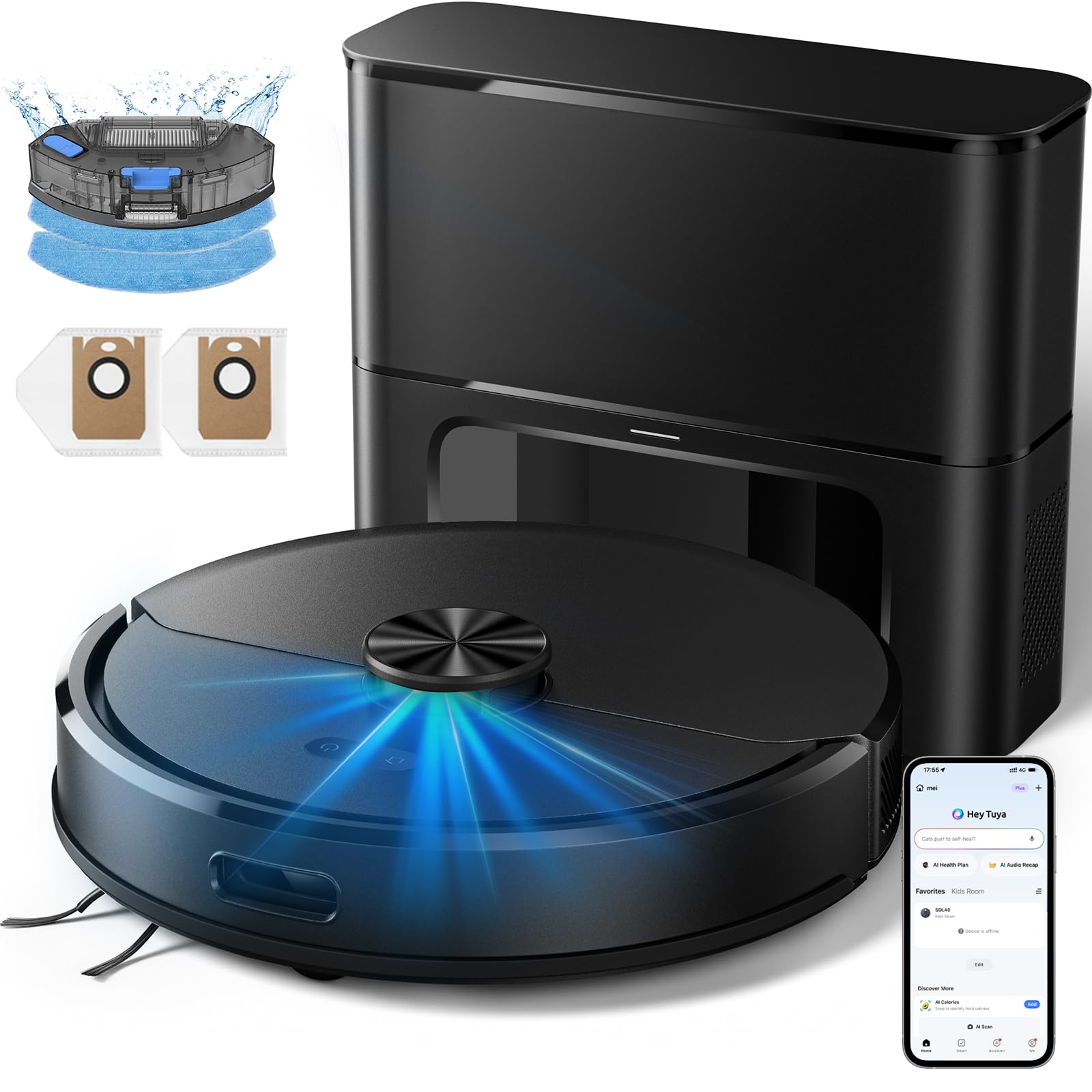
The KILGONE SDL40 focuses on solving one of the most common complaints with robot vacuums — hair wrap. The anti-tangle brush is engineered to prevent long hair and pet fur from spiraling around the roller, so you don’t need to cut away hair after every cleaning cycle. For households with shedding dogs, cats, or long-haired members, this directly translates to less maintenance.
The 6,000 Pa cyclone suction lifts embedded dust and pet dander from hardwood grooves and transitions seamlessly onto low-pile carpets. The self-emptying base holds 2.5 liters of debris (roughly 90 days of capacity), and the dock recharges the robot when the battery runs low. Owners report that the LiDAR mapping works on the first try and creates organized cleaning lines that cover the entire floor area.
On hardwood specifically, the SDL40’s quiet 65 dB operation means you can run it during work hours or while the baby naps. The app supports virtual no-go zones and scheduling, and the 200-minute battery life (in standard mode) covers up to 1,615 square feet per charge. Some users note the robot occasionally struggles to find the charging base in cluttered rooms, but the overall cleaning performance receives high marks.
Why we love it
- Anti-tangle brush eliminates hair wrap on the roller
- 200-minute battery covers large homes in one session
- Self-emptying base with 90-day capacity for minimal interaction
Good to know
- May occasionally struggle to re-dock in cluttered environments
- Stationary mop pad provides light wiping, not deep scrubbing
- Some users note it may need multiple passes in heavily soiled areas
FAQ
Will a robot vacuum scratch my hardwood floors?
How much water is safe for hardwood mopping?
Do I still need to manually mop hardwood if I have a cleaning robot?
What is the best suction power for hardwood floors?
Can a cleaning robot with a mop damage engineered hardwood?
Final Thoughts: The Verdict
For most homeowners, the cleaning robot for hardwood winner is the eufy E25 because its HydroJet roller mop refreshes with clean water every half-second, eliminating the smear pattern that pad mops leave on glossy finishes. If you want a fully autonomous station that washes and dries its own mops, grab the DREAME L10s Ultra Gen 2. And for the best value per dollar with self-emptying convenience, nothing beats the Tikom L8000 Plus.