
If your dog pulls until they cough, lunges at every squirrel, or treats the leash like a tug-of-war rope, you know the frustration of a walk that feels more like a wrestling match. A standard nylon collar gives them a fulcrum to pull against, teaching the wrong lesson with every step. The right restraint system changes the physics of the walk, shifting leverage in your favor without resorting to pain or punishment.
I’m Mo Mahin — the founder and writer behind Furric. I’ve spent years studying canine behavior tools, comparing tension-distribution mechanics across dozens of models, and analyzing verified owner feedback to separate training aids that actually redirect stubborn drive from those that just look serious on a shelf.
Whether your dog is a 75-pound lab puppy who drags you down the block or a reactive German Shepherd who fixes on every passing dog, the best collar for stubborn dogs uses specific mechanical principles — martingale limiting, head-halter redirection, or covered prong pressure — to communicate clearly without choking.
How To Choose The Best Collar For Stubborn Dogs
A stubborn puller requires a collar that changes the dog’s physical leverage, not one that simply tightens uncomfortably. Three main mechanisms dominate this category: martingale loop collars that limit circumferencial expansion, head-halters that steer the entire body by guiding the snout, and covered prong designs that distribute pinch pressure evenly across the neck circumference. The wrong choice wastes money and teaches the dog to resist harder.
Martingale Action vs. Choke Effect
True martingale collars have a fabric loop section that tightens to a fixed maximum circumference — they never close completely around the trachea the way slip chains do. For dogs with necks wider than their heads (greyhounds, huskies, shepherds), a flat collar can slip off during a lunge. A properly fitted martingale prevents escape while providing a clear tactile cue when the dog reaches the end of the leash. Look for models with an integrated chain section that adds audible feedback without compromising the limit stop.
Head-Halter Fit and Nose-Strap Design
Head-halters control the dog’s entire body by attaching the leash to a nose loop rather than the neck. When the dog pulls, the head turns sideways, redirecting forward momentum into a gentle arc. The critical spec here is nose-strap width: wider straps distribute pressure across the bridge of the snout and reduce rubbing. A behind-the-head leash hook prevents the strap from riding up into the dog’s eyes. Dogs need an adjustment period of several short sessions, but once accepted, a head-halter provides remarkable control with virtually no physical force.
Covered Prong Collars and Rubber Tipping
Prong collars use blunt metal prongs that pinch the loose skin on the neck, mimicking the corrective nip of a mother dog. Modern covered versions wrap each prong in a rubber tip and encase the entire chain in a nylon sleeve. This design eliminates the visual stigma of exposed prongs while preserving the tactile correction. The rubber tips prevent the sharp focus of bare metal, distributing pressure over a slightly larger surface area — enough to get the dog’s attention without the “yelp” reaction sometimes caused by uncovered prongs.
Quick Comparison
On smaller screens, swipe sideways to see the full table.
| Model | Category | Best For | Key Spec | Amazon |
|---|---|---|---|---|
| PetsProMax Dog Headcollar | Head-Halter | Dogs that lunge and pull hard with neck strength | 0.75″ padded nose strap; behind-head leash hook | Amazon |
| Anglevate Martingale Collar (Black) | Martingale | Medium breeds that need escape-proof security | 15″-23″ neck range; 1.5″ wide nylon | Amazon |
| Mayerzon Prong Collar | Covered Prong | Strong, stubborn pullers that ignore other collars | Rubber-capped prongs; reflective nylon cover | Amazon |
| Crazy Felix Martingale | Martingale | Large/XL dogs needing one-handed quick release | 19.25″-22″ neck; 1.5″ wide; safety lock buckle | Amazon |
| Anglevate Martingale Collar (Khaki) | Martingale | Small to medium dogs with sensitive necks | 11″-15″ neck range; 1″ wide; neoprene padded | Amazon |
In‑Depth Reviews
1. PetsProMax Dog Headcollar

The PetsProMax Headcollar stands apart from the martingale crowd because it attacks pulling from an entirely different axis — steering the head rather than constricting the neck. The leash attaches to a loop that sits behind the dog’s head, so when the dog surges forward, the nose strap gently turns the head sideways, killing forward momentum without any tracheal pressure. The redesigned metal buckle and reinforced 0.75-inch nose strap address the earlier sizing complaints head-on; the neck collar now spans four distinct size ranges from Medium to XL, and the padded under-panels prevent the rubbing that plagued older head-halters.
Real-world reports from owners of 75-pound lab puppies and 2-year-old German Shepherds describe a 75% reduction in pulling force within the first walk. The double-side feeder buckle lets you center the under-chin hook precisely, which eliminates the annoying strap migration that cheap halters cause. One reviewer noted their dog initially pawed at the nose loop, but after three days of consistent use, the dog accepted it completely and walks became manageable for the whole family.
The conversion feature is a practical bonus — the headcollar can double as a regular walking collar when you unclip the nose loop, saving you from swapping hardware between walks. For owners dealing with reactive lunging or sheer brute force, this design solves the pulling puzzle without the social scrutiny of a prong collar. The padding on the nose band makes it comfortable enough for longer training sessions, and the steel leash hooks show no signs of wear after months of daily use.
Why we love it
- Steers the dog’s entire body by redirecting the head, requiring minimal owner strength
- Padded nose strap prevents the soreness common with thin halters
- Converts to a standard collar for walks without pulling issues
Good to know
- Dogs that paw at their face may loosen the nose loop until adjusted to the snug fit
- Some strong chewers can reach the strap if left unattended
2. Mayerzon Prong Collar for Large Medium Dogs

The Mayerzon Prong Collar solves the two biggest objections to prong collars: visual stigma and discomfort. The entire chain assembly is sheathed in a rugged black nylon sleeve, so from three feet away it looks exactly like a standard flat collar — no exposed metal, no judgey stares from other dog owners. Each stainless steel prong is capped with a soft rubber tip that distributes the pinch over a wider surface area, mimicking the gentle corrective pressure of a mother dog’s mouth rather than the sharp focus of bare metal.
Owners of 85-pound shepherd-husky mixes and 65-pound pitbulls report dramatic turnarounds, often within a single walk. The collar must sit high on the neck, just behind the ears — the standard position for all prong-style corrections. When fitted correctly, the rubber-tipped prongs apply even pressure around the full neck circumference, eliminating the focal-pressure points that cause yelping. One reviewer noted that after their dog yelped once on the first pull, it never pulled again; subsequent walks were calm and controlled.
The quick-release metal buckle is a welcome safety upgrade over the traditional martingale loop that requires slipping over the head. You can snap this open with one hand, which matters when dealing with a reactive dog in a tight hallway. The built-in reflective strip runs the full length of the nylon cover, providing low-light visibility that most prong collars completely ignore. For owners who want the effectiveness of a prong correction without the visual baggage or harsh feel, this is the most thoughtful execution on the market.
Why we love it
- Nylon sleeve hides the prong mechanism for discreet training in public
- Rubber-capped prongs provide corrective pressure without sharp focus points
- Full-length reflective strip improves visibility during low-light walks
Good to know
- Some dogs with thick fur may need the rubber caps removed for clearer contact
- Must be positioned high on the neck, not low on the throat, for correct function
3. Anglevate Martingale Collar (Black, M)
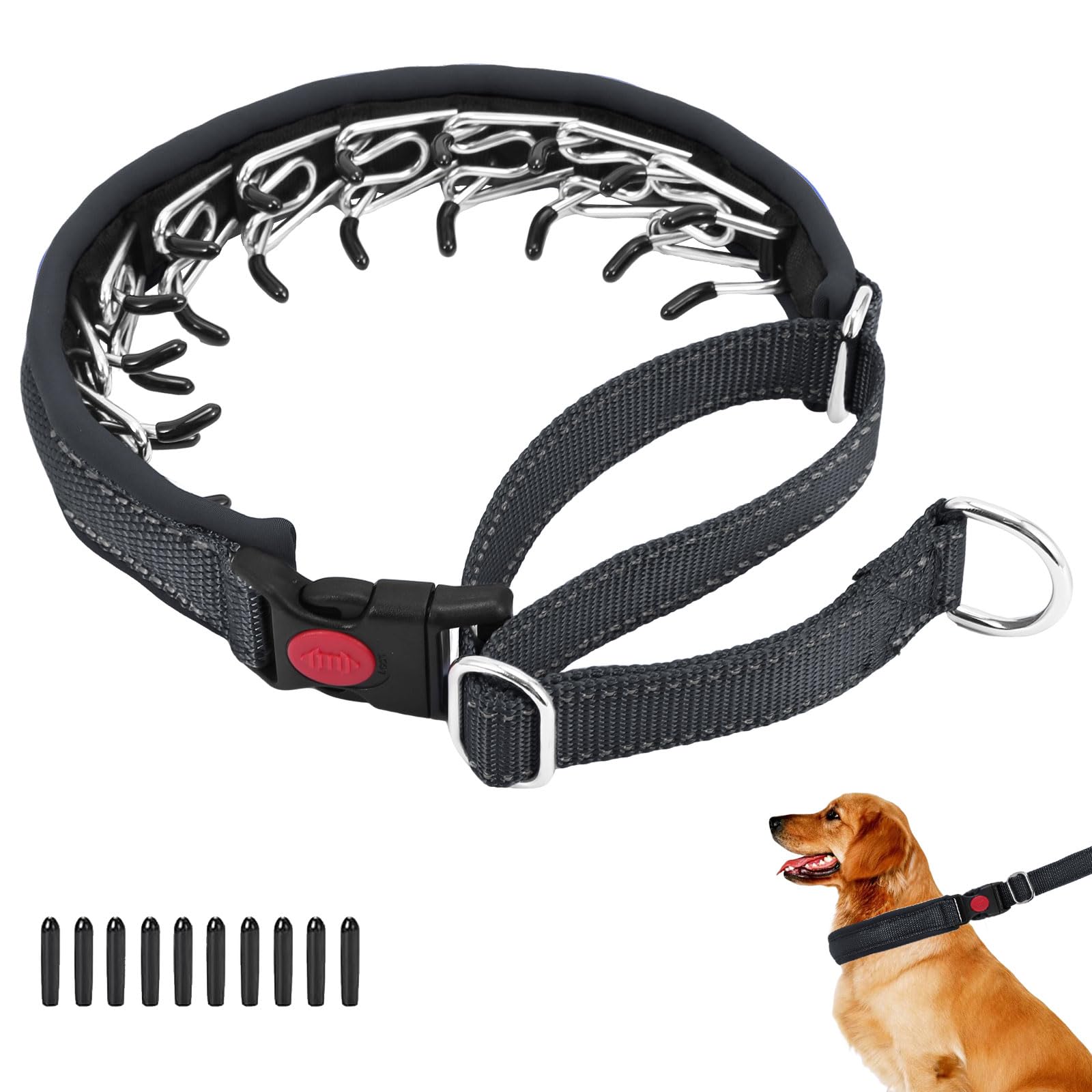
The Anglevate Martingale takes the classic limited-slip design and reinforces it with a stainless steel chain core wrapped in neoprene and nylon. The chain provides audible feedback — the dog hears a soft clink when it reaches the tension limit — while the neoprene padding absorbs shock and prevents the collar from cinching too abruptly. The quick-release buckle is a rare feature on martingale collars, most of which require you to slip them over the dog’s head; here, you can unbuckle the collar for easy removals.
The Medium size covers a 15- to 23-inch neck with a 1.5-inch band width, making it suitable for medium-to-large breeds like German Shepherds, Pitbulls, and standard Huskies. Owner reports consistently praise the rubber-capped chain links that prevent the metal from digging into the dog’s skin, even during sharp corrections. One reviewer who had tried every collar on the market said this was the only one that stopped their dog from pulling — no coughing, no choking, just a clear tactile boundary that the dog respected.
The reflective stitching adds a practical safety layer for evening walks, though it’s less prominent than the full reflective strip on the Mayerzon. The neoprene lining also helps prevent the collar from slipping when wet — a common issue with all-nylon martingale collars. For owners who prefer the martingale mechanism over a head-halter or prong system, this is the most executionally complete option in the mid-range tier, balancing durability, comfort, and safety features that compete with collars costing significantly more.
Why we love it
- Integrated stainless chain provides audible feedback without sharp edges
- Quick-release buckle offers easier removal than traditional martingale slip-on
- Neoprene padding prevents shock-loading when the dog hits the leash limit
Good to know
- The rubber prong caps can loosen with extended use; extras are included
- Some reviewers noted the sizing runs slightly larger than the chart suggests
4. Crazy Felix No Pull Martingale Collar (XL)
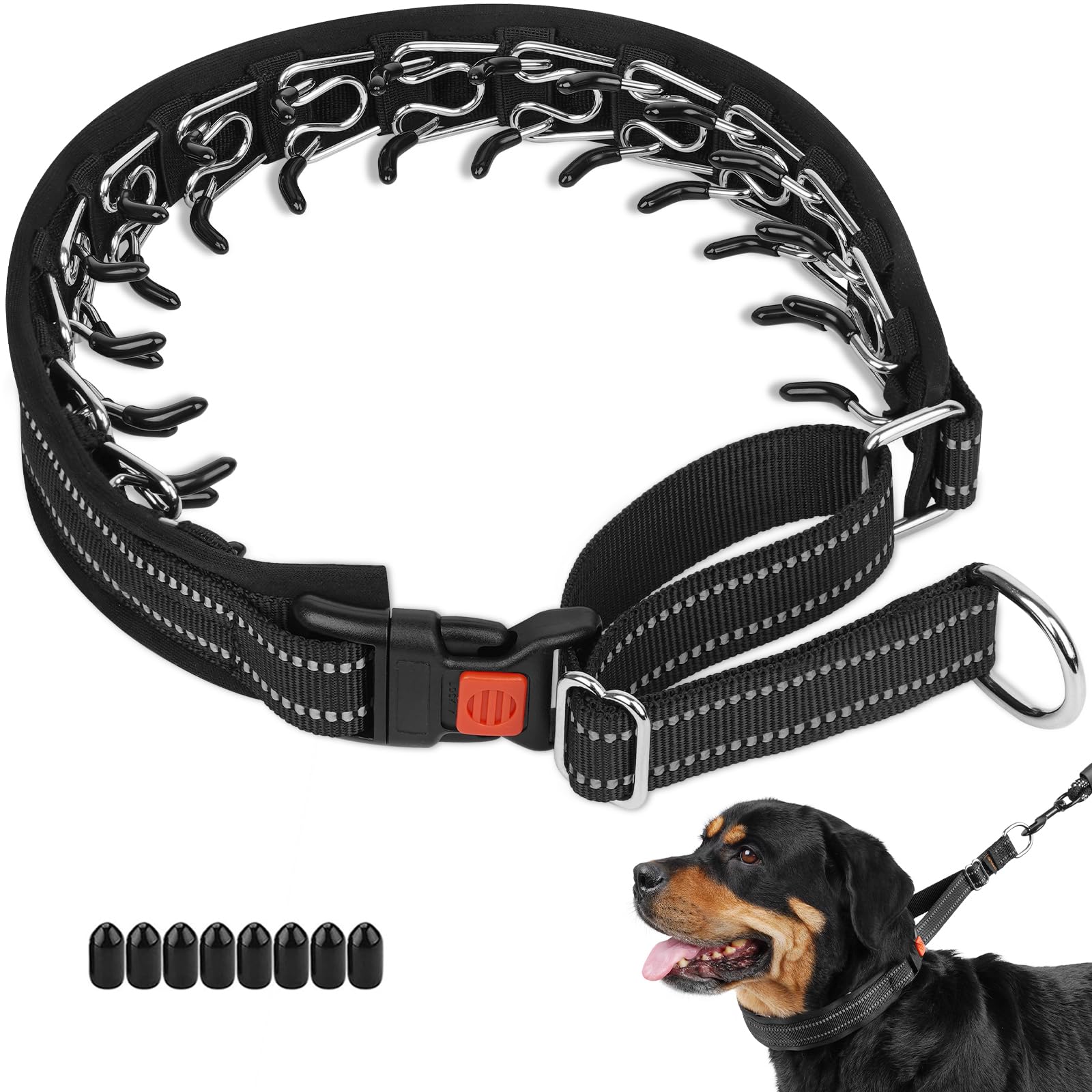
The Crazy Felix Martingale targets the very large end of the spectrum — the XL size fits necks from 19.25 to 22 inches, accommodating Great Dane mixes, Bullmastiffs, and massive shepherds. The 1.5-inch band width distributes pressure across a wider surface area than narrower martingales, reducing focused tension on any single point. The internal chain links are embedded in the fabric sleeve rather than exposed, creating a smoother look that doesn’t scream “training collar” at the dog park.
The standout feature is the double-security buckle: a quick-release snap combined with a sliding lock that prevents accidental unfastening. For owners of powerful dogs that twist and roll, this eliminates the nightmare of a collar popping open during a lunge. One owner of a Great Dane-Bullmastiff cross reported that the dog previously ignored all corrections, but within three walks with the Crazy Felix, the pulling stopped entirely. The dog’s attention shifted from the environment to the handler once it realized forward movement was no longer available as a reward.
The reflective strip runs along the full length of the band, providing solid visibility for early-morning or late-night potty breaks. The included user guide walks through the proper sizing and fitting procedure, which is critical for martingales — too loose and the collar loses its corrective action, too tight and it functions more like a flat collar. For owners of the largest stubborn breeds who need a martingale that reaches the right circumference without special ordering, this is the most accessible option.
Why we love it
- Extra-large sizing accommodates 22-inch necks without custom ordering
- Safety lock buckle prevents accidental release during corrections
- Wide 1.5-inch band reduces focal pressure on the neck
Good to know
- Not intended for unattended or 24/7 wear — remove after walks and training
- Some owners of 70-pound wolf hybrids found the large size too loose despite chart recommendations
5. Anglevate Martingale Collar (Khaki, S)
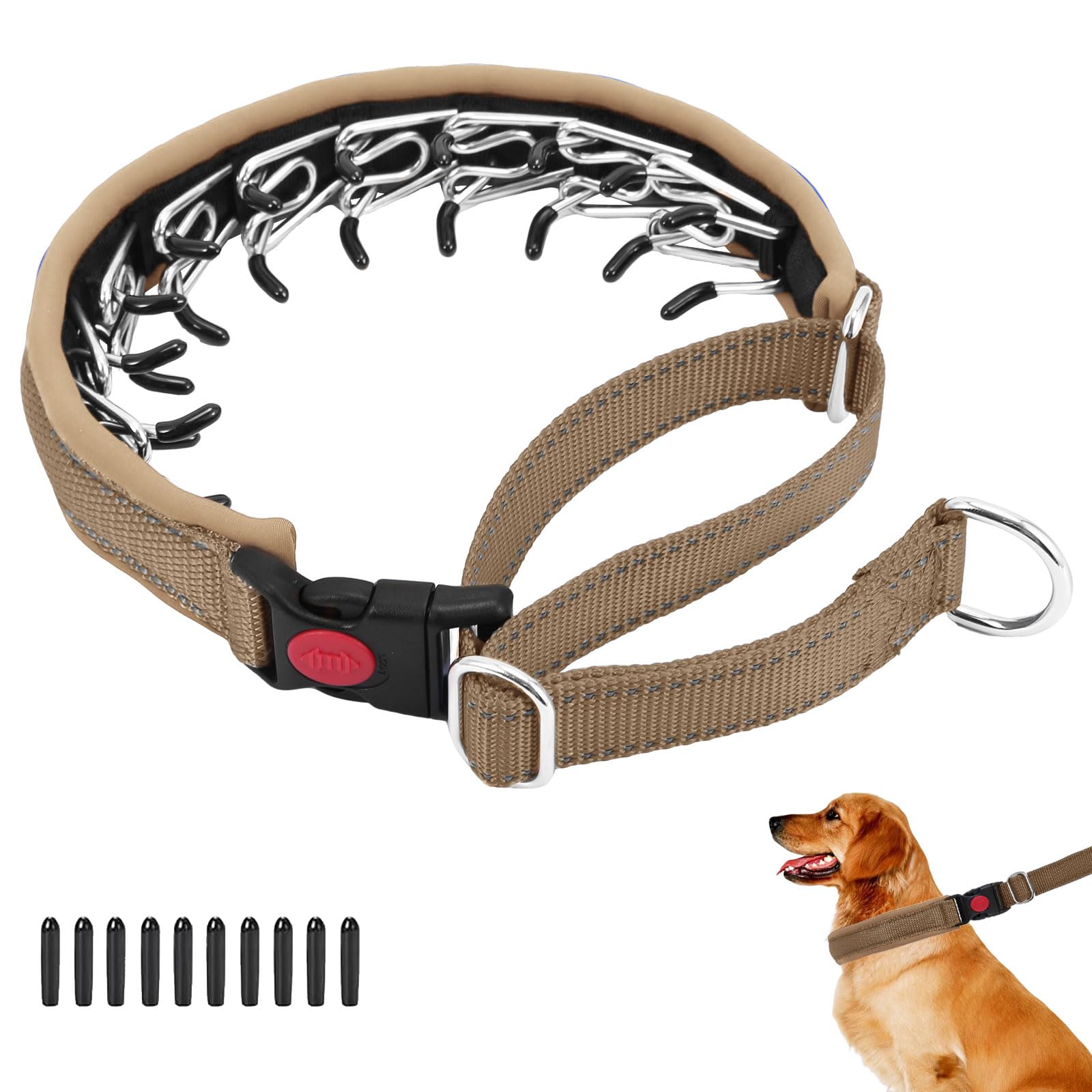
The khaki Small Anglevate Martingale shares the same dual-layer construction — inner stainless chain, outer neoprene and nylon — but in a narrower 1-inch band designed for necks from 11 to 15 inches. This makes it ideal for smaller stubborn breeds like Jack Russell Terriers, Miniature Pinschers, and Corgis that can be surprisingly strong pullers relative to their size. The narrower band prevents the collar from bunching or looking oversized on a compact neck while still delivering the same martingale corrective action as the larger model.
Owner feedback highlights the collar’s effectiveness on dogs that previously slipped out of standard flat collars. One reviewer with a 30-pound pitbull mix noted that the dog’s pulling stopped within five minutes of the first walk — the rubber-capped chain links provided enough sensory feedback to redirect attention without causing distress. The khaki color blends well with lighter coats and doesn’t show dirt as readily as white or cream collars, though the nylon material can be hand-washed when it does get grimy.
The sizing runs slightly larger than the chart suggests, with some owners of 70-pound wolf hybrids finding the Large size too loose. The advice for this collar is to measure carefully and, if between sizes, size down rather than up. The reflective stitching is present but subtle — functional for safety without being garish during daytime wear. This is a budget-friendly entry point into the martingale world that doesn’t cut corners on the chain core or the rubber tipping that makes the correction humane.
Why we love it
- Narrow 1-inch band fits small necks without overlapping or bunching
- Rubber-capped chain links prevent metal-on-skin contact even during hard pulls
- Dual-layer construction with waterproof stainless chain core prevents rust
Good to know
- Sizing runs slightly large — measure carefully and consider sizing down
- Some dogs can chew through the nylon outer layer if left unsupervised
FAQ
Can a martingale collar replace a head-halter for a dog that pulls extremely hard?
How long does it take for a stubborn dog to accept a headcollar?
Do rubber-tipped prong collars leave marks or cause injury?
What if my dog can slip out of a martingale collar?
Can I use a training collar for a puppy or a young dog?
Final Thoughts: The Verdict
For most owners dealing with a stubborn puller, the best collar for stubborn dogs winner is the PetsProMax Dog Headcollar because it redirects the dog’s entire body by steering the head, requires minimal owner strength to maintain control, and converts to a standard collar when pulling isn’t an issue. If you prefer the martingale mechanism and want a discrete look with rubber-tipped correction, grab the Mayerzon Prong Collar. And for XL breeds that need a wide, secure martingale with a safety lock buckle, the Crazy Felix Martingale delivers the coverage and durability that massive dogs demand.