
Your dog sheds enough fur every week to knit a second dog, and most brushes just push that hair around without actually pulling out the loose undercoat. The difference between a tool that merely strokes the topcoat and one that reaches deep to extract the dead hair before it lands on your sofa is the difference between a house that feels clean and one that constantly looks like a grooming salon exploded.
I’m Mo Mahin — the founder and writer behind Furric. I’ve spent months analyzing blade curvature, pin gauge, bristle density, and handle ergonomics across dozens of deshedding tools, cross-referencing hundreds of verified owner reports to separate the brushes that work from the ones that just slide over the surface.
This guide breaks down the five most effective options for pulling out loose undercoat and reducing airborne fur, helping you find the right deshedding brush for dogs based on your pet’s coat type and your tolerance for cleanup time.
How To Choose The Best Deshedding Brush For Dogs
Not every brush labeled “deshedding” actually reaches the undercoat. Most pet owners buy a slicker brush thinking it will stop shedding, then wonder why fur still floats across the hardwood floor. The real difference comes down to pin construction, blade design, and whether the tool is built for a double-coat or a short single-layer coat.
Pin Gauge and Tip Coating
Fine, closely packed pins work best for extracting the soft undercoat that standard bristle brushes miss. Pins that are too thick simply push hair aside. Coated tips (usually plastic or rounded metal) prevent scratching on dogs with thin or sensitive skin — look for pins bent at a slight angle to hook loose hair without digging into the dermis.
Curved vs. Flat Brush Head
A curved head follows the natural contour of a dog’s ribs, shoulders, and hips, allowing more pin contact per stroke. Flat heads provide better coverage on broad, flat areas like the back but require more wrist adjustment around the legs and belly. For dogs with deep chests or thick double coats, a curved design typically extracts more hair per session.
Self-Cleaning Mechanism
Push-button retractable bristles let you eject the collected hair in one clump rather than picking it out pin by pin. This feature makes a real difference on long-haired breeds where fur wraps tightly around the pins. Standard slicker brushes without this mechanism require a comb to clean the brush itself, which adds several minutes to every grooming session.
Quick Comparison
On smaller screens, swipe sideways to see the full table.
| Model | Category | Best For | Key Spec | Amazon |
|---|---|---|---|---|
| Paw Brothers Curved Slicker | Curved Slicker | Sensitive skin and dense coats | Soft plastic-coated pins, curved head | Amazon |
| Paw Brothers Flat Slicker | Flat Slicker | Curly coats and broad back coverage | Stainless steel coated pins, flat head | Amazon |
| Hertzko Self Cleaning | Self-Cleaning | Long-haired dogs and quick cleanup | Push-button retraction, fine angled bristles | Amazon |
| Freshly Bailey Deshedder | Blade Deshedder | Short-haired breeds like Pitbulls and Labs | Stainless steel edge, anti-slip handle | Amazon |
In‑Depth Reviews
1. Paw Brothers Soft Pin Curved Slicker Brush

This curved slicker from Ryan’s Pet Supplies hits the sweet spot between gentle enough for dogs with thin skin and aggressive enough to pull out undercoat from double-coated breeds. The pins are soft plastic with rounded tips, so you can work through tangles without leaving scratch marks on the belly or inner thighs — areas where most steel-pin brushes cause visible irritation.
The oblong curved head matches the ribcage contour of medium-sized dogs particularly well. Each stroke makes contact along the entire curve rather than just the center row of pins, which means you remove more loose hair per pass. Owners of Goldendoodles and Border Collies report noticeably less fur on furniture after two weeks of regular use compared to flat paddle brushes.
It lacks a self-cleaning mechanism, so you will need to comb hair out of the pins between sections. That minor inconvenience aside, the build quality is professional grade — the metal handle base and plastic grip have held up through hundreds of sessions without loosening. For most households with one or two shedding dogs, this is the only brush you need.
Why we love it
- Curved head fits body contours for maximum undercoat extraction
- Soft coated pins prevent skin irritation on sensitive areas
- Professional build quality with ergonomic grip
Good to know
- No self-cleaning mechanism — must manually remove hair from pins
- Best suited for medium-sized dogs; smaller breeds may need the flat version
2. Ryan’s Pet Supplies Paw Brothers Soft Flat Slicker Brush
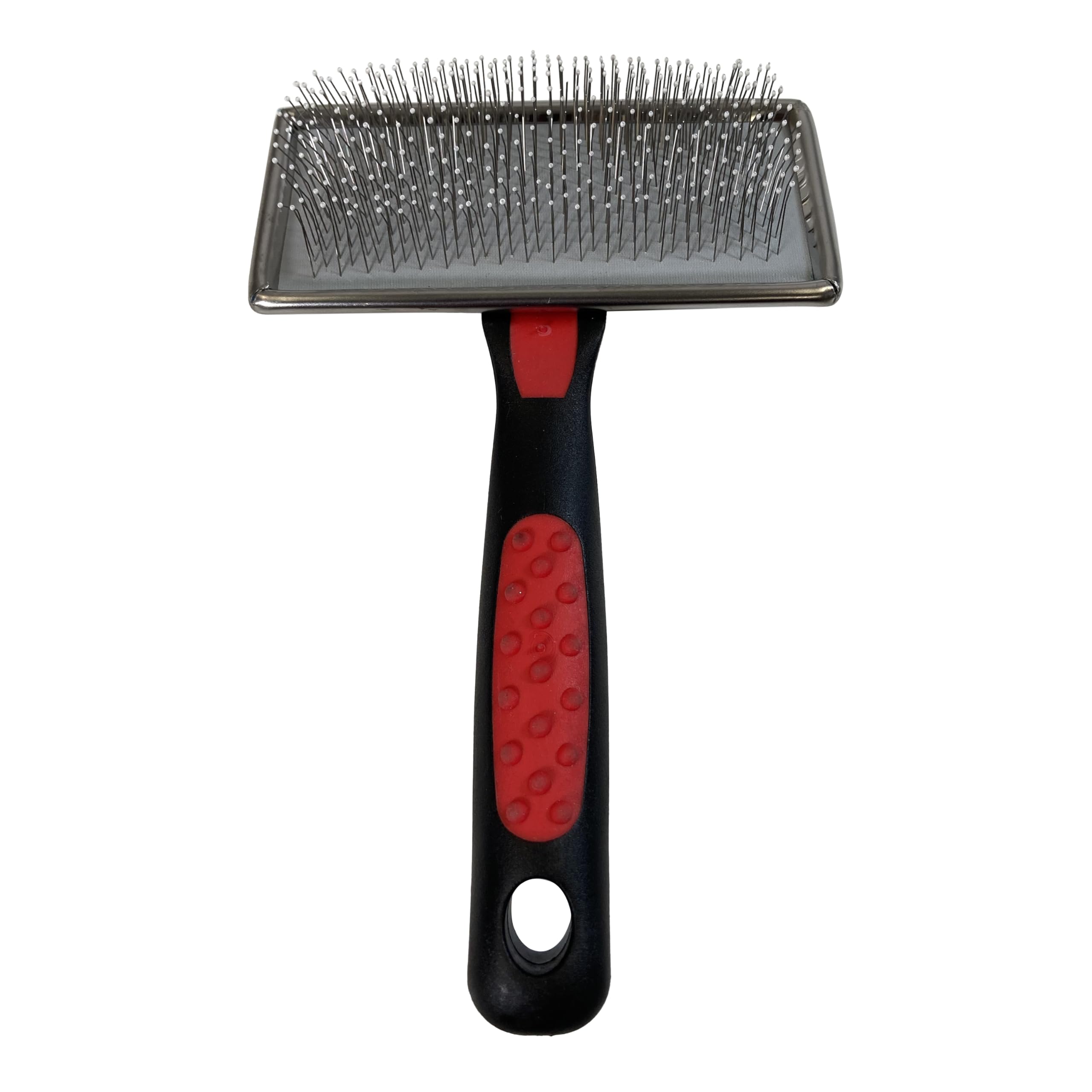
Where the curved Paw Brothers brush excels at contour-following, this flat version is built for broad, even coverage across the back and shoulders. The stainless steel pins have a coated tip layer that prevents scratching, making it a good option for dogs with curly or wiry coats that tend to wrap tightly around uncoated metal pins.
The flat head measures wider than most slicker brushes in this price range, which translates to fewer strokes per session on larger dogs. Owners of Shepherds and Huskies report that the pin density is high enough to grab the woolly undercoat without needing to go over the same spot twice. The flexible pin base absorbs some of the force, so you do not have to worry about pressing too hard through a matted patch.
Build consistency is excellent — the pins remain firmly seated even after months of weekly use, and the plastic-coated handle does not develop cracks around the rivet points. The trade-off is that it lacks the curved ergonomics, so grooming the legs and chest requires more wrist movement than the curved model. For dogs with predominantly flat body shapes, this is the more efficient daily tool.
Why we love it
- Wide flat head covers more surface area per stroke
- Coated stainless steel pins resist bending and stay sharp
- Excellent for curly and wiry coat types
Good to know
- Less effective on curved body areas like ribs and legs
- No self-cleaning feature — hair removal requires a separate comb
3. Hertzko Self Cleaning Slicker Brush
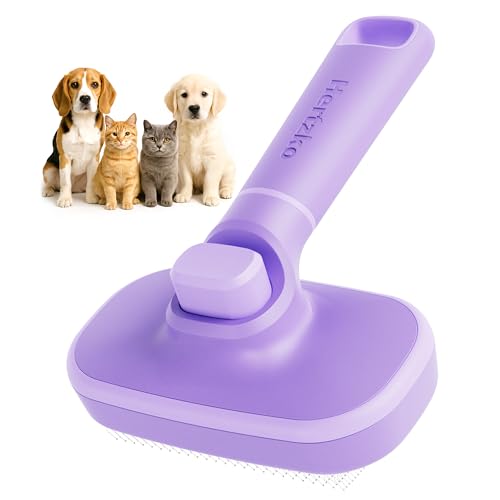
The Hertzko brush solves the one frustration that drives owners away from slicker brushes: cleaning the tool itself. The push-button mechanism retracts the bristles into the handle, allowing the trapped fur to slide off in one piece. For long-haired breeds like Collies or Shih Tzus where hair wraps aggressively around pins, this feature cuts grooming time by several minutes per session.
The bristles are fine and slightly angled, which helps them hook into loose undercoat without scraping the skin. The purple rubberized grip is comfortable for extended sessions — important when you are working through a heavy seasonal shed on a large breed. Owners note that the bristle pressure is moderate, making it a better choice for maintenance grooming rather than removing established mats.
The retraction mechanism uses a sliding button along the handle spine. A few users have reported the mechanism becoming stiff after several months, but a rinse with warm water usually restores smooth operation. For households with multiple dogs or a single heavy shedder, the convenience of instant brush cleaning outweighs the slightly higher price point.
Why we love it
- Push-button retraction makes fur removal instant and mess-free
- Angled fine bristles hook undercoat without scratching skin
- Ergonomic grip reduces hand fatigue during long sessions
Good to know
- Bristles are not stiff enough for heavy mat removal
- Retraction slide can stiffen over time if not rinsed occasionally
4. Freshly Bailey Deshedding Brush

This deshedding blade is purpose-built for short-haired breeds — Pitbulls, Beagles, Labs, French Bulldogs — where slicker brushes mostly slide over the topcoat without reaching the undercoat. The stainless steel edge cuts through the surface layer and lifts the dead hair from below in a way that bristle brushes simply cannot replicate on short, fine fur.
The anti-slip handle is a welcome detail for owners with arthritic hands or those who groom wriggly dogs that shift mid-stroke. Owners of short-haired dogs consistently report a visible reduction in fur on floors and furniture after the first few uses, with several verified reviews noting that the brush works especially well when applied to damp fur after a bath.
This is a single-purpose tool — it does not detangle or smooth the coat, and it will not work on long-haired breeds with dense double coats. The blade is not replaceable, so the brush has a finite lifespan depending on usage frequency. But for its intended audience — short-haired dogs that shed constantly — it delivers the highest fur-removal efficiency per dollar in this lineup.
Why we love it
- Stainless steel blade extracts undercoat from short-haired breeds effectively
- Anti-slip handle provides secure grip even with wet hands
- Noticeable reduction in loose fur after first grooming session
Good to know
- Not suitable for long-haired or double-coated breeds
- Blade is not replaceable — tool has a finite lifespan
FAQ
How often should I use a deshedding brush on my dog?
Can a deshedding brush cut my dog’s skin?
What is the difference between a slicker brush and a deshedding blade?
Final Thoughts: The Verdict
For most dog owners, the best deshedding brush for dogs is the Paw Brothers Curved Slicker because the curved head delivers maximum undercoat extraction with zero skin irritation across the widest range of coat types. If you have a short-haired breed and want efficient blade-style removal, grab the Freshly Bailey Deshedder. And for long-haired dogs where cleaning the brush takes longer than grooming the dog itself, nothing beats the convenience of the Hertzko Self Cleaning.