
Keeping pace on a rocky ridgeline is hard enough — doing it while your dog’s legs give out can end the adventure early. A backpack-style carrier shifts your furry partner’s weight onto your frame, leaving your hands free for trekking poles, water bottles, or scrambling up steep sections. But not every carrier with straps is built for uneven terrain; the wrong one chafes your shoulders, tips your dog sideways, or collapses under the load.
I’m Mo Mahin — the founder and writer behind Furric. I’ve spent years analyzing owner feedback on carrier weight distribution, ventilation panel rigidity, and harness safety clips to separate the day-hike novelties from the summit-worthy performers.
Whether you’re carrying a tired senior pup over the last mile or giving a small dog a front-row view of the trail, this guide breaks down the seven best options to help you pick the right dog carrier for hiking based on real-world specs and trail-tested construction.
How To Choose The Best Dog Carrier For Hiking
A proper hiking carrier isn’t just about stuffing your dog in a bag. You need a design that balances load across your hips, keeps your dog’s spine supported, and offers enough airflow to prevent overheating when the sun is high. Nail these three specs and you’ll avoid the bulk of buyer’s remorse.
Carry Style: Backpack vs. Saddlebag
Decide who carries the weight. A backpack-style carrier (like the K9 Sport Sack or VERSMELO) straps your dog onto your back, leaving you responsible for the entire load. These are ideal for tired seniors, injured dogs, or small breeds that can’t keep up. A saddlebag pack (like the Ruffwear Approach or Front Range) fits onto your dog so they carry their own food, water, and waste bags. Use a saddlebag for healthy, energetic dogs that need a job and can handle the extra ounces on their own frame.
Internal Frame and Hip Belt for Your Comfort
Once your dog exceeds 12–15 pounds, a basic foam back panel won’t cut it. Look for an internal frame — either a metal back plate or a rigid polymer sheet — that transfers weight from your shoulders to your hips. A padded hip belt with adjustable stabilizer straps is the single biggest factor determining whether you finish a 5-mile hike pain-free or hunched over. The K9 Sport Sack Knavigate and the VERSMELO Extra Large both integrate this feature; budget carriers typically skip it and rely entirely on shoulder straps.
Ventilation, Visibility, and Escape Prevention
Mesh windows on three or four sides provide cross-breeze airflow that prevents your dog from panting excessively inside the carrier. Look for panels with a tight enough weave that your dog’s paws or snout can’t push through (some owners with anxious dogs report mesh abrasion on the face). A built-in safety tether or leash clip inside the compartment is non-negotiable — if your dog gets spooked and tries to leap out on a switchback, that clip is the only thing keeping them inside. Lockable zippers and reinforced top openings add another layer of security.
Quick Comparison
On smaller screens, swipe sideways to see the full table.
| Model | Category | Best For | Key Spec | Amazon |
|---|---|---|---|---|
| K9 Sport Sack Knavigate XL | Backpack Carrier | Senior / large dogs on tough trails | 50 lb capacity / 23-25″ back length | Amazon |
| Ruffwear Front Range Day Pack S | Dog Saddlebag | Medium dogs carrying their own gear | Compression straps / 5‑point fit | Amazon |
| Ruffwear Approach Pack M | Dog Saddlebag | Rugged trails with weight‑forward bags | Radial‑cut bags / anodized aluminum V‑ring | Amazon |
| VERSMELO Extra Large Backpack | Backpack Carrier | Big cats / small dogs up to 30 lb | 15.7×12.2×20.5″ interior | Amazon |
| Petsfit Weight Reduction Backpack | Backpack Carrier | Day hikers with sub‑25 lb dogs | 14×9.5×19.5″ / built‑in leash clip | Amazon |
| Petsfit Cat Backpack | Backpack Carrier | 12‑22 lb dogs / foldable travel | 600D Oxford cloth / waist support | Amazon |
| Forestpaw Tactical Harness | Worn Dog Pack | No‑pull control with MOLLE storage | 1000D nylon / 1000 lb buckles | Amazon |
In‑Depth Reviews
1. K9 Sport Sack Knavigate XL
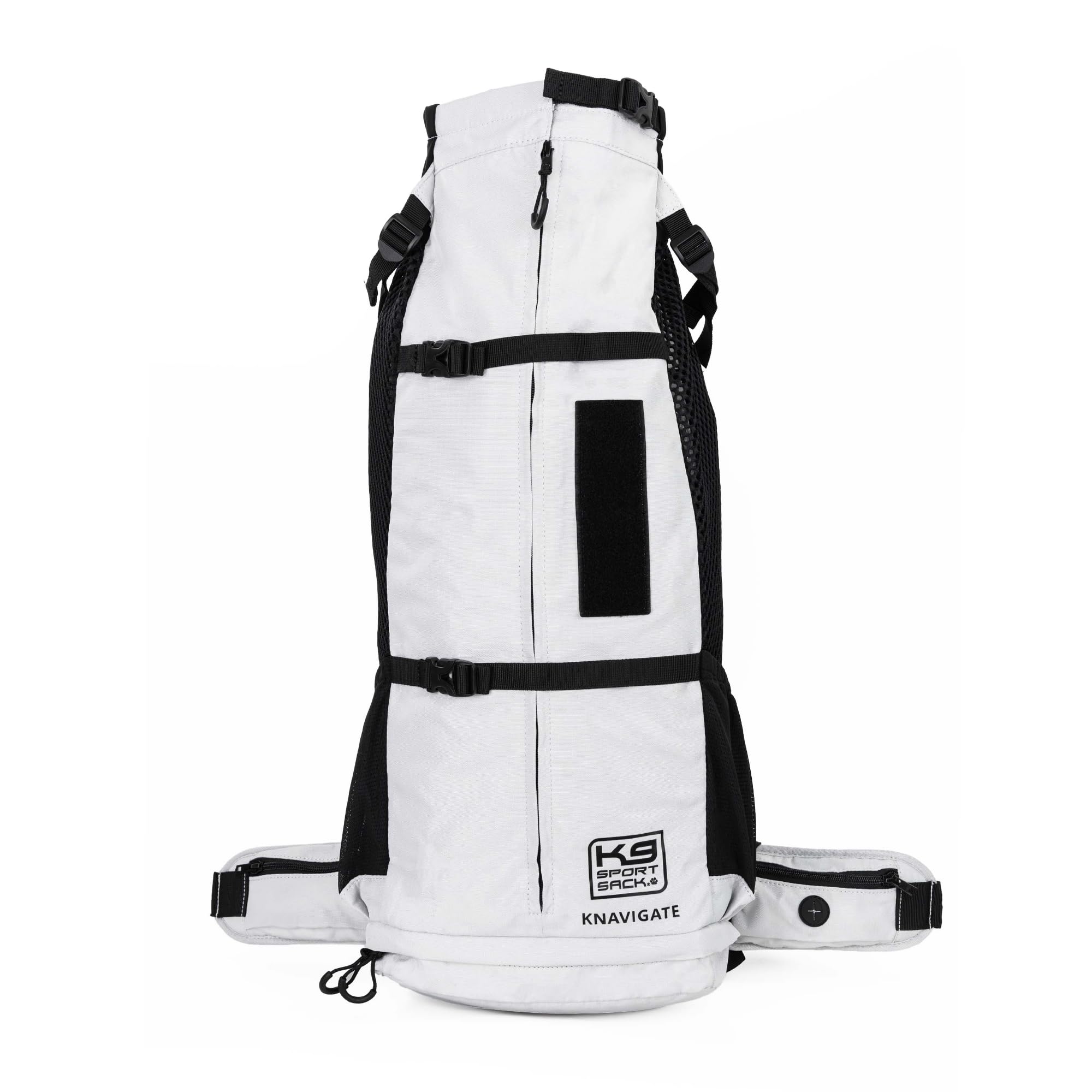
The K9 Sport Sack Knavigate is the closest thing to a climbing backpack for your dog. It features a metal back plate frame that keeps a 40-pound Golden Retriever stable on uneven ground, while a padded hip belt transfers the load to your hips — critical for anyone with lower-back concerns. The adjustable shoulder straps dial in a custom fit for carriers of different torso lengths, and the side bottle holders keep hydration within arm’s reach without unclipping the pack.
The patented upper-arm holes let your dog’s front legs hang freely, reducing the panicked “trapped” feeling some dogs experience in enclosed carriers. Mesh panels around the sides and front circulate enough air that owners report their pups napping mid-hike. The zippered storage pocket on the back and two waist-belt pouches swallow snacks, a phone, and a folded poop bag holder. Owners of senior Dobermans and huskies consistently praise the XL’s ability to handle a 23–25 inch back length without sagging.
One note: the bottom panel where your dog’s rear sits is firm — a few owners added a small foam pad for longer carries. The price reflects its build quality, but if you routinely hike with a dog over 25 pounds, the Knavigate spares your shoulders in a way no budget pack can.
Why we love it
- Metal frame and hip belt eliminate shoulder strain on long hikes
- Upper-arm holes allow natural leg movement and reduce anxiety
- Multiple storage pockets keep trail essentials organized without extra bags
Good to know
- Bottom padding is thin — a supplemental cushion helps for dogs over 35 lb
- Size selection requires precise back-length measurement; not a one-size-fits-all
2. Ruffwear Front Range Day Pack S

The Front Range Day Pack is Ruffwear’s answer to the “worn-dog pack” category — your pup hauls their own water, kibble, and waste bags while you handle the navigation. At 14.4 ounces, it’s one of the lightest saddlebags on the market, making it a solid choice for smaller dogs with shorter legs. The foam-padded chassis and five adjustment points (neck, chest, belly, and two girth straps) prevent the saddlebags from sliding sideways when your dog scrambles over logs or dips into a creek.
Internal compression straps cinch the load tight against the dog’s body, eliminating the loose-flap wobble that distracts some dogs on fast single-track trails. The recycled ripstop outer shell shrugs off brush scrapes, and the reinforced aluminum V-ring on the back gives you a secure leash attachment point for sketchy downhill sections. A small light loop on the back makes it easy to clip a blinker for dusk hikes. Owners of Beagles and Corgis appreciate the narrow width of the Small size — it doesn’t force their dog’s legs into a wider gait.
The trade-off is storage volume. The saddlebags fit a day’s worth of essentials for a 25-pound dog, but you won’t cram a full gallon of water plus a jacket in there. If your dog needs to carry bulkier gear, consider the larger Ruffwear Approach.
Why we love it
- Extremely lightweight — dogs barely notice the pack at a trot
- Five-point adjustment prevents saddlebag shifting on rough terrain
- Compression straps keep loads stable and bounce-free
Good to know
- Saddlebag capacity is modest; not intended for multi-day gear hauls
- Best suited for dogs with a deep chest and narrow waist — barrel-chested breeds may gap at the girth
3. Ruffwear Approach Pack M

The Approach Pack shares the same trail DNA as the Front Range but adds a weight-forward saddlebag cut that shifts the load slightly toward the dog’s shoulders rather than the lower back. This geometry reduces fatigue on longer hikes — the dog’s front legs bear weight naturally, so the pack doesn’t drag on the rear. The radial-cut bags distribute items evenly across both sides, and the internal vertical stash pocket keeps a collapsible bowl or a rolled jacket from flopping around.
The anodized aluminum V-ring at the back feels significantly more robust than the pot-metal clips on sub- packs, and the webbing loop on the chest offers a second leash attachment point for directional control. Owners of Labrador and pointer mixes report the Medium fits chests in the 24–32 inch range without the bags riding up under the armpits. The ripstop outer is tougher than the Front Range’s, making it a better match for bushwhacking through manzanita or pumice scree.
Where the Approach falls short is packability: it doesn’t fold flat like the Front Range. The stiffer saddlebag structure keeps its shape when empty but takes up more space in your vehicle when not in use. Also, the weight-forward design works best when both sides are loaded evenly — running it asymmetrical (one side heavy) can throw off your dog’s gait.
Why we love it
- Weight-forward saddlebags reduce rear-end fatigue on 5+ mile treks
- Anodized aluminum hardware resists corrosion from stream crossings
- Ripstop shell holds up against abrasive rock and dense brush
Good to know
- Stiffer bag structure doesn’t collapse for compact storage
- Uneven loads can affect your dog’s natural stride — pack symmetrically
4. VERSMELO Extra Large Pet Backpack
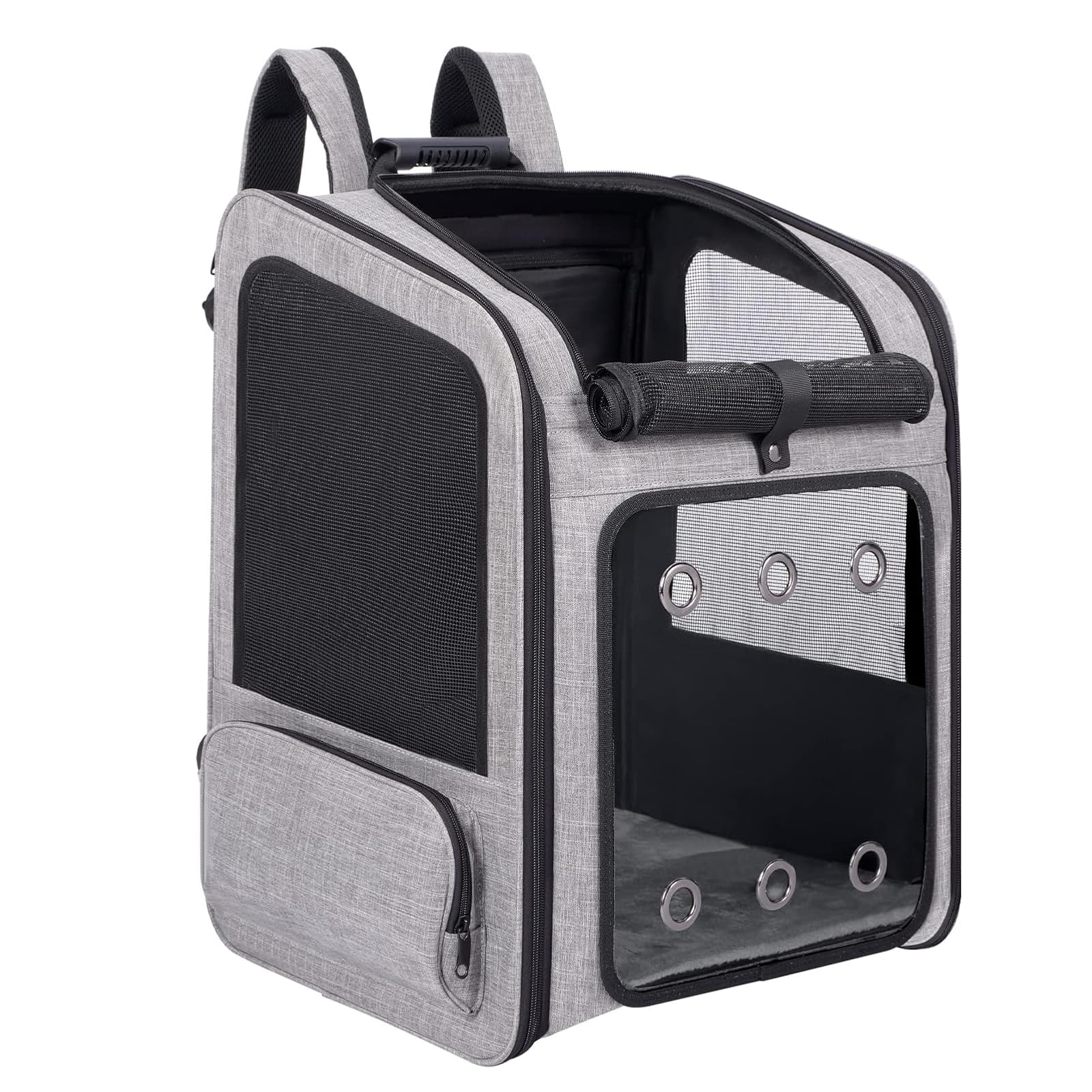
The VERSMELO Extra Large is one of the biggest backpack carriers currently on Amazon, with an interior measuring 15.7 inches long, 12.2 inches wide, and 20.5 inches tall. That extra vertical clearance lets a large Maine Coon or a 25-pound Beagle stand up and turn around without hitting the roof. The acrylic front panel gives your dog a wide, distortion-free view of the trail ahead — a feature anxious pets respond to better than mesh-only designs where vision is obstructed.
The foldable waist support pad is a clever addition: it flips out from the back of the pack and wraps around your hips to bear a portion of the load, similar to an internal-frame backpack for humans. The 300D Oxford cloth outer is dense enough to resist claw punctures from a panicked cat but remains lightweight enough that the bag itself doesn’t add useless pounds. Three mesh windows (top and sides) create a cross-breeze path that prevents condensation buildup on the inside of the acrylic panel. Two internal safety straps clip to your dog’s harness or collar as a redundant escape barrier.
The main drawback is that the waist support pad works better on taller torsos. Shorter carriers may find the pad sits too high, leaving most of the weight on their shoulders. Also, the pack’s large footprint can feel bulky on narrow trails — you’ll tap rocks and tree trunks with the side panels if you’re weaving through tight gaps.
Why we love it
- Massive interior accommodates big cats and stocky small dogs comfortably
- Acrylic front panel offers a clear view that reduces pet stress
- Foldable waist pad helps distribute heavy loads to the hips
Good to know
- Waist support pad positioning is less effective for carriers under 5’4″
- Wide profile can catch on rocks and brush in tight single-track sections
5. Petsfit Weight Reduction Backpack
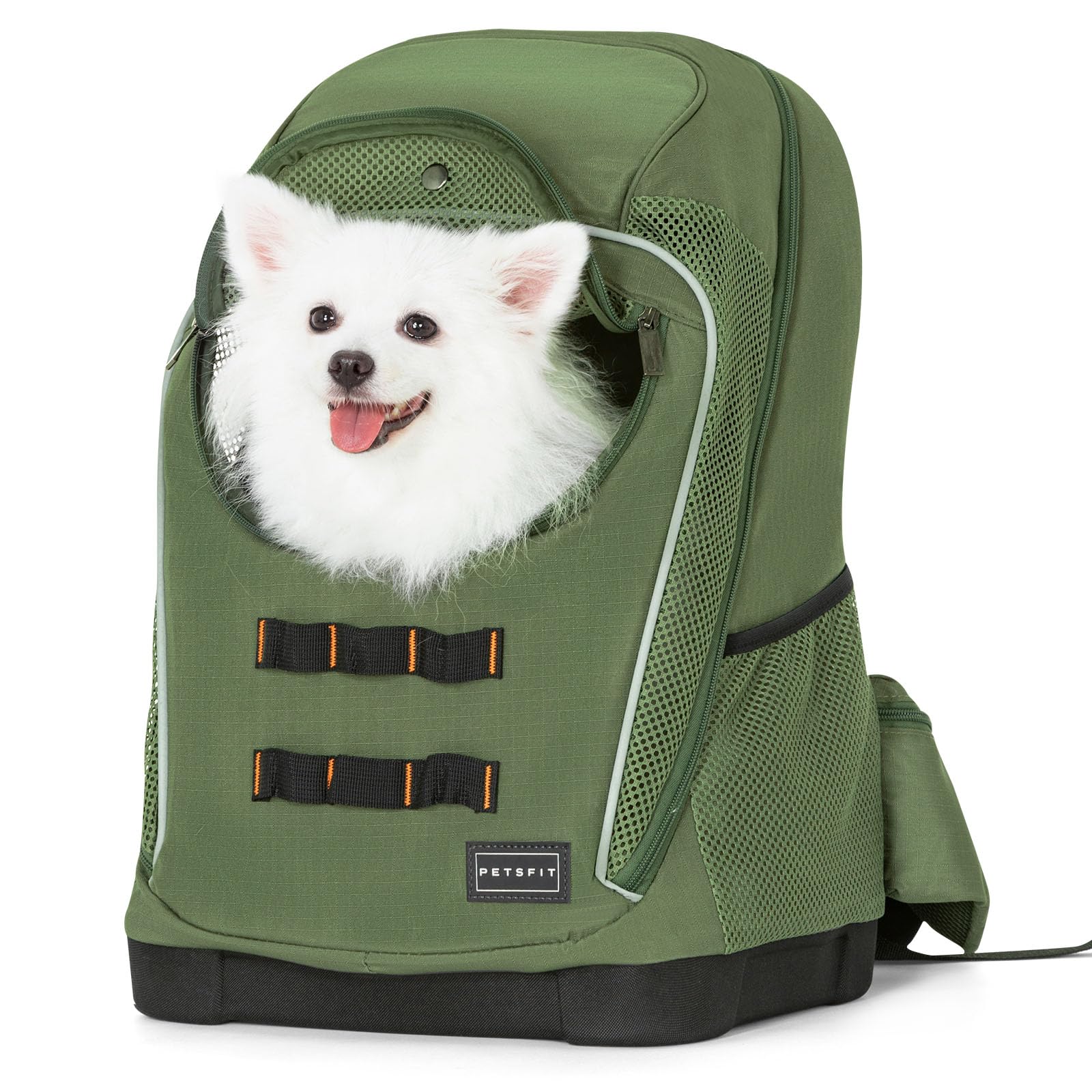
Petsfit’s “Weight Reduction” model targets the mid-range gap between bare-bones budget carriers and heavy-duty premium packs. The adjustable shoulder straps and contoured back panel spread the load across your trapezius muscles rather than concentrating pressure on the collarbones. With a 25-pound weight limit and dimensions of 14×9.5×19.5 inches, it slots perfectly between the compact PETSFIT backpack and the giant VERSMELO, making it a Goldilocks choice for 12–20 pound dogs like Schnauzers, French Bulldogs, and Bichons.
The interior includes a leash clip that secures to your dog’s harness, and the double-sided foam mat at the base provides a cushioned platform that can be flipped for temperature regulation — a nylon side for warm weather and a more plush side for cooler days. Three mesh panels wrap around the front and sides, and the top opening allows your dog to poke their head out for a better view. Owners hiking with 14-year-old Shih Tzus report the bag’s structure holds its shape even when the dog shifts weight suddenly. The reflective trim along the perimeter is subtle but effective for late-afternoon descents when tree cover dims the trail.
The biggest complaint from real users is that the backpack’s bulk makes it uncomfortable for very short hikes or flat walks — it’s overbuilt for pavement but feels right on trail. One owner with a 12-pound dog found the shoulder straps dug in after two miles, so check the padding density if your dog is on the lighter side of the weight range.
Why we love it
- Contoured back panel and straps improve load distribution vs. flat-backed carriers
- Double-sided floor mat adapts to hot or cold conditions
- Structured walls prevent collapse when the dog moves inside
Good to know
- Shoulder strap padding may feel insufficient for sub-15 lb dogs
- Overbuilt for neighborhood walks — shines best on actual trails
6. PETSFIT Cat Backpack (Waist Protection)

This PETSFIT backpack takes the “waist protection” approach — a padded lumbar panel sits against your lower back and distributes the dog’s weight more broadly than a standard flat-back carrier. The 13×11×15 inch interior fits small dogs and cats up to 22 pounds, and the 600D Oxford cloth exterior resists scratches from anxious claws. The foldable design collapses flat for stuffing into a suitcase or the bottom of a daypack when you need to transition from carrying your dog to letting them walk.
The mesh ventilation covers all four sides, creating a cross-flow system that keeps your pet cooler than carriers with only a single front window. A lockable zipper adds a layer of security against escape, and the reinforced top opening prevents the roof from sagging under your dog’s weight when they stand up to look around. Real owners mention that Cavalier King Charles Spaniels and kittens under 10 pounds fit comfortably, and the onboard safety rope clips to your pet’s harness to prevent jump-outs when you open the front flap. The side pockets are deep enough for a water bottle, a collapsible bowl, and a treat pouch.
The main limitation is the lack of a hip belt. The waist protection pad sits on your lumbar region but doesn’t include side straps to transfer weight to your hips, so heavier dogs (over 15–18 pounds) still pull on your shoulders over time. The backpack also runs small for its advertised limit — a 22-pound dog will fill the interior with almost no wiggle room.
Why we love it
- Foldable design packs flat when not in use — ideal for trips
- Four-sided mesh ventilation keeps dogs cooler than single-window carriers
- Lockable zipper and internal safety rope prevent escapes
Good to know
- No hip belt — weight stays on shoulders for dogs over 15 lb
- Interior dimensions are tight for the maximum 22-pound capacity
7. Forestpaw Tactical Dog Harness
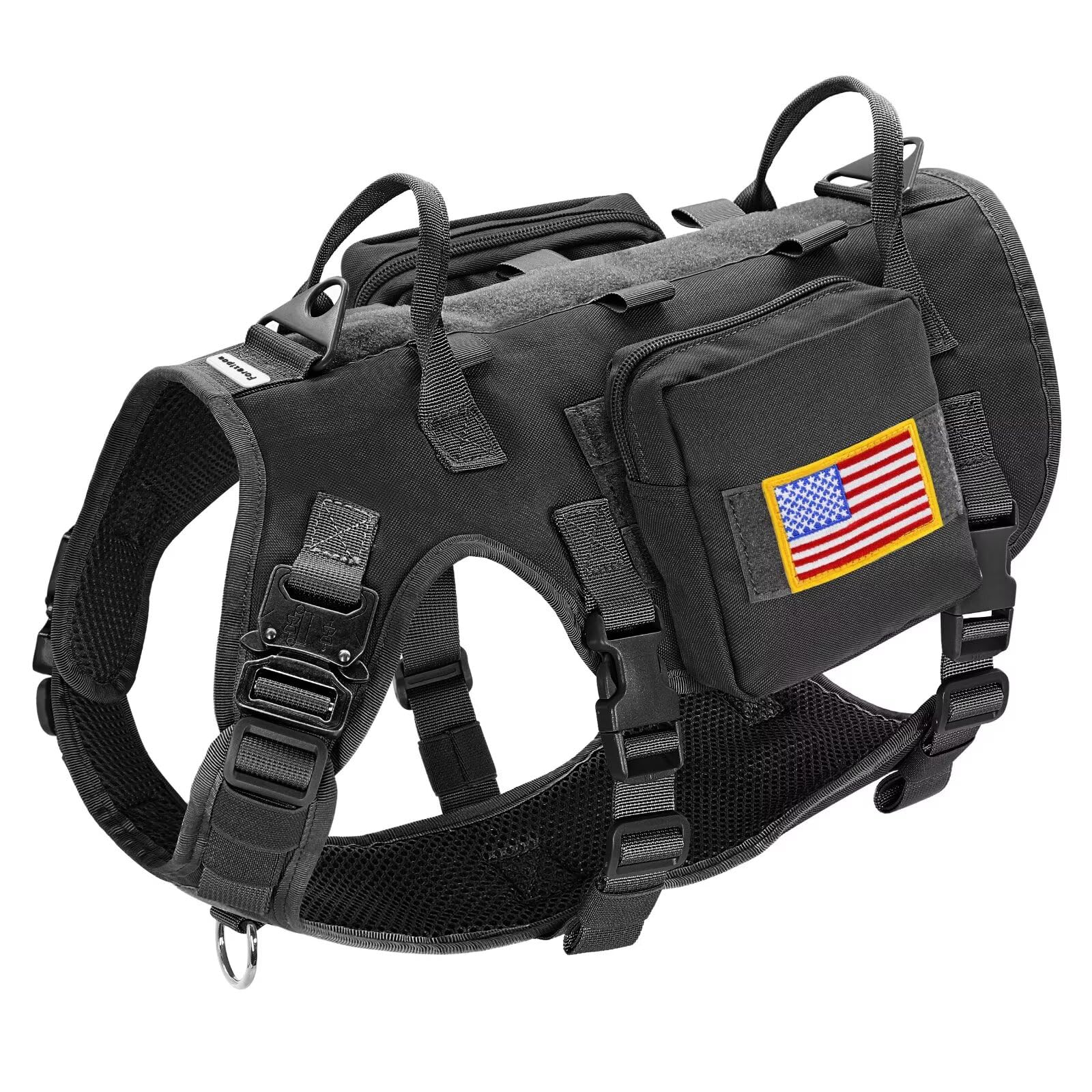
The Forestpaw Tactical Harness is not a carrier — it’s a high-control worn pack for dogs that need to carry their own gear on the trail. The 1000D nylon exterior and dual metal buckles rated at 1,000 pounds of load capacity make this an exceptionally tough saddle-less pack for active, medium-to-large dogs. Two MOLLE-compatible side pouches (included with the harness) attach via webbing and can hold treats, waste bags, a small water bottle, or a folded bowl. The front clip redirects pulling, giving you leverage when your dog spots a squirrel mid-stride.
The breathable air-mesh lining prevents chafing under the armpits, a common problem with all-nylon harnesses on long downhill sections. Three reflective patches bolt onto the MOLLE webbing for low-light visibility, and the dual handles (one on the back, one near the chest) let you lift your dog over obstacles or into the car without bending over. Owners of German Shepherds and Malinois report the Medium size fits chests from 19.5 to 41.5 inches with enough strap slack to accommodate growth. The eight color options include high-visibility orange and green for hunting and off-trail navigation.
The limitation is that the pouches are small — they’re optimized for compact items, not bulk. If your dog needs to carry a full liter of water, the pouches won’t accommodate a standard 1-liter bottle. Also, the harness’s military-style buckles can feel stiff initially and require a bit of hand strength to snap shut, especially in cold weather when the nylon stiffens.
Why we love it
- Extremely durable 1000D nylon and 1,000 lb metal hardware
- Front no-pull clip gives excellent control on steep or narrow trails
- Dual lifting handles aid obstacle navigation and vehicle loading
Good to know
- Included MOLLE pouches are small — not for bulky gear or large water bottles
- Buckles require firm hand pressure to close, stiff in cold weather
FAQ
Can I use a regular pet carrier for hiking?
What is the difference between a dog saddlebag and a dog carrier backpack?
How do I measure my dog for a hiking carrier?
Should my dog wear a separate harness inside the carrier?
Final Thoughts: The Verdict
For most hikers, the dog carrier for hiking winner is the K9 Sport Sack Knavigate because its internal frame and padded hip belt let you carry a 35–40 pound dog for miles without back strain, and the upper-arm holes keep your dog comfortable and calm. If you want your dog to carry their own gear and stay active, grab the Ruffwear Front Range Day Pack — it’s the lightest, most adjustable saddlebag for dogs under 25 pounds. And for the ultimate large-capacity carrier that fits big cats and stocky small dogs, nothing beats the VERSMELO Extra Large Backpack with its foldable waist pad and spacious acrylic window.