
A dog that slips out an unlatched gate or bolts after a deer in the woods triggers a level of panic only another owner understands. The seconds of not knowing where they are feel like hours. The market offers two completely different solutions to this problem: some devices work through a cellular network and show your dog on a map anywhere in the country, while others use direct radio signals and need zero cell tower to show you distance and direction. Knowing which architecture fits your dog’s lifestyle — suburban yard, backcountry trail, or farm — is the first decision you need to lock in.
I’m Mo Mahin — the founder and writer behind Furric. I spend my time cross-referencing GPS chipset generations, comparing RF link reliability data, and analyzing thousands of aggregated owner reviews to pinpoint which models actually hold a lock under tree canopy and which ones drop a signal at the worst possible moment.
The most reliable solution depends on where you live, how far your dog roams, and whether you want a monthly subscription. This detailed guide breaks down the best dog gps tracker by real-world range, battery stamina, and critical trade-offs between network-reliant and network-free systems.
How To Choose The Best Dog GPS Tracker
The wrong tracker leaves you staring at a frozen last-known location while your dog keeps running. Focus on these four pillars to avoid that outcome.
Network Type: Cellular vs. Direct RF
Cellular trackers from brands like Fi and PetSafe use an embedded LTE chip to communicate your dog’s GPS coordinates to the cloud, then to your phone. They work anywhere with cell coverage, which means nationwide for most of the US, but they stop the second the collar enters a dead zone. Direct RF trackers like the Aorkuler and Dogtra Pathfinder 2 transmit coordinates straight from the collar to a handheld receiver or your phone over a dedicated radio frequency. These units function in canyons, deep forests, and remote farms where no cell tower exists, but their range tops out between 3.5 and 9 miles depending on terrain and line of sight.
Battery Life and Charging Cycle
A collar that dies halfway through a day hike is worse than no collar at all. Cellular trackers with frequent location pings typically last 1 to 3 days before needing a charge. The Fi Series 3+ stretches to about a week if you don’t use constant tracking, while the Fi Mini lasts up to 3 weeks with moderate use. RF-based collars like the Garmin Alpha T 20 can push 68 hours with a standard pack and 136 hours with an expanded pack, thanks to dynamic tracking that adjusts update frequency based on movement. Measure your typical charge-availability cycle — a collar that needs nightly charging is fine for suburban use, while a multi-day backcountry trip demands a model that can go the distance.
Fence Accuracy and Correction System
Virtual fences rely on GPS precision that varies with satellite geometry and overhead cover. On a clear day in an open field, most systems hold accuracy within 10 to 20 feet. Under heavy tree canopy or near tall buildings, the same collar can show your dog 100 feet from its actual position, triggering false alerts or punishing a dog that hasn’t left the yard. If you plan to use a containment fence, look for dual-frequency GPS (available on the PetSafe Guardian GPS 2.0) or systems with a generous correction graduation that starts with a tone before escalating to static correction.
Subscription Cost and Total Ownership
The sticker price of the collar is rarely the final cost. Fi and PetSafe require monthly or annual subscriptions that run between and per month per dog. Aorkuler, Garmin Alpha T 20, and Dogtra Pathfinder 2 charge zero subscription fees — you pay for the hardware and nothing else. Over a four-year lifespan, a Fi collar with a annual subscription costs nearly total. A Garmin collar with no subscription costs exactly total. Run the four-year math before committing to a platform.
Quick Comparison
On smaller screens, swipe sideways to see the full table.
| Model | Category | Best For | Key Spec | Amazon |
|---|---|---|---|---|
| Dogtra Pathfinder 2 | RF / E-Collar | Hunting & off-grid tracking | 9-mile range, no subscription | Amazon |
| Garmin Alpha T 20 | RF Collar Only | Serious hunters and trainers | 68-hr battery with standard pack | Amazon |
| PetSafe Guardian GPS 2.0 | Cellular / Fence | Fence containment + tracking | Dual-frequency GPS antenna | Amazon |
| Aorkuler GPS Tracker 2 | RF Handheld | Off-grid no-subscription use | 3.5-mile range, no apps | Amazon |
| PetSafe Guardian GPS (Original) | Cellular / Fence | Large properties 3/4+ acre | 48-hour battery, 20 fences | Amazon |
| Fi Series 3+ | Cellular Collar | All-day cellular tracking | 7+ day battery, AI health | Amazon |
| Fi Mini | Cellular Attachment | Small dogs and cats | 80% lighter, 3-week battery | Amazon |
| Versmelo GPS Fence | GPS Fence Only | Rural containment, no subscription | 2000-yard radius, no apps | Amazon |
| Dogtra Pathfinder 2 (AA) | RF / E-Collar | Large breed training & tracking | 21-dog support, 2-second updates | Amazon |
In‑Depth Reviews
1. Dogtra Pathfinder 2 GPS Tracker / E-Collar

The Dogtra Pathfinder 2 is the most complete RF-based tracking and training collar for owners who demand real off-grid capability. It delivers location updates every 2 seconds at up to 9 miles with zero subscription fees — you buy it once and use it forever. The system relies on your smartphone as the display, so you get full map views (satellite, terrain, and standard) through the free Pathfinder 2 app without paying a monthly penny for cellular data.
The collar integrates Nick, Constant, and Audible tone correction modes plus a Pager Vibration and LED Locate Light, all controllable from the dedicated GPS Connector button or the app. Owners report the tracking holds steady in heavily wooded areas and across 16-acre farms, though the e-fence feature must be manually activated each session and requires the phone to stay within Bluetooth range. Battery life runs roughly 24 hours under continuous tracking, which is adequate for daily use but demands nightly charging for heavy backcountry days.
The Pathfinder 2 supports tracking up to 21 dogs simultaneously, making it the top choice for multiple-dog hunters or owners managing a pack on large properties. The free app with downloadable offline maps removes the cellular dependency entirely. The only consistent criticism is that adjusting the stimulation level during a fast-moving situation requires unlocking the phone, which can feel slow when you need an instant correction.
Why we love it
- No subscription — free app, free offline maps
- 9-mile range with 2-second updates in open terrain
- Tracks up to 21 dogs and works with Galaxy Watch 4+ and Apple Watch Series 5+
Good to know
- E-fence must be manually toggled on each session
- Adjusting stimulation level mid-walk requires unlocking the phone
- Phone Bluetooth range limits off-grid containment radius
2. Garmin Alpha T 20 GPS Dog Tracking Collar

Garmin’s Alpha T 20 is a collar-only tracking unit designed to pair with Garmin handhelds like the Alpha series or Pro 550 Plus. If you already own a Garmin dog tracking handheld, this collar gives you a 9-mile range with dynamic updates as frequent as 2.5 seconds. The collar tracks based on the dog’s movement — when the dog is sitting still, updates slow to conserve power; when the dog runs, updates speed up. With the standard rechargeable battery pack, runtime reaches 68 hours, and the upgraded expanded pack pushes that to 136 hours for multi-day expeditions.
The collar is rugged and universally sized, fitting both large and small breeds through a user-replaceable flex band. A multicolor LED on the collar lets you identify your dog at night by choosing from 7 colors — useful when tracking multiple dogs in low light. Users report the GPS locks to within a few feet and maintains accuracy even in heavy rain. The new USB-C charging clip is a welcome upgrade over older Garmin collars, and the Wi-Fi connectivity automatically updates firmware when the collar is charging at home.
The biggest caveat is that the Alpha T 20 is a receiver collar only — it has no built-in handheld screen and no e-collar stimulation capabilities. You must buy a separate Garmin handheld device to see the location data. For hunters and trainers who already own Garmin equipment, this is a seamless, high-end option. For new buyers, the combined cost of the collar plus handheld pushes the total investment significantly higher than all-in-one solutions like the Dogtra.
Why we love it
- 68-hour standard battery, 136-hour expanded pack
- User-replaceable battery and flex band extend collar lifespan
- Multicolor LED with 7 color options for night identification
Good to know
- Requires separate Garmin handheld for tracking — no phone integration
- High entry cost when purchased with handheld
- No e-collar stimulation built into the collar unit
3. PetSafe Guardian GPS 2.0 Wireless Dog Fence + Tracker
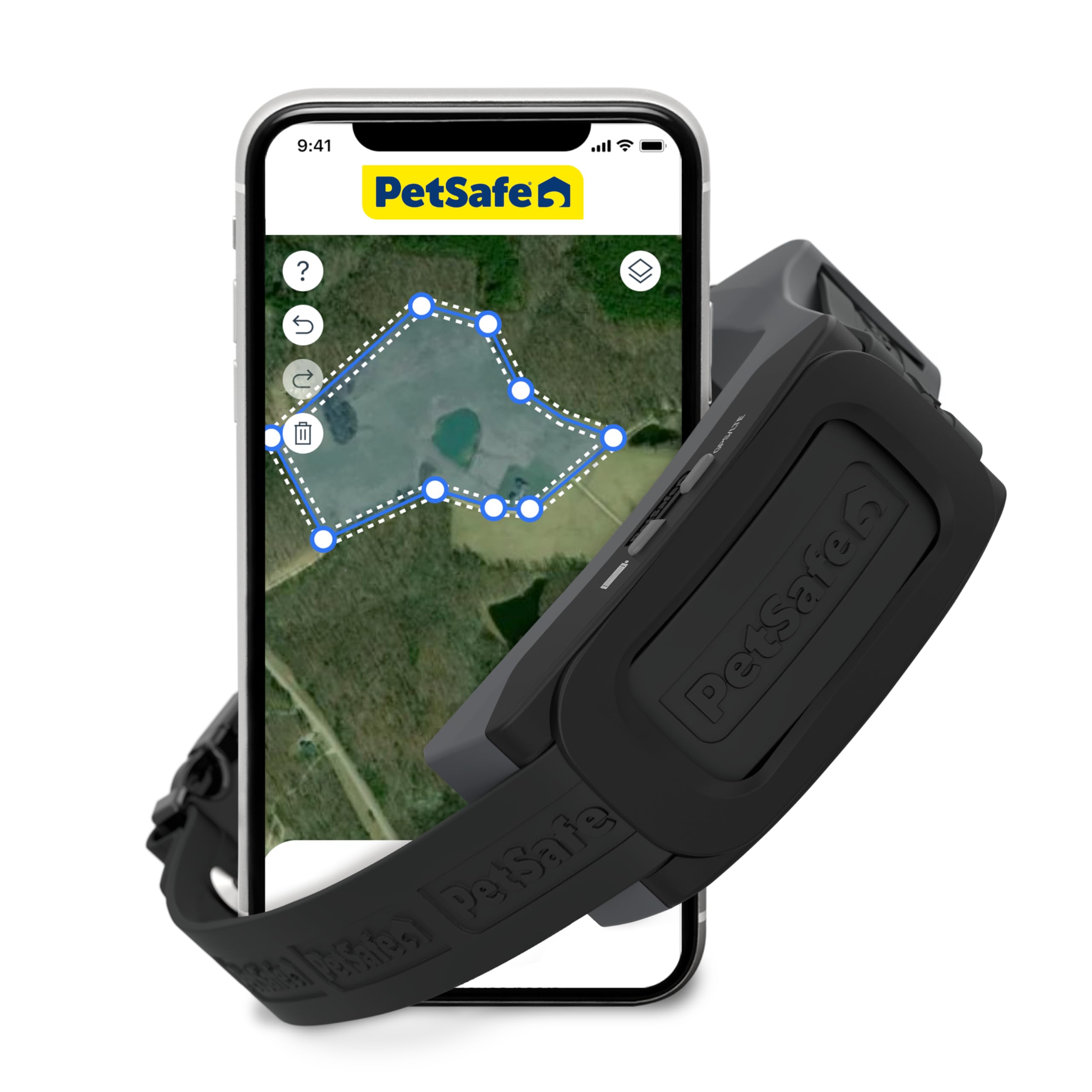
PetSafe’s second-generation Guardian GPS 2.0 shrinks the collar down by 50% compared to the original while boosting battery life to 70 hours — a massive leap that makes it suitable for 24/7 wear on most dogs. The dual-frequency GPS antenna improves reliability by switching between GPS bands when one signal weakens, reducing the false alerts and location jumps that plagued earlier single-frequency fence systems. The collar weighs only 4.64 ounces and fits neck sizes as small as 8 inches, accommodating breeds down to 10 pounds.
The system creates up to 50 custom virtual fences through the MyPetSafe app and sends push notifications the instant your dog crosses a boundary. Three training modes — tone, vibration, and 10 levels of static — let you dial in the minimum effective correction for your dog’s temperament. Owners report that the app-guided setup is straightforward and that the GPS accuracy holds well on properties ½ acre and larger, though dense tree cover still reduces precision occasionally. The subscription runs roughly per month, and each dog needs its own collar and plan.
Dual-frequency GPS at this price point represents a significant upgrade over the first-generation PetSafe Guardian, which relied on a single GPS antenna and suffered from accuracy complaints in borderline coverage areas. The 70-hour battery is especially impressive for a cellular unit that maintains a constant LTE connection. If you need a fence-and-tracker combo for a suburban or rural property and are comfortable with a monthly plan, this is the most balanced option on the market.
Why we love it
- Dual-frequency GPS reduces fence accuracy drift
- 70-hour battery life is best-in-class for cellular GPS collars
- 50 virtual fences and fits dogs as small as 10 pounds
Good to know
- Requires monthly subscription per dog
- GPS accuracy still degrades under dense tree canopy
- Setup requires 2.4 GHz Wi-Fi connection
4. Aorkuler GPS Dog Tracker – No Phone, No Subscription
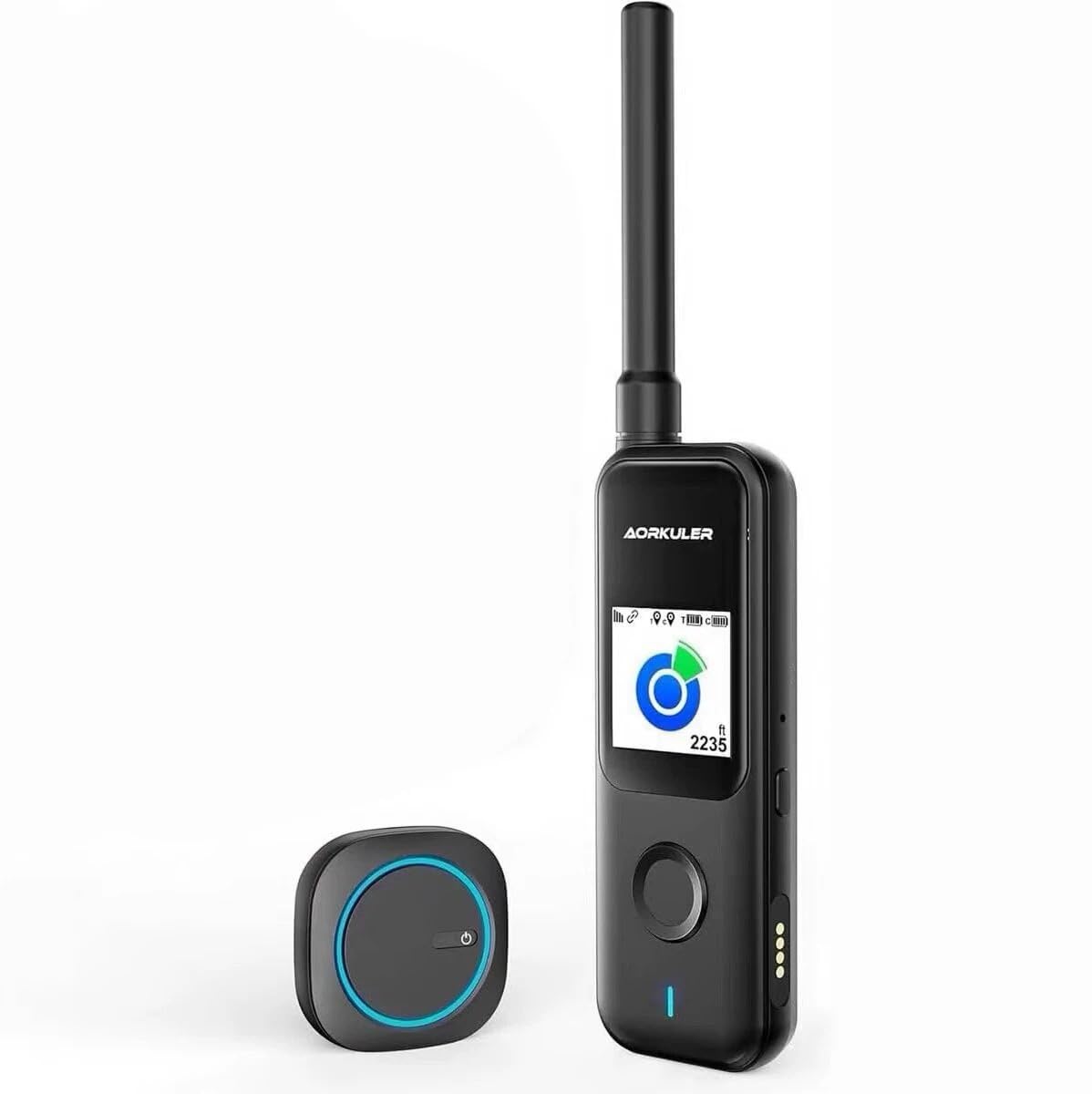
The Aorkuler GPS Tracker 2 takes a completely different approach from every cellular model on this list — it uses no phone, no app, and no subscription. The system consists of two components: a lightweight 1.08-ounce collar module that clips onto the dog’s existing collar and a handheld controller with a green arrow display that shows the exact direction and distance to your dog up to 3.5 miles away. The tracker refreshes every 3 seconds and works entirely via direct GPS satellite communication, meaning zero monthly fees and zero dependency on cell towers.
Battery life stands out here. The 1000 mAh battery in the collar lasts up to 24 hours of continuous tracking or more than 10 days of daily walks, and the controller battery runs 16 days in standby. Owners in rural and off-grid areas report the tracker locks onto a signal in open terrain within about 1 to 3 minutes and stays accurate within a few feet at 1,600 feet. The unit is waterproof and rugged enough for farm work and deep woods excursions. A built-in sound function on the collar helps you locate the dog by ear in thick brush.
This is not a fence system — it provides no containment correction and no geofencing alerts. The tracking works best with a clear line of sight to the sky; dense forests, buildings, or indoor environments will degrade accuracy or lose the signal entirely. The handheld controller screen becomes unreadable with polarized sunglasses, and some owners found the initial satellite connection finicky. For hunters, hikers, and farm owners who want a simple tracker with no recurring costs, the Aorkuler is a specialized but excellent tool.
Why we love it
- Zero subscription fees and no phone or app required
- Lightweight collar module at only 1.08 ounces
- Sound function helps find dog in thick brush
Good to know
- Handheld LCD screen is difficult to read with polarized sunglasses
- No geofencing or escape alerts — tracker only
- Satellite connection can take 1–3 minutes to lock
5. PetSafe Guardian GPS + Tracking Dog Fence Collar

The original PetSafe Guardian GPS combines real-time tracking with a virtual fence system on properties larger than ¾ acre. Its AccuGuard technology blends GPS location data with motion detection and AI to decide when the dog is approaching a fence line. The rechargeable collar delivers up to 48 hours of battery life and charges fully in 2 to 4 hours. The system supports up to 20 custom virtual fences and offers tone, vibration, and 10 levels of static correction.
Owners report that the collar works well for containing medium and large dogs that previously escaped physical fences — a 30-pound hound-mix was successfully kept inside after two hours of setup and a week of training with boundary flags and treats. The real-time tracking feature shows the dog’s location on a map inside the MyPetSafe app, and Lost Pet Mode provides frequent location updates if your dog escapes a fence boundary. The collar is waterproof and built from nylon and plastic with a buckle closure.
The downsides include mixed feedback on GPS accuracy, especially near buildings or under porches where the signal can drift by 50 to 100 feet. Some owners experienced the collar shocking the dog inside the house because the GPS defaulted to the fence centroid when it lost satellite lock. The collar is also large — at 16 ounces, it’s noticeably bulky on dogs under 40 pounds and should not be worn 24/7. The subscription cost adds or more per year, so factor that into your long-term budget.
Why we love it
- Combines real-time tracking and virtual fence in a single collar
- Up to 20 custom fences and AccuGuard motion + GPS fusion
- Lost Pet Mode provides frequent location updates during escapes
Good to know
- GPS accuracy drifts near buildings and under dense cover
- Collar is heavy (16 oz) — not ideal for small dogs or 24/7 wear
- Requires monthly or annual subscription
6. Fi Series 3+ Smart Dog Tracker Collar
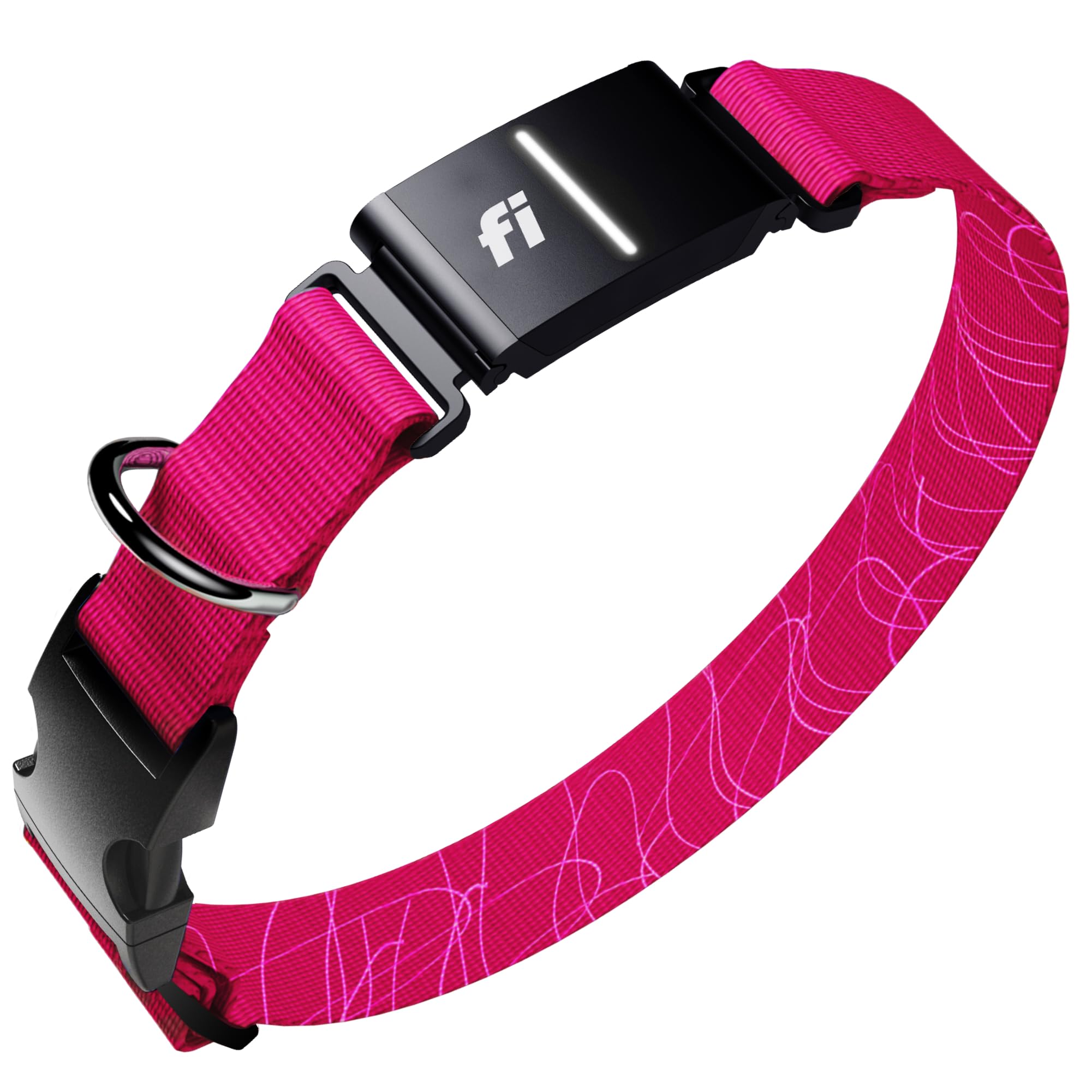
Fi’s Series 3+ collar is a cellular-based tracker that emphasizes health and behavior monitoring alongside location tracking. The 285 mAh battery, combined with Fi’s proprietary power management, delivers a week or more of runtime between charges for most owners — significantly better than the 2-to-3-day runtimes of earlier Fi models. The collar tracks location nationwide with no range limit, using LTE cellular as the data link and Wi-Fi for at-home charging and updates.
Beyond location, the collar uses AI-powered sensors to detect rest, barking, licking, scratching, eating, and drinking, giving owners a daily snapshot of their dog’s health baseline. The app integrates with Apple Watch and can provide personalized reminders for vet visits and vaccinations. The “Lost Dog Mode” pushes location updates every few seconds when the dog escapes, and custom virtual fences with escape alerts work across the entire collar’s battery life.
The proprietary collar cannot be replaced individually, meaning you buy a whole new unit if the strap wears out. At for the collar plus a annual subscription, the four-year total ownership cost lands near . It works best for owners who want the health data features and live in areas with good cellular coverage.
Why we love it
- Battery lasts 7+ days between charges for most users
- AI health tracking detects barking, scratching, eating, and drinking
- Nationwide range with no roaming limits
Good to know
- Setup process sometimes takes over a week due to connectivity bugs
- Proprietary collar cannot be replaced individually
- High long-term cost due to annual subscription requirement
7. Fi Mini GPS Tracker for Dogs
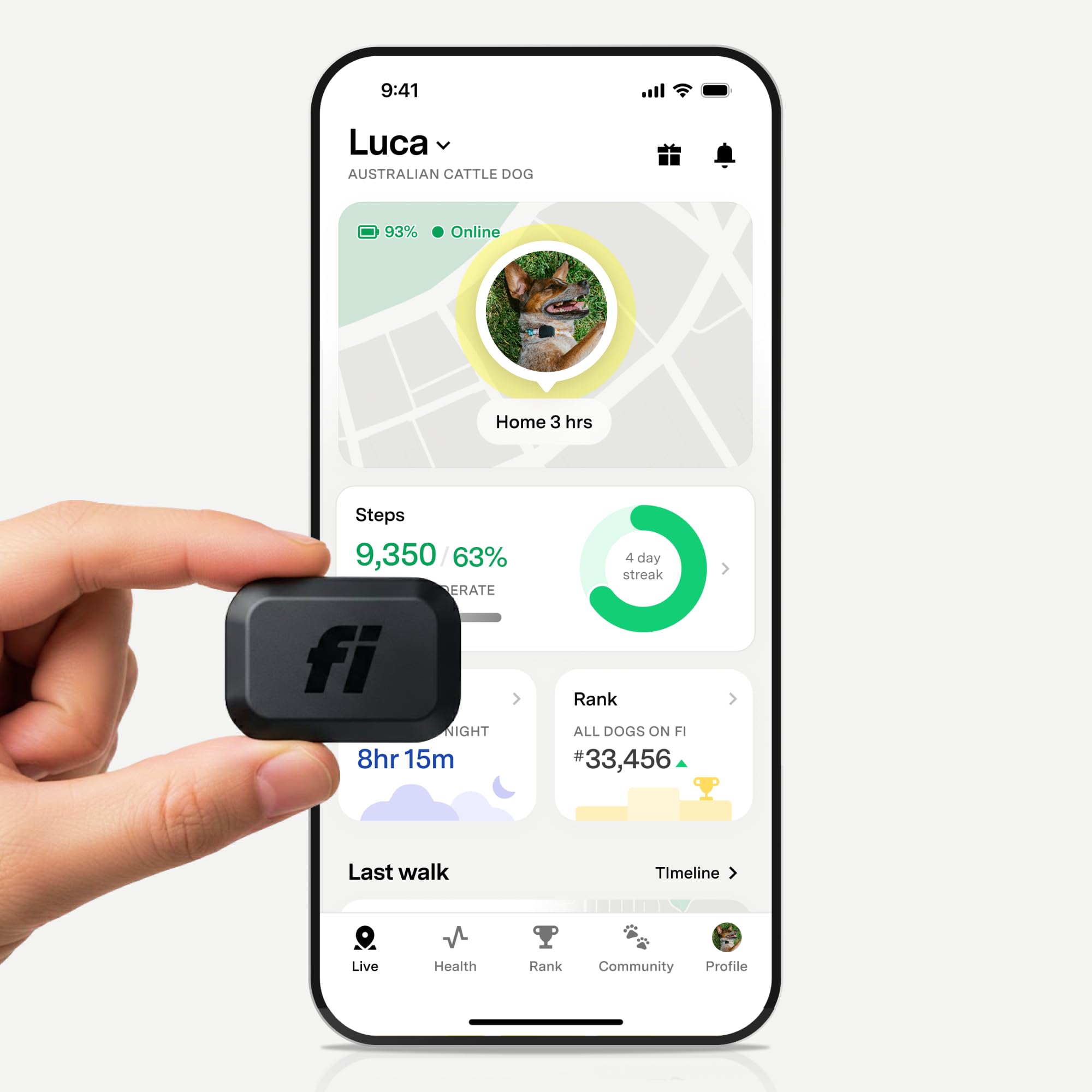
The Fi Mini shrinks the full-sized Fi tracker into a 16-gram module that attaches to any existing collar or harness up to 1.25 inches wide. At 80% lighter than the Series 3+, it’s designed for small dogs, cats, and pets that would be weighed down by a full GPS collar. Despite the size reduction, the Mini packs the same LTE-M cellular connectivity and GPS tracking chip, providing nationwide location tracking with no range limit. The battery life extends to roughly 3 weeks for most users on a single charge.
Escape alerts work identically to the larger Fi model — custom geofences trigger instant push notifications when your pet leaves a designated safe zone. The IP68 waterproof rating means it survives rain, mud, and submersion without issue, and the low-profile attachment keeps the tracker flush against the collar instead of dangling. Owners of small breeds like Chihuahuas and Miniature Schnauzers report the Mini fits comfortably without causing neck strain or irritation.
The weak point is the rubber collar holder, which some owners found damaged after only a couple days of normal active-dog use, causing the tracker to slip out and go offline. The tracker is not a containment system — it provides no correction or training functions. As with the Series 3+, the Fi Mini requires an annual subscription that adds roughly per year to the purchase price. For owners of small dogs who want a lightweight, rechargeable tracker for peace of mind on walks, this is the best low-weight option.
Why we love it
- Ultra-light at 16 grams — comfortable for small breeds and cats
- 3-week battery life between charges
- IP68 waterproof and low-profile slip-on attachment
Good to know
- Rubber holder is not durable enough for very active dogs
- Annual subscription required (+ per year)
- No containment fence or training correction features
8. Versmelo GPS Wireless Dog Fence System
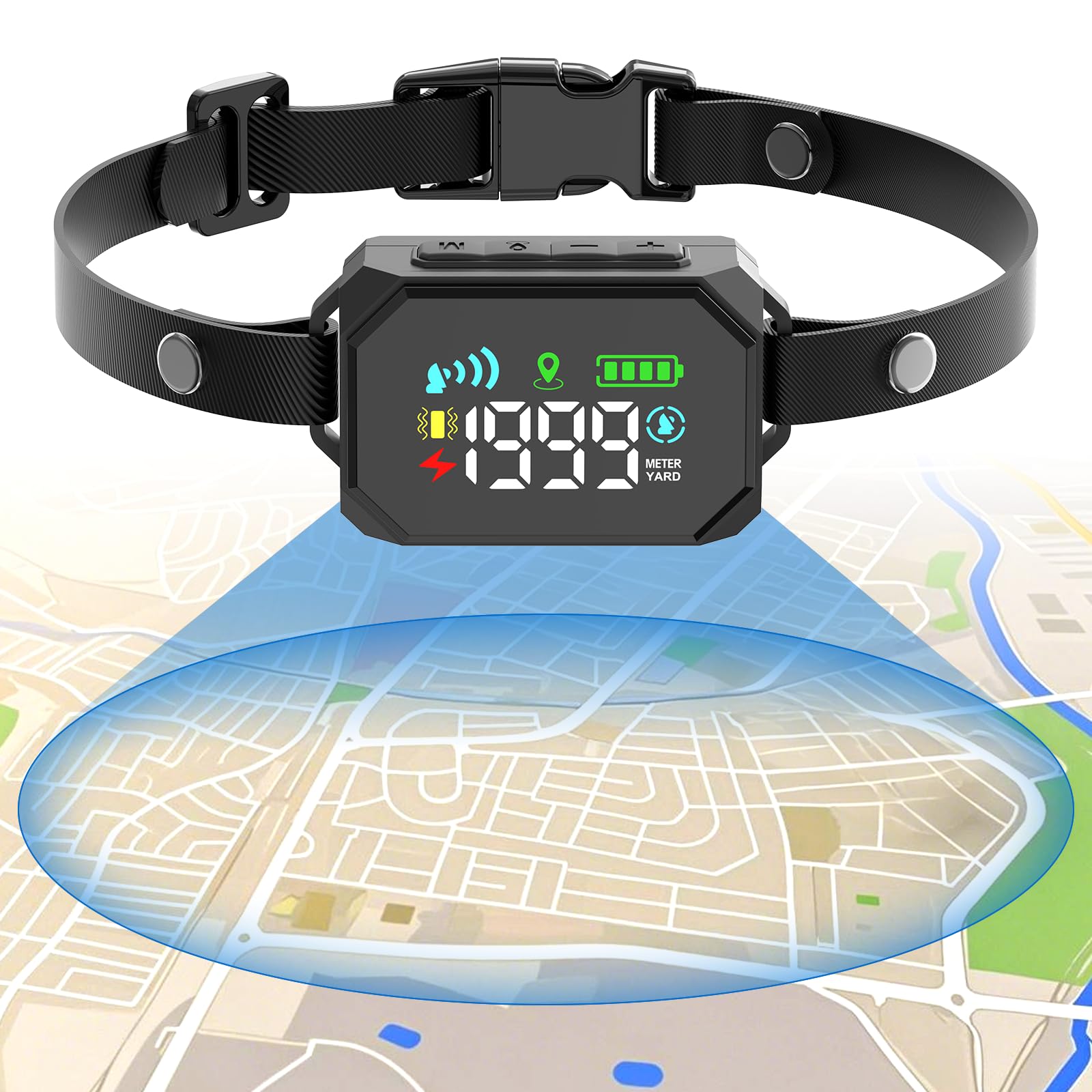
The Versmelo GPS Fence offers an entry-level containment solution with no apps, no Wi-Fi, and no subscription fees. The system creates a circular boundary that adjusts from 33 yards to 2,000 yards in radius, covering up to 2,593 acres — enough for large farms and open ranches. The collar uses a US-made GPS chip combined with an AI algorithm that gradually escalates correction from sound to vibration to static shock up to 6 levels before entering protection mode after two correction cycles.
Setup is refreshingly simple: turn on the transmitter, set the radius, and fit the collar. No smartphone pairing or account creation is required. Owners on 10- to 20-acre properties report that most dogs learn the boundary within one day and respond to the beep as a warning. The collar is IPX7 waterproof and rechargeable, with a stated 24-to-36-hour battery life that in practice runs closer to 8 hours under continuous use. The collar fits dogs over 18 pounds with neck sizes from 9 to 26 inches.
GPS reliability depends heavily on open sky. Dense woods, cloudy weather, and steep terrain can cause the collar to lose its lock and fail to deliver correction, and a few owners reported total system failure within days after the return window. The single-button interface is confusing to some, and there is no customer website or dedicated support team. For the price, it works well as a training aid on large open properties where you can supervise the initial training, but it should not be relied on as a set-and-forget invisible fence.
Why we love it
- Covers up to 2,593 acres with no subscription or app
- Dogs typically learn the boundary within one day
- Gradual correction system with 6 levels before protection mode
Good to know
- Real-world battery life is closer to 8 hours than the stated 24–36
- GPS loses lock in dense woods and overcast weather
- No customer support website; some units failed shortly after purchase
9. Dogtra Pathfinder 2 – E-Collar Training & GPS Tracking

This variant of the Dogtra Pathfinder 2 comes packaged specifically for large breeds (35+ pounds) and includes the GPS remote transmitter and receiver as a complete system. The hardware is functionally identical to the standalone Pathfinder 2 but ships with the full kit: collar receiver with contact points, remote transmitter, USB splitter charger, belt clip, test light, and a PetsTEK clicker. The 9-mile range and 2-second update rate apply here as well, with no subscription fees for the app or maps.
Hunting dog owners consistently rate this system as the best-in-class for farms and backcountry use. The e-fence feature works well on properties up to 16 acres, and the collar’s stimulation, vibration, and tone modes provide complete training flexibility. Long contact points are included for thick-coated breeds like Great Pyrenees and Australian Shepherds. The offline map download capability ensures you still have trail map access when you’re miles from cell service.
Drawbacks mirror the standalone Pathfinder 2: the e-fence must be manually turned on every session, and the phone app must stay within Bluetooth range of the collar for containment to work. Owners note the phone battery drains faster when the app runs continuous tracking, and the boundary accuracy can drift 50 to 80 feet in practice. The collar is also larger than many competing models, which may feel bulky on dogs under 50 pounds. For dedicated hunters and large-breed owners who want the full training-plus-tracking package with no ongoing fees, this is the benchmark.
Why we love it
- Complete system with remote transmitter and receiver included
- Supports up to 21 dogs and offline maps for backcountry use
- 100 levels of Nick and Constant stimulation plus vibration and tone
Good to know
- Phone must stay within Bluetooth range for e-fence to operate
- Boundary accuracy has a 50–80 foot drift zone
- Collar is larger and heavier — best for dogs over 35 pounds
FAQ
Can a dog GPS tracker work without cell service?
How accurate is the virtual fence on a GPS dog collar?
Do I need a subscription for a dog GPS tracker?
How often should I charge a GPS dog collar?
Will a GPS collar work for a puppy?
Final Thoughts: The Verdict
For most owners, the best dog gps tracker winner is the PetSafe Guardian GPS 2.0 because its dual-frequency antenna and 70-hour battery solve the two biggest pain points in GPS fence systems: accuracy drift and frequent charging. If you want a pure tracking collar with no monthly fees and 9-mile range for off-grid adventures, grab the Dogtra Pathfinder 2. And for a zero-subscription, no-phone-needed tracker that works in the deepest backcountry, nothing beats the Aorkuler GPS Tracker 2.