
Watching your dog struggle to stand, climb stairs, or step into the car is heart-wrenching. A well-designed lifting harness restores their freedom and protects your back, turning every assisted step into a moment of relief rather than strain.
I’m Mo Mahin — the founder and writer behind Furric. I’ve spent countless hours comparing specifications, analyzing owner feedback, and studying the mechanical demands of canine mobility aids to help you find the exact harness your situation calls for.
Whether your dog is recovering from TPLO surgery, managing degenerative myelopathy, or simply feeling the weight of age, choosing the right best dog lifting harness means evaluating handle placement, weight capacity, and rear-leg support design to match your dog’s specific needs.
How To Choose The Best Dog Lifting Harness
Buying a lifting harness isn’t like buying a walking harness. The structural demands are higher, the fit tolerances are tighter, and the wrong choice can cause skin irritation or fail when you need it most. Focus on these three factors.
Handle Configuration & Lifting Points
The number and position of handles determines how much mechanical advantage you have. A single rear handle works for minor support during walks, but a full-body harness with three or four handles — positioned over the shoulders, mid-back, and hips — allows you to distribute your dog’s weight evenly during stair climbs or car entries. Look for padded handles that don’t dig into your palms under load.
Weight Capacity & Size Range
Every harness in this review lists a specific weight range and girth measurements. Do not guess. Measure your dog’s neck, chest, and back length while they are standing. A harness that is too loose will shift and cause chafing; one that is too tight restricts breathing and movement. Premium models often span wider weight ranges, which is useful if your dog is between standard sizes.
Rear-Leg Support Design
Not all rear-leg straps are created equal. Some harnesses use fixed stirrups that can interfere with a male dog’s ability to urinate. Others come with detachable or adjustable leg loops that stay clear of the genital area. For dogs with degenerative myelopathy or severe hip dysplasia, a harness with separate, padded rear-leg straps prevents the support band from riding up into the groin.
Quick Comparison
On smaller screens, swipe sideways to see the full table.
| Model | Category | Best For | Key Spec | Amazon |
|---|---|---|---|---|
| Help ‘Em Up Conventional | Premium | Vet-recommended full-body support | 5 sizes, 10-225 lbs capacity | Amazon |
| Lafoty 2-in-1 (XL) | Premium | Male dogs needing genital clearance | 4 handles, detachable rear support | Amazon |
| Lafoty Full Body (XL) | Mid-Range | 200+ lb giant breeds | 3 handles + shoulder strap | Amazon |
| OneTigris INVICTUS | Mid-Range | Large breeds needing 360° coverage | 1000D nylon, 3 handles, 180 lbs max | Amazon |
| Lafoty 2-in-1 (L) | Value | Budget-friendly 2-in-1 versatility | 4 handles, detachable lift strap | Amazon |
In‑Depth Reviews
1. Help ‘Em Up Conventional Dog Lift Harness
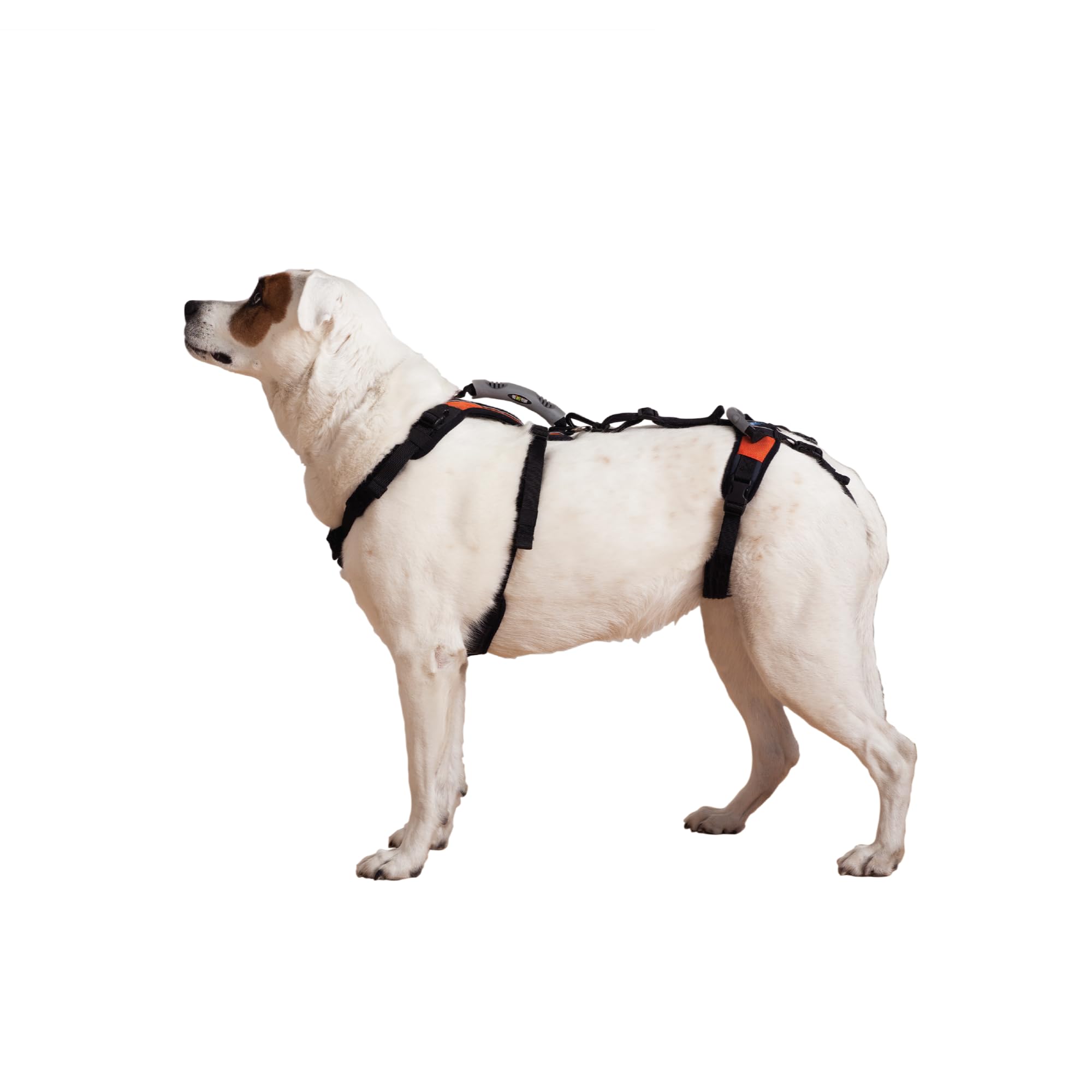
The Help ‘Em Up harness is the one you’ll hear recommended by veterinarians and rehab therapists — for good reason. Its patented hip-lift design uses a cushioned band that wraps under the dog’s rear, allowing you to support the hindquarters without putting pressure on the abdomen or bladder. The Medium size alone covers 45–80 lbs, and the full range spans from a 10-lb Chihuahua to a 225-lb Mastiff. The padding is thick, breathable, and machine-washable, which matters when your dog wears it for extended periods.
Owners of dogs with degenerative myelopathy report that the harness stays in place without twisting, even during 24/7 wear. The two robust handles — one over the shoulders and one at the rump — give you precise control for stairs and vehicle transfers. The clips are heavy-duty but can be stiff for arthritic hands, though that stiffness translates to confidence under load. A 130-lb Newfoundland owner called it rugged and comfortable, noting their dog regained the confidence to stand and walk.
Initial fitting takes patience because of the many adjustment points, but once dialed in, you only use the chest and rear clips to put it on and take it off. The conventional style works well for most female dogs and male dogs with standard anatomy. If your male dog has anatomy set further back, Help ‘Em Up offers a U-band version. This is the benchmark for full-body support and the harness we’d choose for long-term, daily use.
Why we love it
- Vet-recommended with patented hip-lift for bladder-safe support
- Five sizes cover 10 to 225 lbs without guesswork
- Machine-washable padding stays soft through repeated use
Good to know
- Initial setup is time-consuming; follow the guide carefully
- Clips can be difficult to operate for owners with reduced hand strength
2. Lafoty 2-in-1 Detachable Support Harness (X-Large)

The Lafoty 2-in-1 in X-Large solves a specific problem: male dogs who struggle to urinate without soiling their harness. The lift handles are positioned to stay clear of the genital area, and the rear leg straps sit low enough that they don’t interfere with elimination. With four handles — two at the front shoulders and two at the rear — you have multiple grip options for rotating your dog during stair climbs or car lifts. The six adjustable straps distribute force evenly, reducing the load on your lower back.
This is a 2-in-1 design: the entire rear-leg support section can be detached, leaving a well-constructed walking harness behind. The lift strap itself can be used separately as a temporary sling for short carries. Owners of 70-lb post-surgery dogs report that the padding is soft in all the right places, with no clips rubbing against fur or skin. A 90-lb dog with degenerative myelopathy used this harness daily for walks and potty breaks without any chafing.
The material is sturdy polyester with reinforced stitching, though it adds noticeable weight compared to simpler slings. You’ll need to spend time on the initial fit — the 9 clasps (neck, body, back legs) allow extensive customization, but that many points means more to adjust. Once set, you can take it on and off using just the buckles. This is a strong choice for owners of large male dogs who need all-day rear support without mess.
Why we love it
- Male-friendly handle placement allows natural urination without soiling
- Detachable rear section converts to a standard harness for walks
- Four handles provide versatile lifting and rotation options
Good to know
- Heavier than basic slings; may feel bulky for small owners
- Nine clasps require a careful initial adjustment session
3. Lafoty Full Body Support Sling (X-Large)
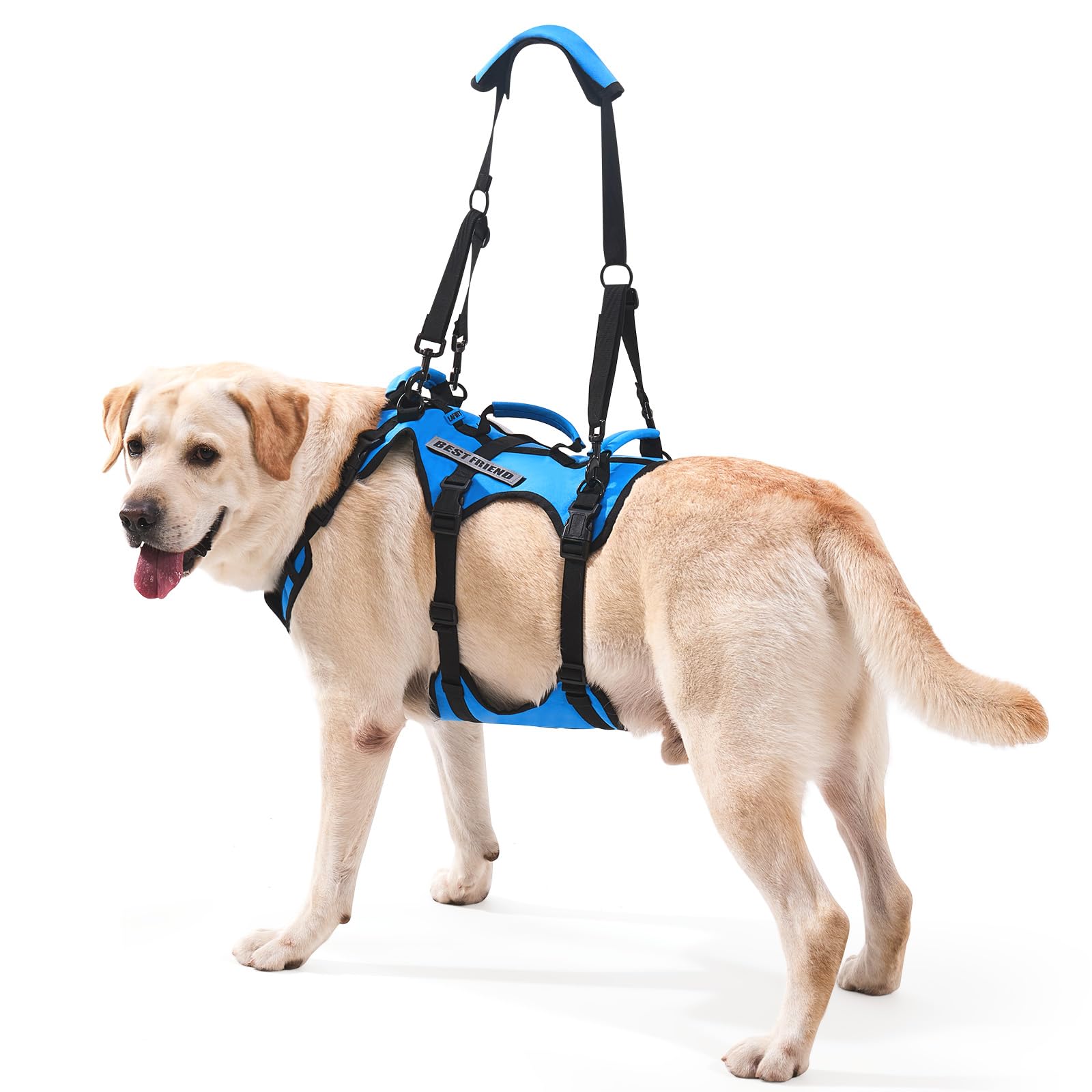
This Lafoty model in X-Large is built for the heaviest dogs on the list — verified by a 200-lb giant breed owner who called it perfect. Three reinforced handles run along the spine, giving you front, center, and rear grip points. The included shoulder strap clips to the front handle and lets you distribute your dog’s weight across your torso, which is a game-changer for stairs or longer carries. The padding is soft and breathable, with no hard edges pressing against the abdomen.
Post-surgery owners of dogs recovering from TPLO found this harness easy to use for potty breaks without removing the entire vest. The rear opening allows elimination to happen naturally, and the three support points mean you can shift your grip as your dog gains or loses stability mid-walk. The material is lightweight nylon — noticeably lighter than the OneTigris version — which makes it easier to pack for travel or keep on the dog during resting periods.
The trade-off is sizing sensitivity. A 50-lb Labradoodle fell between the Medium and Large, with the Large being too loose on the neck. You must measure your dog precisely across neck, chest, and back length before ordering. The price sits in the premium tier, but the construction quality and the included shoulder strap justify the cost for owners of giant or extra-large breeds who need reliable daily lifting support.
Why we love it
- Three handles plus a shoulder strap provide multiple lifting configurations
- Lightweight build reduces fatigue for both dog and owner
- Confirmed by owners of 200-lb dogs as sturdy and effective
Good to know
- Sizing between Medium and Large can be tricky — measure twice
- Premium price point; cheaper options exist for short-term use
4. OneTigris INVICTUS Dog Lift Harness (Large)

The OneTigris INVICTUS uses 1000-denier nylon, the same fabric found in tactical military gear, giving it unmatched abrasion resistance for daily use with strong, large dogs. The Large size fits 60–90 lbs, while the XXL extends to 180 lbs. Three grab handles — two horizontal on the sides and one vertical along the back — plus a detachable shoulder sling give you multiple lifting strategies. The front chest piece is separate from the main vest, which distributes weight evenly across the ribcage and prevents the harness from riding up into the throat.
Owners of 85-lb Labrador Retrievers pre-ACL surgery found this harness allowed a 120-lb person to lift and guide the dog easily. The rear leg attachments use anti-chafing sleeves, but they can be fiddly to secure. One reviewer noted that the hip straps tend to slide out of position on a dog that goes limp and resists standing — so this harness works best with cooperative dogs who are willing to participate in walking or standing. The 360° support design is excellent for dogs who need help navigating stairs, getting into cars, or maintaining balance during potty breaks.
The main drawback is weight. At nearly 2 lbs for the larger sizes, it is the heaviest harness on this list. The material also attracts pet hair, so expect to lint-roll it between washes. Stainless steel D-rings and zinc alloy snap hooks feel reassuringly solid, and the whole unit is machine-washable. If your dog is a stoic, willing partner in recovery, this harness will outlast several rounds of surgery rehab.
Why we love it
- 1000D nylon shell is practically indestructible with large dogs
- Detachable rear leg straps with anti-chafing sleeves
- Three handles plus a sling strap offer versatile carrying options
Good to know
- Heavier build may be overkill for dogs under 50 lbs
- Rear leg straps can slip on dogs that go limp
5. Lafoty 2-in-1 Dog Lift Harness (Large)
The Large version of the Lafoty 2-in-1 brings the same male-friendly design and 2-in-1 versatility as the X-Large but at a more accessible price point. It fits dogs in the 60–90 lb range and shares the same four-handle configuration and detachable rear-leg support. The polyester build is durable enough for daily walks and potty breaks, and the lift strap works independently as a temporary sling for quick carries. Owners of a 15-year-old senior beagle reported excellent rear-leg support during stairs and car access, noting that the harness washed well with gentle soap.
The sizing adjustments take some effort — reviewers consistently mention that the initial fit session is the most time-consuming part. But once you dial it in, the 9 clasps allow you to take the harness on and off without re-adjusting. The male-friendly lift handles genuinely work: male dogs can urinate without wetting the webbing, and the rear leg straps don’t interfere with defecation. A 70-lb post-back-surgery dog wore this harness comfortably with no friction points or pinched fur.
Where this harness saves money, it also cuts weight — it is lighter than the OneTigris and easier for smaller owners to manage. The shoulder padding is adequate but not as plush as the Help ‘Em Up. If you need a functional, well-made 2-in-1 harness for a large dog with hind-leg weakness and you want to keep the budget in check, this is the most practical option.
Why we love it
- Male-friendly design prevents mess during urination
- 2-in-1 versatility — detachable rear section works as a standard harness
- Lighter build than premium competitors, easier for small owners
Good to know
- Initial adjustment is fiddly with 9 separate clasps
- Padding is less plush than higher-tier options like Help ‘Em Up
FAQ
Can I use a dog lifting harness on a puppy?
How do I measure my dog for a lifting harness correctly?
What is the difference between a rear-leg sling and a full-body lifting harness?
Will a lifting harness help a dog with degenerative myelopathy?
How long does it take to put on a full-body lifting harness?
Final Thoughts: The Verdict
For most owners managing a dog with serious mobility challenges, the best dog lifting harness winner is the Help ‘Em Up Conventional Harness because it combines vet-recommended hip-lift engineering, generous size range, and machine-washable padding that holds up to daily wear. If you need a male-friendly design with 2-in-1 versatility, grab the Lafoty 2-in-1 X-Large. And for owners on a budget who still want robust rear-leg support and detachable versatility, nothing beats the Lafoty 2-in-1 Large.