
A dog with a bored brain is a recipe for shredded pillows, excavated flower beds, and that relentless stare that says “entertain me.” Physical exercise alone doesn’t solve this — what your dog actually craves is a cognitive challenge that taps into their natural instincts to sniff, forage, and problem-solve. The right interactive toy turns five minutes of frantic energy into twenty minutes of focused, mentally draining work that leaves them satisfied, not just tired.
I’m Mo Mahin — the founder and writer behind Furric.
After digging through hundreds of user reports and measuring each product against real-world engagement metrics, I’ve built a shortlist of the best dog toys for mental stimulation that actually hold a dog’s attention beyond the first fifteen minutes.
How To Choose The Best Dog Toys For Mental Stimulation
A toy that merely drops kibble when nudged doesn’t qualify as true mental stimulation — real cognitive engagement requires your dog to process a sequence of actions, differentiate between visual or scent cues, and adapt as the puzzle changes. Before you buy, focus on three factors that determine whether a toy will genuinely challenge your dog or become a five-minute novelty.
Difficulty Level and Progression
Dogs solve puzzles faster than owners expect. A single-level board where all treats are visible behind sliding doors becomes mastered in minutes. Look for toys that offer multiple difficulty modes — spinning layers, rotating dispensers with adjustable resistance, or step-up designs where the mechanism changes as your dog figures out each stage. Toys that allow you to increase the challenge without buying a separate unit provide far better long-term value.
Material Safety and Chew Resistance
Mental stimulation toys are often built from plastic, fleece, or plush fabric, each with different durability profiles. Food-grade ABS and BPA-free plastics hold up well under normal use but can crack if a persistent chewer decides to dismantle the mechanism. Fleece snuffle mats withstand repetitive pawing and sniffing without creating choking hazards. Avoid toys with small detachable pieces if your dog is an aggressive chewer — look for integrated structures where the moving parts don’t separate from the base.
Cleaning Practicality
Every treat-based toy accumulates saliva, kibble dust, and moisture that breeds bacteria if left uncleaned. Snuffle mats that are machine-washable and dry quickly stay fresh longer. Plastic puzzle feeders with removable compartments that rinse clean without harboring residue in crevices reduce the risk of mold and unpleasant odors. The easier a toy is to clean, the more likely you are to use it daily rather than letting it gather dust in a corner.
Quick Comparison
On smaller screens, swipe sideways to see the full table.
| Model | Category | Best For | Key Spec | Amazon |
|---|---|---|---|---|
| KADTC Dog Puzzle Toy | Premium Interactive Puzzle | Multi-level challenge & slow feeding | 3 difficulty levels, 4 play modes | Amazon |
| Potaroma Electronic Treat Dispenser | Premium Electronic Toy | Remote play & paw coordination training | 80ft remote range, 280ml capacity | Amazon |
| Outward Hound Dog Tornado | Mid-Range Puzzle | Intermediate problem-solving with adjustable layers | 3 spinning layers, Level 2 Intermediate | Amazon |
| YOPSI Snuffle Mat | Mid-Range Foraging Mat | Natural foraging & slow eating for large breeds | 39.4″ x 23.6″, machine washable | Amazon |
| Outward Hound Hide-A-Squirrel | Budget-Friendly Plush Puzzle | Hide-and-seek prey drive engagement | 6 squeaky squirrels, X-Large 12.6″ trunk | Amazon |
In‑Depth Reviews
1. KADTC Dog Puzzle Toy, 3 Levels Step-by-Step Challenge
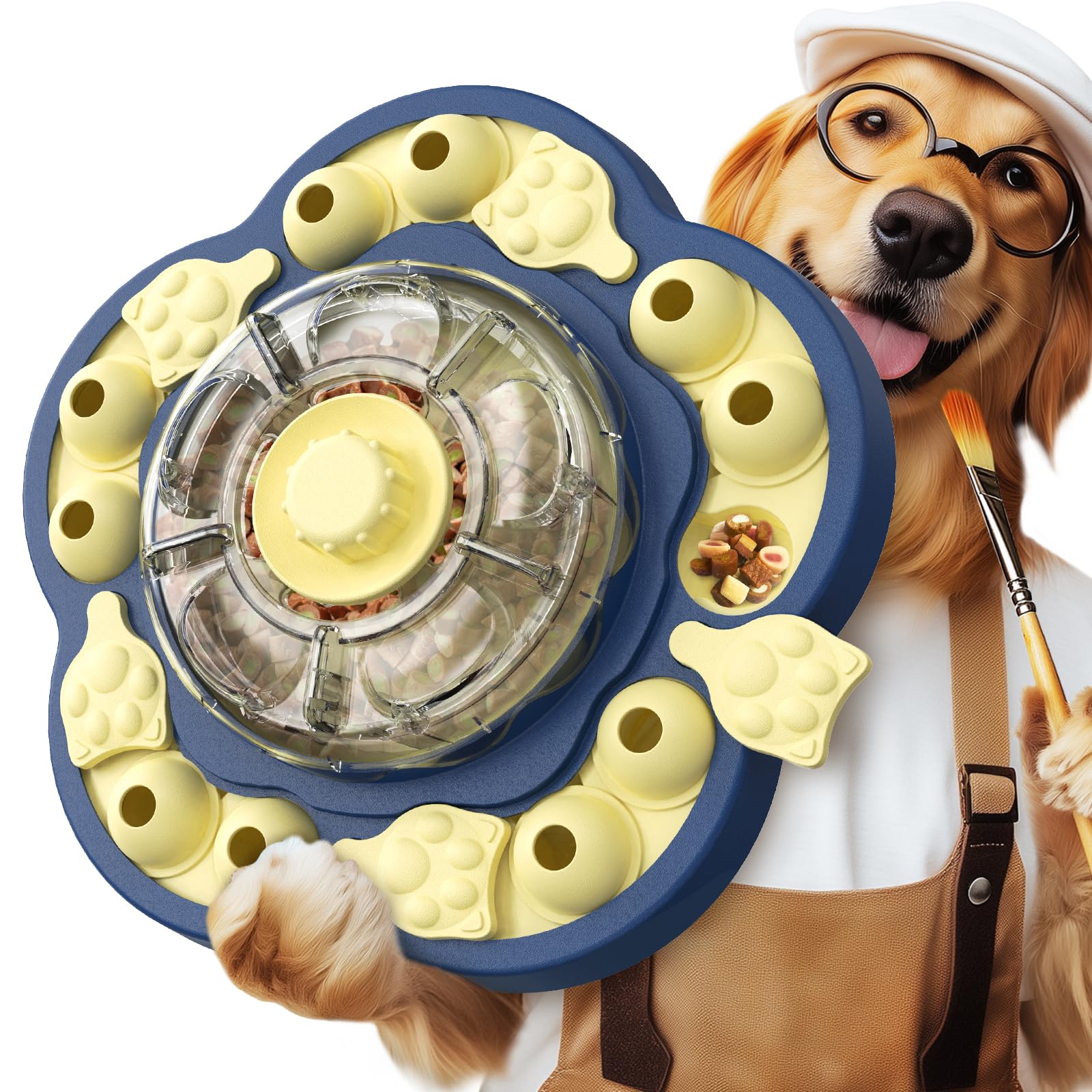
The KADTC puzzle breaks away from flat board designs by using a vertical spin-to-release mechanism that drops treats into lower pods for the dog to discover. This 3-level, 4-mode system means your dog doesn’t just slide a door — they spin, sniff, slide, and solve in sequence. The structure keeps smart dogs engaged far longer than a single-mechanism toy, and owners report the vertical design prevents the “gaming the system” workaround that flat puzzles often suffer from.
Built from food-grade ABS with no BPA, PVC, or phthalates, the integrated main body minimizes loose game pieces that could become choking hazards. The clear food pods rinse easily under running water, making daily cleaning straightforward. At 12.99 inches wide and weighing roughly 2.1 pounds, it stays planted on the floor without sliding, even during enthusiastic batting and pawing. Dogs as light as 10 pounds can operate the spinning mechanism, while 70-pound Labs work through the levels without damaging the unit.
When used as a slow feeder, the KADTC stretches a 30-second bowl-gulp into a 6-7 minute cognitive session on level two. Owners of high-energy breeds like Aussiedors and border collies consistently note that the progressive difficulty keeps their dogs returning to the toy instead of losing interest after a single solve. The only caution is that moving parts can detach if a dog forcefully bites down on the spinner — supervision during the first few uses helps gauge your dog’s interaction style.
Why we love it
- Vertical spin mechanism creates a more complex challenge than flat puzzles
- 3 difficulty levels and 4 modes extend replay value for months
- Slow feeder function prevents gulping and turns meals into mental work
Good to know
- Spinning center part can detach if aggressively chewed — supervise strong chewers
- Requires slightly more cleaning effort than open flat board puzzles
2. Potaroma Dog Puzzle Feeder Toy, Electronic Treat Dispenser

The Potaroma electronic dispenser takes mental stimulation into a different territory — instead of a static puzzle, it’s a moving target that rewards your dog for chasing, batting, and pawing at the rotating dispenser. The remote operates up to 80 feet away, making it useful for outdoor play where you want to encourage running and tracking. The 280ml capacity holds enough kibble for multiple training sessions before refilling, and the adjustable dispensing amount lets you control how much food releases per activation.
A standout feature is the voice record function — you can record your own call-to-play command, which plays when treats dispense. This personal cue reinforces the connection between your voice and the reward, turning the device into a training aid rather than just a treat cannon. The 9 preset sounds offer variety, and the DIY stickers let you customize the appearance. Owners report that dogs figure out the mechanism within 3-4 days, then eagerly respond to the sound trigger even when the dispenser is stationary.
Battery life holds up well across multiple daily sessions, and the USB rechargeable design eliminates the expense of disposable batteries. The occasional treat jam occurs with irregularly shaped kibble, but loading slightly crunched treats or uniform pellets minimizes this. At under a pound, it’s portable enough to move between rooms or take to the yard, and the ABS plastic construction withstands normal pawing without cracking.
Why we love it
- Remote-controlled play at up to 80 feet encourages physical movement plus mental tracking
- Voice recording creates a personalized training cue that strengthens response behavior
- USB rechargeable battery eliminates ongoing battery costs
Good to know
- Occasional treat jams with irregularly shaped kibble — use uniform pellets for best results
- Some dogs learn the mechanism quickly and may lose interest without difficulty progression
3. Outward Hound by Nina Ottosson Dog Tornado

The Outward Hound Dog Tornado, designed by Nina Ottosson, is a proven mid-range puzzle that uses three independently spinning layers to hide treats behind compartment doors. Rated Level 2 Intermediate, it strikes the right balance for dogs who have mastered basic slider puzzles but aren’t ready for complex multi-step mechanisms. The bone-shaped pieces that sit on top of each layer must be lifted or spun to align doors with hidden treat chambers, requiring the dog to sequence two actions — lift then spin — rather than just pawing randomly.
The base holds up to 1/2 cup of kibble or small treats, which converts a full meal into a 5-45 minute engagement session depending on how you set the difficulty. Owners of smart breeds like Australian Shepherds and Shelties report that adjusting the difficulty — by freezing broth in the compartments or stacking layers in different orders — extends the toy’s useful life well past the initial learning curve. The plastic construction is durable enough to survive years of regular use, though the white bone pieces can be chewed off by persistent mouthing.
Cleaning is straightforward: a quick rinse after use removes residual food dust, and the layers separate for thorough washing. The 9.75-inch footprint works well on hardwood and tile floors without excessive sliding. The main noise concern is the plastic-on-plastic scratching sound when dogs paw at the layers — this bothers some owners in quiet rooms but doesn’t affect the toy’s function. For dogs that solve it quickly, the included tips guide teaches owners how to increase difficulty without buying a separate puzzle.
Why we love it
- Three-layer spin mechanism requires sequenced actions rather than single-motion solving
- Adjustable difficulty with freezing, stacking, and treat placement variations
- Durable construction that survives years of daily use across multiple dogs
Good to know
- White bone pieces may detach and get chewed — remove them if your dog mouths aggressively
- Scratching noise on hard floors during play may be noticeable in quiet environments
4. YOPSI Snuffle Mat for Dogs Large Breed 39.4″x23.6″

The YOPSI snuffle mat is the largest foraging surface in this roundup at 39.4 inches by 23.6 inches, designed to accommodate multiple dogs simultaneously or give a single large breed plenty of territory to explore. The varied fleece textures include loose strips, tight woven pockets, and layered fabric flaps that hide kibble at different depths, forcing the dog to use scent discrimination rather than visual scanning to locate food. The leaf-shaped pattern isn’t just decorative — the irregular fabric folds create natural hiding spots that change configuration each time you load it.
Owners of high-energy breeds like Golden Retrievers report that the mat keeps dogs actively sniffing and pawing for 30 minutes or longer during meal replacement sessions. The non-slip rubberized bottom prevents the mat from sliding across floors during enthusiastic foraging, and the fleece material is soft enough to prevent nose or paw irritation even after extended use. The entire mat rolls up with built-in ties for storage, and the machine-washable construction means you can toss it in the washer on a gentle cycle to remove accumulated saliva and food debris.
One of the strongest advantages of this mat over plastic puzzle feeders is the complete absence of small parts that could become choking hazards — it’s just fabric and rubber. This makes it suitable for dogs who approach puzzles with destructive intent rather than gentle pawing. The 1.5-inch fabric strip lengths are long enough to bury treats deeply but short enough to avoid tangling during washing. The only limitation is that the mat doesn’t provide the sequential problem-solving structure that some smart dogs need — it’s scent work and foraging, not logic-puzzle reasoning.
Why we love it
- Extra-large surface accommodates multiple dogs or large breeds in a single session
- Zero choking hazards — no detachable pieces, just fabric and rubber
- Machine washable construction keeps the mat fresh and hygienic with minimal effort
Good to know
- Provides scent foraging rather than sequential logic challenges — may not satisfy puzzle-focused dogs
- Some kibble pieces can fall onto the floor around the mat edges during vigorous sniffing
5. Outward Hound Hide-A-Squirrel Dog Toy, X-Large

The Hide-A-Squirrel is a 2-in-1 plush puzzle that combines a soft tree trunk with six removable squeaky squirrels, tapping directly into a dog’s natural prey drive. The mental stimulation comes from the hide-and-seek process — your dog must root through the trunk’s opening, identify which squirrel to pull, and extract it while resisting the urge to tear the entire trunk apart. The X-Large version measures 12.6 inches tall by 7.1 inches in diameter, providing enough depth to fully conceal all six squirrels.
Owner reports consistently praise the entertainment value relative to the cost. Dogs ranging from 5-pound Morkies to 40-pound puppies stay engaged for extended periods, and the squeakers in each squirrel provide auditory reinforcement that encourages persistent digging and rooting. The squirrels are sold separately as refills, extending the toy’s lifespan without buying a whole new set.
The main durability concern centers on the trunk’s bottom stitching, which some dogs manage to tear open within minutes. For these cases, the trunk functions well as a treat-stuffing toy once the bottom has been opened. The plush material collects saliva and fur, so occasional spot cleaning or gentle washing is necessary. Despite these limitations, the Hide-A-Squirrel delivers a genuinely different form of mental engagement — prey-drive hunting versus food-logic solving — making it a useful supplement to treat-based puzzles rather than a replacement for them.
Why we love it
- Unique hide-and-seek mechanism engages natural prey drive for a different mental challenge
- Squirrels sold separately as affordable refills extend the toy’s lifespan
- Trunk body often outlasts expectations, surviving over a year with regular use
Good to know
- Bottom trunk stitching can be torn open by persistent chewers in minutes
- Squirrels lose tails and fur over time — not suitable as a standalone chew toy
FAQ
How long should a single mental stimulation session last for my dog?
Can I use a mental stimulation toy as my dog’s primary food bowl every day?
What difficulty level should I start with for a puppy versus an older dog?
My dog solves every puzzle in under 2 minutes — what’s the next step up?
Final Thoughts: The Verdict
For most dogs, the dog toys for mental stimulation winner is the KADTC Dog Puzzle Toy because its three-level, four-mode vertical design provides the most sustained cognitive challenge without requiring additional purchases or setup changes. If you want an interactive toy that combines physical movement with sound-based training cues, grab the Potaroma Electronic Treat Dispenser. And for scent-driven foraging that works for multiple dogs or destructive chewers, nothing beats the YOPSI Snuffle Mat.