
That split-second panic when you glance down and your dog isn’t there is a feeling every owner dreads. Whether your escape artist has a taste for adventure or you just want the confidence to let them roam off-leash, a dedicated tracker collar is the only true safety net. The right unit blends real-time GPS accuracy with a battery that lasts the whole weekend, giving you back the freedom to enjoy your time outdoors.
I’m Mo Mahin — the founder and writer behind Furric. I’ve spent months analyzing 4G LTE signal strengths, satellite lock speeds, app ecosystem reliability, and subscription cost structures across dozens of GPS dog collars to separate the true performers from the frustrating duds.
No two dogs run the same path, which is why choosing the right dog tracker collar comes down to balancing range, battery life, containment features, and the real-world accuracy of its GPS chipset under a forest canopy or on a foggy hillside.
How To Choose The Best Dog Tracker Collar
Every GPS collar on the shelf promises to keep your dog safe, but the difference between a collar that works and one that frustrates comes down to four critical factors. Ignore the marketing fluff and focus on the specs that determine if the device will actually find your dog when it matters.
Satellite Locks and Network Dependencies
A true GPS collar uses satellites to triangulate position, not cellular triangulation. Look for models that support multiple satellite constellations (GPS + GLONASS or GPS + Galileo) and dual-frequency (L1 + L5) reception. Dual-frequency chips pull in corrections from ground stations and maintain a lock under heavy tree cover, within canyon walls, or during overcast weather. If a collar relies only on cellular towers for location, it loses most of its value the moment your dog runs beyond a tower’s range or into a rural dead zone.
Battery Life vs. Real-World Tracking
Manufacturers quote battery life under ideal conditions — low polling rates, minimal app interaction, no training corrections. The real-world drain is much higher. A collar that advertises 14 days is a solid city-dog option for daily walks. A collar that advertises 24–36 hours is built for high-frequency GPS pings (every 2–5 seconds) and active containment on a large property. If you plan to hike and hunt, prioritize a unit with at least a full day of aggressive tracking per charge. Fast charging (under 2 hours) is a hidden bonus that gets you back out the door quickly.
Subscription Costs and Free Tiers
This is the single biggest differentiator between models. Some collars bundle 6–12 months of cellular data in the purchase price, then require a monthly or annual membership after that. Others — like the higher-end Dogtra Pathfinder 2 — use direct satellite-to-smartphone communication with zero subscription fees but require your phone to remain paired within Bluetooth range. Study the fine print: a cheap collar with a perpetual /month fee becomes expensive within two years, whereas a collar with no monthly fee can justify a higher upfront cost for long-term ownership.
Containment vs. Pure Tracking
Not every tracker collar is a fence. Pure trackers simply tell you where your dog is on a map. Containment collars add geofencing alerts (push notification when the dog leaves a virtual boundary) and — in the case of e-collar hybrids — apply sound, vibration, or static correction to encourage the dog to stay within the zone. If your primary goal is off-leash hiking with recall backup, a tracking-only collar with a geofence alert is sufficient. If your dog has zero recall and you need a physical boundary, you need a containment model with adjustable correction levels.
Quick Comparison
On smaller screens, swipe sideways to see the full table.
| Model | Category | Best For | Key Spec | Amazon |
|---|---|---|---|---|
| Dogtra Pathfinder 2 | Premium Tracker + E-Collar | Hunting & long-range off-leash | 9‑mile range, 100 stimulation levels | Amazon |
| Halo Collar 5 | Premium Containment | Wireless fence + 24/7 tracking | Dual-frequency L1+L5 GPS, 2‑ft accuracy | Amazon |
| Dogtra Pathfinder 2 (Hunting Kit) | Premium Training + GPS | Large-breed training & e-fence | 2‑sec GPS updates, 21‑dog capacity | Amazon |
| VERSMELO GPS Wireless Fence | Mid-Range Containment | Large property perimeter control | 1999‑yd radius, no subscription | Amazon |
| Fi Series 3+ | Mid-Range Smart Tracker | AI health monitoring + escape alerts | 285 mAh battery, Apple Watch support | Amazon |
| PETLOC8 GPS Tracker | Budget Tracker | Lightweight daily tracking | 14‑day battery, 12‑mo subscription incl. | Amazon |
| Garmin PT10 | Budget Training Collar | Training + bark control (1‑mile) | 27 MHz radio, 1‑mile range | Amazon |
In‑Depth Reviews
1. Dogtra Pathfinder 2 GPS Dog Tracker E-Collar

The Dogtra Pathfinder 2 is the closest thing to a universal solution for off-leash hunting, hiking, and containment. It pairs a 9-mile GPS tracking range with 100 levels of nick and constant stimulation, plus a 2-second satellite refresh rate that keeps the blue dot on your map moving smoothly even when your dog is cresting a distant ridge. The real winner is the subscription-free model: after the initial purchase, the Map Box-powered app remains completely free, covering general, satellite, and terrain views without a monthly bill.
Owners consistently report sub-10-foot GPS accuracy in open fields and only minor drift inside deep woods, where the collar still holds a lock longer than most competitors. The companion remote gives you one-touch corrections without needing to unlock your phone, a critical advantage when a distraction—like a deer—suddenly appears. The collar body is waterproof and rated for saltwater, so beach runs and creek crossings won’t cut the session short. Battery life under aggressive tracking averages a full day, and the sleep mode extends that significantly when the collar is idle.
Setback is minor: the geofence boundary must be re-engaged manually each time you open the app, and the collar’s on/off procedure feels a bit fussy until you memorize the sequence. But for anyone who values outright range, zero subscription creep, and integrated e-collar training in one rugged package, this is the benchmark.
Why we love it
- No ongoing subscription fees for GPS and mapping
- 9-mile range with 2-second position updates
- Physical remote provides instant stimulation without phone
- Waterproof and saltwater-resistant construction
Good to know
- E-fence boundary resets each time the app is closed
- On/off process has a learning curve
- Requires smartphone paired via Bluetooth to maintain function
2. Halo Collar 5 Wireless Dog Fence & GPS Dog Collar

The Halo Collar 5 tackles the number-one frustration of GPS containment fences: location drift. Its dual-frequency L1 and L5 satellite receiver pulls real-time correction data from a global network of ground stations, narrowing accuracy down to roughly 2 feet. That precision means your dog receives a warning only when they actually approach the boundary, not when the collar’s GPS randomly skips 20 feet to the left. The collar also uses AI obstacle filtering to ignore temporary signal reflections off buildings or tree trunks.
Setup requires a subscription — choose a plan at purchase — but Halo’s AlwaysOn GPS keeps a continuous location lock even while charging. You can draw a virtual fence from your phone in under a minute, scaling from 900 square feet up to 1,200 square miles, which makes the system genuinely portable to campsites, vacation rentals, or a friend’s property. The included training program by Cesar Millan guides owners through the sound, vibration, and static stages so the dog learns the boundary in days, not weeks. Owners of escape-prone breeds report that the immediate alert and 20-times-per-second position refresh catch escapes before they happen.
The trade-off is that the collar’s containment performance relies on cellular and Wi-Fi connectivity. If you take the dog to a remote area with zero cell signal, the fence and tracking functions degrade or disappear. A handful of users report random static corrections when the GPS drifts while the dog is stationary inside the house — a firmware issue Halo continues to patch. Despite those edge cases, for suburban and rural properties where a wire-free perimeter is the top priority, the Halo 5 delivers a reliability margin no other collar in its class matches.
Why we love it
- Sub-2-foot accuracy with drift prevention software
- Entirely self-contained, no base station needed
- Portable to any location, fence configurable from phone
- Rapid charging (under 1 hour) for all-day containment
Good to know
- Requires ongoing subscription for GPS and fence features
- Loses fence function in areas without cellular service
- Occasional firmware-related static correction reported indoors
3. Dogtra Pathfinder 2 (Hunting Kit) GPS Dog Training Collar

This is the same Pathfinder 2 GPS engine as the first pick, but configured as a complete hunting kit intended for large-breed working dogs. The collar ships with a remote transmitter, 100 levels of nick and constant stimulation, and the ability to track up to 21 dogs on a single app instance — a necessity for serious hunters running multiple dogs on a drive. The GPS receiver updates every 2 seconds, and the app offers offline map caching so you can download a topo map of a backcountry hunting unit before you lose cell signal.
The physical difference from the first Pathfinder 2 listing is the included long contact pins designed for dense double coats — Great Pyrenees, Huskies, GSDs. Owners of these thick-coated breeds confirm the stimulation reliably breaks through fur without shaving contact patches. The 2-year warranty and USA-based phone support back the hardware, and in practice the collar has survived years of submersion in mud, snow, and creek water without RF degradation. Battery life runs roughly 24 hours with GPS pinging every 2 seconds, and switching to the lower-power tracking mode stretches that to a full weekend.
Where it trips up: the entire system requires your iPhone or Android to stay paired via Bluetooth to the remote transmitter. If the phone battery dies on a long hunt, you lose both the map display and the ability to adjust stimulation levels from the app. The e-fence feature must be manually activated each session — it doesn’t persistently hold the boundary after the app closes. But for serious hunters and rural property owners who need a durable, antenna-lock collar with zero monthly fees, this kit is the gold standard.
Why we love it
- No ongoing subscription or data fees
- Offline map support for remote backcountry use
- Long contact pins fit heavy double-coated breeds
- Rugged construction with 2-year warranty
Good to know
- Requires a phone connected via Bluetooth for full functionality
- E-fence boundary resets when app is closed
- App can drain phone battery quickly at default tracking rate
4. VERSMELO GPS Wireless Dog Fence Collar
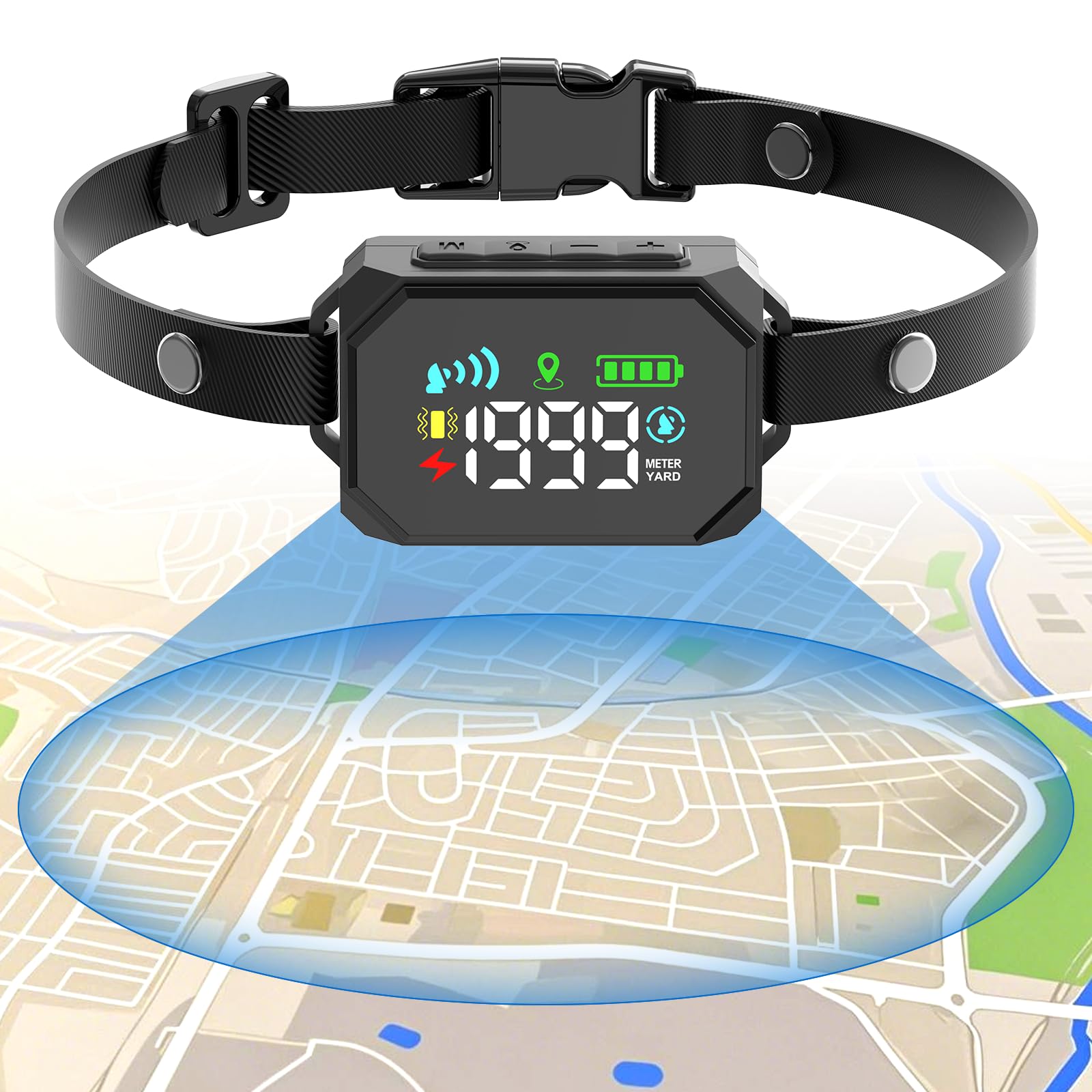
The VERSMELO system flips the script on GPS collars by eliminating every modern dependency: no smartphone app, no Wi-Fi, no cellular plan, and no subscription. You set the circular boundary radius from 33 yards up to 1,999 yards directly on the collar receiver using the built-in control panel. That simplicity makes it a perfect fit for farms, rural acreages, and owners who want a containment tool without handing their phone to a dog walker or housesitter.
The collar uses a U.S.-made GPS chip paired with an AI algorithm that recognizes the boundary crossing pattern and escalates corrections from beep to vibration to static stimulation across six levels. After two correction cycles, the collar automatically enters a protection mode to prevent overstimulation — a humane design that dog training experts recommend. Owners of herding and hound breeds on 10–20 acre properties report the dogs learn the invisible fence in one day and respect the boundary even when the collar is removed. The IPX7 waterproof rating means the collar survives swimming, rain, and muddy play without issue.
The biggest limitation is that the collar operates entirely on GPS satellite signals, which are blocked by dense tree canopy and multi-story structures. If your property has thick overhead cover, the GPS can drift, causing the collar to correct the dog while they are still inside the safe zone. For open-field properties where you want a straightforward, phone-free perimeter solution at a reasonable price, the VERSMELO delivers without recurring costs.
Why we love it
- Completely independent, no app or internet needed
- Massive range adjustable up to 1,999-yard radius
- Automatic overstimulation protection mode
- IPX7 waterproof for swimming and rain exposure
Good to know
- GPS drift under heavy tree cover can cause false corrections
- Battery life limited to 24–36 hours in active mode
- Single-button interface can be confusing during setup
5. Fi New Series 3+ Smart Dog Tracker Collar
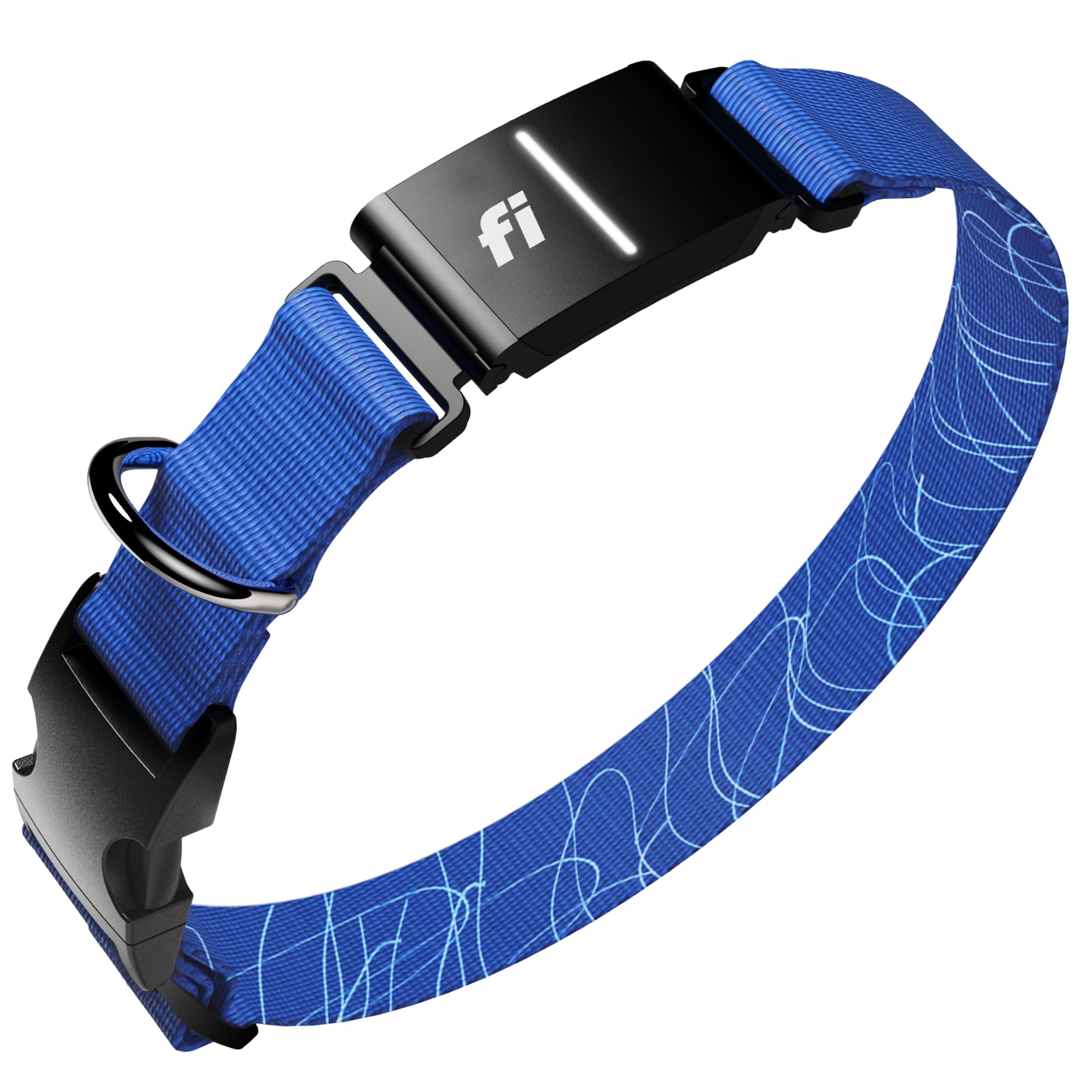
The Fi Series 3+ is as much a wellness wearable as it is a GPS tracker. Beyond the core nationwide cellular tracking and escape alerts, the collar uses an AI-powered sensor suite to detect and log activity, rest, barking, licking, scratching, eating, and drinking patterns. All of that data feeds into a health dashboard that also stores vaccine records, insurance documents, and training certificates — effectively replacing the paper filing system most owners default to.
The collar ships with a 6-month membership included, and the integrated LTE-M chip supports real-time location polling with no range limit as long as the dog is within cellular coverage. The companion Fi app integrates with Apple Watch, allowing you to view live location, activate Lost Mode, and receive escape alerts directly from your wrist. Owners of high-energy rural dogs report week-plus battery life between charges, and the IP67 water resistance holds up against creek crossings and rainy trail runs. The 1-year warranty covers hardware defects, and Fi’s customer support is responsive.
The trade-off is that Fi is a pure tracker — it has no containment fence function and no static or vibration correction. If escape prevention is your primary concern, this collar tells you where your dog went after they leave, not stops them from leaving. The initial setup process has drawn criticism for confusing QR code instructions and a Wi-Fi base station that can struggle to connect. Once connected, the system is solid, but the onboarding friction is a real frustration for non-technical owners. For health-conscious owners who want daily distance tracking and rapid escape notifications, the Fi Series 3+ is a strong mid-range pick.
Why we love it
- AI-powered health and behavior monitoring is unique in this category
- No range limit on tracking within cellular coverage
- Apple Watch companion app for wrist-based alerts
- Long battery life between charges for daily use
Good to know
- No containment fence or correction modes
- Setup process can be frustrating for some users
- Proprietary collar strap must be replaced through Fi
6. PETLOC8 GPS Dog Tracker
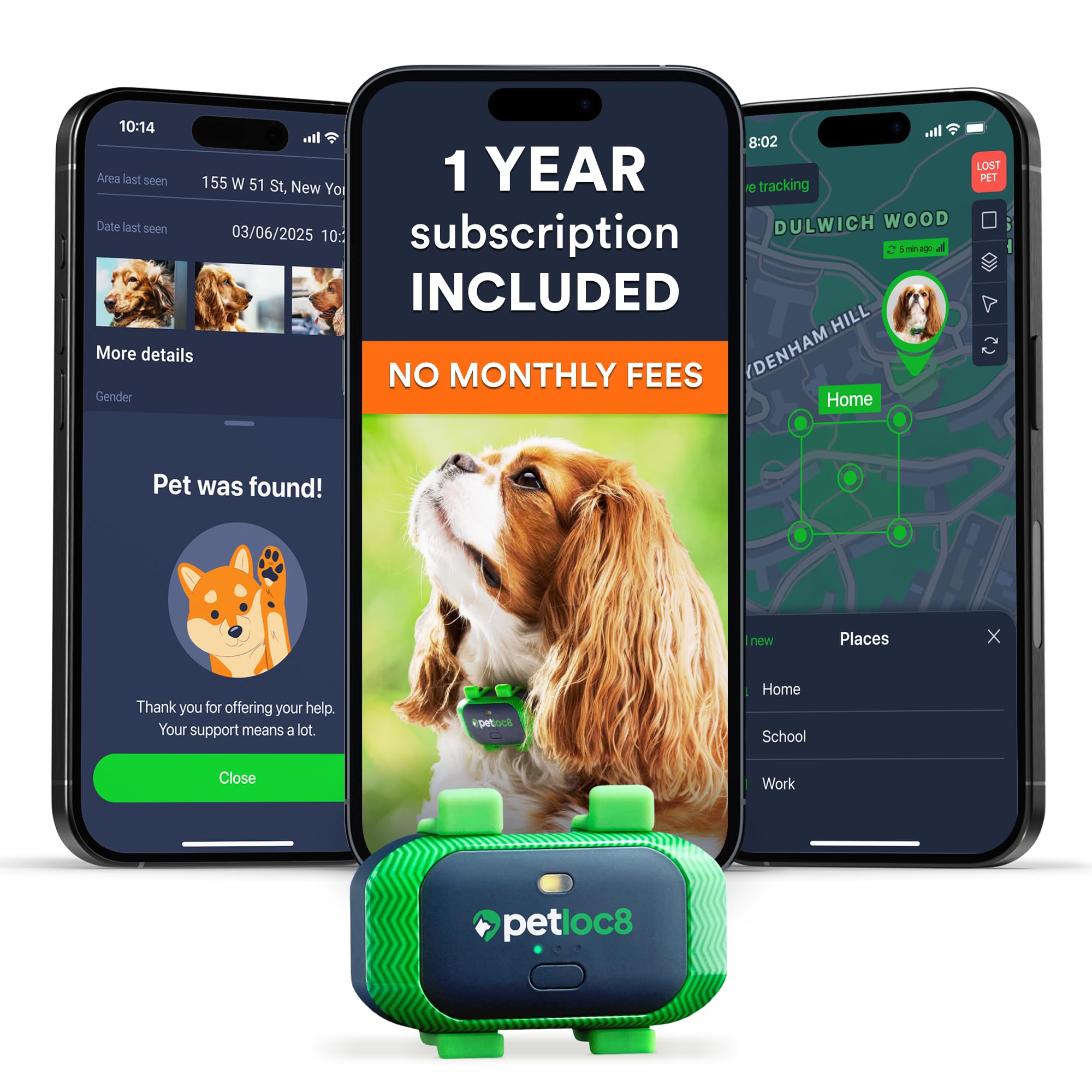
The PETLOC8 tracker prioritizes weight and battery endurance over flashy features. At just over 1 ounce, it attaches to any existing collar and runs for up to 14 days on a single charge, making it the best option for owners who want a simple location check-in without hauling a phone app around all day. The included 12-month subscription covers the 4G LTE CAT 1 cellular connectivity, and the unit ships with an embedded SIM so there is no carrier negotiation.
The Petloc8 companion app creates custom geo-fence zones and sends push alerts the moment the dog exits the safe area. The IP67 waterproof housing lets the device survive rain, puddles, and surface water without sealing failures. The LED light on the tracker helps with low-light location spotting. Owners report that the app interface is intuitive and that the lightweight design barely changes how the collar feels on the dog.
Accuracy, however, is the weak link. Multiple owners report indoor location drift within a 40-yard diameter circle, making it unreliable for finding a cat inside a house or pinpointing a neighbor’s yard. The tracker also exhibited random offline behavior — shutting down mid-use despite showing 70% battery — which required a factory reset to restore function. For urban and suburban dogs who stay within a few-block radius, the 14-day battery and lightweight profile are compelling, but the inconsistent GPS lock reliability means this is not a collar for escape artists or remote hiking.
Why we love it
- Extremely lightweight (1.23 oz) for daily collar wear
- 14-day battery life reduces charging frequency
- 12-month cellular subscription included with purchase
- Simple app with geo-fence alerts
Good to know
- GPS accuracy degraded indoors, up to 40-yard drift
- Unit may go offline unexpectedly despite showing battery
- Not suitable for real-time tracking of fast escape artists
7. Garmin PT10 Dog Device Collar

The Garmin PT10 is not a GPS tracker in the modern sense — it is a durable radio-frequency e-collar that pairs exclusively with Garmin Pro 70 and Pro 550 handheld transmitters. It operates on a 27 MHz frequency with a 1-mile range, and it delivers nick, constant, tone, and vibration corrections through stainless steel contact points that come in two lengths for short or thick coats. The collar also includes BarkLimiter, which auto-detects barking and applies a pre-set correction to curb nuisance vocalization.
Battery life is the standout feature: owners report charging the collar roughly once per week with daily training use, and a full charge takes about one hour. The unit is waterproof and has survived years of submersion in mud, creek water, and heavy brush without losing range or signal strength. Owners of field trial dogs and hunting breeds say the PT10 holds up to the worst abuse and still pairs instantly with the Garmin Sport Pro or Pro 550 transmitter. The collars can be mixed in any color (black, red, blue) to differentiate multiple dogs during training.
The hard limit is that this collar is a companion accessory to Garmin’s transmitter line — it has no standalone GPS, no mapping app, and no geofencing. If you already own a compatible Garmin handheld, the PT10 is an affordable way to add a collar for a new dog or replace an aging unit. If you are shopping for your first GPS tracker and need mapping capability, this is not the right starting point. For experienced trainers who want a bombproof e-collar add-on with zero subscription fees, the PT10 remains a reliable classic.
Why we love it
- Weekly battery life with daily training use
- Rugged, waterproof construction proven over years
- Built-in BarkLimiter for automatic nuisance correction
- Interchangeable contact points for different coat thicknesses
Good to know
- No built-in GPS or mapping functionality
- Requires a compatible Garmin Pro 70 or Pro 550 transmitter
- Limited 1‑mile range compared to modern GPS units
FAQ
How often does a GPS dog collar update location?
Will a tracker collar work in deep woods or mountains?
Can I use multiple collars for multiple dogs on one app?
Does a GPS tracker collar require a cellular data plan?
How long do GPS dog collar batteries last in real use?
Final Thoughts: The Verdict
For most active owners who want a balance of rang, training control, and zero recurring fees, the winner is the Dogtra Pathfinder 2 because its 9-mile GPS range, e-collar integration, and subscription-free app give you the widest operating envelope without nickel-and-diming you every month. If your primary goal is a wire-free containment perimeter with sub-2-foot accuracy and you are willing to pay a monthly subscription, grab the Halo Collar 5. And for budget-conscious owners looking for an ultra-light tracker with 14-day battery life for daily peace of mind, the PETLOC8 GPS Tracker is the entry-level choice.