
The moment your dog slips out the back gate or bolts after a scent, every second without a location fix feels like an hour. A GPS tracker that loses signal, drains fast, or pins your dog two houses away doesn’t buy you peace of mind — it creates a new source of anxiety. The technology has evolved far beyond basic radio-frequency collars, and the real leaders now deliver sub-three-second updates, nationwide cellular connectivity, and AI-powered behavior alerts that tell you when something is wrong before the escape even happens.
I’m Mo Mahin — the founder and writer behind Furric. I’ve spent months cross-referencing satellite positioning data, battery capacity benchmarks, and subscription cost structures while analyzing thousands of owner-reported field experiences to identify which trackers actually hold a reliable signal in rural timber, dense suburbs, and open water scenarios.
Whether you need containment on a 20-acre farm or a compact unit for a 15-pound escape artist, the best dog tracker gps delivers real-time location, long battery life, and durable waterproofing without a confusing setup process.
How To Choose The Best Dog Tracker GPS
GPS dog collars are not one-size-fits-all. A tracker that excels for a weekend hunter fails for a suburban owner who wants a 24/7 containment fence. The critical spec to start with is frequency range — do you need real-time cellular tracking with no range limit, or is a 4-mile radio-frequency system paired with a handheld remote sufficient for your property? The decision dictates your subscription requirements, battery life expectations, and overall ownership cost.
Tracking Technology: Cellular vs. Radio Frequency (RF)
Cellular trackers (Fi, Halo, PetSafe) use nationwide LTE-M networks to display your dog’s location on a smartphone app from anywhere with cell service. They offer unlimited range but require a monthly or annual subscription (-/month). RF-based systems (Garmin, Dogtra) communicate directly between the collar and a dedicated handheld device, which means zero recurring fees but a hard range cap (typically 4 to 9 miles line-of-sight). RF trackers excel in remote wilderness where cell towers are absent, while cellular trackers win for continuous at-home monitoring.
Battery Life: The Real-World Constraint
Manufacturer battery claims often assume idle mode — not active tracking. A collar that advertises 48 hours may last only 12-18 hours with 2-second GPS update intervals. For daily wear collars (Fi, Halo), look for a baseline of 1-2 weeks on a single charge with moderate activity logging. For hunting or working dogs (Garmin Alpha TT 25), dynamic tracking that adjusts update frequency based on movement extends runtime to 60-70 hours. The trade-off: RF collars with replaceable battery packs allow field swaps, while most cellular collars require a full recharge cycle.
Subscription Cost and Total Ownership
An entry-level cellular tracker with a upfront cost can cost + over three years when you factor in subscription fees. RF-based GPS systems carry higher upfront prices (-) but are subscription-free after purchase. If you plan to own the device for 4+ years, the RF route often breaks even around month 24. The exception is Dogtra’s Pathfinder 2 — a premium RF system with a free app and no monthly fee, making it the most cost-effective option for long-term ownership if you don’t need cellular connectivity.
Collar Fit and Breed Compatibility
A GPS collar that doesn’t make proper contact with the skin fails at both tracking and correction. Thick-coated breeds (Malamute, Great Pyrenees, German Shepherd) require extended contact points to penetrate the undercoat. The strap width also matters — collars narrower than 1 inch tend to twist on active dogs, causing the GPS antenna to point at the ground and degrade signal. Ensure the collar’s receiver housing is no more than 2.5 inches long for dogs under 30 pounds to avoid neck fatigue.
Quick Comparison
On smaller screens, swipe sideways to see the full table.
| Model | Category | Best For | Key Spec | Amazon |
|---|---|---|---|---|
| Dogtra Pathfinder 2 Mini | Premium RF | No-subscription tracking for dogs 15+ lbs | 4-mile range, free app, no monthly fee | Amazon |
| Dogtra Pathfinder 2 | Premium RF | Hunting/large property, 21-dog capacity | 9-mile range, 100-level stimulation | Amazon |
| Garmin Alpha TT 25 | Premium RF | Serious hunters needing 9-mile reach | 68h battery, user-replaceable pack | Amazon |
| Halo Collar 5 | Cellular | Wireless fence + real-time containment | Dual-frequency L1+L5, 2-ft accuracy | Amazon |
| Fi Series 3+ Smart Collar | Cellular | Daily health + location monitoring | Nationwide no-range-limit tracking | Amazon |
| PetSafe Guardian GPS | Cellular | Large-yard containment + tracking | 48h battery, up to 20 virtual fences | Amazon |
| Garmin PT10 | Entry RF | Budget training + bark correction | 1-mile range, 60-hour battery | Amazon |
In‑Depth Reviews
1. Dogtra Pathfinder 2 Mini GPS Dog Tracker

The Pathfinder 2 Mini delivers the best balance of performance and cost for owners who want serious GPS tracking without an ongoing subscription. Its receiver is 22% smaller than the original Pathfinder 2, making it suitable for dogs as light as 15 pounds while still housing a 4-mile tracking range. The free app provides General, Satellite, and Terrain map views, plus offline map downloads for areas without cell service.
Real-world battery performance runs about 18-22 hours with GPS updating every 2 seconds, which covers a full day of hiking or hunting. The e-collar functionality includes Nick, Constant, and Audible tone modes, plus a Pager Vibration and LED Locate Light. Smartwatch compatibility with Apple Watch Series 5 and Galaxy Watch4 gives you on-wrist tracking without pulling out your phone mid-walk.
The trade-off: you must keep the smartphone connected via Bluetooth to use the GPS Connector for corrections, and changing stimulation levels mid-field requires unlocking your phone rather than turning a physical dial. Owners report the E-Fence boundary accuracy is around 50 feet, so it works best for large properties rather than small-yard precision containment. For pure location tracking and basic e-collar training with zero monthly fees, this is the most cost-effective premium system available.
Why we love it
- No subscription fees ever — free mapping and tracking
- Compact enough for dogs down to 15 pounds
- Offline map saving for remote wilderness areas
Good to know
- Requires smartphone nearby via Bluetooth for e-collar commands
- E-Fence boundary accuracy is approximately 50 feet
- Stimulation level adjustments require unlocking phone
2. Dogtra Pathfinder 2 GPS Dog Training Collar

The full-size Pathfinder 2 extends the range to 9 miles and adds 100 levels of Nick and Constant stimulation, making it the go-to for serious hunters running multiple dogs in open terrain. It handles up to 21 dogs simultaneously on the same app, each with individual location pins and correction profiles. The GPS updates every 2 seconds with what owners consistently describe as foot-level accuracy, even in deep timber with no cell signal.
Battery life hits roughly 24 hours of active tracking, and the collar is built for large breeds (35+ pounds). The nylon strap and waterproof housing survived rough play between two Shepherds in one owner’s account, and the collar light makes night retrieval straightforward. The E-Fence and Mobile-Fence features use Geo-Fencing alerts that notify you when a dog exits the defined boundary.
The primary catch: the app drains smartphone battery noticeably when GPS tracking is active. Owners recommend setting the tracking line update to 10-minute intervals to preserve phone charge during all-day excursions. One owner reported an RF link failure after two weeks, though customer service replaced the unit quickly. For off-grid performance without a subscription, this is the benchmark.
Why we love it
- 9-mile range with 2-second GPS updates in zero cell coverage
- 100-level stimulation gives fine-grained correction control
- Compatible with up to 21 dogs on one app
Good to know
- App drains phone battery rapidly during active tracking
- E-Fence must be manually turned on each session
- Boundary accuracy can drift 50–80 feet
3. Garmin Alpha TT 25 GPS Dog Tracking Collar

The Alpha TT 25 is Garmin’s newest tracking collar, built for owners who already own a compatible handheld (Alpha or Pro 550 Plus). It delivers tracking and training commands up to 9 miles with updates as fast as 2.5 seconds. The dynamic tracking feature adjusts GPS polling frequency based on your dog’s movement, extending standard battery life to 68 hours — and an expanded battery pack pushes that to 136 hours, enough for multi-day expeditions.
The collar’s slim design fits both large and small breeds, with a user-replaceable flex band and contact point set. The multicolor LED (7 colors) lets you identify multiple dogs in the dark. Wi-Fi connectivity during charging ensures automatic firmware updates. Owners consistently report foot-level GPS accuracy and praise the bright light feature for night hunting. The collar works reliably in heavy rain without signal degradation.
The major limitation: no smartphone app — you must purchase a separate Garmin handheld (starting around ) to use this collar. The initial investment is the highest in this guide, and the handheld units do not include cellular backup, so signal depends entirely on RF line-of-sight. For dedicated hunters who already own Garmin equipment, runtime and durability are unmatched.
Why we love it
- Up to 136-hour battery with expanded pack
- User-replaceable battery and flex band
- Foot-level GPS accuracy in heavy rain
Good to know
- Requires separate Garmin handheld (sold separately)
- No smartphone app or cellular backup
- Highest upfront cost; no subscription-free alternative
4. Halo Collar 5 Wireless GPS Dog Fence
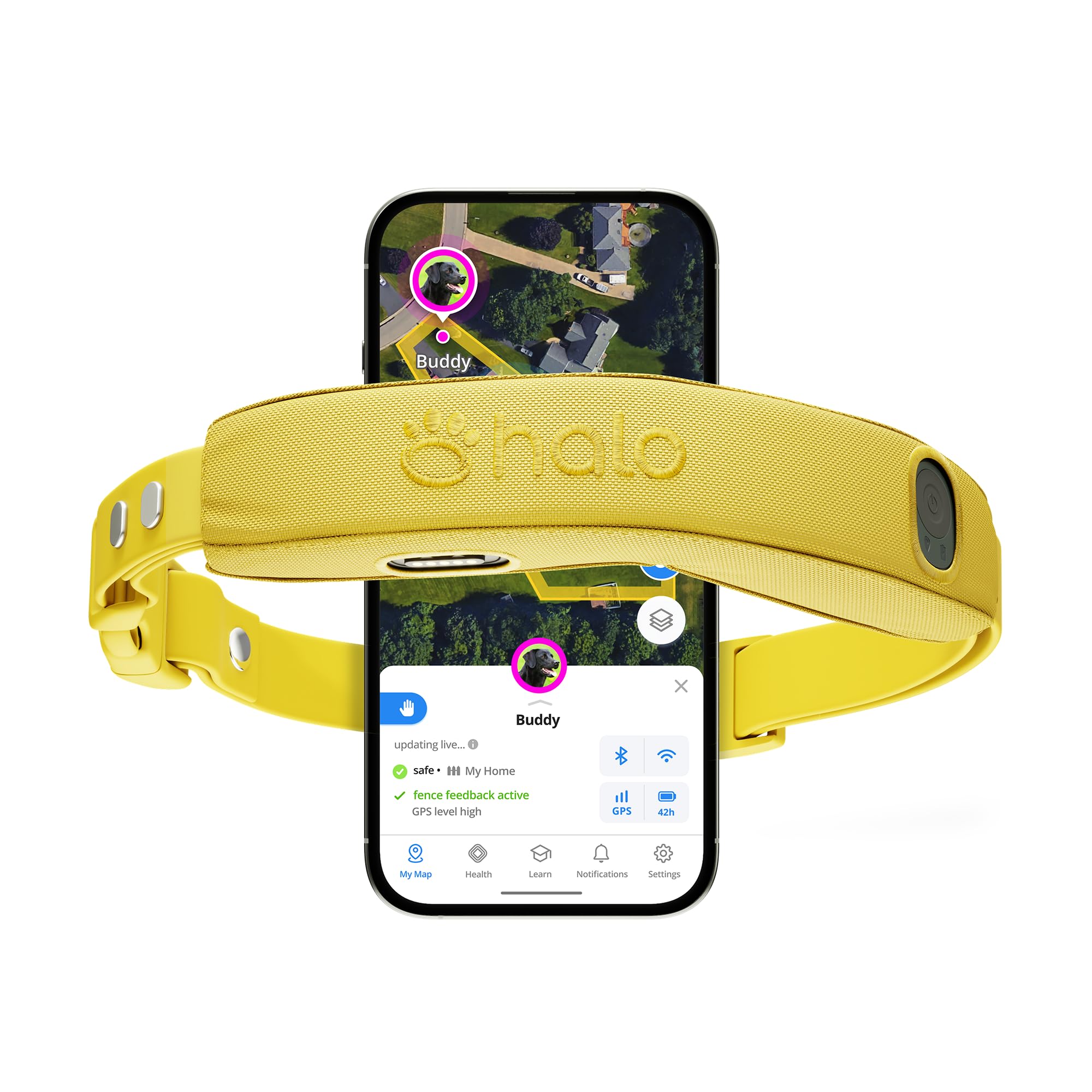
The Halo Collar 5 is the only tracker in this guide using dual-frequency L1 and L5 satellite reception with real-time ground-station correction, delivering GPS accuracy within 2 feet of your dog’s actual location. This matters most for properties with irregular shapes, narrow lots, or multi-story houses where spherical fence boundaries from other systems create false alerts. The collar works on properties from 900 square feet up to 1,200 square miles, making it equally viable for urban backyards and rural acreage.
Battery life is the main compromise: owners report needing daily charging with AlwaysOn GPS active, and the collar cannot be turned off between uses. The included training program by Cesar Millan teaches dogs to respond to the automatic sound, vibration, and static warnings. The IP67 waterproof rating allows swimming and running in rain. Owners of thick-coated breeds emphasize that the long adapter contact points are essential for proper correction delivery.
The subscription (-15/month) is required to activate all GPS and fence features, which includes unlimited cellular data for tracking, virtual fence creation, training guidance, and activity reports. A small subset of owners reported initial reliability problems (random shocks, GPS drift), though most long-term reviews describe accurate containment after the training period. For wireless fence precision without burying wire, the Halo 5 is the most advanced option.
Why we love it
- 2-foot GPS accuracy — best in class for wireless fences
- Dual-frequency L1+L5 with real-time ground correction
- Works on properties from 900 sq ft to 1,200 sq miles
Good to know
- Requires monthly subscription for all features
- Needs daily charging; cannot be turned off
- Thick-coated dogs require extended contact points
5. Fi New Series 3+ Smart Dog Tracker Collar
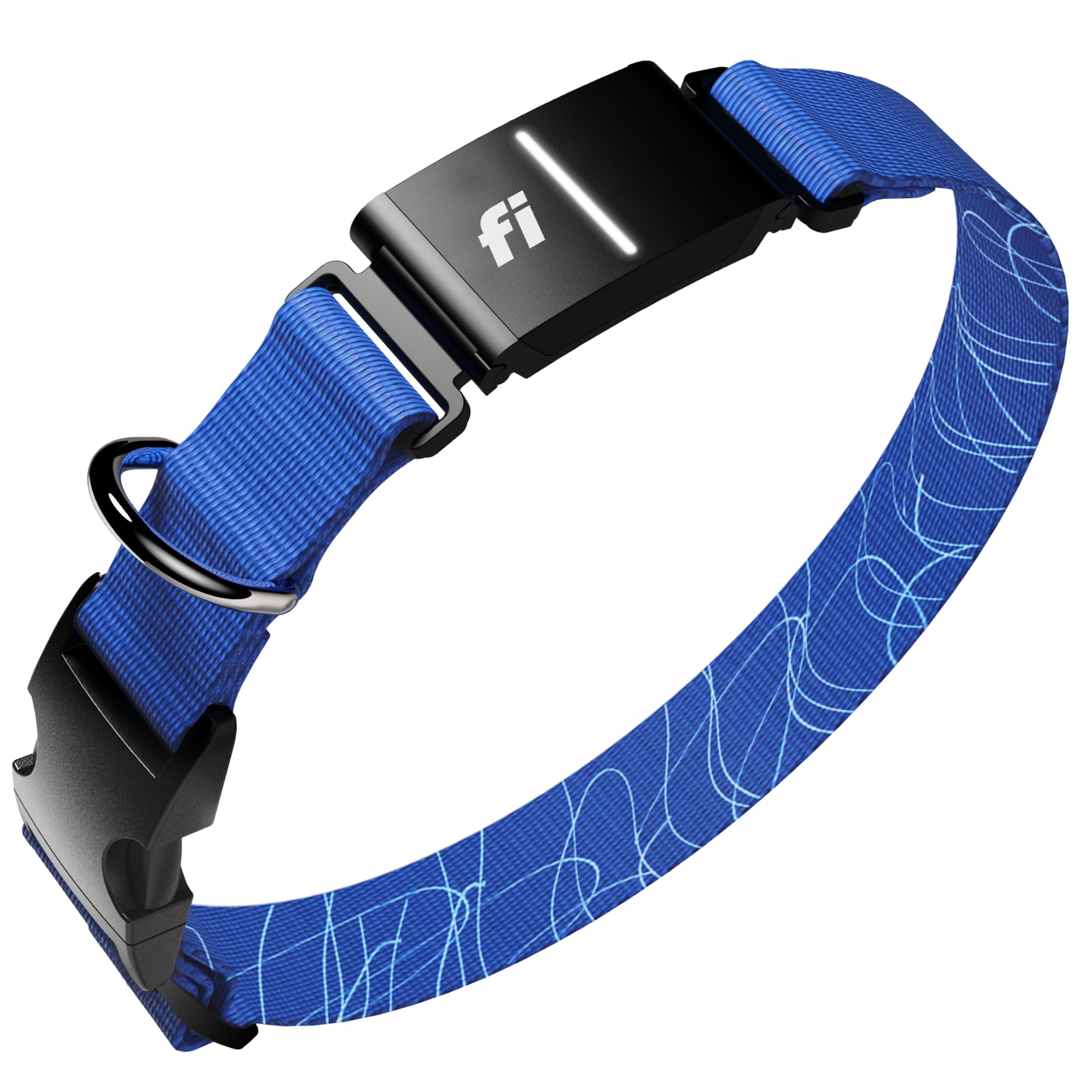
The Fi Series 3+ collar brings 2x improved GPS performance over its predecessor, combined with AI-powered health and behavior monitoring that detects activity, rest, barking, licking, scratching, eating, and drinking. The cellular-based system has no range limits — as long as there’s cell service in the area, you can see your dog’s location from anywhere via the Fi app. The 6-month membership included with purchase covers the first half-year of service.
Real-world battery life runs about 1-2 weeks on a single charge with moderate activity tracking, making it one of the longest-lasting cellular collars in this guide. The escape alerts work through custom virtual fences that notify you the instant your dog leaves a safe zone, updating position every few seconds. Apple Watch compatibility allows location viewing and Lost Mode activation from your wrist, and the built-in AI Companion answers behavior questions and sends personalized vet reminders.
The biggest frustration: initial setup can be finicky. Multiple owners reported difficulty with the QR code scanning, collar insertion into the base, and base Wi-Fi connection. A few units required a full week before the collar connected reliably. The proprietary collar strap cannot be replaced with a standard buckle collar, and some small dogs find the receiver housing bulky. When it works — which it does for most owners after the setup hurdle — the health tracking data is genuinely insightful for early illness detection.
Why we love it
- Nationwide tracking with no range limits via cellular
- 1-2 week battery life for a cellular tracker
- AI detects scratching, licking, and eating patterns
Good to know
- Setup can be frustrating — allow up to a week for connection
- Proprietary collar strap, not standard buckle replacement
- App requires Bluetooth and location always on
6. PetSafe Guardian GPS + Tracking Dog Fence

The PetSafe Guardian combines a wireless GPS fence with real-time tracking, leveraging AccuGuard technology that blends GPS, real-time motion detection, and AI. The system supports up to 20 custom virtual fences and works on properties larger than 3/4 acre. The rechargeable collar boasts up to 48-hour battery life with a 2-4 hour charge time, though owners report more realistic 24-30 hours with active tracking enabled.
Setup takes roughly 1 hour with a training guide included, and the My PetSafe app sends real-time alerts about your dog’s safety. Lost Pet Mode provides location updates every few seconds during an escape. The correction system offers tone, vibration, or 10 levels of static. A 30-pound hound-mix owner noted that the spherical fence boundary created conflicts on a narrow lot with a three-story house, and the transmitter must be positioned on the second floor for consistent coverage.
GPS accuracy is the system’s weakest point. Several owners report location discrepancies of 50-100 feet, especially under tree cover or near multi-story structures. One documented case involved the collar shocking the dog while inside the house because the GPS defaulted to the fence centroid upon losing satellite lock. The collar is also notably large — not suitable for dogs under 25 pounds. With a subscription cost around /year, the total 3-year ownership exceeds , putting it in a premium price bracket without premium accuracy.
Why we love it
- 48-hour advertised battery for all-day containment
- Up to 20 virtual fences for complex properties
- Lost Pet Mode provides frequent location updates
Good to know
- GPS accuracy inconsistent under tree cover or near buildings
- Can deliver correction inside house when GPS signal is lost
- Large collar not suitable for small dogs
7. Garmin PT10 Dog Device Red Collar

The Garmin PT10 is a radio-frequency tracking and training device designed specifically for the Garmin Pro 70, Pro 550, Delta SE, and Sport Pro handhelds. With a 1-mile range at 27MHz, it is not a standalone GPS tracker — rather, it receives data from the handheld and reports the dog’s relative position. The collar includes both long and short stainless steel contact points for reliable wet-condition performance across various coat lengths.
The built-in BarkLimiter uses Advanced Bark Correction Technology to reduce nuisance barking. Owners who use only the vibrate or tone modes report successful training results without static stimulation. Battery life runs approximately 60 hours on a standard charge, and the collar weighs just 3.36 ounces, making it one of the lightest options for a small dog. The 3/4-inch strap is narrow and can twist on active dogs — several owners replaced it with a wider aftermarket strap for better fit.
The PT10 is not a GPS tracker in the modern sense; it offers no map view, no smartphone app, and no real-time location history. It functions as a directional training collar that communicates with your Garmin handheld to show approximate dog position. For owners who already own a compatible Garmin remote and want a low-cost backup collar or a training-only device, this is a solid buy. For anyone wanting standalone GPS tracking with map visuals, skip this and look at the Pathfinder or Fi systems.
Why we love it
- Lightweight at 3.36 ounces — good for small dogs
- 60-hour battery life for extended field use
- BarkLimiter works without static stimulation
Good to know
- 1-mile range only — not a long-range GPS tracker
- No map view, no smartphone app, no location history
- Requires a compatible Garmin handheld to function
FAQ
Do I need a subscription for a dog GPS tracker?
How accurate is GPS tracking under heavy tree cover?
What size dog can wear a GPS tracker collar?
Can I track my dog in real time without cell service?
Final Thoughts: The Verdict
For most owners, the best dog tracker gps winner is the Dogtra Pathfinder 2 Mini because it delivers reliable GPS tracking with e-collar training for dogs as small as 15 pounds, with zero recurring subscription costs. If you need a cellular-based system with health monitoring and nationwide coverage, grab the Fi Series 3+. And for serious hunters who demand 9-mile range and 136-hour battery life, nothing beats the Garmin Alpha TT 25.