
If your dog inhales dinner in under a minute, you are facing a real health risk beyond just a messy kitchen floor. Rapid eating can lead to bloat, vomiting, and regurgitation, turning a simple meal into a potential emergency. A properly designed dog treat puzzle forces your pup to work for every kibble and treat, slowing their intake and engaging their mind instead of just their stomach.
I’m Mo Mahin — the founder and writer behind Furric. I’ve spent years analyzing indoor pet enrichment products, comparing material toxicity reports, measuring kibble capacity against breed sizes, and parsing through thousands of verified owner experiences to separate the truly durable puzzles from the cheap disposables.
Whether you need a slow feeder bowl for a gulping Great Dane or a multi-level puzzle to challenge a clever Border Collie, finding the right dog treat puzzles comes down to matching difficulty, durability, and capacity to your specific dog’s behavior and size.
How To Choose The Best Dog Treat Puzzles
Picking the right puzzle isn’t complicated, but most buyers make the same mistake: grabbing the cheapest option without checking whether it matches their dog’s eating speed, size, or intelligence. Here are the three specs that actually matter.
Match the Difficulty Level to Your Dog’s Experience
Puzzles are rated by manufacturer-defined levels. Level 1 (Slow) is a flat maze that forces the dog to lick and nudge for kibble. Level 2 (Intermediate) adds moving parts—sliding compartments, spinning layers, or flaps that must be lifted. Level 3 (Expert) combines multiple mechanisms in sequence, often with vertical designs that require pawing, spinning, and sliding. Beginners should start at Level 1 or 2 to avoid frustration; experienced puzzle hounds need Level 3 to stay engaged beyond a single session.
Check Kibble Capacity Against Meal Size
A treat-dispensing toy that holds only half a cup is fine for training sessions but worthless for replacing a full meal. Large-breed owners need at least 3 to 4 cups of capacity, which only slow feeder bowls and the tallest interactive feeders provide. Measure your dog’s typical portion before buying—if the puzzle can’t hold a full meal, you will still need a second feeding method.
Prioritize Dishwasher-Safe, BPA-Free Materials
Your dog will slobber, paw, and possibly chew on this puzzle daily. Look specifically for formulations marked “BPA-free, PVC-free, and phthalate-free,” especially on plastic-based puzzles. Hard plastic (ABS) is durable but can crack under determined chewers. Food-grade silicone and non-slip TPR bases are gentler on teeth and easier to clean. Dishwasher-safe top-rack claims are the gold standard for hygiene—hand-washing alone may not remove trapped kibble residue from intricate maze channels.
Quick Comparison
On smaller screens, swipe sideways to see the full table.
| Model | Category | Best For | Key Spec | Amazon |
|---|---|---|---|---|
| KADTC Dog Puzzle Toy | Interactive Puzzle | Multi-level mental challenge | 3 difficulty levels, 4 play modes | Amazon |
| Potaroma Dog Puzzle Feeder | Electronic Dispenser | Remote play & training | USB rechargeable, 80 ft remote range | Amazon |
| KONG Wobbler | Treat Dispenser | Active wobbly play | 9.25″ height, unbreakable plastic | Amazon |
| Outward Hound Fun Feeder Slo Bowl | Slow Feeder Bowl | Slowing extreme gulpers | 4-cup capacity, 2.25″ depth maze | Amazon |
| Outward Hound Nina Ottosson Dog Tornado | Intermediate Puzzle | Spinning layer challenge | 3 spinning layers, 1/2 cup capacity | Amazon |
In‑Depth Reviews
1. KADTC Dog Puzzle Toy
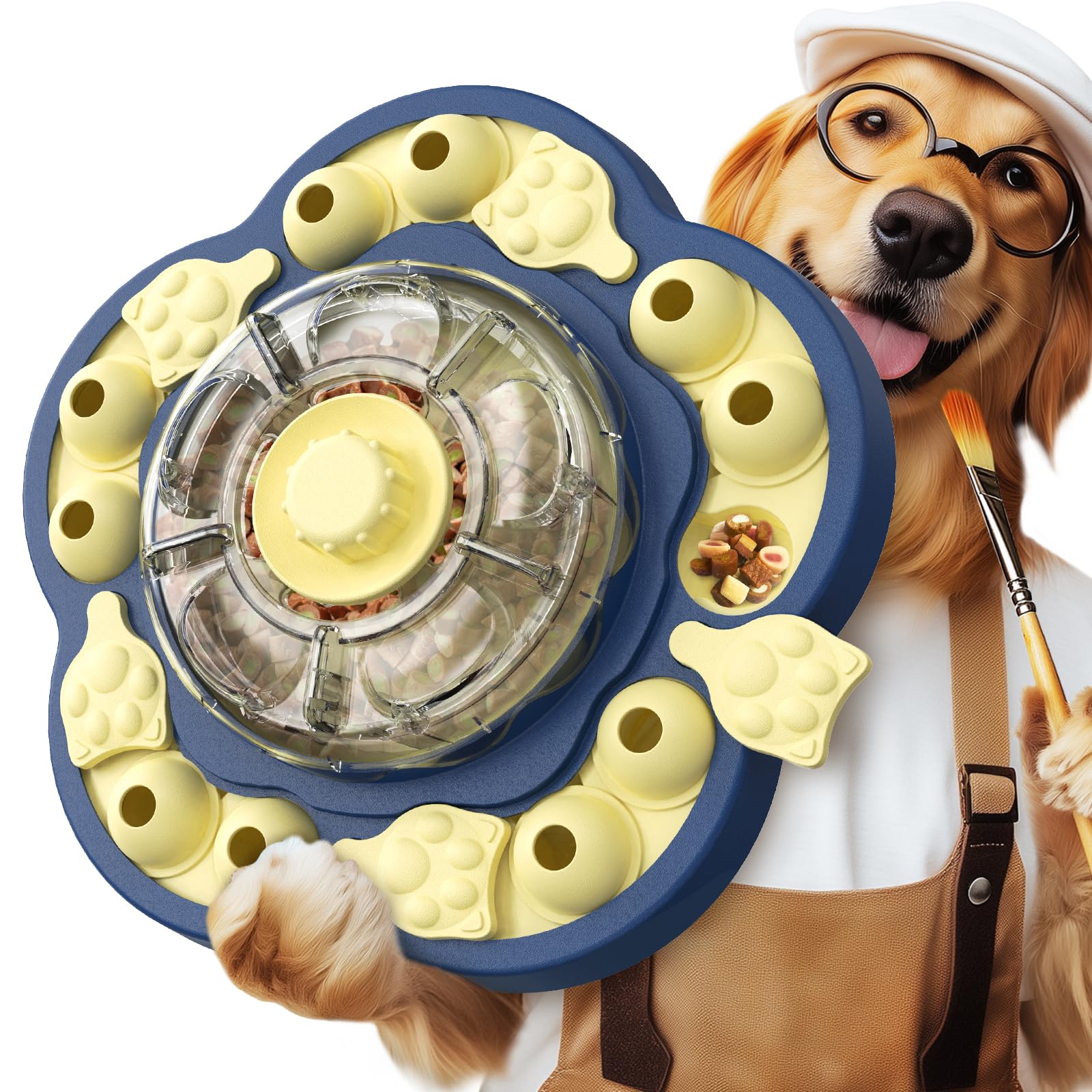
This vertical sunflower design represents a genuine departure from flat board puzzles. The core mechanism works by having the dog spin the center hub, which drops kibble into lower pods that must be slid and sniffed out. With three built-in difficulty levels and four play modes you can cycle through, this toy avoids the one-trick-pony problem that plagues simpler puzzles—dogs don’t lose interest after mastering a single pattern.
The capacity is substantial enough to replace a full meal for medium and large dogs. Owners report that it slows extreme gulpers from a 30-second inhale to a 6-to-7-minute problem-solving session at Level 2 alone. The food-grade ABS construction is noticeably sturdy, with a non-slip base that keeps the puzzle anchored during enthusiastic paw work. The integrated main structure also means fewer loose pieces that could be lost or chewed off.
The primary trade-off is that the moving parts can detach if a particularly determined dog pries at them—owners of power chewers should supervise initial sessions. Cleaning is straightforward since the clear food pods pop out for rinsing. At roughly 13 inches wide, it takes up counter space, but for a toy that adapts as your dog gets smarter, the footprint is well worth it.
Why we love it
- Three difficulty levels keep smart dogs continuously challenged
- Spin-and-slide mechanism slows fast eaters effectively
- Non-slip base and integrated design reduce mess and lost parts
Good to know
- Moving parts can detach under forceful chewing—supervise initial use
- Large footprint may not suit small kitchens or tight storage
2. Potaroma Dog Puzzle Feeder

This is the only electronic treat dispenser on the list, and it changes the engagement dynamic entirely. Instead of the dog manipulating a static object, the Potaroma dispenses treats on command from a remote controller that works up to 80 feet away. The dog must learn to run to the dispenser when they hear the sound, then paw at the opening to receive the kibble. The result is a full-body mental and physical workout that mimics hunting—the dog expends energy running back and forth, not just sitting and pawing.
The 280ml capacity is smaller than bowl-style puzzles, but it is designed for training sessions and boredom relief rather than full meal replacement. The rechargeable battery on both the dispenser and the remote impressed owners, with many reporting days of use between charges. The voice recording feature lets you call your dog in your own voice, adding a personal touch that strengthens recall during play. The adjustable dispensing portion size accommodates kibble from tiny training bits up to larger treats.
The main downside is mechanical: treats can occasionally jam in the rotating mechanism, and the tray is not removable for cleaning, requiring some maneuvering to wash thoroughly. The unit is also light enough that a large, determined dog might knock it over. But for rainy-day indoor exercise and mental stimulation, no other puzzle on this list matches its interactive range.
Why we love it
- Remote-controlled dispensing builds recall and paw coordination
- Rechargeable battery lasts days between charges
- Voice recording adds a personalized training element
Good to know
- Treats can jam occasionally—use uniform, dry kibble for best performance
- Non-removable tray makes deep cleaning more difficult
3. KONG Wobbler
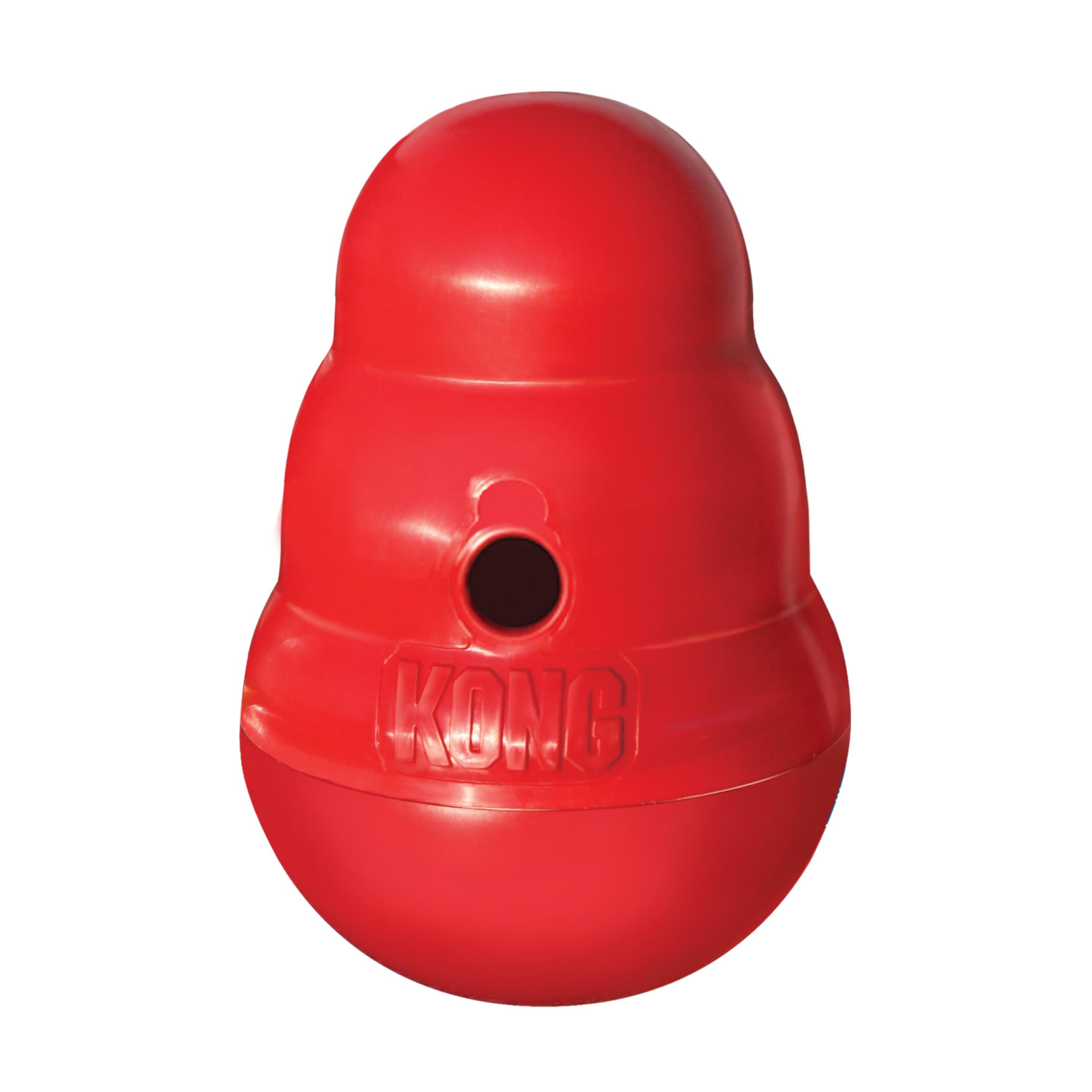
The KONG Wobbler has been a staple in the treat-dispensing category since 1976, and its longevity is earned. The design is brutally simple: a weighted, pear-shaped plastic base with a screw-top reservoir. When the dog bats it, the wobbling motion scatters kibble out of a single hole. There are no flaps to lift, no layers to spin, no electronic components to fail—just a physics-based challenge that works every single time.
The hard plastic construction is genuinely tough. Owners of medium-energy dogs report years of daily use without cracks, though confirmed power chewers can damage the seam near the opening hole. The capacity is large enough (about 1.5 to 2 cups depending on kibble size) to replace a moderate meal or last through a 30-minute play session. The unpredictable spinning and sliding movement keeps dogs engaged because they cannot memorize a predictable pattern—every wobble sends the dispenser in a different direction.
One real limitation is that the hole size is fixed. Owners of very small dogs found that large kibble could get stuck, while owners of clever medium dogs noted that the hole is large enough for some dogs to simply tip the Wobbler and dump all the food at once. Cleaning is effortless: unscrew the top, rinse both halves, and toss them in the dishwasher. For sheer durability and zero-maintenance reliability, the Wobbler remains the benchmark.
Why we love it
- Nearly indestructible hard plastic stands up to daily abuse
- Unpredictable wobble keeps dogs engaged long after mastering
- Dishwasher-safe design makes cleaning effortless
Good to know
- Fixed hole size can be too large for small kibble or too small for large treats
- Power chewers may damage the seam at the opening over time
4. Outward Hound Fun Feeder Slo Bowl
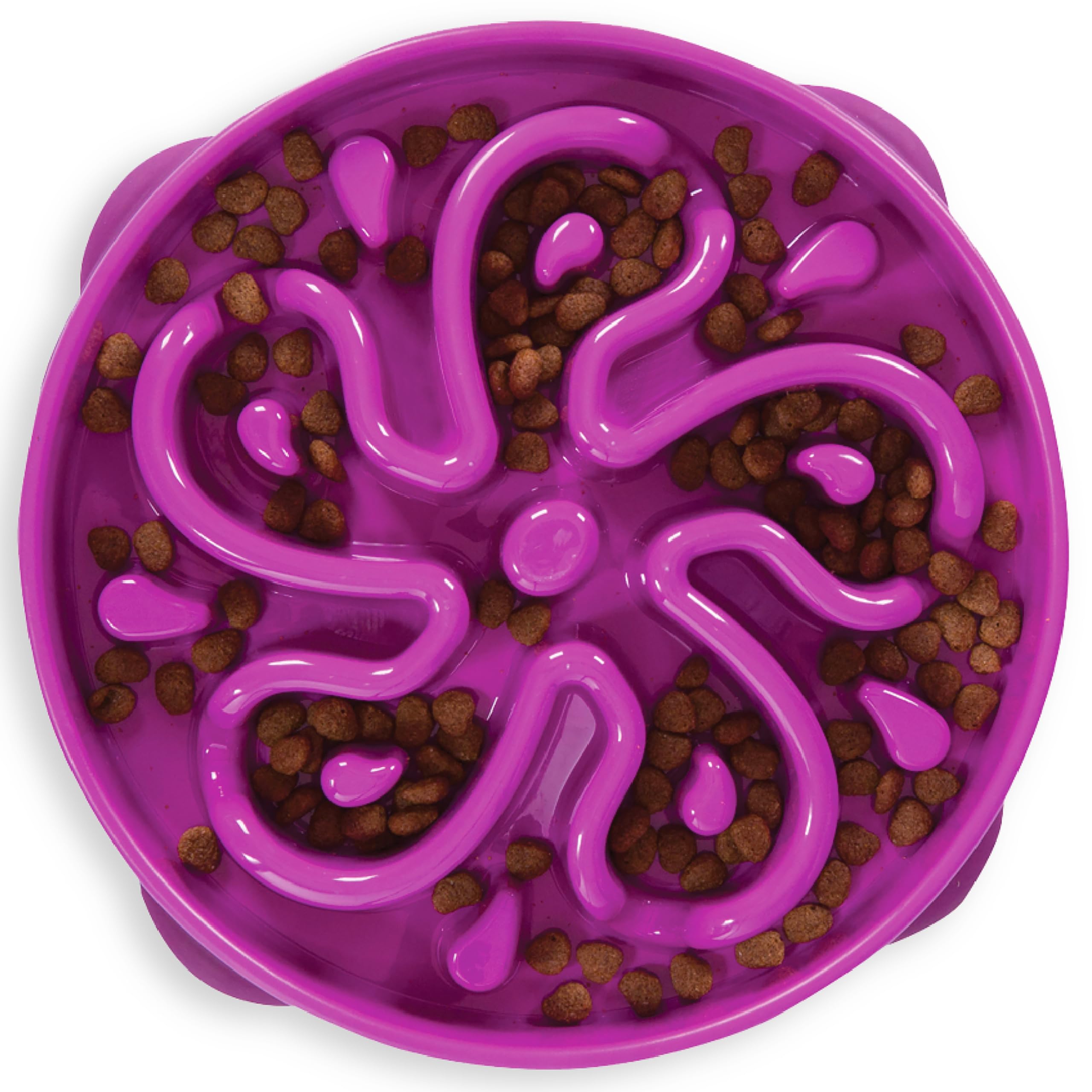
When your primary problem is a dog that vacuums down a full bowl of kibble in under 10 seconds, the solution does not need spinning layers or electronic beeps—it needs a physical barrier that forces the dog to eat around obstacles. The Outward Hound Fun Feeder is exactly that: a 11.75-inch wide bowl with a deep, raised maze pattern that the dog must navigate with their tongue and muzzle. The purple flower pattern is the most challenging maze in Outward Hound’s lineup, rated as their “Slowest” level.
The 4-cup capacity is a standout for large-breed owners. Great Dane, Doberman, and Lab owners specifically report that this bowl stops bloat-inducing gulping immediately. The non-slip TPR base keeps the bowl anchored even when enthusiastic eaters push it around. The 2.25-inch depth means the maze walls are tall enough to prevent the dog from simply scooping kibble over the top. Owners of giant breeds love that they can fit a full 4-cup meal without needing a second bowl.
The trade-off is that this is a passive feeder—it provides zero mental engagement beyond the physical challenge of eating slowly. Smart dogs that learn to flip or tip the bowl may eventually beat the maze. Cleaning is straightforward thanks to dishwasher-safe top-rack construction, but because the maze channels are deep, some owners found that hand-brushing is necessary to fully remove caked-on wet food residue. For pure feeding-speed reduction at this price point, nothing else comes close.
Why we love it
- Massive 4-cup capacity fits full meals for giant breeds
- Deepest maze pattern effectively stops gulping and vomiting
- Non-slip base stays put on tile and hardwood floors
Good to know
- No active engagement—purely a physical slow feeder, not a puzzle
- Deep maze channels require thorough brushing to remove wet food residue
5. Outward Hound Nina Ottosson Dog Tornado

The Nina Ottosson line is the most recognized name in dog puzzle design, and the Dog Tornado is their signature intermediate-level entry. The concept is three rotating bone-shaped compartments stacked on a central post, each hiding treats that the dog must spin into position to release. The dog must paw or nudge each layer to align the openings, which requires more coordination than a simple push-and-slide puzzle.
The half-cup capacity makes this a treat-dispensing toy rather than a meal replacement, but that is appropriate for its intended use: 15 minutes of brain game equals about 30 minutes of physical exercise in terms of mental fatigue. Owners of working breeds like Border Collies and Aussies reported that the spinning mechanism kept their dogs occupied for solid 10-to-15-minute sessions, which is impressive for a non-electronic puzzle. The included tips-and-tricks guide walks owners through adjusting difficulty by using differently sized treats or smearing peanut butter inside the compartments.
The durability is good but not bulletproof. Several owners noted that the white plastic bones can fly off if the dog scratches aggressively, and there is a risk of losing parts if play is unsupervised. The noise level is moderate—the spinning plastic against the base creates a clicking sound that some owners find distracting. Assembly is simple, and cleaning is straightforward with a rinse and brush. For owners looking to graduate their dog from flat board puzzles to something with moving parts, the Dog Tornado hits the perfect stepping-stone difficulty.
Why we love it
- Three-layer spinning mechanism teaches dogs cause-and-effect problem-solving
- Adjustable difficulty with treat size and placement variation
- Lightweight and portable for travel or indoor/outdoor use
Good to know
- Plastic bone pieces can detach and go missing with aggressive play
- Spinning layers produce a clicking sound that some owners find noisy
FAQ
Can I use a dog treat puzzle to replace my dog’s entire meal?
What difficulty level should I buy for a first-time puzzle dog?
How do I clean a deep maze slow feeder bowl properly?
Are electronic treat dispensers safe for unsupervised use?
Final Thoughts: The Verdict
For most dogs and their owners, the dog treat puzzles winner is the KADTC Dog Puzzle Toy because its three-level adjustable design grows with your dog’s skills and its spin-to-release mechanism effectively slows fast eaters while providing genuine mental engagement. If you want an electronic dispenser that adds a recall and training element to playtime, grab the Potaroma Dog Puzzle Feeder. And for the simplest, most durable way to stop a gulping dog from vomiting at mealtime, nothing beats the Outward Hound Fun Feeder Slo Bowl.