
The difference between a dog that tears through the house and one that naps contentedly often comes down to a single decision: what you put in front of their nose. An empty floor invites destruction, but a toy that moves, beeps, drops a treat, or wobbles unpredictably rewires that destructive energy into focused play.
I’m Mo Mahin — the founder and writer behind Furric. I’ve spent years cross-referencing motor specs, battery cycles, material durabilities, and chew-test data to separate the toys that hold up from those that end up as plastic shards under the couch.
After analyzing owner feedback on dozens of models, I’ve narrowed the field to the five most durable, mentally engaging, and breed-compatible options for anyone hunting for the best electronic toys for dogs that actually hold up to real-world play.
How To Choose The Best Electronic Toys For Dogs
Electronic dog toys vary wildly in build quality, battery life, and the type of interaction they demand from your pet. The right choice depends on your dog’s size, chewing force, and boredom threshold. Here are the three specs that matter most.
Battery Capacity & Charging Convenience
Toys with built-in Li-ion rechargeable batteries (common in the – range) eliminate the cost and hassle of constantly replacing alkaline cells. Look for a toy that runs at least one hour per charge cycle and includes a USB charging cable — micro-USB or USB-C. Avoid toys that require proprietary chargers; if the cable breaks, the toy becomes a paperweight.
Material Grade & Seam Strength
Plush electronic toys use either standard polyester fabric or a reinforced outer shell. For dogs over 25 pounds that shake toys, the interior module must be secured with double-stitched hook-and-loop closures — not thin stitching that rips open on the first pounce. Puzzle feeders should be molded from food-grade ABS or natural rubber with no sharp edges or small parts that can dislodge. Always check that the motor housing inside a plush toy is fully sealed from the outer fabric layer.
Interaction Type & Difficulty Progression
Three common interaction modes exist: bouncing/chasing, treat-dispensing, and puzzle-sliding. Chasing toys work best for high-energy breeds that need physical exercise. Treat-dispensing toys suit food-motivated dogs that need portion control during play. Puzzle-sliding toys challenge problem-solving breeds like Border Collies or Poodles. The best electronic toys for dogs offer adjustable difficulty levels so the toy grows with the dog’s skill, preventing the “one-and-done” boredom cycle.
Quick Comparison
On smaller screens, swipe sideways to see the full table.
| Model | Category | Best For | Key Spec | Amazon |
|---|---|---|---|---|
| KADTC Dog Puzzle Toy | Puzzle Feeder | Mental stimulation for smart breeds | 12.99″ diameter with 3 difficulty levels | Amazon |
| Potaroma Puzzle Feeder Toy | Electronic Dispenser | Remote training & independent play | 280ml capacity with 80-foot remote range | Amazon |
| Roolo Treat Dispenser Toy | Passive Roller | Heavy chewers, slow feeding | 6.7″ natural rubber, no electronics | Amazon |
| GUKCO Interactive Turtle | Bouncing Plush | Self-play chasing, separation anxiety | 5.5″ plush with 3 play modes | Amazon |
| GUKCO Interactive Crab | Bouncing Plush | Self-play chasing, separation anxiety | 5.5″ plush with 3 play modes | Amazon |
In‑Depth Reviews
1. KADTC Dog Puzzle Toy, 3 Levels Step-by-Step Challenge
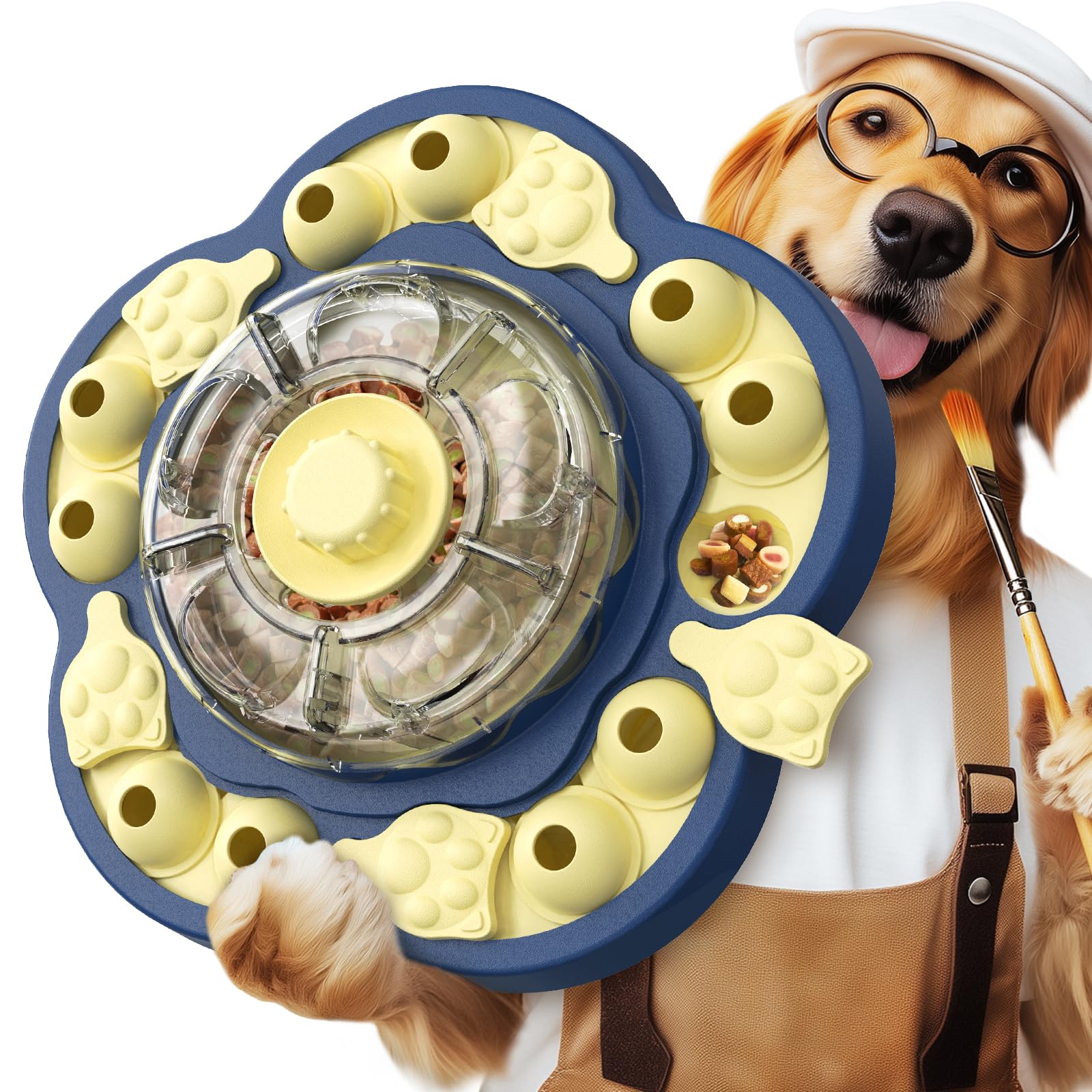
This sunflower-shaped puzzle from KADTC takes the top spot because it solves the single biggest problem with electronic toys: the dog learns the trick in five minutes and never touches it again. With three escalating difficulty levels and four distinct play modes — spin, slide, sniff, and release — the toy keeps a fast learner mentally engaged for weeks, not days. The vertical center-spin mechanism drops kibble (up to 0.67 inches) into lower pods, forcing the dog to work across multiple compartments rather than just pawing a single depression. Owners of Aussiedors and Labs report mealtime extending from 30 seconds on a flat bowl to six or seven minutes on level two — a meaningful difference for dogs that tend to scarf-and-barf.
The construction uses food-grade ABS molded without BPA, PVC, or phthalates, with an integrated main structure that reduces loose game pieces that could become choking hazards. At nearly 13 inches across and weighing just under a kilogram, the base has enough mass to stay planted during aggressive pawing, and the bottom traction ring keeps it from sliding across hardwood or tile. The clear food pods remove for quick rinsing under warm water — no crevices that trap wet kibble residue. It is designed for dogs 10 pounds and up, and the three-level system means a teething puppy can start on the easiest setting with flaps partially covered while an experienced puzzle dog runs the full gauntlet.
A few owners noted that if a dog is particularly forceful, the spinning center can dislodge entirely, which poses a very brief supervision risk. That said, the overall feedback across five-star reviews is consistently that this toy provides a mental workout far beyond flat silicone mats, particularly for high-energy breeds that need indoor enrichment during rainy days. The KADTC outclasses basic treat balls because it demands sniffing and problem-solving, not just random rolling. It is the most thoughtfully engineered electronic toy on this list for owners who prioritize cognitive engagement over flashy movement.
Why we love it
- Three difficulty levels prevent early boredom
- Spinning slow-feed mechanism extends mealtime significantly
- Food-grade ABS construction with no loose parts
- Easy to clean — pods rinse out without tools
Good to know
- Center spinner can dislodge with very aggressive play
- Not suitable for dogs under 10 pounds
- Does not include treats or starter kibble
2. Potaroma Dog Puzzle Feeder Toy, Electronic Treat Dispenser

The Potaroma feeder breaks the mold of passive ball-dropping toys by putting the owner in control via a wireless remote that works up to 80 feet away. That range matters — it lets you stand at the back door while the dispenser releases kibble on the patio, turning feeding into a recall training exercise. The machine records your voice (up to nine preset sounds plus one custom recording), so you can call your dog by name before dispensing, reinforcing verbal cues with a tangible reward. Owners of 5-month-old French Bulldogs and 75-pound mixed breeds both reported high engagement rates, with the toy visibly tiring dogs from the back-and-forth sprint between the button and the dispenser.
The internal 280ml hopper holds roughly two-thirds of a cup of standard dry kibble or small treats, which is enough for a full training session or a slow-feed meal. The dispensing mechanism is adjustable — you control how much falls each time the remote triggers it — so you can dial down to single-kibble drops for precision training or release a small handful for a mealtime puzzle. Both the remote button and the dispenser unit are USB rechargeable with a single included charger, which eliminates the constant battery drain of older treat-dispensing robots. A few owners noted that on rare occasions, a piece of kibble can jam the rotor or the tray releases two treats instead of one, but these are minor inconsistencies given the price and the level of engagement it sustains.
The unit is made from ABS plastic with a transparent lid so you can see the kibble level at a glance, and it comes with a set of fun stickers for decorating the housing. It works both indoors on hard floors and outdoors on grass or concrete, making it a versatile tool for rainy-day enrichment, crate training, or yard recall. The Potaroma is not a chewing toy — the plastic housing will crack under sustained gnawing — but for training-focused owners who want a remote-controlled enrichment system, it delivers a level of interactivity that no plush or ball can match.
Why we love it
- 80-foot remote range enables distance training
- Voice recording builds personal cue-reward connection
- USB rechargeable dispenser and remote
- Adjustable dispensing amount for portion control
Good to know
- Occasional dry kibble jam in rotor mechanism
- Not suitable as a chew toy — ABS housing cracks
- Requires supervision to prevent over-feeding
3. Roolo Dog Treat Dispenser Toy – Passive Puzzle Feeder
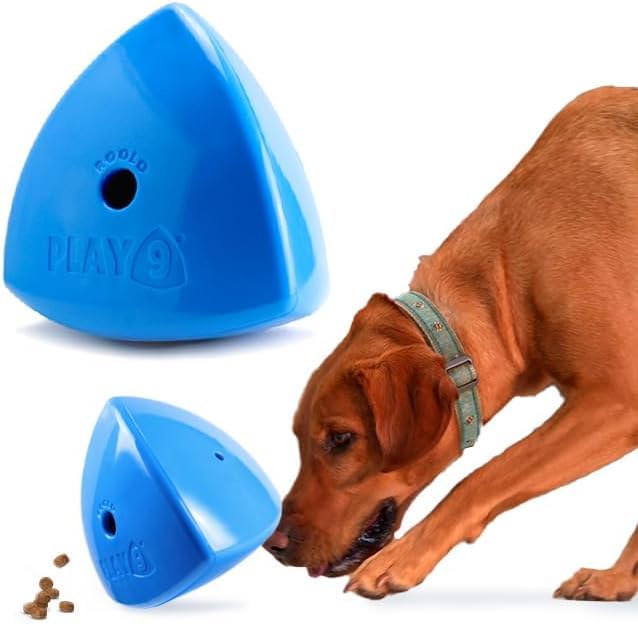
The Roolo is the only toy on this list that contains zero electronics, yet it earns its place among electronic toys because of how its passive mechanics — based on the Reuleaux tetrahedron geometric shape — create erratic, self-propelling movement that mimics an electronic device. When filled with kibble or treats and set in motion, the odd geometry causes it to bounce and roll in unpredictable directions, forcing the dog to chase, calculate, and reposition to shake out the food. No batteries, no motors, no charging cables — just gravity and the dog’s own persistence. For owners whose dogs destroy plush toys within the first five minutes, the natural rubber construction (450 grams, 6.7 inches in diameter) holds up to aggressive chewers that leave tooth marks but no punctures. One Lab owner reported the dog tried to crush it but didn’t leave a single indentation, which is rare for any soft-enough-to-roll toy.
The rubber material is food-safe, flexible enough to be gentle on teeth, and quiet enough to thump on hardwood floors without waking the neighbors — a major advantage over plastic puzzle bowls that clatter loudly. The center hole accepts kibble up to about half an inch in diameter, and the irregular shape means the treat release is staggered: the dog can’t just knock it once and get everything. It doubles as a slow feeder for gulpers, a training reward tool, and a boredom breaker for rainy afternoons. Cleaning is straightforward — rinse with warm soapy water and let it air dry. The product is designed by UK-based canine experts and recommended by trainers for its balance of durability and mental challenge.
The single caveat from owners is engagement variability: some independent or low-food-drive dogs lose interest unless the owner sits down and rolls it for them, turning it into a bonding game rather than a solo play toy. A few buyers suggested adding a squeaker to the mold to boost initial curiosity, though that would complicate the rubber’s clean geometry. If your dog is driven by food, the Roolo delivers continuous enrichment without the risk of a dead battery or a torn fabric seam. It is the safest bridge between electronic interactivity and brute-force durability for heavy chewers that nothing else survives.
Why we love it
- Unbreakable natural rubber survives heavy chewers
- Erratic rolling mimics electronic motion without batteries
- Quiet on hard floors — great for apartment use
- Slow-feeds kibble to prevent gulping
Good to know
- Not all dogs self-engage without owner participation
- No squeaker or electronic stimulation
- Requires supervision if used as a treat dispenser
4. GUKCO Interactive Moving Dog Toys – Plush Turtle with Bouncing Ball
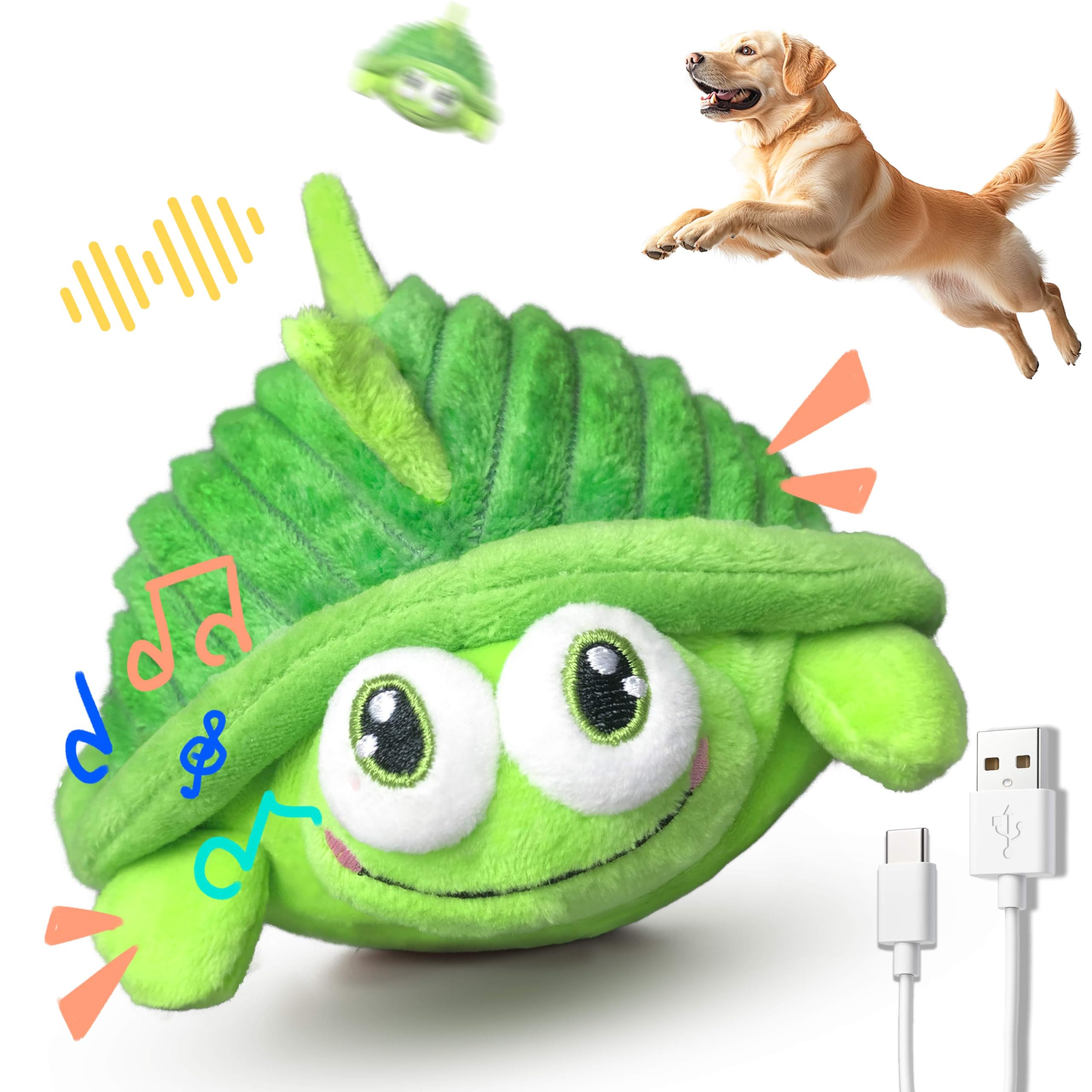
The GUKCO Turtle brings a full suite of electronic interactivity — music mode, silent vibration mode, and voice recording mode — inside a cuddly plush shell, all at a price point that makes it an easy impulse buy for owners testing whether their dog responds to motion toys. The core gimmick is a vibrating ball inside the turtle’s fabric body that bounces randomly when activated, triggering the dog’s prey drive. Owners of 10-year-old German Shepherds and 70-pound mixed breeds both described their dogs pawing the toy, carrying it around, and bringing it back to be turned on again — a sign of high replay value. The music mode plays a melody that energizes most dogs, while the recording mode captures the owner’s voice or the dog’s bark and plays it back, adding a layer of familiar sound that seems to comfort anxious dogs during alone time.
The toy is built with a secure hook-and-loop fastener compartment that holds the electronic ball inside, and the plush turtle cover is machine-washable — critical for any toy that will be drooled on and dragged through dirt. The battery runs for roughly one hour per charge (verified by owners using it daily for 30-minute sessions across multiple days before needing a recharge), and the 30-minute auto shut-off prevents battery drain if the toy gets shoved under the couch. At 5.5 inches in diameter, it suits small to medium dogs best, though larger breeds still enjoy the chase as long as they are not aggressive chewers. The manufacturer explicitly warns against use with heavy chewers — the plush exterior, while tougher than expected, will tear if a determined dog targets the seam.
The most consistent owner complaint is the accidental button-press problem: when a dog bats the toy around, its nose or paw can hit the power switch, changing modes or turning the ball off mid-play. A few owners solved this by opening the velcro compartment and repositioning the ball deeper inside. The sound volume is also a bit loud for noise-sensitive dogs, though the silent mode eliminates that issue entirely. For owners of energetic puppies or anxious adult dogs that need a screen-free distraction during the workday, the GUKCO Turtle offers strong engagement at a budget-friendly entry point without feeling cheap.
Why we love it
- Three modes (music, silent, recording) prevent single-trick boredom
- Rechargeable battery with USB charging eliminates alkaline waste
- Machine-washable plush cover for easy cleaning
- 30-minute auto shut-off saves battery life
Good to know
- Not for aggressive chewers — plush seams will tear
- Dog can accidentally press the mode-switch button during play
- Sound may be loud for noise-sensitive dogs
5. GUKCO Crab Interactive Dog Toys – Plush with Motion-Activated Ball
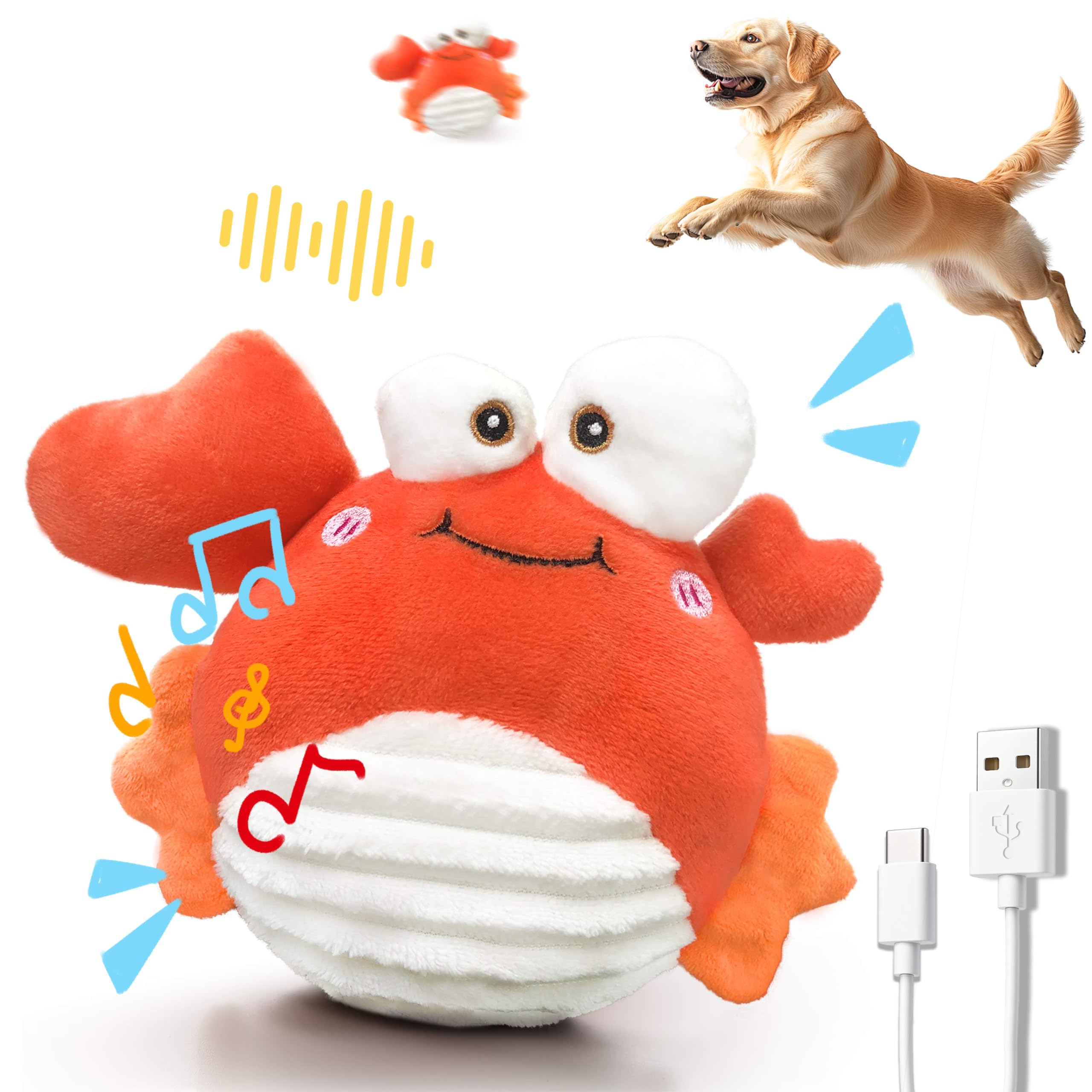
The GUKCO Crab is functionally identical to the Turtle variant — same 5.5-inch dimensions, same three-mode electronic ball, same rechargeable battery, same machine-washable plush shell — but the crustacean design offers a slightly different visual appeal and a separate chance to double up if your dog wears through the first one. Owners reported the exact same engagement patterns: a 4-month-old puppy loved it after initial confusion, a 10-year-old German Shepherd brought it to the owner to be turned on, and a 70-pound mixed breed played until exhausted. The battery life held for hours of cumulative play across several days before needing a recharge, with the 30-minute auto shut-off preventing the ball from running under furniture unnoticed.
The plush crab fabric showed better-than-expected resistance to shaking and light chewing, with the hook-and-loop compartment securing the ball tightly enough that it never popped out during normal play. Owners appreciated having both a music mode for high-energy sessions and a silent vibration mode for evening or apartment use, and the recording mode allowed them to capture a bark and replay it, which excited the dog into chasing. The cleaning process was straightforward: open the compartment, remove the ball, toss the plush cover in the washing machine on a gentle cycle, and air dry. The entire toy weighs only 0.27 kilograms, making it light enough for small breeds to carry but substantial enough to trigger a chase response in larger dogs.
Every structural limitation of the Turtle applies equally to the Crab: the button placement allows a determined dog to switch modes by batting the toy, the sound volume can startle skittish dogs, and aggressive chewers will eventually breach the fabric seam. If your dog is already a fan of the Turtle and you want a spare toy for rotation, or if you simply prefer the crab aesthetic, this is a direct equivalent rather than an upgrade. For owners who want the same reliable electronic engagement but need a backup that works the same way, the Crab is a smart redundancy purchase.
Why we love it
- Same proven 3-mode system as the Turtle, different look
- Rechargeable battery lasts hours across multiple play sessions
- Machine-washable cover for sanitary upkeep
- Lightweight enough for small dogs to carry
Good to know
- Not suitable for aggressive chewers
- Mode-switch button can be pressed accidentally by the dog
- Sound level may be loud for noise-sensitive pets
FAQ
What battery runtime should I expect from a rechargeable electronic dog toy?
Are electronic dog toys safe for puppies under six months old?
How do I prevent an electronic toy from becoming a choking hazard?
Can I leave an electronic dog toy on all day for my dog to play alone?
Final Thoughts: The Verdict
For most owners looking for the best electronic toys for dogs that deliver real mental exercise and long-term replay value, the winner is the KADTC Dog Puzzle Toy because it introduces three difficulty levels that grow with your dog’s skill, rewiring mealtime into a focused challenge instead of a two-second inhale. If you want remote-training convenience and voice-customized treat dispensing, grab the Potaroma Puzzle Feeder Toy. And for heavy chewers that destroy everything with a battery inside, nothing beats the Roolo Treat Dispenser Toy — a zero-electronics smart toy that outlasts every plush on the shelf.