
Walking into a feed room with a bucket of dusty powder or fighting a horse that clamps its jaw shut at the sight of a deworming paste is a daily reality for too many owners. The equine feed market is packed with products promising shinier coats, stronger hooves, and fewer vet bills, but the real difference between a supplement that collects dust in the tack room and one that actually delivers measurable results comes down to bioavailability, palatability, and matching the specific nutritional gap your horse has.
I’m Mo Mahin — the founder and writer behind Furric. I’ve spent years analyzing ingredient panels, comparing nutrient bioavailability across equine feed formulations, and cross-referencing manufacturer claims against aggregated owner feedback to separate the supplements that produce real coat and hoof changes from those that are mostly marketing.
Whether you need a dewormer your horse will actually eat, a psyllium pellet to flush sand from the ventral colon, or a daily vitamin to strengthen brittle hooves and restore coat luster, this guide covers five distinct solutions under best equine feed that target specific health outcomes.
How To Choose The Best Equine Feed
Not all equine feed is created equal. A glossy coat supplement with high biotin might do nothing for a horse with sand accumulation in the colon, while a deworming pellet solves a parasite problem but adds zero nutritional value. You need to identify the specific physiological issue first — then match the ingredient profile and delivery form to that need. Below are the three pillars serious buyers evaluate before purchasing.
Palatability & Pellet Integrity
A supplement’s ingredient panel is irrelevant if your horse refuses to eat it. Pelleted feeds — especially alfalfa-based or apple-cinnamon flavored options — generally have higher acceptance rates than powders that settle at the bottom of the grain bin. Look for products where the active ingredient is integrated into a palatable base rather than top-dressed, because horses quickly learn to separate out unpalatable granules.
Active Ingredient Concentration Per Serving
The difference between a maintenance dose and a therapeutic dose often comes down to milligrams per scoop. For hoof health, look for at least 16 mg of biotin per daily serving. For joint support, glucosamine HCl should be in the 1,500–1,800 mg range. Psyllium products need a high enough soluble fiber concentration to physically bind sand particles — not just a token amount. Always check the “active ingredients” per weight serving, not just the front-of-bag marketing claims.
Matching the Form to the Feeding Routine
If you feed multiple horses from the same grain bin, a crumble or small pellet that mixes evenly is critical to avoid one horse getting a double dose while another gets zero. For picky eaters or horses on a hay-only diet, a highly palatable pellet that can be hand-fed as a treat increases compliance. Deworming pellets should be a single-dose package that treats the exact body weight to avoid under-dosing resistance.
Quick Comparison
On smaller screens, swipe sideways to see the full table.
| Model | Category | Best For | Key Spec | Amazon |
|---|---|---|---|---|
| Sho-Glo Horse Vitamin & Mineral Supplement | Daily Vitamin | General coat, hoof & immune support | 25 lb bag, crumble format | Amazon |
| Horse Health Joint Combo Hoof & Coat | 3-in-1 Joint/Hoof/Coat | Joint, hoof & coat care combined | 16 mg biotin + 1,800 mg glucosamine per 2 oz | Amazon |
| Farnam Equi Aid Psyllium Pellets | Digestive Fiber | Sand removal & colon health | 5 lb, apple/molasses-flavored pellet | Amazon |
| Intervet Safeguard Dewormer Pellets | Deworming | Single-dose deworming in feed | 1.25 lb pouch, treats 1,250 lb horse | Amazon |
| Life Data Labs Farrier’s Formula 2X | Hoof Health | Severe hoof weakness & cracking | 11 lb bag, 2X strength concentrate | Amazon |
In‑Depth Reviews
1. Manna Pro Sho-Glo Horse Vitamin & Mineral Supplement

The Manna Pro Sho-Glo delivers a complete daily vitamin and mineral profile in a crumble form that mixes into grain without clumping — a practical advantage for barns feeding multiple horses from the same bin. The formula is fortified with biotin, copper, and zinc to address the three most visible markers of equine nutrition: coat gloss, hoof integrity, and skin condition. Owners consistently report visible coat shine within three to four weeks, and the 25-pound bag lasts a single horse roughly two months at the recommended daily feeding rate.
What sets Sho-Glo apart from basic vitamin powders is the antioxidant blend of Vitamins E and C, which supports immune recovery in performance horses and seniors dealing with oxidative stress after transport or competition. The crumble format avoids the dust issue of loose powders — horses can’t blow it out of the feeder — and the base is palatable enough that even notoriously picky eaters (often stallions or recovering horses) accept it without hesitation.
One trade-off is the crumble texture itself: it does not stick well to dry pellets and may require a splash of water or molasses to prevent waste, especially if fed on top of hard feed. For owners who soak grain anyway, this is a non-issue. The long track record of this product — it has been a staple in competitive barns for years — means the formulation is proven rather than experimental. For a one-bag solution that covers coat, hoof, and immune support without needing three separate supplements, this is the most practical choice.
Why we love it
- Visible coat and hoof improvements within weeks in most horses
- 25-pound bag provides exceptional value for multi-horse households
- Antioxidant blend supports post-travel and senior recovery
Good to know
- Crumble may need moisture to stick to dry grain pellets
- Not a therapeutic fix for severe hoof cracking — use a dedicated hoof supplement for that
2. Horse Health Joint Combo Hoof & Coat

The Horse Health Joint Combo Hoof & Coat is built for owners who need to address joint stiffness, weak hooves, and a dull coat with a single scoop — a realistic scenario for aging horses where multiple degenerative issues emerge simultaneously. Each 2-ounce serving delivers 1,800 mg of glucosamine HCl and 600 mg of chondroitin sulfate for synovial fluid support, paired with 16 mg of biotin for hoof keratin strength and omega-3/6 fatty acids for sebum production that restores coat luster. The apple-cinnamon flavoring makes this easy to mix into a senior horse’s soaked grain mash or a performance horse’s morning ration.
The ingredient density is what justifies the premium tier: most combination supplements skimp on either the joint or the hoof component, but this formula delivers therapeutic-level glucosamine and biotin simultaneously. The MSM (750 mg per serving) adds an anti-inflammatory layer that helps horses with mild arthritis maintain comfort through the work week. Owners of horses with chronic joint issues will appreciate not having to buy a separate joint powder and hoof supplement — this consolidates three buckets into one.
The 8-pound bucket provides a 64-day supply for a horse at the full 2-ounce serving, which is competitive compared to buying three separate products. The main consideration is that the apple-cinnamon fragrance is strong — most horses find it attractive, but a few ultrasensitive noses may need a gradual introduction mixed into wet feed. For the owner managing an older horse with creaky joints, flaking hooves, and a winter coat that won’t shine, this is the most efficient way to target all three issues without cabinet clutter.
Why we love it
- Therapeutic-level glucosamine and biotin in a single serving
- Palatable apple-cinnamon flavor reduces supplement refusal
- 64-day supply consolidates three supplement categories
Good to know
- Strong scent may be off-putting to a very small subset of horses
- Not a full-spectrum vitamin — does not replace a general daily mineral supplement
3. Farnam Equi Aid Natural Psyllium Pellets

Sand colic is one of the most common preventable emergencies in horses kept on sandy soil or overgrazed pastures, and the Farnam Equi Aid Psyllium Pellets offer a practical, palatable way to bind and flush sand from the ventral colon. Unlike psyllium powders that turn into a gelatinous mess in the feed bucket, these pellets remain intact until the horse chews them, releasing the soluble fiber gradually in the digestive tract. The apple and molasses flavoring makes them highly acceptable — owners report horses eating them straight from the hand, which is critical when you need to ensure every bit is consumed.
The typical protocol is a seven-day loading period followed by twice-weekly maintenance, and the 5-pound bag provides 16 scoops — enough for roughly two monthly cycles for a single horse. The psyllium husk concentration is high enough that fecal sand tests often show a significant reduction after one loading cycle. This is a NASC-certified product, meaning it has passed quality audits for ingredient sourcing and manufacturing consistency, which matters because psyllium quality varies widely across brands.
The pellet form eliminates the nuisance of sticky psyllium powder coating your scoop and feed room floor. One limitation is that very small ponies or foals may need a half dose to avoid excessive fiber that could cause loose manure — the feeding directions assume a 1,000-pound horse as the baseline. For any horse that lives on sandy ground or eats hay off the ground, this is the most effective standalone sand-management supplement available in a palatable pellet format.
Why we love it
- Palatable apple-molasses pellet accepted by even picky horses
- NASC-certified for quality and ingredient consistency
- Proven to reduce fecal sand levels in controlled feeding cycles
Good to know
- Ponies and foals require careful dose adjustment to avoid loose manure
- Not a complete dewormer — does not replace parasite control
4. Intervet Safeguard Dewormer Pellets for Horses
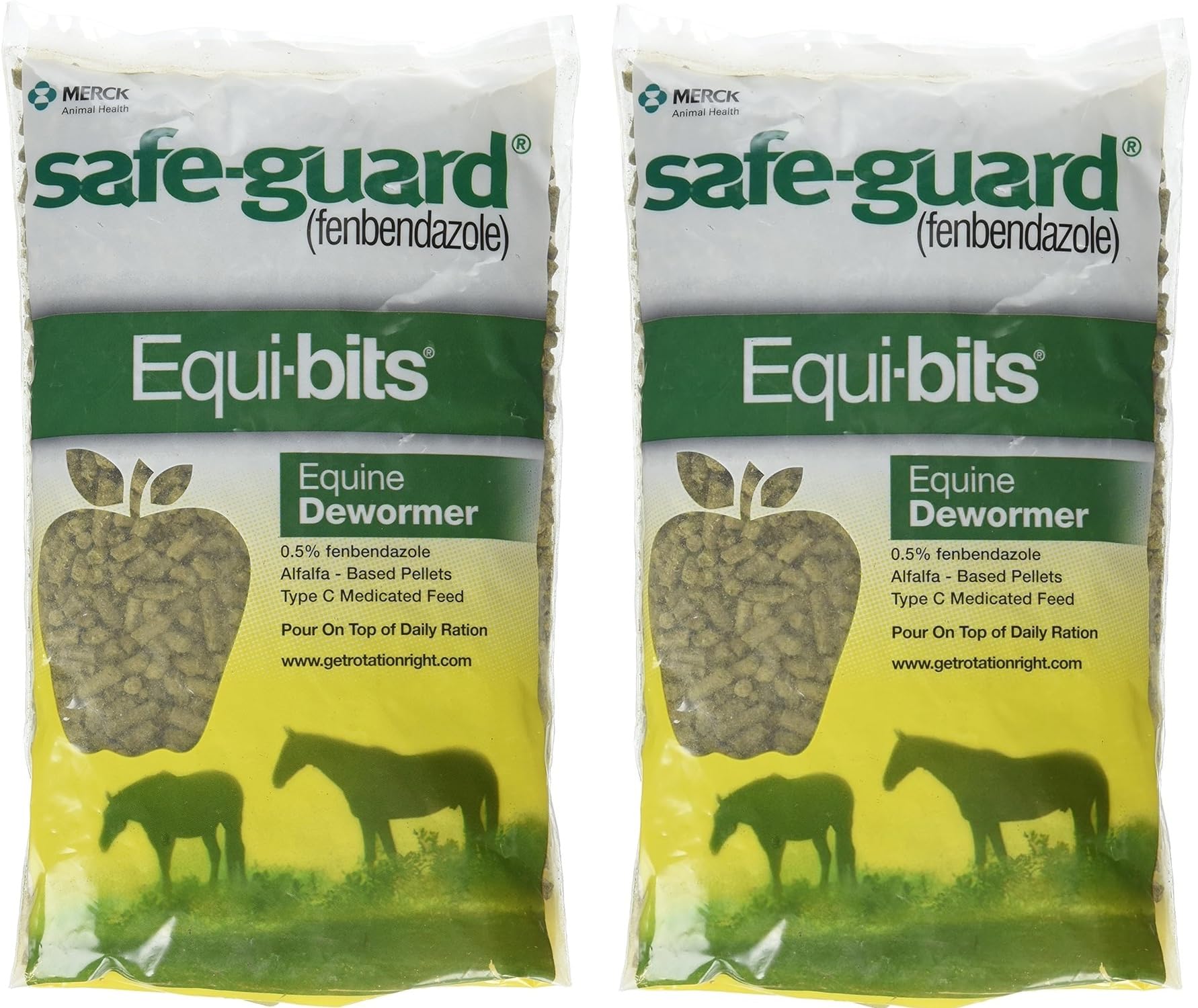
For horses that fight the oral deworming syringe with clamped jaws, head tossing, or outright refusal, the Intervet Safeguard Dewormer Pellets transform a stressful wrestling match into a five-second feeding event. Each 1.25-pound pouch treats a 1,250-pound horse in a single meal, and the alfalfa-based pellet base is so palatable that owners report mustangs and donkeys — both notoriously suspicious of novel feed — consuming the entire dose without hesitation. The active ingredient is fenbendazole, a broad-spectrum benzimidazole anthelmintic effective against large strongyles, small strongyles, ascarids, and pinworms.
The key advantage over paste dewormers is compliance: you don’t have to guess whether the horse swallowed the full dose or spit half of it onto the stall floor. The pellet is simply mixed into the morning grain, and as long as the horse eats everything, you have delivered a precise weight-based dose. The pack-of-two format gives you one pouch for the initial treatment and a spare for the recommended follow-up in six to eight weeks — a rotation-friendly structure for barns that rotate dewormer classes seasonally.
The single limitation is dosing flexibility: the pouch is calibrated to 1,250 pounds, so owners of miniature horses, ponies, or oversized draft breeds will need to calculate a partial or double pouch. The pellet form also means you cannot split a dose across two days; it must be consumed in one meal. For the average adult riding horse (1,000–1,300 pounds), this is the simplest, least stressful deworming method available in feed form, eliminating the paste struggle entirely.
Why we love it
- Eliminates the struggle of paste deworming for resistant horses
- Alfalfa pellet base is highly palatable across breeds
- Single-dose pouch ensures accurate weight-based dosing
Good to know
- Single pouch size limits flexibility for ponies or draft horses
- Must be consumed in one meal — cannot be split across days
5. Life Data Labs Farrier’s Formula 2X Strength

When a farrier specifically recommends a hoof supplement by name, that product has earned its reputation through measurable clinical results — and the Life Data Labs Farrier’s Formula 2X Strength is the most farrier-recommended hoof supplement on the market. The 2X concentration means you feed half the volume of the original formula while delivering the same therapeutic dose of phospholipids, omega fatty acids, biotin, and zinc, making the 11-pound bag last longer than its weight suggests. Owners of horses with chronic hoof cracking, shelly walls, or slow growth after a founder episode report visible changes in hoof wall integrity within 60 to 90 days — the average time for a full hoof capsule turnover.
The ingredient philosophy here is different from general coat supplements: Farrier’s Formula focuses on the structural building blocks of the hoof wall — phospholipids for cell membrane integrity and methionine/lysine for keratin protein synthesis — rather than just surface-level biotin. This makes it the product of choice for horses with recurrent abscesses, white line disease, or thin soles where the hoof wall is actively delaminating. The pelleted form is surprisingly palatable given the medicinal reputation; owners of picky eaters report that horses will eat these pellets straight from the hand without any masking.
The trade-off is the higher price per bag compared to general vitamin supplements, but the concentrated formula means you are buying hoof-specific ingredients at therapeutic levels rather than paying for filler grain. The 5.6-pound bag weight listed in specs is for the bag itself; the product contains 11 pounds of supplement. For any horse whose hoof quality is causing lameness or frequent farrier visits, this is the most scientifically formulated hoof-specific feed available, backed by decades of veterinary and farrier field use.
Why we love it
- Most farrier-recommended hoof supplement for chronic wall issues
- 2X concentration reduces feeding volume while maintaining therapeutic dose
- Phospholipid-based formula addresses hoof structure, not just surface shine
Good to know
- Premium pricing reflects therapeutic ingredient concentration
- Results require 60–90 days for full hoof capsule turnover
FAQ
Can I feed a vitamin supplement and a hoof supplement at the same time?
How do I get a picky horse to eat psyllium pellets?
How often should I rotate between Sho-Glo and a joint-specific supplement?
Final Thoughts: The Verdict
For most horse owners looking for a single product that covers coat, hooves, and immune function without needing multiple supplement buckets, the best equine feed winner is the Manna Pro Sho-Glo because its 25-pound bag, balanced vitamin-mineral profile, and palatable crumble format offer the most versatile daily solution. If your horse needs joint support alongside hoof and coat care, grab the Horse Health Joint Combo Hoof & Coat for its therapeutic glucosamine and biotin levels. And for a horse with chronic hoof cracking that requires targeted structural repair, nothing beats the farrier-recommended Life Data Labs Farrier’s Formula 2X Strength.